Finding the right prospects is one of the biggest challenges in B2B sales. Sales teams need accurate contact information, relevant company data, personalized outreach, and a reliable way to manage every opportunity. In 2026, AI prospecting tools are helping businesses automate much of this work.
But choosing the right platform isn't easy. Some tools specialize in B2B contact databases, others focus on data enrichment, and some automate email outreach or sales engagement. The best option depends on your target audience, budget, and sales workflow.
In this guide, we compare 12 AI prospecting tools, explain what each platform does best, and explore how to choose the right solution for your business.
We'll also look at how combining lead generation, AI-powered email personalization, and CRM pipeline management can help sales teams turn prospect data into meaningful conversations.
Table of Contents
What Is an AI Prospecting Tool?
Why AI Prospecting Matters in 2026
The 12 Best AI Prospecting Tools in 2026
How to Choose the Right AI Prospecting Software
How to Find and Reach More B2B Prospects
Building an AI-Powered Prospecting Workflow
Data Privacy and Compliance
Conclusion
Frequently Asked Questions
What Is an AI Prospecting Tool?
An AI prospecting tool helps businesses identify potential customers, collect relevant business information, and improve the process of reaching out to qualified prospects.
Most tools focus on one or more of these capabilities:
Lead generation: Discover businesses and potential customers that match your target market.
Contact discovery: Find available business emails, phone numbers, websites, and social profiles.
Data enrichment: Add missing information to existing prospect records.
AI personalization: Generate relevant cold emails based on prospect information.
Lead qualification: Prioritize prospects based on their suitability for your offer.
CRM management: Track conversations, follow-ups, meetings, and sales opportunities.
Not every platform provides all these features. Some specialize in finding contacts, while others help sales teams manage outreach after a prospect has been identified.
For small businesses, freelancers, agencies, and startups, choosing a tool that combines several essential prospecting tasks can reduce the need for multiple subscriptions.
Why AI Prospecting Matters in 2026
Traditional prospecting often involves switching between search engines, company websites, spreadsheets, email tools, and CRM software.
This fragmented workflow creates several problems. Contact research takes time, information becomes outdated, follow-ups get missed, and sales representatives spend hours on administrative tasks instead of engaging with potential customers.
AI-powered prospecting can help streamline these activities.
1. Find Relevant Business Leads Faster
Instead of manually researching every company, sales teams can search for businesses by industry, location, and other available attributes. The resulting prospect list provides a starting point for targeted outreach.
2. Personalize Cold Emails at Scale
AI can help draft introductory emails using available business information. Rather than writing every message from scratch, teams can generate personalized drafts and review them before sending.
3. Keep Sales Opportunities Organized
A lead database is only useful when the team can act on it. CRM pipeline management helps track prospects from the initial discovery stage through contact, follow-up, meetings, and closed deals.
4. Reduce Unnecessary Software Costs
Using separate subscriptions for lead discovery, email writing, and pipeline tracking can become expensive. An integrated prospecting workflow can simplify the process and reduce the number of tools a team needs.
The important distinction is that AI doesn't automatically make every prospect valuable. Results still depend on data quality, targeting, the relevance of your offer, and how you approach potential customers.
The 12 Best AI Prospecting Tools in 2026
The following platforms serve different purposes. Some focus on contact databases, while others specialize in enrichment, email optimization, automation, or sales engagement.
ToolBest ForMain StrengthLeadTaroB2B lead generation and sales workflowsBusiness leads, contact discovery, AI emails, and CRM pipelineApollo.ioAll-in-one B2B prospectingContact database and outreachClayData enrichment and orchestrationMultiple data providers and automated workflowsZoomInfo CopilotEnterprise sales intelligenceCompany intelligence and buying signalsWizaLinkedIn-based prospectingContact extraction and email discoveryAiSDRAI-assisted outbound salesAutomated prospecting and outreachLavenderCold email optimizationEmail coaching and personalizationAmplemarketSales prospecting and engagementIntegrated outbound workflowHubSpot Sales HubCRM-based prospectingCRM integration and sales automationSalesloftSales engagementSequences, engagement, and analyticsNooksSales calling teamsDialing and sales coachingSeamless.AIB2B contact discoveryContact search and enrichmentFeatures, plan limits, and prices can change. Check each provider's current pricing page before purchasing.
1. LeadTaro — B2B Lead Generation and Sales Pipeline Management
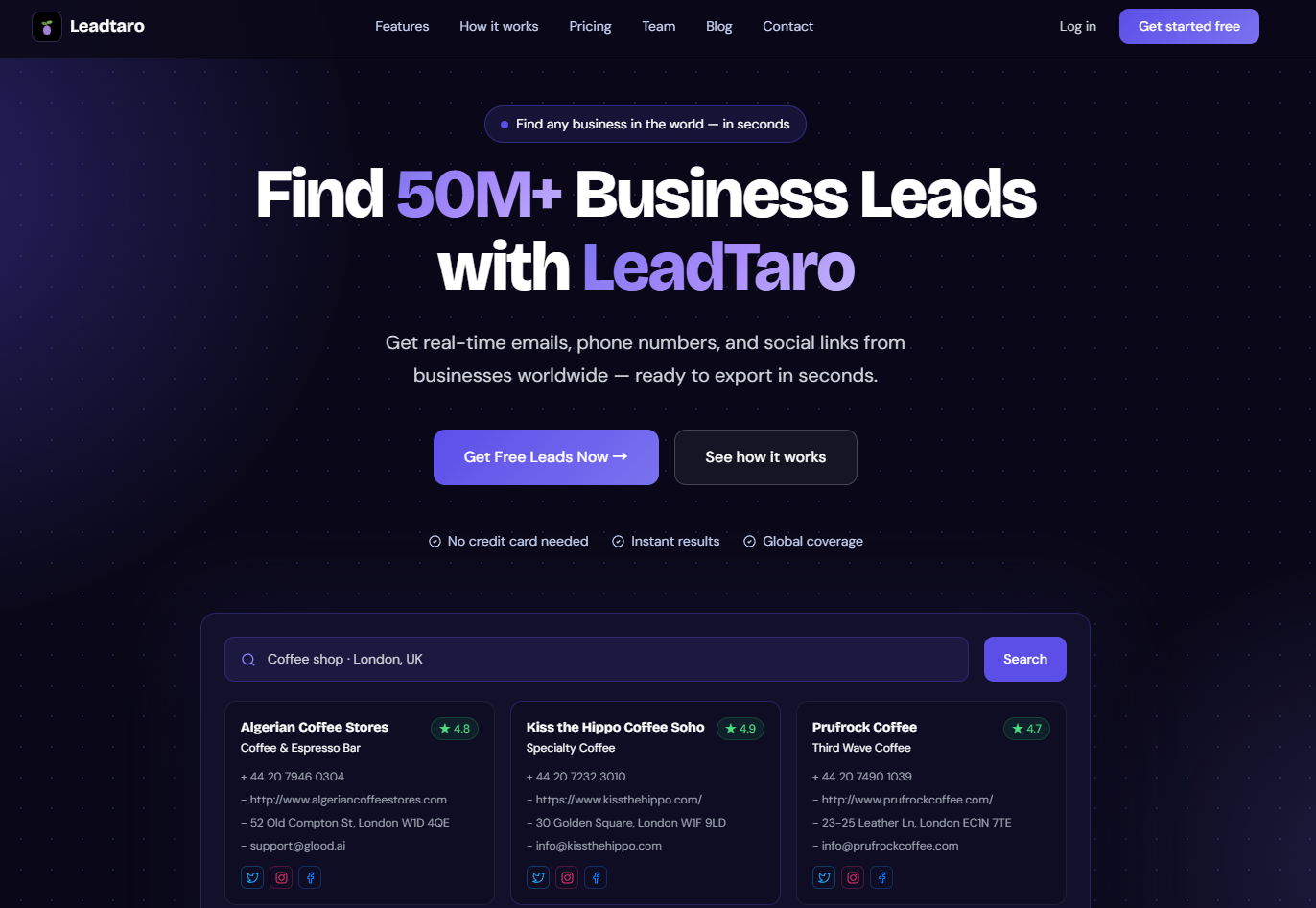
LeadTaro is a B2B lead generation platform designed to help businesses discover prospects, access available contact information, and manage their sales workflow.
Instead of treating lead discovery and sales follow-up as completely separate activities, LeadTaro brings several prospecting tasks together.
Key capabilities include:
B2B business lead discovery.
Access to available business contact information, including emails, phone numbers, websites, and social links.
AI-powered cold email generation.
CRM pipeline management for organizing and tracking prospects.
Lead status tracking, from new leads to contacted prospects, meetings, and closed opportunities.
Lead exports for compatible prospecting workflows, subject to plan limits.
These capabilities are useful for freelancers, marketing agencies, sales teams, startup founders, and businesses that need to build prospect lists without managing a complicated collection of tools.
AI-Assisted Cold Email Generation
Finding a prospect is only the first step. The next challenge is starting a conversation.
LeadTaro helps users generate cold email drafts with AI, making it easier to prepare outreach based on available prospect information. Users can review and customize messages before sending them.
CRM Pipeline Management
LeadTaro also helps users organize prospects after discovery. Rather than leaving contacts in a spreadsheet, users can track their progress through a sales pipeline and keep follow-up activities organized.
Free B2B Lead Generation
LeadTaro offers a free plan that allows users to access 60 B2B leads without requiring a credit card. This gives new users an opportunity to explore the platform and evaluate whether its data and workflow fit their needs.
Best for: Freelancers, agencies, founders, and small sales teams looking for B2B lead discovery, AI-assisted email writing, and pipeline management in one workflow.
Explore LeadTaro to see whether it fits your prospecting process.
2. Apollo.io — B2B Contact Database and Outreach
Apollo.io combines B2B contact discovery with sales engagement features. Users can search for prospects, build lists, enrich contact records, and organize outreach campaigns.
Its integrated approach can be useful for businesses that want to manage much of their outbound sales process from one platform.
Best for: B2B sales teams that need a contact database and outreach functionality.
Considerations: Database coverage and contact accuracy vary by geography, industry, and individual record. Verify important contact details before launching campaigns.
Website: https://www.apollo.io/
3. Clay — Data Enrichment and Workflow Automation
Clay helps sales and growth teams combine data from multiple providers and automate enrichment workflows.
Users can build prospect lists, retrieve additional company information, and use AI to research or personalize outreach. It is particularly useful when a team wants to create customized prospecting workflows rather than rely on a single database.
Best for: Growth teams and technically minded sales operators who need flexible enrichment workflows.
Considerations: Complex workflows may require setup, testing, and ongoing credit management.
Website: https://www.clay.com/
4. ZoomInfo Copilot — Enterprise Sales Intelligence
ZoomInfo focuses on B2B company and contact intelligence. Its sales intelligence capabilities help enterprise teams research accounts, identify potential buyers, and prioritize outreach.
Organizations with complex sales processes may benefit from its account information, organizational insights, and broader sales intelligence features.
Best for: Enterprise sales organizations with larger prospecting budgets.
Considerations: Pricing and packaging depend on the agreement. Smaller businesses should compare the total cost with their expected prospecting volume and actual requirements.
Website: https://www.zoominfo.com/
5. Wiza — LinkedIn-Based Prospecting
Wiza helps users discover contact information through LinkedIn-oriented prospecting workflows, including workflows involving Sales Navigator.
It can be useful when a sales team already knows its target companies and wants to identify professional contacts for outreach.
Best for: Recruiters, sales representatives, and teams prospecting through professional networks.
Considerations: Coverage depends on the source data and available contact information. Review the platform's current terms and the rules of any third-party service you use.
Website: https://wiza.co/
6. AiSDR — AI-Assisted Outbound Sales
AiSDR focuses on using AI to assist with outbound sales activities, including prospect research and personalized outreach.
Automation can reduce repetitive work, but teams still need to define their target audience, review messaging quality, and monitor campaign performance.
Best for: Teams looking to automate parts of their outbound prospecting process.
Considerations: Evaluate how much control you retain over targeting, message approval, sending behavior, and follow-up logic.
Website: https://aisdr.com/
7. Lavender — Cold Email Coaching
Lavender focuses on improving cold email quality. Its email coaching capabilities help users review messages and identify opportunities to improve clarity, readability, and personalization.
Unlike a lead database, Lavender is primarily designed to improve the communication stage of prospecting.
Best for: Sales representatives who already have prospect lists and want to improve their email writing.
Considerations: Better emails cannot compensate for poor targeting or inaccurate contact information.
Website: https://www.lavender.ai/
8. Amplemarket — Integrated Sales Prospecting
Amplemarket combines prospect discovery, sales intelligence, and outbound engagement features into a platform designed for sales teams.
Its approach can help organizations coordinate several prospecting activities without relying entirely on disconnected tools.
Best for: Outbound sales teams looking for an integrated prospecting and engagement platform.
Considerations: Compare its available integrations, contract terms, and features with the tools your team already uses.
Website: https://www.amplemarket.com/
9. HubSpot Sales Hub — CRM-Based Prospecting
HubSpot Sales Hub connects prospecting and sales activities with a CRM environment. Depending on the plan and available features, teams can use its tools to manage contacts, organize deals, automate selected tasks, and monitor sales performance.
It is particularly convenient for businesses that already use HubSpot to manage their customer relationships.
Best for: Businesses that want prospecting activities closely connected to their CRM.
Considerations: Check which automation and AI features are included in your subscription tier.
Website: https://www.hubspot.com/products/sales
10. Salesloft — Sales Engagement and Cadences
Salesloft focuses on sales engagement, helping teams coordinate outreach sequences, manage interactions, and evaluate sales activity.
It is most useful after a business has established its prospecting process and needs a structured way to manage communication across a sales team.
Best for: Sales development teams that need repeatable engagement workflows.
Considerations: Businesses that only need occasional lead discovery may not require a dedicated sales engagement platform.
Website: https://www.salesloft.com/
11. Nooks — AI-Powered Sales Calling
Nooks focuses on sales calling workflows, including dialing, team collaboration, and coaching capabilities.
For organizations where phone outreach plays a major role, dialing and coaching tools can help representatives spend less time on repetitive tasks and more time speaking with prospects.
Best for: Teams that rely heavily on outbound calling.
Considerations: Evaluate its calling capabilities against your team's geography, phone systems, compliance requirements, and workflow.
Website: https://www.nooks.ai/
12. Seamless.AI — B2B Contact Discovery
Seamless.AI helps sales professionals search for business contacts and discover information that can support prospecting.
It is designed for teams that need to identify potential contacts and build lists for outbound sales activities.
Best for: Sales teams that prioritize contact discovery and prospect list building.
Considerations: Verify email addresses and other critical information before using them in large campaigns. Contact availability and accuracy can vary.
Website: https://www.seamless.ai/
How to Choose the Right AI Prospecting Software
The right platform depends on what your business needs to accomplish. A tool that works well for an enterprise software sales team may not be the best option for a freelancer targeting small businesses.
Consider these four factors before choosing a solution.
1. Identify Your Ideal Customer Profile
Start by defining your ideal customer profile, or ICP.
Consider:
Industry and business type.
Company size.
Geographic location.
Relevant job titles or decision-makers.
Contact information required for outreach.
A clearly defined ICP helps you avoid paying for large lists of irrelevant prospects.
2. Evaluate Data Quality
A large database is not automatically a useful database.
Check whether the platform provides the fields you actually need, how recently records are updated, and whether you can validate critical contact details.
For example, a marketing agency may prioritize business websites, general contact emails, and phone numbers. An enterprise software vendor may care more about decision-maker roles, company size, and organizational structure.
3. Compare the Total Cost
Look beyond the advertised starting price. Consider credits, contact exports, enrichment limits, user seats, email sending, and additional integrations.
For smaller businesses, an affordable tool that covers the essential workflow may provide more value than an expensive platform with features they rarely use.
4. Match the Tool to Your Sales Workflow
Ask yourself what happens after you find a lead.
Do you need to enrich an existing spreadsheet? Generate personalized emails? Track prospects through a sales pipeline? Automate multichannel engagement?
If you need several of these functions, compare platforms that bring multiple steps together. LeadTaro, for example, combines B2B lead discovery, AI-assisted cold email generation, and CRM pipeline management.
How to Find and Reach More B2B Prospects
An effective prospecting process is not just about collecting contacts. It is about moving suitable prospects toward a meaningful sales conversation.
A practical workflow looks like this:
Step 1: Define your target market.
Identify the industries, locations, business types, and decision-makers that are most likely to need your product or service.
Step 2: Build a relevant prospect list.
Use a B2B lead generation tool to discover potential customers and collect the business information available for each record.
Step 3: Review and qualify your leads.
Remove irrelevant companies, check important contact details, and prioritize prospects that match your offer.
Step 4: Generate personalized outreach.
Use AI to draft relevant cold emails based on the prospect's business and your value proposition. Review each message for accuracy and avoid making claims you cannot substantiate.
Step 5: Track follow-ups.
Organize prospects in a CRM pipeline. Record when you contact them, which prospects respond, and which opportunities need another follow-up.
Step 6: Measure the results.
Track delivery rates, positive replies, meetings booked, and conversions. Use the results to improve your targeting and messaging over time.
LeadTaro can support several of these steps by combining lead discovery, AI-assisted email generation, and pipeline tracking in one platform.
Building an AI-Powered Prospecting Workflow with LeadTaro
AI prospecting works best when the tools you use support a consistent process.
With LeadTaro, you can start by discovering B2B leads, review available business contact information, prepare personalized cold email drafts, and organize prospects in your sales pipeline.
This creates a practical workflow:
Discover leads: Search for businesses relevant to your target market.
Review contact information: Check available emails, phone numbers, websites, and social links.
Prepare outreach: Use AI-assisted email generation to create a starting draft.
Manage prospects: Organize contacts and update their sales status.
Improve your process: Review outcomes and refine your targeting.
The benefit is not that every task becomes fully autonomous. It is that fewer activities need to be handled through disconnected spreadsheets and applications.
For founders and small sales teams, a straightforward workflow can be more valuable than a complicated technology stack.
You can start with LeadTaro's free plan, which includes access to 60 B2B leads without a credit card, and evaluate the platform using your own target market.
Visit LeadTaro to get started.
Data Privacy and Compliance
Using AI for prospecting does not remove your responsibilities under data protection and electronic marketing laws.
Before collecting or contacting prospects, consider the following:
Understand your legal basis: Identify the appropriate legal basis for processing personal data where required.
Distinguish business data from personal data: Publicly available information is not automatically exempt from data protection requirements.
Follow marketing rules: Requirements differ depending on the recipient, jurisdiction, and communication channel.
Provide required opt-out mechanisms: Make it straightforward for recipients to object to or unsubscribe from marketing where applicable.
Respect suppression lists: Do not continue contacting people who have validly opted out.
Review your data sources: Understand where contact information originates and what restrictions apply to its use.
In the UK, businesses should consider UK GDPR, the Data Protection Act 2018, and applicable PECR requirements. EU GDPR and California privacy laws may also apply depending on the people and organizations involved.
B2B marketing rules can differ for corporate subscribers, sole traders, partnerships, and individual contacts. Do not assume that a publicly listed email address automatically grants permission to send any type of marketing message.
Consult the relevant regulator's guidance or qualified legal advice when designing campaigns for multiple jurisdictions.
Conclusion: Which AI Prospecting Tool Should You Choose?
The best AI prospecting tool depends on your audience, budget, and workflow.
Apollo.io is worth evaluating for businesses that want a combined B2B database and outreach platform. Clay is useful for sophisticated data enrichment. ZoomInfo focuses on enterprise sales intelligence, while Lavender specializes in email coaching. Salesloft and Nooks address more specific sales engagement and calling requirements.
LeadTaro is an option for businesses that want to combine B2B lead discovery, available contact information, AI-assisted cold email generation, and CRM pipeline management.
Instead of selecting a platform based on its headline database size alone, evaluate how effectively it helps you find relevant prospects and turn those records into organized sales opportunities.
If you're a freelancer, agency, founder, or small sales team, you can start by testing LeadTaro's free plan with 60 B2B leads and no credit card requirement.
Explore LeadTaro and build a more organized B2B prospecting workflow.
Frequently Asked Questions
What is an AI prospecting tool?
An AI prospecting tool helps businesses identify potential customers, collect or enrich contact information, qualify prospects, and prepare personalized outreach. Depending on the platform, it may also support sales automation and CRM management.
What are the best AI prospecting tools in 2026?
Popular options include LeadTaro, Apollo.io, Clay, ZoomInfo Copilot, Wiza, AiSDR, Lavender, Amplemarket, HubSpot Sales Hub, Salesloft, Nooks, and Seamless.AI. The best choice depends on whether you need lead discovery, contact enrichment, email personalization, calling, or sales engagement.
Is there a free AI prospecting tool?
Some prospecting platforms offer free plans or limited trials. LeadTaro offers a free plan that includes access to 60 B2B leads without requiring a credit card. Review the current plan details to understand any search, export, or feature restrictions.
Can AI prospecting tools find business email addresses?
Some platforms provide available business email addresses and other contact information. Coverage varies by provider, industry, country, and individual record. Verify critical contact details before using them in outreach campaigns.
Can AI write personalized cold emails?
Yes. AI tools can generate email drafts based on available prospect information, your product, and your intended message. Human review remains important to confirm accuracy, relevance, tone, and compliance.
What is the difference between lead generation and prospecting?
Lead generation focuses on identifying and collecting potential customers. Prospecting is the broader process of finding, researching, qualifying, and approaching those potential customers. Many sales platforms support both activities.
Is AI prospecting suitable for small businesses?
Yes. AI prospecting can help small businesses reduce manual research and organize outreach. The best starting point is a tool that matches the company's target market and budget without introducing unnecessary complexity.
How does LeadTaro help with B2B prospecting?
LeadTaro combines B2B lead discovery, available business contact information, AI-assisted cold email generation, and CRM pipeline management. It is designed to help users move from discovering prospects to preparing outreach and tracking sales opportunities.