What's in This Guide
Why Most Discovery Questions Fail on Local Prospects
The Science Behind Sales Discovery Questions
Pre-Call Intelligence: The Silent Discovery Advantage
30 Sales Discovery Questions for Local Business Prospecting
How to Ask Without Interrogating
5 Common Discovery Call Mistakes That Kill Deals
Is Local Data Prospecting Legal?
FAQ
How to Start Every Discovery Call With Better Prospect Research
Sales discovery is one of the most important parts of the sales process. Ask the right questions, and you uncover a prospect's problems, priorities, buying process, and reasons to act. Ask the wrong questions, and even a promising conversation can end before it begins.
Research from Gong Labs has highlighted a relationship between discovery-call performance and the number of questions sales representatives ask. Its analysis of hundreds of thousands of sales conversations suggests that effective discovery depends on asking thoughtful questions, listening carefully, and understanding the buyer rather than rushing into a pitch. Results vary by sales context, so no single question count guarantees a win.
But there's an important distinction that many sales guides overlook: selling to an enterprise procurement team is not the same as selling to a local business owner.
Consider a roofing contractor with three employees, a dentist who answers the phone between appointments, or a restaurant owner managing staff during the lunch rush. These prospects have limited time and practical priorities. They want to know whether your solution can help them attract customers, save time, reduce costs, or solve a problem.
That's why effective sales discovery questions need to reflect the prospect's situation.
In this guide, you'll find 30 practical questions for local B2B prospecting, advice on researching businesses before you call, and a repeatable framework for turning discovery conversations into qualified opportunities.
1. Why Most Discovery Questions Fail on Local Prospects
Imagine a sales representative named Mike. He sells reputation management software and has memorized the BANT framework: Budget, Authority, Need, and Timeline.
Mike calls a plumber in Tampa and opens with:
"So, what's your currently allocated budget for reputation management solutions?"
The plumber has been working since early morning and has no idea why a stranger is asking about an allocated budget. The conversation ends.
Mike understands the theory of sales qualification, but he hasn't adapted it to his audience.
Local business owners are often busy, receive frequent sales pitches, and prefer straightforward conversations. They don't necessarily think in terms of procurement cycles, buying committees, or digital transformation budgets.
They think about practical outcomes:
Will this help me get more customers?
How much time will it take?
Is it worth the money?
Can I trust the person selling it?
Will it solve a problem I'm already experiencing?
The problem isn't discovery itself. It's applying a generic framework without understanding the person on the other end of the phone.
Enterprise sales approachLocal business reality"Who's on your buying committee?""Will you make the decision, or should we speak with your manager or business partner?"Six-month procurement processA decision that might happen this week"What's your digital transformation budget?""What would you be comfortable investing to solve this problem?"Formal, multi-stage presentationsA short conversation between appointmentsBroad strategic objectivesMore bookings, fewer missed calls, better visibility, or higher revenueThe solution is to make discovery conversational, specific, and relevant.
A practical sales prospecting strategy begins before the first call. Identify businesses that fit your ideal customer profile, research their circumstances, and prepare a relevant reason for reaching out.
Your questions should help the prospect explain their situation, not make them feel as though they're completing a questionnaire.
2. The Science Behind Sales Discovery Questions
Good discovery is not about asking the largest number of questions. It's about uncovering useful information while maintaining a natural conversation.
Research published by sales conversation analytics companies such as Gong Labs has explored how question frequency, talk-to-listen ratios, and conversational patterns relate to sales outcomes.
Several principles are particularly useful for local prospecting.
Ask enough questions to understand the situation
A call with only one or two superficial questions might not reveal the prospect's actual needs. However, asking question after question without responding to the answers can make the conversation feel like an interrogation.
Use a flexible target rather than a rigid quota. A short introductory call might require only a few questions, while a scheduled discovery meeting could cover more ground.
The appropriate number depends on the complexity of your offer, the prospect's availability, and how much you already know.
Listen more than you pitch
Salespeople often spend too much time explaining their products before they understand the customer's problems.
Instead, allow the prospect to describe their current process, frustrations, and goals. Follow up when an answer reveals something important.
For example:
Prospect: "Most of our new customers come through recommendations."
Sales representative: "That's great. Have you been looking for ways to generate more enquiries outside referrals, or are referrals keeping you busy enough?"
This response acknowledges what the prospect said and opens the door to a more meaningful discussion.
Distribute questions throughout the conversation
Avoid asking every question in the first three minutes and then delivering a long product pitch.
Start with the prospect's current situation. Explore challenges when they arise, and discuss decision criteria once you understand what matters.
This makes the conversation feel collaborative rather than scripted.
Respond quickly when a prospect shows interest
Discovery doesn't end when a prospect expresses interest. Follow-up matters, too.
If a prospect requests information, agrees to a meeting, or asks for a proposal, establish the next step and complete it promptly. Delayed follow-up can allow an opportunity to lose momentum.
The key takeaway is simple: ask relevant questions, listen carefully, and make every follow-up purposeful.
3. Pre-Call Intelligence: The Silent Discovery Advantage
One of the easiest ways to improve a discovery call is to research the business before contacting it.
You don't need to know everything about a prospect. You need enough context to explain why you're reaching out and ask a question that makes sense for their business.
This is where a structured prospecting workflow becomes valuable.
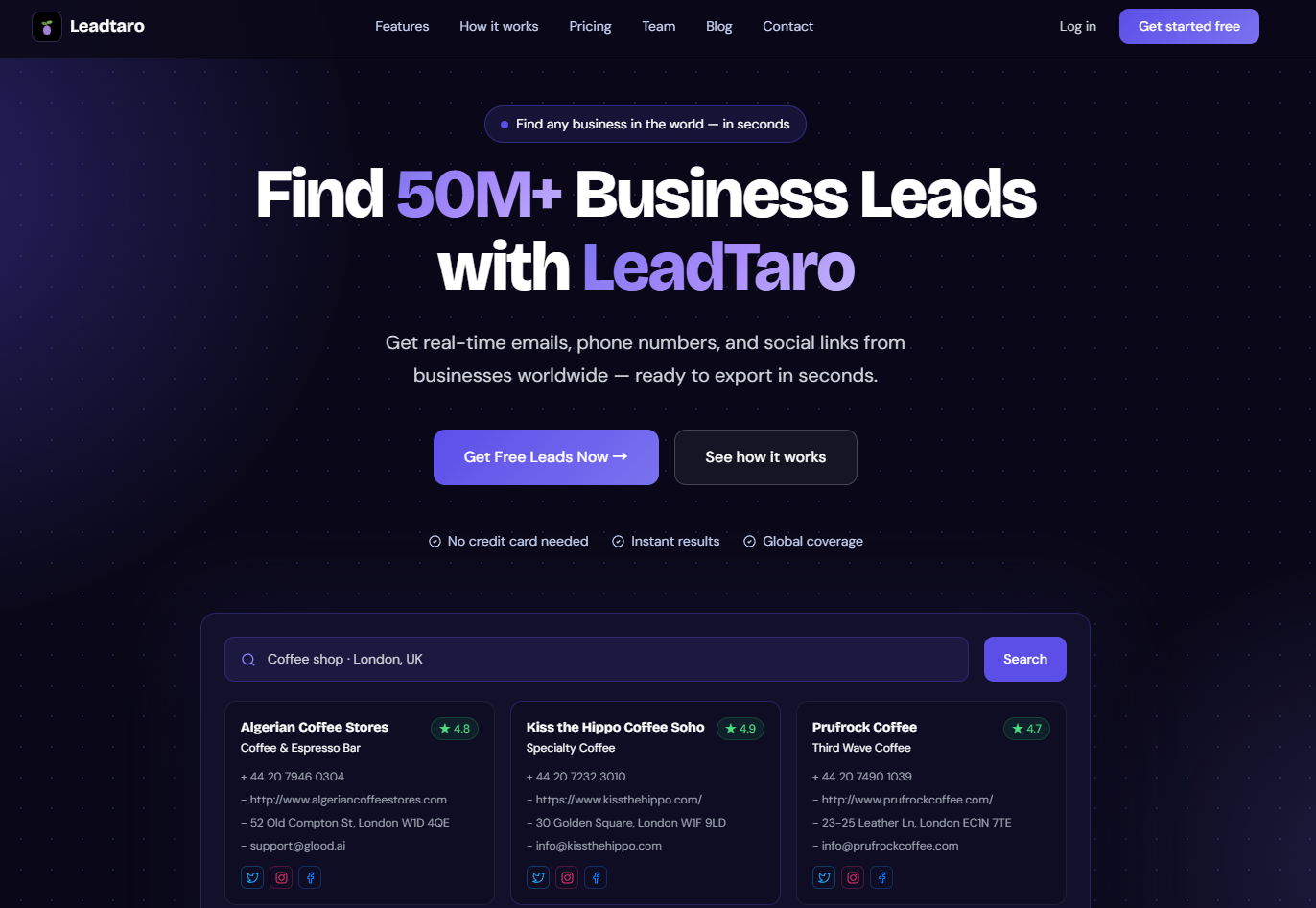
With LeadTaro, you can approach prospecting as a repeatable process: identify potential businesses, organize your target accounts, record useful research, and prepare more relevant outreach rather than relying on an unstructured list of names.
The goal is to understand your prospects before you ask them to explain themselves.
The five-point pre-call research checklist
1. Business reputation
Look at the business's public ratings and customer feedback where available.
A business with mixed reviews may have opportunities to improve its customer experience or reputation management. A highly rated business might instead be interested in increasing its reach or maintaining its competitive position.
Don't assume a particular rating means a business needs your product. Use it as a possible conversation starter and verify your assumptions with the prospect.
2. Recent customer reviews
Recent reviews can reveal what customers appreciate and where they encounter problems.
Look for recurring themes rather than focusing on a single negative comment. For example, repeated complaints about unanswered calls may be relevant if you sell call-management software.
Use publicly available information respectfully. Avoid treating customer reviews as proof of internal business problems.
3. Website and online presence
Check whether the business has a website and whether it clearly communicates its services, location, and contact details.
If you sell web design, conversion optimization, or digital marketing services, these observations can help you prepare a relevant question.
For example:
"I noticed your website focuses mainly on your services. Are you currently trying to generate more enquiries through it, or do most customers contact you another way?"
4. Marketing activity
Where observable, review the business's advertising, social media activity, promotions, and other marketing channels.
An active marketing presence may suggest that customer acquisition is a priority. However, it doesn't establish the business's budget, performance, or willingness to purchase your solution.
Ask questions to understand those details instead of assuming them.
5. Business fit and buying context
Check whether the business matches your ideal customer profile.
Consider its industry, location, services, size where reliably available, and likely need for your product. Also look for relevant business developments that could make your offer timely.
For example, a newly opened business might need help generating initial demand, while an established company might want to improve its lead qualification process.
How to turn research into a better opening
Imagine you sell marketing services to independent dental practices.
A generic opener might be:
"Hi, we provide digital marketing services to businesses. Are you interested?"
A research-informed opener could be:
"Hi, I was looking at your practice's online presence and wanted to ask a quick question. Are you currently looking to attract more new-patient enquiries, or are your existing referral channels working well?"
The second version gives the prospect a reason to engage. It also invites a useful answer instead of demanding an immediate yes or no.
The same principle applies to B2B software, commercial services, agencies, and other businesses selling to local companies.
Organize prospect research with LeadTaro
Research becomes much more useful when you can find it again.
Use LeadTaro as part of your prospecting workflow to keep your target businesses and qualification process organized. Record the reason each business fits your target market, what you've learned, and what you need to confirm during the conversation.
A simple pre-call record might include:
Business name and location
Industry and services
Why the business fits your target customer profile
Relevant public observations
Potential business challenge to explore
Contact attempts and responses
Next action and follow-up date
This creates continuity between research, outreach, qualification, and follow-up.
Remember: research generates hypotheses, not certainty. The discovery conversation is where you find out whether those hypotheses are correct.
4. 30 Sales Discovery Questions for Local Business Prospecting
The following questions are organized into six stages. Use them as a flexible sales discovery questions template, selecting the ones that fit your offer and the prospect's answers.
You don't need to ask all 30 questions on one call. In most introductory conversations, a handful of well-chosen questions is more effective than working through the entire list.
A. Opening and Permission: Questions 1–5
Your first objective is to earn enough attention for a brief conversation. Be transparent about why you're calling and respect the prospect's time.
1. "Have I caught you at a bad time, or do you have a minute?"
Acknowledges that the prospect may be busy and gives them control over the conversation.
2. "I was looking at your business and noticed something I wanted to ask about. Do you have a moment?"
Use this when you've genuinely identified something relevant during your research. Be ready to explain what caught your attention.
3. "I work with [type of business] on [specific outcome]. Is improving that area something you're thinking about at the moment?"
Connects your offer to a concrete business outcome instead of starting with a list of features.
4. "I know you're probably busy, so I'll keep this brief. Could I ask one question to see whether this is relevant?"
A useful option when you want to make a concise, low-pressure introduction.
5. "Before I explain what we do, could I ask how you're currently handling [specific challenge]?"
Moves the discussion toward the prospect's situation before you introduce a solution.
The goal of these opening questions is not to force a sales conversation. It's to establish relevance and find out whether continuing makes sense.
B. Current-State Assessment: Questions 6–10
Once the prospect is willing to talk, understand how their business currently operates.
6. "How are you currently attracting new customers?"
A broad question that reveals whether the business relies on referrals, search, advertising, partnerships, outbound sales, or other channels.
7. "What's working particularly well for you at the moment?"
Helps you identify existing strengths rather than assuming the prospect has a problem.
8. "When a potential customer first discovers your business, how do they usually get in touch?"
Reveals whether the business receives enquiries through phone calls, forms, email, social media, or other channels.
9. "What usually happens when someone enquires but doesn't become a customer straight away?"
Explores follow-up processes and whether potential opportunities are being missed.
10. "Roughly how many new enquiries do you receive in a typical week or month?"
Provides a starting point for understanding demand. If the prospect doesn't know the exact number, an estimate is fine.
These open-ended discovery questions help prospects describe their business in their own words. Listen for details you can explore rather than immediately moving to your next prepared question.
C. Pain and Business Impact: Questions 11–15
After understanding the current situation, explore what the prospect would like to improve and why it matters.
11. "I noticed [specific observation about the business]. Is that something you're actively trying to improve?"
Use a genuine, relevant observation from your research. Avoid making assumptions based on incomplete information.
12. "If things stayed exactly as they are for the next six months, how would that affect your business?"
Helps the prospect consider the consequences of maintaining the status quo.
13. "When a potential customer chooses a competitor instead, what do you think usually influences their decision?"
Encourages discussion about pricing, visibility, reputation, service, convenience, or other competitive factors.
14. "Do you have a sense of how much a missed enquiry or lost customer costs you?"
Connects an operational problem to its possible financial impact. If the prospect doesn't know, don't invent a figure for them.
15. "If you could improve one part of your customer acquisition process this quarter, what would make the biggest difference?"
Helps uncover the prospect's highest-priority opportunity without dictating what their problem should be.
These questions are especially useful when you've researched the prospect beforehand. You can introduce relevant observations, then let the business owner explain whether they matter.
For example, seeing an outdated website might suggest an opportunity for a web design agency. It does not prove that the website is losing customers. Ask before drawing conclusions.
D. Decision Process: Questions 16–20
Understanding a problem is only part of qualification. You also need to understand how the business evaluates solutions and makes decisions.
16. "Who else would normally be involved in a decision like this?"
Identifies other stakeholders without assuming that the person answering the phone has sole authority.
17. "What would you need to see to feel confident moving forward?"
Reveals the evidence, information, or assurances the prospect needs.
18. "Have you tried to solve this before? What did you learn from that experience?"
Uncovers previous solutions, frustrations, and expectations.
19. "Is there a particular deadline or time of year when you'd want this in place?"
Helps establish timing and whether the opportunity is immediate or longer-term.
20. "If we found an approach that made sense, what would the next step normally look like for you?"
Creates a natural transition toward a follow-up meeting, demonstration, proposal, or internal discussion.
Local businesses can have simple decision-making structures, but don't assume every decision is made by the owner alone. An office manager, business partner, operations manager, or other stakeholder may play an important role.
E. Solution Fit: Questions 21–25
Once you understand the problem and decision process, explore whether your offer is a realistic fit.
21. "If we could help improve [specific outcome], what would that allow you to do differently?"
Connects your solution to the practical result the prospect wants.
22. "What would be essential in a solution, and what would simply be nice to have?"
Separates genuine requirements from secondary preferences.
23. "Six months from now, what results would make you feel this was a worthwhile investment?"
Encourages the prospect to define success in their own terms.
24. "Have you compared any other ways of addressing this? What stood out to you?"
Reveals competing options, previous research, and the criteria the prospect is using.
25. "What matters most in choosing a solution: the cost, the expected results, the time involved, or something else?"
Explores buying priorities without reducing the entire decision to budget.
These are useful sales qualifying questions because they help you decide whether to invest more time in an opportunity.
A prospect may have a genuine problem but no urgency to address it. Another might be ready to buy but need evidence that your approach works for a business like theirs. Your next step should reflect that difference.
F. Objection-Handling Questions: Questions 26–30
Objections are not always rejections. They may indicate uncertainty, competing priorities, missing information, or a genuine mismatch.
Respond with curiosity instead of pressure.
26. "That makes sense. What would need to change for this to become a priority?"
Helps distinguish a temporary timing issue from a lack of need.
27. "You mentioned that [specific challenge] is important. How well do your current tools or processes address it?"
Returns the conversation to the problem the prospect identified, rather than relying on an aggressive competitor comparison.
28. "If we could demonstrate that the solution delivered the results you're looking for, would you want to explore it further?"
Tests whether the main concern is confidence in the outcome or something else. Avoid using hypothetical results as a promise.
29. "What's your biggest concern about making a change?"
Gives the prospect room to raise risks, implementation difficulties, switching costs, or other objections.
30. "Would it be helpful if I showed you an example of how a similar business approached this problem?"
Offers a relevant next step without assuming that a case study or demonstration will resolve every concern.
You don't need a clever comeback for every objection. Often, the most effective response is a genuine follow-up question that helps both parties understand whether a solution makes sense.
5. How to Ask Without Interrogating
Even excellent questions can fail when delivered mechanically.
The objective is to understand the prospect, not complete a checklist. Use the following practices to keep discovery natural.
Spread questions throughout the conversation
Start with permission and context. Explore the current situation, then follow relevant threads into problems and potential solutions.
Don't force every question into the conversation simply because it appears in your template.
Use a listen-first approach
After asking a question, give the prospect time to answer fully.
If they say, "Most of our customers come through referrals," don't immediately jump to the next question. Try:
"That's interesting. Has that been consistent, or has it changed recently?"
A thoughtful follow-up can reveal more than several unrelated questions.
Ask one question at a time
Avoid combining several questions into a long sentence.
Instead of asking, "How do you get leads, what does it cost, how do you follow up, and how many convert?", start with the first question and explore the relevant details as the conversation develops.
Share useful observations
Discovery should feel like an exchange.
If your research reveals something relevant, explain it briefly and ask whether it reflects the prospect's experience.
For example:
"I noticed you offer several different services. Are you looking to generate enquiries across all of them, or is there one service you'd particularly like to grow?"
This is more useful than making a generic product pitch.
Respect the prospect's time
A short cold call is not the same as a scheduled discovery meeting.
If the prospect is busy, offer to arrange another time. If they aren't interested, respect the answer. A good prospecting process prioritizes relevant opportunities rather than trying to turn every conversation into a sale.
Record the answers and agree on a next step
After the call, record the prospect's main challenge, priorities, decision process, objections, and agreed next action.
A structured workflow using LeadTaro can help you keep prospect research and outreach organized so that future interactions build on previous conversations.
The result is a more consistent sales process and less time spent trying to remember who said what.
6. Five Common Discovery Call Mistakes That Kill Deals
Avoid these five mistakes when using your sales discovery questions.
1. Asking too many questions
More questions do not automatically mean better discovery.
If you already understand the prospect's problem, asking the same thing in different ways adds little value. Focus on the information you still need to determine whether the opportunity is worth pursuing.
2. Front-loading every question
Asking a dozen questions in the opening minutes can make the conversation feel like an interrogation.
Start with a relevant opener and let the discussion develop naturally. Ask follow-up questions when the prospect's answers create a reason to explore further.
3. Using enterprise language with local businesses
Questions about procurement committees, digital transformation budgets, and complex implementation plans may not suit a small business.
Use language that reflects the prospect's day-to-day priorities. Ask about enquiries, bookings, operating costs, customer retention, and practical outcomes when those subjects are relevant.
4. Skipping pre-call research
If you haven't researched the business, your opening may sound identical to every other sales call it receives.
Before contacting a prospect, identify one or two genuine details that help explain why your offer might be relevant.
Don't pretend to know their internal problems. Use your research to ask better questions, not to make unsupported claims.
5. Talking more than you listen
A discovery call should not become a long presentation disguised as a conversation.
Pay attention to the prospect's answers. Summarize what you've heard, confirm that you've understood correctly, and explain your solution only when you can connect it to an identified need.
A useful summary might sound like this:
"So, if I've understood correctly, referrals are working well, but you'd like a more predictable source of new enquiries. Is that the main thing you're looking to improve?"
This gives the prospect a chance to correct your understanding before you recommend a solution.
7. Is Local Data Prospecting Legal?
Using public business information for prospect research can be legitimate, but public availability does not automatically make every collection or use of data lawful.
The rules depend on the jurisdiction, the type of information, how it was obtained, how it is used, and the communication channel.
Before building a local prospecting process, consider the following.
Data protection. In the UK and EU, information that identifies an individual can be personal data even when it appears on a public website. The UK GDPR, EU GDPR, and applicable national laws may impose obligations concerning lawful basis, transparency, data minimization, retention, and individual rights.
Marketing communications. Email and telephone outreach are subject to separate rules. In the UK, for example, PECR and data protection law may apply differently depending on whether you contact a corporate subscriber, a sole trader, or an individual. Check the rules that apply to your recipient and communication method.
Platform terms and collection methods. Public visibility does not necessarily grant permission to extract information through every method. Review the applicable website or platform terms and any relevant restrictions.
Transparency and opt-outs. Identify yourself accurately, explain your purpose where required, and honor valid objections and opt-out requests. Maintain suppression records so that people who have opted out aren't contacted again.
Data quality and security. Collect only what you need, protect prospect records, and avoid retaining inaccurate or irrelevant information indefinitely.
For authoritative guidance, consult the Information Commissioner's Office (ICO) for UK data protection and direct marketing rules, and the European Commission's data protection guidance for EU requirements.
For LeadTaro users, the practical principle is straightforward: build a prospecting workflow around relevant business information, responsible data handling, and outreach that respects applicable legal requirements. When in doubt, obtain qualified legal advice for your particular process.
8. FAQ: Sales Discovery Questions
How many questions should you ask on a discovery call?
There is no universally optimal number. A brief introductory call may require only a few questions, while a longer discovery meeting may need more.
Some sales research has identified associations between question patterns and sales outcomes, but these findings are not guarantees. Focus on uncovering the prospect's situation, challenges, priorities, decision process, and next steps without making the conversation feel scripted.
What is the 70/30 rule in sales?
The 70/30 rule is a general guideline suggesting that a salesperson should spend more time listening than talking. The precise ratio varies by context and is not a universal standard.
The principle is more important than the exact percentage: let the prospect explain their situation before you recommend a solution.
What is the 3-3-3 rule in sales?
The 3-3-3 rule is sometimes used as a follow-up cadence: three contact attempts over three days, followed by additional attempts at a different frequency over subsequent weeks or months.
There is no single universally accepted definition, and the cadence should be adapted to the sales cycle, channel, prospect's preferences, and applicable marketing rules. Don't continue contacting someone who has clearly declined or opted out.
What are the five W questions in sales?
The five W questions help structure discovery:
Who: Who is involved in the decision?
What: What problem or outcome matters most?
When: When does the prospect want to address it?
Where: Where does the problem occur, or which market or channel is involved?
Why: Why is solving the problem important now?
These questions help you understand both the business challenge and the circumstances surrounding the buying decision.
What are the five P's of prospecting?
There are several versions of the five P's. A practical prospecting checklist is:
Purpose: Know why you're contacting the business.
Preparation: Research the prospect before reaching out.
Personalization: Explain why your offer might be relevant.
Persistence: Follow up appropriately when there is a legitimate reason to do so.
Patience: Allow the prospect to evaluate the opportunity without unnecessary pressure.
The exact framework matters less than consistently applying these principles.
What are the five C's of sales?
One commonly used interpretation is Credibility, Curiosity, Connection, Communication, and Closing.
For local prospecting, credibility comes from being accurate and prepared. Curiosity helps you understand the prospect's situation. Connection makes the conversation relevant. Communication clarifies the potential value, and closing means agreeing on an appropriate next step.
Different organizations use different versions of this framework.
What's the difference between discovery questions and qualifying questions?
Discovery questions help you understand the prospect's current situation, challenges, goals, and desired outcomes.
For example: "How are you currently attracting new customers?"
Qualifying questions help establish whether the opportunity is a realistic fit.
For example: "When would you want to have a new process in place?"
Discovery builds understanding. Qualification helps you decide whether and how to proceed. Effective sales conversations combine both, without making the prospect feel as though they're being screened before you've established any value.
What makes a good sales discovery question?
A good discovery question is relevant, clear, and easy for the prospect to answer. It encourages a meaningful response rather than forcing a yes or no.
The best questions also reflect what you've learned about the business and help you understand something you don't already know.
For example, instead of asking, "Do you need more customers?", try:
"How are you currently generating new enquiries, and is that producing the volume you'd like?"
This gives the prospect more room to explain their situation.
How do you prepare for a local business discovery call?
Start by checking the business's services, location, website, and other relevant public information. Identify why it fits your ideal customer profile and prepare one or two questions based on genuine observations.
Then review any previous interactions, decide what you need to learn, and establish a clear next step if the conversation goes well.
Tools such as LeadTaro can support a more organized prospecting workflow by helping you keep target businesses and your outreach process structured.
9. Start Every Discovery Call With Better Prospect Research
The right sales discovery questions can help you uncover business challenges, establish whether your solution fits, and move promising opportunities toward a decision.
But your questions are only part of the equation.
The quality of the conversation also depends on how well you understand the prospect before you call. Research helps you identify relevant businesses, personalize your opening, and avoid wasting time on companies that are unlikely to benefit from your offer.
Build a repeatable process:
Identify your ideal customer profile. Define the industries, locations, and business characteristics that make a prospect a good fit.
Research your target businesses. Look for relevant information about their services, online presence, and potential needs.
Prepare a specific opening. Explain why you're reaching out and ask a question connected to a plausible business outcome.
Discover before pitching. Understand the current process, challenges, priorities, and decision criteria.
Qualify the opportunity. Decide whether there is a genuine fit and whether the timing makes sense.
Record the conversation. Capture the key answers, objections, and agreed next step.
Follow up appropriately. Continue the conversation when there is a legitimate reason, and respect the prospect's preferences.
LeadTaro can be part of that process. Use LeadTaro to support a more organized approach to finding and managing B2B prospects, so your sales activity is guided by a clear target market and a consistent workflow.
Ultimately, the goal isn't to ask all 30 questions. It's to ask the few questions that matter most to each prospect, listen carefully to the answers, and determine whether you can genuinely help.
That's how discovery becomes more than a sales script. It becomes the foundation of a better sales process.