AI lead scoring is changing how B2B sales teams decide which prospects deserve their attention. Instead of treating every lead equally, businesses can use company information, engagement signals, and historical sales data to identify prospects that are more likely to become customers.
For startups, freelancers, agencies, and growing sales teams, this matters. Spending hours contacting businesses that have little interest in your offer leaves less time for prospects who may actually convert.
The solution is not simply collecting more leads. It is finding the right prospects, organizing their information, and prioritizing outreach based on meaningful signals.
In this guide, we explain how AI lead scoring works, which data points matter most, how to build a practical scoring system, and how B2B lead generation platforms such as LeadTaro can help you create a stronger prospecting workflow.
What's in This Guide?
What Is AI Lead Scoring?
How AI Lead Scoring Works
AI Lead Scoring vs. Manual Lead Qualification
The Data Points That Matter Most
Best Tools for AI Lead Scoring in 2026
How to Build an AI Lead Scoring Model
Common Lead Scoring Mistakes
Data Privacy and Compliance
Frequently Asked Questions
What Is AI Lead Scoring?
AI lead scoring is the process of using machine learning or other predictive methods to estimate how likely a prospect is to become a customer.
Rather than evaluating every prospect manually, a scoring system analyzes available information and assigns a score or priority level to each lead.
For example, a web design agency might prioritize businesses that operate in its target location, have an established customer base, and appear to need a better website. A B2B software company might prioritize organizations that match its ideal company profile and have demonstrated interest in its product.
The exact signals depend on the business model, target market, and available data.
The objective is straightforward: help sales teams spend more time on promising opportunities and less time on poorly matched prospects.
Traditional Lead Scoring vs. AI Lead Scoring
Traditional lead scoring usually relies on predefined rules. A business might assign points for a particular job title, company size, website visit, or email interaction.
This approach is relatively simple to implement, but it depends on choosing the right rules in advance.
AI-assisted scoring can analyze historical sales outcomes and identify patterns across multiple variables. When sufficient high-quality data is available, it may uncover relationships that are difficult to identify manually.
MethodHow It WorksMain AdvantageMain LimitationManual qualificationSalespeople evaluate prospects individuallyHuman judgment and contextTime-consumingRule-based scoringFixed criteria assign pointsEasy to understand and controlRequires manual adjustmentsAI-assisted scoringModels identify patterns in historical and current dataCan evaluate complex combinations of signalsDepends on data quality and sufficient training examplesAI does not automatically make every scoring system accurate. A model trained on incomplete records or outdated assumptions can still prioritize the wrong prospects.
The best approach combines reliable lead data, clearly defined qualification criteria, and regular performance reviews.
How AI Lead Scoring Works
A practical AI lead scoring workflow can be divided into three stages: data collection, pattern analysis, and lead prioritization.
1. Collect and Enrich Lead Data
A scoring model can only evaluate the information available to it. If your database contains little more than a company name and an email address, its ability to distinguish between promising and unsuitable prospects will be limited.
Useful data may include:
Firmographic data: Industry, company size, business location, and other company characteristics.
Contact data: Available business contact information used to support relevant B2B outreach.
Behavioral signals: Website visits, content engagement, form submissions, and product activity, where this information is available and collected appropriately.
Business signals: Website presence, online reputation, service offerings, and other observable characteristics relevant to your ideal customer profile.
Historical sales data: Previous opportunities, qualified leads, closed-won deals, and lost opportunities.
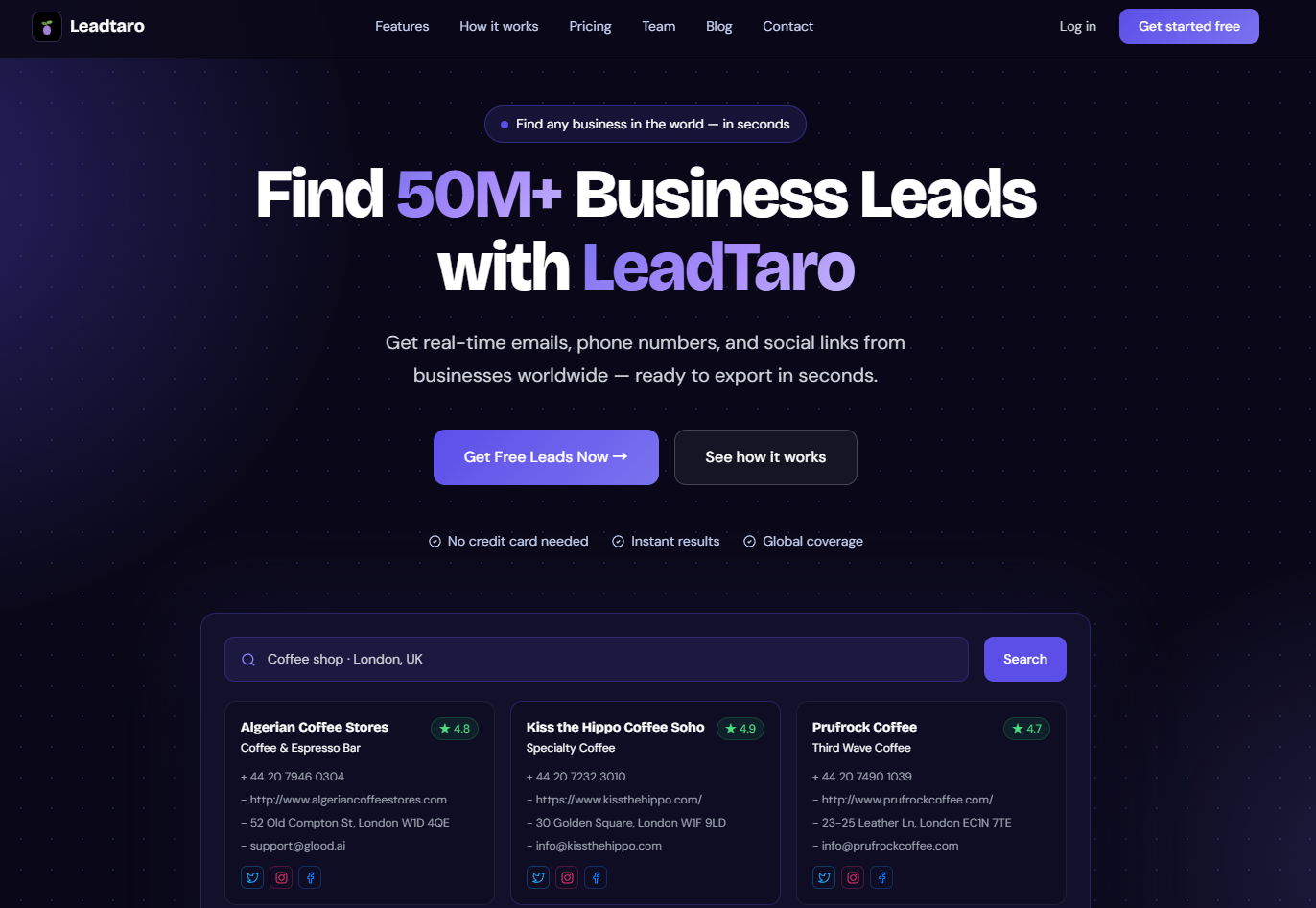
A B2B lead generation platform can help with the initial prospecting stage by making it easier to find and organize potential customers. LeadTaro helps users discover B2B prospects and access available business contact details, giving sales teams a starting point for building more structured prospect lists.
However, finding a lead and predicting whether it will convert are two different tasks. Lead generation supplies prospects; lead scoring helps determine which prospects deserve priority.
2. Identify Patterns in Your Sales Data
Once your records are collected and organized, you can begin identifying characteristics associated with successful deals.
For example, a marketing agency might discover that clients in certain industries are more profitable, retain services longer, or respond more frequently to personalized outreach.
A software company might find that prospects from a particular company-size range are more likely to become paying customers.
These patterns can inform a scoring model. Businesses with sufficient historical data may use machine learning techniques such as logistic regression, Random Forest, or gradient boosting. Smaller teams can begin with a transparent rule-based model before moving to more advanced methods.
The important point is to evaluate patterns against actual business outcomes rather than relying entirely on assumptions.
3. Prioritize Leads for Sales Outreach
After evaluating available signals, the system assigns scores or priority categories to prospects.
A simple system might use three levels:
High priority: Strong match with the ideal customer profile and relevant buying signals.
Medium priority: Suitable company profile, but limited evidence of immediate interest.
Low priority: Weak fit, insufficient information, or clear disqualifying criteria.
Salespeople can then work through their prospect lists in a more deliberate order.
Lead scores should be treated as decision-support signals, not guarantees. A high-scoring lead may never buy, while a lower-scoring prospect may turn into an excellent customer.
Why AI-Assisted Lead Qualification Matters in 2026
The value of lead scoring is not the score itself. It is the improvement in how sales teams allocate their time and resources.
Spend Less Time on Poor-Fit Prospects
Without a consistent qualification process, sales teams can spend substantial time contacting businesses that cannot benefit from their products or services.
A clear scoring framework helps identify poor-fit prospects earlier. This can reduce unnecessary research and make outreach more focused.
For example, a software provider selling to medium-sized retailers could prioritize retailers within its supported markets and company-size range rather than contacting every business in its database.
Improve Personalization
Lead qualification also helps salespeople understand why a particular prospect might be a good fit.
If a company matches your target industry and offers services that relate directly to your product, your outreach can address that context instead of relying on generic sales messages.
Personalization should be based on relevant, verifiable information. Avoid assuming that a company has a particular problem simply because it matches a broad profile.
Make Better Use of Sales Pipelines
A lead scoring system works best when it connects to a consistent sales process.
For example, a team can organize prospects into stages such as New Lead, Contacted, Interested, Meeting, and Closed. Combined with clear qualification criteria, this makes it easier to see which leads require follow-up and which opportunities deserve additional attention.
LeadTaro provides a prospecting and lead-management workflow that can help businesses organize leads and manage their sales activities. Teams can use this foundation to create a repeatable process for finding prospects, reviewing their fit, and tracking outreach.
The Data Points That Matter Most for Lead Scoring
There is no universal list of signals that predicts conversion for every business. The most useful data points depend on what you sell and which customers benefit most from it.
Here are several categories worth considering.
Company and Industry Fit
Start by determining whether a prospect matches your ideal customer profile.
Relevant factors may include:
Industry or business category
Company location and service area
Company size, where known
Products or services offered
Compatibility with your target market
For example, a company selling appointment-booking software may prioritize businesses that rely on scheduled consultations. A commercial cleaning provider may focus on offices and other facilities within its service area.
Website and Digital Presence
A company's website can help you understand its services, target audience, and existing digital presence.
For web design agencies, a business with no accessible website may be a relevant prospect. For an SEO agency, a website with obvious technical or content gaps may warrant further investigation.
These observations should be verified before outreach. A missing website in a lead record does not necessarily prove that the business has no website.
Contactability
A prospect is more actionable when the available contact details are accurate and appropriate for the intended outreach.
Useful checks include whether a business website is accessible, whether a listed email appears valid, and whether the contact channel is suitable for the message.
Do not confuse contact availability with buying intent. A valid email address makes outreach possible, but it does not mean the recipient is interested in purchasing.
Engagement and Buying Intent
When lawfully available, engagement data can provide additional context.
Examples include product usage, relevant website interactions, responses to previous outreach, or requests for a demonstration.
Recent, meaningful engagement may justify higher priority than an old record with no signs of interest. Make sure your scoring system respects consent requirements, privacy obligations, and the limits of the data you are authorized to use.
Historical Conversion Patterns
Your own sales outcomes can help you determine which signals matter most.
Review your successful customers and ask:
Which industries generate the most revenue?
Which customer types retain your services longest?
Which lead sources produce qualified opportunities?
Which characteristics appear frequently among closed-won deals?
Which prospect types rarely progress beyond the first stage?
Use these findings to refine your scoring rules over time.
Best Tools for AI Lead Scoring in 2026
Different tools serve different parts of the lead qualification process. Some manage customer relationships, some analyze buying signals, and others help build prospect lists.
The right combination depends on your sales process, budget, and technical resources.
1. HubSpot
HubSpot combines CRM functionality with sales and marketing workflows. Depending on the plan and available features, teams can use it to organize contacts, track engagement, and implement lead qualification or predictive scoring.
It is worth considering if you want customer records and sales activity managed in one environment.
2. Salesforce
Salesforce provides extensive CRM capabilities and offers AI-powered features through its product ecosystem. It may be suitable for organizations with complex sales processes, larger datasets, and established CRM operations.
Implementation and ongoing administration can require more resources than a small team needs.
3. Clay
Clay helps teams build data enrichment and prospecting workflows by combining information from multiple sources. It can be useful for teams that want to customize how prospects are researched, enriched, and prepared for outreach.
Its value depends on the providers, integrations, and workflows selected.
4. LeadTaro
LeadTaro focuses on B2B lead generation and prospecting. It helps users discover potential business customers and access available lead information for sales and outreach workflows.
This is particularly relevant when your first challenge is building a useful prospect list rather than scoring an existing database.
LeadTaro offers a free plan that provides 60 verified B2B leads without requiring a credit card. This gives new users a practical way to explore prospecting and assess whether the platform fits their workflow before committing to a paid plan.
LeadTaro should not be confused with a dedicated predictive machine learning engine. You can use the lead information you gather to support your own qualification criteria, CRM workflow, or scoring process.
5. 6sense
6sense focuses on account-based marketing and buyer-intent intelligence. It is generally more relevant to organizations with established marketing and sales operations that need to prioritize target accounts and coordinate account-based campaigns.
Smaller businesses should evaluate the cost and implementation requirements against the complexity of their sales process.
How to Choose the Right Combination
Tool CategoryBest UseB2B lead generationDiscover and build prospect listsCRMStore records and track sales activityData enrichmentFill gaps in company and contact informationLead scoringRank prospects by fit and conversion likelihoodSales automationCoordinate follow-ups and repetitive workflowsThese categories overlap, but they solve different problems. Before buying multiple tools, identify the main bottleneck in your current process.
If you do not have enough suitable prospects, start with lead generation. If you already have a large database but struggle to identify the best opportunities, focus on qualification and scoring.
How to Build an AI Lead Scoring Model Step by Step
You do not need to start with a complicated machine learning system. A small team can build a useful qualification framework, test it, and improve it as more sales outcomes become available.
Step 1: Define Your Ideal Customer Profile
Your ideal customer profile, or ICP, describes the businesses most likely to benefit from your product or service.
Start by reviewing your best customers. Consider their industries, locations, size, needs, purchasing process, and long-term value.
For example, a digital marketing agency might target independent businesses in a specific region that have an established customer base and could benefit from better online marketing.
Make the profile specific enough to guide prospecting, but not so restrictive that it excludes potentially valuable customers without a good reason.
Step 2: Select Your Qualification Signals
Choose a manageable set of criteria that reflect your ICP and sales experience.
A simple initial framework could look like this:
CriterionExample ScoreMatches target industry+20Operates in a supported location+15Fits the target company profile+15Has a relevant business need you can verify+20Responded positively to outreach+20Contact information is incomplete-10Clearly falls outside your target market-25These values are illustrative starting points, not validated conversion weights. Adjust them based on your actual results.
Also distinguish between fit and intent. A company may be an excellent match for your product without showing any immediate buying interest.
Step 3: Build and Organize Your Lead List
Collect prospects that match your target profile and organize their records consistently.
A lead list should contain enough information to identify the company, assess its relevance, and support appropriate outreach. Depending on availability, this might include company name, location, website, industry, and business contact details.
LeadTaro can help you discover B2B prospects and build a starting list. Its free plan includes 60 verified B2B leads with no credit card required, making it possible to evaluate the prospecting workflow before expanding your efforts.
After collecting the leads, review the information for duplicates, missing fields, and obvious mismatches. A smaller, well-organized list is often more useful than a larger list filled with irrelevant records.
Step 4: Assign Scores and Prioritize Outreach
Apply your qualification rules to each lead and group prospects by priority.
For example:
Scores of 70 or higher: review first
Scores from 40 to 69: research further or nurture
Scores below 40: deprioritize or exclude if they fail essential criteria
These thresholds are examples only. They should be calibrated to your market and workflow.
Use the scores to guide your next action rather than automatically sending the same message to every prospect.
Step 5: Track Outcomes and Improve the Model
A scoring system needs feedback.
Track how many prospects respond, how many become qualified opportunities, how many book meetings, and how many eventually become customers.
Compare these outcomes against the scores you assigned. If high-priority leads consistently fail to progress, investigate whether your criteria are misleading or your data is incomplete.
As your dataset grows, you can consider more advanced predictive models. Until then, a transparent rule-based system may be easier to maintain and evaluate.
Common AI Lead Scoring Mistakes
1. Relying on Incomplete or Outdated Data
Poor data quality leads to poor decisions. Missing company details, invalid contact information, duplicate records, and outdated assumptions can all distort lead scores.
Review your data regularly and distinguish between verified information and assumptions.
2. Treating Every Signal as Equally Important
Not all signals have the same relationship with conversion. A company matching your ICP may be more important than a minor engagement event, while a direct request for a quote may deserve immediate attention.
Start with the criteria most closely connected to your sales outcomes.
3. Confusing Company Fit with Buying Intent
A prospect can match your ideal customer profile without being ready to buy. Conversely, a company outside your usual target may have a genuine need for your solution.
Keep fit and intent as separate dimensions where possible. This makes it easier to understand why a lead receives a particular score.
4. Automating Before Testing
Automation can scale a good process, but it can also multiply mistakes.
Test your qualification rules on a manageable sample before applying them across your entire database. Check whether the highest-scoring leads actually perform better than the rest.
5. Ignoring Sales Feedback
Salespeople often discover practical details that are missing from lead records. They may learn that a particular business type has no budget, that a company is not the decision-maker, or that a certain industry has a longer purchasing cycle.
Use this feedback to refine your ICP and qualification process instead of treating the score as unquestionable.
Is AI Lead Scoring GDPR and Data Privacy Compliant?
AI lead scoring does not automatically guarantee compliance. The legal requirements depend on the type of data involved, where the individuals and businesses are located, the purpose of processing, and how the information was collected.
Publicly available information is not automatically free from data protection obligations, especially when it relates to identifiable individuals.
Businesses operating in or targeting the UK and European markets should consider the UK GDPR, EU GDPR where applicable, and relevant electronic marketing rules. US businesses should also review applicable federal and state privacy and marketing laws.
Good practices include:
Collect only the information needed for a legitimate business purpose.
Document the source and intended use of relevant data.
Maintain appropriate security and access controls.
Provide required privacy information and honor applicable rights.
Make sure outreach complies with the rules for the relevant channel and jurisdiction.
Review whether automated decisions create legal or similarly significant effects that trigger additional obligations.
This is general information, not legal advice. Requirements vary by situation, so businesses with complex or high-volume prospecting workflows should obtain appropriate legal guidance.
Frequently Asked Questions
What is AI lead scoring?
AI lead scoring uses machine learning or predictive methods to estimate which prospects are most likely to become customers. It analyzes available information, such as company characteristics, engagement, and historical sales outcomes, to help prioritize leads.
Is AI lead scoring better than manual qualification?
It can be more scalable and may uncover patterns that manual reviews miss. However, results depend on data quality, model design, and the relevance of the training data. Manual qualification remains useful for smaller datasets and situations requiring human judgment.
What data do I need to start lead scoring?
Start with a clear ideal customer profile and consistent company records. Useful fields may include industry, location, company size, website, contactability, engagement, and previous sales outcomes. You can begin with a simple rule-based framework and add more sophisticated methods as your dataset grows.
Can small businesses use AI lead scoring?
Yes. Small businesses can start with a spreadsheet or CRM and a handful of qualification rules. They do not need a complex machine learning model immediately. The most important first steps are defining the target customer, collecting reliable data, and tracking which prospects become customers.
How does LeadTaro help with lead qualification?
LeadTaro helps users find B2B prospects and access available business lead information for prospecting and outreach. You can use this information to build a target list, assess company fit, and support a lead qualification workflow. LeadTaro's free plan includes 60 verified B2B leads without requiring a credit card.
Does LeadTaro automatically predict which leads will convert?
Lead generation and predictive lead scoring are different capabilities. LeadTaro helps users discover and organize B2B prospects; conversion prediction requires a scoring process based on qualification rules, sales outcomes, or a suitable predictive tool. You can use prospect information as an input to that process.
How many leads should I score at once?
Start with a manageable sample that you can review and evaluate. A small batch makes it easier to identify data-quality problems and test whether your scoring criteria are useful. Expand the process after you understand which signals correlate with qualified opportunities.
How often should I update my lead scoring rules?
Review performance regularly, especially when your target market, product, or sales process changes. The right schedule depends on sales volume and how quickly your market evolves. Update rules when actual outcomes show that your existing criteria no longer prioritize the right prospects.
Conclusion: Turn Your Lead List into a Smarter Sales Process
AI lead scoring is most useful when it helps your team make better decisions about where to spend its time. A complicated model cannot compensate for an unclear target market or unreliable lead data.
Start by defining your ideal customer profile, identifying meaningful qualification signals, and building a consistent process for organizing prospects. Track outreach outcomes, learn from successful deals, and improve your scoring criteria as you gather more evidence.
If your first challenge is finding suitable B2B prospects, LeadTaro can help you get started. Explore the free plan to access 60 verified B2B leads without a credit card, then build a prospecting workflow that fits your business.
Find better B2B prospects with LeadTaro and spend more time focusing on the opportunities that matter.