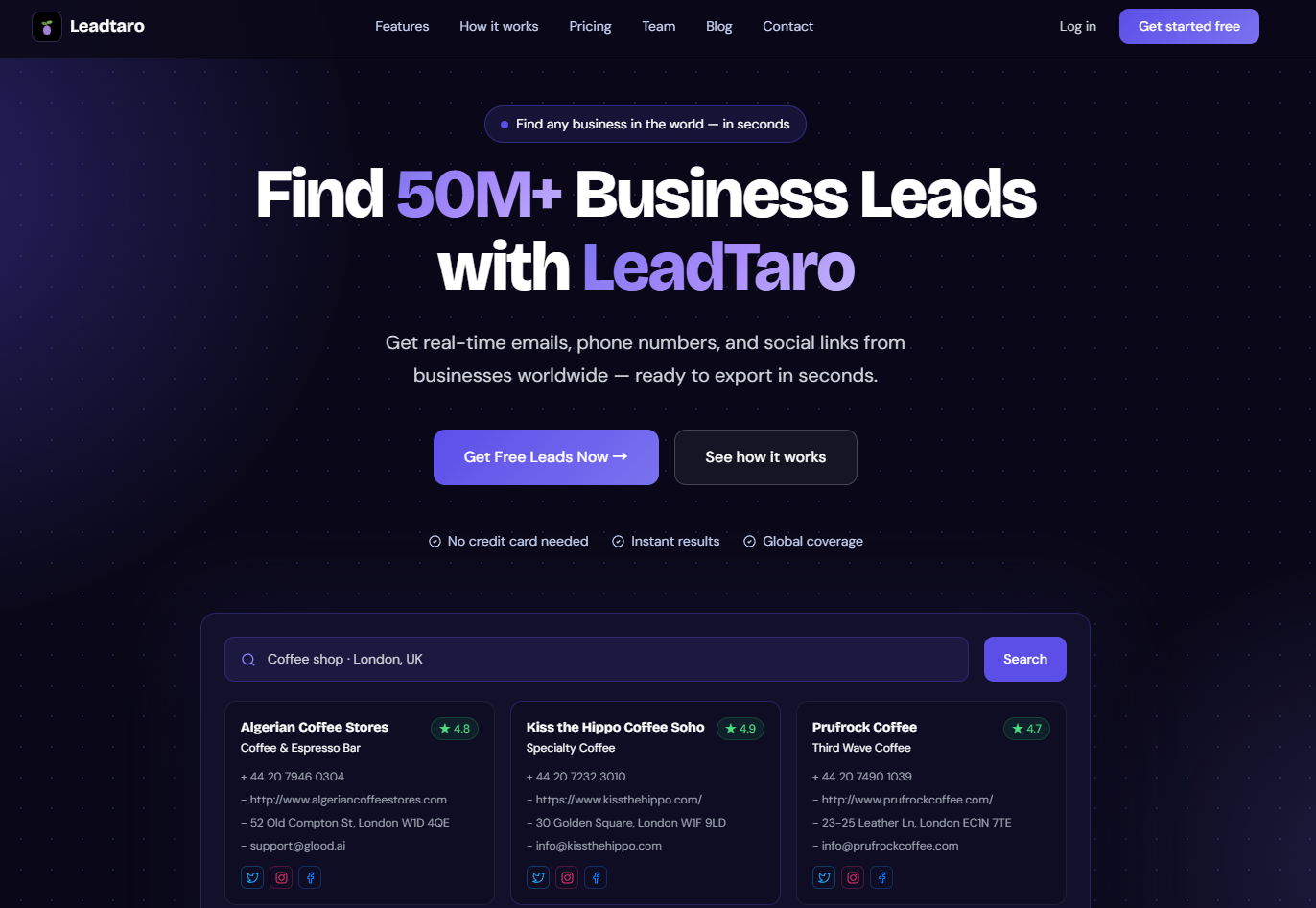
Generating leads does not have to mean spending thousands of pounds on advertising or waiting months for organic traffic to grow. For many B2B businesses, a more direct approach is to identify the right prospects, contact them with a relevant message, and follow up consistently.
Entrepreneur Alex Hormozi frequently emphasizes the importance of outreach, consistent activity, and creating value before trying to sell. The underlying lesson is straightforward: successful prospecting is not just about finding potential customers. It is about starting conversations with the right people and building a repeatable process.
In this guide, we will explore practical lead generation strategies inspired by these principles, including how to find local business prospects, personalize cold outreach, write effective sales scripts, and organize your pipeline with tools such as LeadBoba.
1. Understanding the Core Four Lead Generation Strategies
A useful framework for thinking about lead generation is to divide your activities into four categories:
- Warm outreach: Contacting people who already know you, your business, or your brand.
- Cold outreach: Reaching potential customers who have not interacted with you before.
- Free content: Attracting prospects through articles, videos, social media, podcasts, and other educational resources.
- Paid advertising: Paying to reach a specific audience through advertising platforms.
Each method serves a different purpose.
Warm outreach can be effective when you already have a network, but that network may not be large enough to support consistent growth. Content marketing can attract relevant prospects over time, although results often take time to develop. Paid advertising can generate demand, but it requires a budget and ongoing optimization.
Cold outreach offers a more direct way to start conversations with potential customers. Rather than waiting for people to discover your business, you identify companies that fit your target market and approach them with a relevant offer.
For businesses selling web design, marketing, consulting, recruitment, or other B2B services, this can be a practical starting point.
The important distinction is that outreach should not mean sending the same message to thousands of businesses. Effective prospecting starts with identifying a suitable audience and understanding why your offer might be relevant to them.
2. What Is Local Business Lead Generation?
Local business lead generation is the process of identifying potential customers within a particular industry, city, region, or geographic market.
For example, a web design agency might target independent restaurants without modern websites. A marketing consultant might focus on dental practices with limited online visibility. A recruitment agency might build a list of growing construction companies in a particular region.
In each case, the process begins with a clear target audience.
A useful B2B lead record may include:
- Business name and industry
- Business address and location
- Website URL
- Available phone number and email address
- Relevant social media links
- Other publicly available business information
The information available varies by business and source. Some companies publish several contact details, while others provide only a website or telephone number.
The objective is to turn this information into an organized list of relevant prospects that you can research, prioritize, and contact.
Define your ideal customer profile first
Before building a lead list, define your ideal customer profile (ICP).
Consider the following questions:
- Which industries are most likely to need your service?
- Which locations can you serve?
- What business size is appropriate for your offer?
- What problem does your product or service solve?
- What observable signs might indicate that a business needs your help?
For example, an agency offering website redesigns might prioritize businesses with outdated websites or no website at all. A company selling appointment-booking software might focus on businesses that rely on phone calls to schedule customers.
A specific ICP makes it easier to identify relevant prospects and write messages that address their actual needs.
3. Finding Local Business Leads at Scale
Once you know whom you want to reach, the next challenge is finding enough suitable businesses to support your prospecting efforts.
Manually searching business directories, visiting individual websites, and copying contact details into spreadsheets can become time-consuming when you need to research hundreds or thousands of companies.
A business lead generation platform can help organize this process.
Use LeadBoba to build a targeted prospect list
LeadBoba helps sales teams, agencies, freelancers, and founders discover business leads and organize their prospecting workflow.
Depending on your search requirements, you can use two approaches:
Bulk Search
Use the existing LeadBoba business database to discover businesses that match your target market. This approach is useful when you want to build prospect lists without researching every company individually.
Fresh Search
Use LeadBoba's fresh-search workflow when you want to discover business information through a live search and crawling process. Results and available information can vary depending on the business and source.
For either approach, start with a specific industry and location rather than collecting every available business.
For example, a marketing agency could build a list of independent gyms in Manchester, while a software company might research accounting firms across several UK cities.
Once you have a suitable list, review the available information and prioritize businesses that appear relevant to your offer.
Why lead quality matters more than list size
A list of 10,000 unrelated companies may be less useful than a carefully selected list of 200 businesses that fit your ideal customer profile.
Before contacting a prospect, check:
- Whether the business fits your target industry and location
- Whether its website and business details appear current
- Whether the available contact information is appropriate for your intended outreach
- Whether you can identify a genuine reason to start a conversation
- Whether the business is already a customer or has asked not to be contacted
Lead generation tools help you discover prospects, but they do not replace research, qualification, or sound sales judgment.
4. Cold Outreach in 2026: Why Personalization Matters
Cold outreach remains a practical prospecting method, but success depends on more than sending a large number of messages.
Generic messages often fail because they give the recipient no clear reason to respond. A message that demonstrates an understanding of the prospect's business is more relevant and gives the conversation a stronger starting point.
Compare these two openings.
Generic message:
"Hi, we provide digital marketing services to businesses. Would you like to learn more?"
Personalized message:
"Hi Sarah, I noticed your bakery recently started offering online ordering. Are you currently doing anything to encourage repeat customers to order directly through your website?"
The second message refers to a specific business detail and asks a relevant question. It starts a conversation rather than immediately presenting a sales pitch.
Focus on three principles
1. Relevance
Contact businesses that are likely to benefit from what you offer.
2. Personalization
Use a genuine observation about the business to explain why you are reaching out.
3. Follow-up discipline
Some prospects will not respond to the first message. A reasonable follow-up may give them another opportunity to reply, provided your outreach complies with applicable rules and respects opt-out requests.
Do not assume that one response-rate benchmark applies to every industry, audience, offer, or channel. Track your own campaign results to understand what works for your business.
5. The ACA Conversation Framework
A conversation framework associated with Alex Hormozi is ACA: Acknowledge, Compliment, Ask.
It can be used as a reminder to begin conversations with genuine attention rather than launching straight into a pitch.
A — Acknowledge
Recognize something specific about the prospect or their situation.
Example:
"I saw that your company recently expanded its services to include commercial projects."
C — Compliment
Offer a sincere, relevant compliment where appropriate.
Example:
"That looks like a useful expansion, especially for businesses looking for a single provider."
Avoid exaggerated praise or comments that sound artificial. If you do not have a genuine compliment, you can simply acknowledge the observation and move to a question.
A — Ask
Ask an open, relevant question that helps you understand the prospect's needs.
Example:
"Are you currently looking for ways to reach more commercial customers in your area?"
The goal is to create a natural exchange and discover whether there is a genuine opportunity.
ACA is not a guaranteed conversion formula. It is a useful conversational structure that can help you avoid overly aggressive openings and focus on the person you are contacting.
6. Cold Outreach Scripts for Local Businesses
Different channels call for different messages. Keep your communication brief, relevant, and honest.
Phone prospecting script
A phone call can be useful when you need to speak directly with a business owner or someone responsible for purchasing decisions.
Example:
"Hi, is this [Name]? My name is [Your Name], and I'm calling from [Company]. We help [type of business] with [specific outcome]. I noticed [genuine observation about their business], and I wanted to ask whether improving [relevant area] is something you're currently considering. Is now a convenient time for a quick question?"
If the person is busy, ask whether there is a more convenient time to call. If they are not interested, respect their answer.
Avoid pretending to have worked with their competitors or inventing a relationship to make the call seem more credible.
Cold email script
Subject: A question about [Business Name]
Hi [Name],
I came across [Business Name] while researching [industry] businesses in [location].
I noticed [specific, verifiable observation]. We help businesses like yours with [relevant service or outcome], and I thought it might be worth reaching out.
Would you be open to a brief conversation about how you're currently approaching [specific problem]?
Best regards,
[Your Name]
[Company]
The best opening is not necessarily the most clever one. It is the one that clearly explains why you are contacting that particular business.
Keep the email focused on one idea and one simple next step. Make sure the subject line accurately reflects the message.
Social media message
Social messages generally work better when they fit the platform and the relationship.
Example:
"Hi [Name], I saw your recent post about [topic]. I'm interested in how businesses in [industry] approach [relevant challenge]. Is that something your team is currently working on?"
Do not assume that publicly visible social profiles imply consent to receive unlimited promotional messages. Follow the platform's rules and applicable marketing regulations.
Contact form message
If a business publishes a contact form but no suitable direct email address, a short, relevant inquiry may be an alternative where permitted.
Example:
"Hello, I found [Business Name] while researching [industry] businesses in [location]. I noticed [specific observation] and wanted to ask whether you're currently exploring [relevant business outcome]. If this is relevant to your team, I'd be happy to share a few ideas. Thank you."
Use contact forms for their intended purpose and avoid sending repeated, irrelevant messages.
7. Use Competitor Research to Make Outreach More Relevant
Competitor research can help you identify potential business needs, but it should be used carefully.
Suppose you provide website development services to local businesses. You might notice that a competing business has an online booking system, a more informative service page, or a clearer customer inquiry process.
That observation can help you identify a potential improvement worth discussing with another business.
A suitable message might be:
"Hi [Name], I noticed that several businesses in [industry] are making it easier for customers to request quotes online. I was wondering whether that's something you've considered for [Business Name]."
This approach is more credible than claiming that a competitor has achieved a particular result unless you can verify it.
Turn observations into useful questions
Depending on your service, you might investigate:
- Whether a business has a website
- Whether its website clearly explains its services
- Whether customers can book appointments or request quotes online
- Whether the business publishes recent updates
- Whether its public business information appears consistent
These observations can suggest questions to ask, but they do not automatically prove that a company has a problem or is ready to buy.
The best prospecting messages connect an observable detail to a plausible business need without overstating what you know.
8. Build a Repeatable Daily Prospecting Routine
Consistency is easier when prospecting becomes a structured workflow rather than an activity you perform only when your pipeline is empty.
Here is an example routine for a small sales team or founder. Adjust the numbers to match your capacity, sales cycle, and market.
Step 1: Build a focused lead list
Use LeadBoba to find businesses that match your target industry and location. Review the results and remove unsuitable prospects before starting outreach.
Step 2: Research priority prospects
Choose a smaller group of high-priority businesses and review their websites, services, and relevant public information.
Write down one genuine observation for each prospect.
Step 3: Contact prospects through appropriate channels
Depending on your market and applicable rules, this might involve business calls, relevant emails, or permitted social outreach.
Start with manageable activity targets and increase them only when you can maintain quality.
Step 4: Record every interaction
Track whether each prospect was contacted, whether they responded, what they said, and what action should happen next.
LeadBoba's CRM pipeline can help organize leads through stages such as New Lead, Contacted, Interested, Meeting, and Closed.
Step 5: Schedule follow-ups
Set reminders for prospects who expressed interest or where a follow-up is appropriate. Stop contacting people who opt out or clearly indicate that they do not want further communication.
Step 6: Review performance
At the end of the day or week, examine the results. Identify which industries, messages, and channels produce meaningful conversations rather than simply counting how many messages you sent.
9. Measure the Right Lead Generation Metrics
Lead generation is easier to improve when you know where prospects are dropping out of the process.
Consider tracking these metrics:
Leads discovered: How many businesses did you identify that fit your criteria?
Contactability: How many have usable, appropriate contact details?
Outreach activity: How many calls or messages did you send?
Response rate: What proportion of contacted prospects responded?
Positive response rate: How many responses indicated genuine interest?
Meetings booked: How many prospects agreed to a meeting?
Conversion rate: How many opportunities eventually became customers?
Cost per acquired customer: How much did you spend acquiring each customer, including relevant tools, advertising, and labor?
These metrics help you distinguish a list-quality problem from a messaging problem or a sales-conversion problem.
For example, a low response rate may indicate that your audience is poorly targeted, your message is too generic, your offer is unclear, or your contact details are outdated. A high response rate but low conversion rate may point to a different issue, such as pricing, qualification, or the sales process.
Avoid treating any single benchmark as a guarantee of future results.
10. Organize Your Leads with LeadBoba
Finding prospects is only one part of sales prospecting. You also need a reliable way to manage the businesses you discover and the conversations you start.
LeadBoba brings business lead discovery and lead management into one workflow.
Depending on your needs, you can use it to:
- Discover businesses using Bulk Search
- Explore business information through Fresh Search
- Review available company and contact details
- Export eligible lead data to CSV
- Organize prospects using CRM pipeline stages
- Track leads as they move from initial discovery to customer conversion
A simple workflow looks like this:
Discover → Review → Prioritize → Contact → Follow up → Convert
The advantage of a structured process is that you can see what needs attention next. Interested prospects are less likely to disappear into an old spreadsheet, and your team can focus on moving suitable opportunities forward.
No lead database can guarantee that every business record is complete or every prospect will respond. Review important details before using them in a campaign.
11. Common Lead Generation Mistakes to Avoid
Sending the same message to everyone
A generic message gives prospects little reason to engage. Segment your list and adjust your message to the audience.
Prioritizing quantity over relevance
A large list is not automatically a valuable list. Start with a clearly defined customer profile and evaluate lead quality before scaling up.
Giving up after one message
Some people miss messages or need more time to respond. Follow up thoughtfully where appropriate, without becoming intrusive.
Making claims you cannot support
Do not invent competitor relationships, customer results, or observations. Credibility matters more than creating artificial urgency.
Failing to manage the pipeline
Without a clear record of previous conversations and next steps, it becomes difficult to know which prospects deserve attention.
Ignoring legal and platform requirements
Rules for marketing calls, emails, texts, and social messages differ by jurisdiction and channel. Publicly available business information does not automatically make every use of that information lawful.
12. Cold Outreach Compliance: What Businesses Should Know
Before launching an outreach campaign, understand the rules that apply to your business, your recipients, and the channels you intend to use.
For example:
- United Kingdom: UK GDPR, the Data Protection Act 2018, and PECR may apply to the collection and use of contact information and to direct marketing. The rules can differ between corporate subscribers, sole traders, and certain partnerships.
- European Union: GDPR requirements and national electronic marketing rules may apply, depending on the circumstances.
- United States: CAN-SPAM applies to commercial email, while telephone and text marketing may be subject to TCPA and other federal or state requirements.
Depending on the applicable rules, you may need to identify yourself clearly, provide an appropriate way to opt out, respect suppression lists, and document the legal basis for processing personal data.
Business contact information can still qualify as personal data when it identifies an individual. Do not assume that information being publicly visible means it can be used without restrictions.
Review official guidance for the jurisdictions in which you operate and seek qualified legal advice where necessary.
13. Frequently Asked Questions
What is local lead generation?
Local lead generation is the process of identifying potential customers within a defined geographic area and developing opportunities through appropriate outreach, marketing, or referrals.
What is the ACA method?
ACA stands for Acknowledge, Compliment, Ask. It is a conversational framework for recognizing something relevant about a prospect, offering a sincere compliment when appropriate, and asking a question that starts a useful discussion.
How many prospects should I contact each day?
There is no universal number that guarantees results. Choose an activity target that allows you to research prospects, personalize messages, follow applicable rules, and follow up consistently. Measure the quality of the resulting conversations before increasing volume.
Is cold outreach still useful in 2026?
Cold outreach can still be useful for B2B prospecting when it is targeted, relevant, and compliant. Results vary by industry, offer, channel, and execution. It works best as part of a broader sales process rather than as indiscriminate mass messaging.
How do I find local business leads?
Start by defining your target industry, location, and ideal customer profile. You can then use business directories, company websites, professional networks, and lead generation platforms such as LeadBoba to discover relevant businesses and review their available information.
How can I manage leads after finding them?
Use a CRM or structured pipeline to record contact attempts, responses, qualification status, and follow-up actions. LeadBoba includes pipeline stages that can help you organize prospects as they progress through your sales process.
What is the difference between lead generation and lead conversion?
Lead generation identifies potential customers and creates opportunities to contact them. Lead conversion is the process of turning those opportunities into paying customers.
Conclusion: Turn Lead Discovery into a Consistent Sales Process
Effective lead generation is not about collecting the largest possible database or sending the most messages. It is about identifying relevant businesses, understanding their potential needs, starting useful conversations, and following up consistently.
The practical approach is straightforward:
- Define your ideal customer profile.
- Build a targeted list of relevant businesses.
- Research prospects before contacting them.
- Use clear, personalized messages.
- Track conversations and follow-ups.
- Review performance and improve your process over time.
LeadBoba can help simplify the business discovery and lead management parts of this workflow, from finding prospects to organizing them in your sales pipeline.
Ready to build your next prospect list? Explore LeadBoba at leadboba.com and start organizing your B2B prospecting workflow.