Cold calling remains a valuable B2B sales channel in 2026, but success depends on more than picking up the phone. Sales professionals need a clear script, a well-targeted prospect list, and a reliable process for tracking every conversation.
Calling hundreds of random businesses rarely produces consistent results. A better approach is to identify companies that match your ideal customer profile, find the right decision-makers, and tailor your opening to their business needs.
That's where a structured prospecting workflow makes a difference.
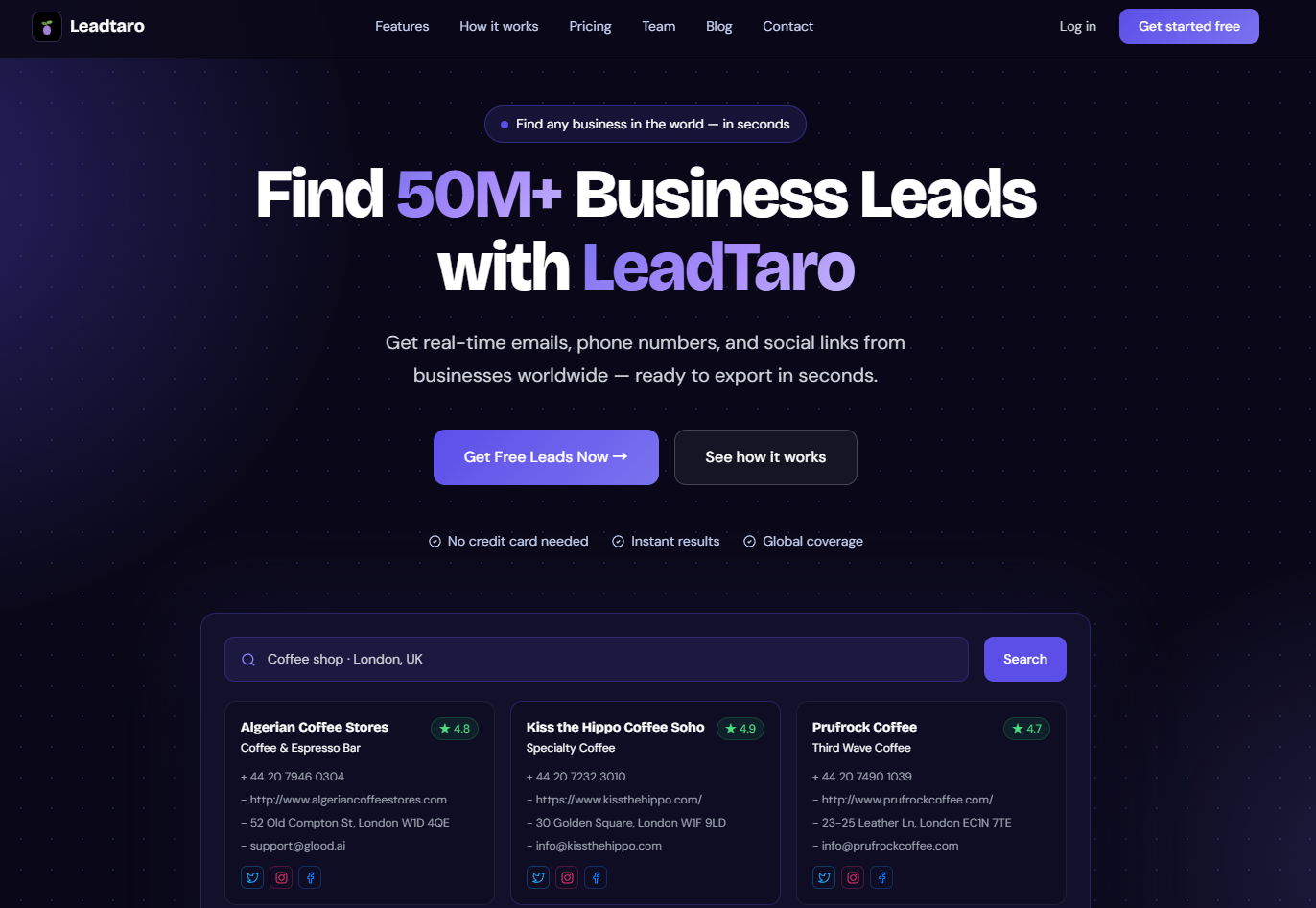
In this guide, you'll find 15 practical B2B cold calling scripts, industry-specific templates, objection-handling techniques, and a step-by-step approach to building a targeted prospect list. You'll also learn how to use LeadTaro to discover potential customers, find business contact information, generate personalized cold emails with AI, and manage prospects through a CRM pipeline.
Whether you're a freelancer, agency owner, startup founder, or sales representative, these templates will help you approach cold calling with more confidence and consistency.
Table of Contents
Why Cold Calling Still Matters in 2026
The 5-Step Framework for an Effective Cold Call
15 Best Cold Calling Scripts for B2B Sales
Industry-Specific Cold Calling Scripts
How to Handle the 7 Most Common Cold Calling Objections
How to Build a Targeted B2B Prospect List
How LeadTaro Helps You Organize Your Sales Prospecting
Cold Calling Compliance in 2026
Frequently Asked Questions About B2B Cold Calling
Why Cold Calling Still Matters in 2026
Cold calling gives sales teams a direct way to start conversations with potential customers. Unlike email campaigns, where messages can remain unopened, a successful phone call lets you ask questions, understand business challenges, and determine whether a prospect is worth pursuing.
However, cold calling is not simply a numbers game.
Your results depend on several factors:
Prospect quality: Are you contacting businesses that genuinely need your product or service?
Contact accuracy: Are the phone numbers current and associated with the right business?
Personalization: Does your opening demonstrate that you understand the prospect's situation?
Conversation quality: Are you asking relevant questions instead of delivering a long sales pitch?
Follow-up consistency: Do you record outcomes and follow up appropriately?
A carefully researched list of 100 relevant businesses can be more useful than a list of 1,000 poorly matched prospects.
For example, a web design agency targeting independent dental practices should prioritize clinics with a clear need for website improvements rather than calling every business in a city.
The same principle applies to SaaS companies, marketing agencies, consultants, recruitment firms, and other B2B service providers.
The goal is not to make more calls at any cost. It is to make more relevant calls to businesses that are likely to benefit from your offer.
The 5-Step Framework Behind Effective Cold Calling Scripts
The best cold calling scripts provide structure without making conversations sound robotic. Use this five-step framework to keep your calls focused.
1. Start With a Short, Permission-Based Opening
Introduce yourself, identify your company, and ask whether the prospect has a moment to speak.
Example:
"Hi [Name], this is [Your Name] from [Company]. I know you're busy, so I'll be brief. Could I ask you one quick question?"
Keep your opening natural. Avoid lengthy introductions or immediately listing every feature of your product.
2. Explain Why You're Calling
Give the prospect a relevant reason to continue listening.
Example:
"I noticed your company works with [target market]. We help businesses like yours improve [specific business outcome], and I wanted to see how you're currently handling that."
Whenever possible, use a genuine observation about the business rather than a generic sales statement.
3. Ask a Relevant Question
A cold call should be a conversation, not a monologue.
Useful discovery questions include:
How are you currently finding new customers?
What is your biggest challenge when building a prospect list?
How much time does your team spend researching potential customers?
Are you satisfied with the quality of your current leads?
How do you manage follow-ups after contacting a prospect?
Listen carefully to the answers. They will help you determine whether your solution is relevant.
4. Connect Their Challenge to Your Solution
Once you understand the prospect's situation, explain how your product or service could help.
For example:
"That makes sense. We help sales teams discover relevant businesses, access available contact information, and organize prospects in a CRM pipeline. That can reduce the amount of manual research involved in prospecting."
Keep your explanation tied to the problem they mentioned.
5. Suggest a Clear Next Step
The immediate goal of most cold calls is to secure a conversation, not close the entire deal.
Example:
"Would you be open to a quick 15-minute walkthrough next week to see whether this could fit your workflow?"
Offer two possible times if appropriate, and respect the prospect's decision if they decline.
15 Best Cold Calling Scripts for B2B Sales
The following scripts are adaptable templates. Replace the bracketed sections with accurate details about your company, prospect, and offer.
Script 1: Problem Discovery
Best for: Consultants, agencies, and B2B service providers.
Goal: Discover a business problem before presenting your solution.
"Hi [Name], this is [Your Name] from [Company]. I noticed your business works with [target audience], and I wanted to ask you a quick question.
How are you currently finding new businesses to approach?
[Listen to their answer.]
That makes sense. We help businesses improve their prospecting process by identifying relevant companies and organizing potential customers more efficiently.
Would you be open to a short conversation about how you could improve your current workflow?"
Script 2: Social Proof
Best for: SaaS companies with genuine customer success stories.
Goal: Establish credibility using relevant evidence.
"Hi [Name], this is [Your Name] from [Company]. We help [type of business] improve [specific outcome].
We've worked with [customer or industry example] to help address [specific problem]. I thought it might be relevant because your company operates in a similar space.
How are you currently approaching [relevant business challenge]?"
If the prospect identifies a relevant problem, explain the proven results you can substantiate and suggest a short meeting.
Only mention customers, statistics, or outcomes you can verify.
Script 3: Personalized Research
Best for: High-value accounts and complex B2B sales.
Goal: Demonstrate that you have researched the prospect.
"Hi [Name], this is [Your Name] from [Company]. I noticed that your business recently [genuine company development], and I had a question about how you're approaching [related challenge].
Are you currently handling that internally, or are you using an external solution?"
After listening, connect their response to a specific benefit of your offer.
"Based on what you've shared, I think there may be an opportunity to make that process more efficient. Would a brief walkthrough next week be useful?"
Script 4: Referral-Based Cold Call
Best for: Prospects with a genuine mutual connection.
Goal: Use a legitimate introduction to establish trust.
"Hi [Name], this is [Your Name] from [Company]. [Mutual Contact] suggested I get in touch because you oversee [relevant area].
We're helping businesses with [specific problem], and I thought there might be some overlap with your current priorities.
How are things going with [relevant project]?"
Never imply that someone referred you unless they actually did.
Script 5: Curiosity-Driven Opening
Best for: Prospects who may benefit from a specific observation.
Goal: Encourage the prospect to engage with a relevant question.
"Hi [Name], this is [Your Name] from [Company]. I was looking at how businesses in [industry] approach [specific challenge], and I noticed something that might be relevant to your team.
Could I ask how you're currently handling [problem]?"
Let the prospect respond before explaining your solution. Curiosity works best when it is based on something genuine rather than manufactured mystery.
Script 6: Value-First Approach
Best for: Building relationships with potential customers.
Goal: Offer something useful before asking for a meeting.
"Hi [Name], this is [Your Name] from [Company]. We work with [target audience] and recently put together a resource about [relevant topic].
I thought it might be useful for your team because you're involved in [relevant activity].
Would you find that helpful?"
If the prospect is interested, offer to send the resource and ask permission to follow up.
Script 7: Credibility-First Script
Best for: Competitive markets where prospects receive frequent sales calls.
Goal: Explain what you do and why it matters.
"Hi [Name], this is [Your Name] from [Company]. We help [target audience] solve [specific problem].
I'm reaching out because businesses in your industry often spend considerable time on [relevant task].
How is your team managing that process today?"
Use verifiable qualifications, experience, or customer evidence to support your credibility.
Script 8: Industry Pain Point
Best for: Industry-specific sales campaigns.
Goal: Start with a challenge relevant to the prospect's sector.
"Hi [Name], this is [Your Name] from [Company]. We work with businesses in [industry], and one challenge we often hear about is [specific industry problem].
Is that something your team encounters as well?"
If the answer is yes, ask what the problem costs them in time, money, or missed opportunities before explaining your offer.
Script 9: Case Study
Best for: B2B technology providers, consultants, and agencies.
Goal: Make your offer tangible through a genuine example.
"Hi [Name], this is [Your Name] from [Company]. I wanted to share a quick example that might be relevant.
We recently worked with [customer type] that was struggling with [problem]. They used [solution] to achieve [verified result] over [time period].
I'm curious whether you're facing a similar challenge. How are you currently handling [related process]?"
Keep the example short and focus on results that are supported by evidence.
Script 10: Genuine Time-Sensitive Offer
Best for: New products, limited onboarding capacity, or relevant upcoming deadlines.
Goal: Explain why speaking now may be useful.
"Hi [Name], this is [Your Name] from [Company]. We're currently helping [target audience] address [specific problem], and I thought it might be relevant given [genuine reason for the timing].
Is improving that process a priority for your team this quarter?"
If the prospect confirms interest, explain the next step and any real deadline.
Avoid artificial scarcity or invented urgency.
Script 11: Competitive Alternative
Best for: Companies already using another product or service.
Goal: Explore whether the current solution meets their needs.
"Hi [Name], this is [Your Name] from [Company]. I imagine you already have a process for [relevant task].
I'm calling because we offer a different approach to [specific capability], particularly for teams that want to improve [specific outcome].
Are you happy with how your current setup is working?"
If the prospect identifies a limitation, explain how your solution differs without making unsupported claims about competitors.
Script 12: CEO and Decision-Maker Script
Best for: Founders, executives, and senior decision-makers.
Goal: Communicate business value quickly.
"Hi [Name], this is [Your Name] from [Company]. I'll keep it brief.
We help [type of company] improve [business outcome] by making [process] more efficient.
Is [relevant business priority] something you're looking at this year?"
If relevant, offer a short meeting focused on business outcomes rather than a long product demonstration.
Script 13: Partnership and Integration
Best for: Complementary products, service providers, and technology partners.
Goal: Explore a partnership rather than a direct sale.
"Hi [Name], this is [Your Name] from [Company]. We work with businesses that serve [shared target audience], and I thought there might be an opportunity to collaborate.
Your team focuses on [their offering], while we help with [your complementary offering].
Are partnerships or complementary services something you're exploring at the moment?"
Script 14: Research-Based Personalization
Best for: Prospects researched through company websites, professional profiles, and public business information.
Goal: Make the call relevant to the individual.
"Hi [Name], this is [Your Name] from [Company]. I noticed your recent work on [specific, publicly available professional activity], and it caught my attention because we help businesses with [related challenge].
How is your team currently approaching that?"
Personalization should be accurate, professional, and relevant to the business conversation.
Script 15: Soft Qualification
Best for: Sales teams that need to prioritize qualified opportunities.
Goal: Determine whether a prospect is a good fit early.
"Hi [Name], this is [Your Name] from [Company]. I'll keep this brief. We help [target audience] with [specific problem].
Can I ask whether improving [relevant process] is a current priority for your team?"
If the answer is yes, ask about their needs, existing process, and timeline. If not, thank them for their time and avoid pushing for an unnecessary meeting.
Industry-Specific Cold Calling Scripts
A script becomes more effective when it reflects the customer's actual business model and challenges. Use these examples as starting points.
SaaS Cold Calling Script
"Hi [Name], this is [Your Name] from [Company]. We help SaaS teams improve [specific workflow or metric].
I'm reaching out because I noticed [relevant business observation]. How are you currently managing [related challenge]?"
Focus on measurable benefits such as reduced manual work, improved productivity, or better visibility into sales activity.
Digital Marketing Agency Cold Calling Script
"Hi [Name], this is [Your Name] from [Company]. We work with agencies that want to identify more businesses that fit their ideal client profile.
How does your team currently build prospect lists for outreach?"
If prospect research is time-consuming, explain how a more structured lead-generation workflow can help the agency identify potential clients and organize follow-ups.
Web Design Cold Calling Script
"Hi [Name], this is [Your Name] from [Company]. I came across your business while researching companies in [location].
I noticed [specific, verified website issue or opportunity]. Are you currently considering any improvements to your website or online customer experience?"
Only mention issues you have actually verified. If the prospect is interested, offer a short review of potential improvements.
Real Estate Wholesaling Cold Calling Script
"Hi [Name], my name is [Your Name]. I'm contacting you regarding [property or relevant inquiry].
Would you be open to discussing whether selling the property is something you're considering?"
Real estate outreach requires particular care with privacy, calling permissions, and local telemarketing rules. Avoid making assumptions about someone's financial circumstances or motivation to sell.
Professional Services Cold Calling Script
"Hi [Name], this is [Your Name] from [Company]. We help [type of professional firm] improve [specific business outcome].
I'm reaching out because [genuine reason relevant to the firm]. How is your team currently approaching [related challenge]?"
Keep the conversation focused on business outcomes such as client acquisition, operational efficiency, or pipeline visibility.
Cold Calling Objection Handling: 7 Common Responses
Objections are a normal part of outbound sales. The aim is to understand the prospect's position, not to pressure someone who has declined.
1. "I'm not interested."
Suggested response:
"Understood. Before I let you go, is it that this isn't a priority right now, or that you already have a solution that works well?"
If they repeat their refusal, thank them and end the call.
2. "We already have a solution."
Suggested response:
"That makes sense. If you don't mind me asking, is there anything you'd improve about your current setup, or is it working exactly as you'd like?"
If they are satisfied, acknowledge that. If they mention a gap, explain your relevant difference without criticizing their provider.
3. "We're not looking right now."
Suggested response:
"Thanks for letting me know. Would you prefer that I leave it here, or would a follow-up at a later date be useful?"
Respect their answer and record any agreed follow-up appropriately.
4. "I don't have time."
Suggested response:
"No problem. I can keep this brief. Would another time be more convenient, or would you prefer not to arrange a follow-up?"
Give them a genuine choice rather than insisting on a meeting.
5. "How much does it cost?"
Suggested response:
"Our pricing depends on [relevant pricing factor]. I can explain the options, but first it would help to understand what you're looking to achieve."
If your pricing is fixed and publicly available, give the actual price rather than avoiding the question.
6. "Can you send me some information?"
Suggested response:
"Of course. Which part would be most useful for you: [option A] or [option B]? I can send the relevant information."
Confirm the appropriate contact details and whether a follow-up is welcome. An information request is not automatically permission for unlimited marketing emails.
7. "Who are you calling from?"
Suggested response:
"I'm [Your Name] from [Company]. We help [target audience] with [specific problem]. I'm calling because [brief, accurate reason]."
Be transparent about your identity and purpose.
How to Build a Targeted B2B Prospect List for Cold Calling
A good cold call begins before you dial. The quality of your prospect list determines how many conversations are relevant to your business.
1. Define Your Ideal Customer Profile
Your ideal customer profile, or ICP, describes the businesses most likely to benefit from your product or service.
Consider:
Industry and business category
Country, region, and city
Company size
Business model
Relevant business challenges
Available contact information
The role of the decision-maker
For example, a web design agency might target independent restaurants in selected UK cities that have an outdated website or a clear opportunity to improve their online presence.
A B2B SaaS company might instead focus on growing businesses with dedicated sales teams.
The more clearly you define your target, the easier it becomes to prioritize prospects.
2. Find Businesses That Match Your Criteria
You can build a B2B prospect list using business directories, company websites, professional networks, and lead-generation databases.
Different sources work better for different audiences. Professional networks may help identify corporate decision-makers, while business directories can be useful for discovering local companies.
LeadTaro helps users search for B2B leads and discover business information across target markets. Its lead-generation workflow is designed to make prospect research more organized and reduce reliance on manually collecting information from multiple sources.
Start with a manageable group of relevant businesses rather than collecting as many records as possible.
3. Prioritize Leads With Useful Contact Information
A company record is more actionable when it contains information that helps you initiate an appropriate business conversation.
Depending on availability, useful fields may include:
Company name
Business address
Website
Phone number
Business email address
Industry or category
Relevant social or professional profiles
Verify important details before calling. Publicly available information can still be incomplete, outdated, or associated with the wrong contact.
Do not assume that every listed phone number is a business line or that every email address belongs to a decision-maker.
4. Research Each Prospect Before Calling
Spend a few minutes checking the company's website, services, recent business developments, and likely customer base.
Look for a legitimate reason to contact them.
For example, if you're selling marketing services to a recruitment agency, you might research the sectors it serves and whether your offer addresses a challenge relevant to those clients.
Record your observation in a short note so you can refer to it naturally during the call.
5. Organize Prospects by Priority
Not every lead deserves the same amount of attention.
You could categorize prospects as:
High priority: Strong fit with your ICP and a clear reason to contact them.
Medium priority: Relevant business, but the need is not yet clear.
Low priority: Limited evidence of fit or insufficient information.
This helps sales teams spend more time on promising opportunities and less time on poorly matched records.
6. Track Every Call and Follow-Up
A prospect list becomes much more valuable when it includes the history of each interaction.
Record details such as:
Call date
Call outcome
Decision-maker reached
Key business challenge
Follow-up date
Next action
Sales pipeline stage
For example, a prospect who requests a demonstration should not remain mixed in with companies that have never answered.
A clear tracking process prevents missed follow-ups and helps you understand which prospect segments generate the most meaningful conversations.
How LeadTaro Helps You Manage B2B Prospecting
LeadTaro combines lead discovery with tools that help businesses move from prospect research to organized sales outreach.
Rather than treating lead generation, email outreach, and relationship management as completely separate activities, you can use a more structured workflow.
Discover Potential Customers
Search for businesses that match your target market and use the available company information to identify relevant prospects.
Whether you sell marketing services, software, consulting, or other B2B solutions, start with a clear ICP and focus on companies that fit it.
Access Available Business Contact Information
Use the contact information available in lead records to support your prospecting process.
Depending on the record, this may include phone numbers, email addresses, websites, and social profile links. Availability and accuracy can vary, so verify important details before outreach.
Generate Personalized Cold Emails With AI
Cold calling can be more effective as part of a coordinated outreach process.
LeadTaro includes AI-assisted cold email generation to help you draft messages based on your prospect and offer. Review each message before sending it to ensure that the details are accurate, relevant, and appropriate.
For example, after an unsuccessful call, you might send a concise email introducing your business and explaining why your offer could be relevant, provided the contact and follow-up comply with applicable rules.
Manage Prospects in a CRM Pipeline
LeadTaro's CRM pipeline helps you organize leads by their sales stage, track progress, and manage follow-up activities.
A practical workflow might look like this:
Discover businesses that match your ICP.
Review their available contact information.
Prioritize the strongest prospects.
Call prospects with an appropriate business reason.
Record the call outcome in your pipeline.
Use AI assistance to draft relevant email follow-ups.
Update the opportunity as the relationship progresses.
This process helps you keep lead generation connected to actual sales activity instead of leaving prospects in an unorganized spreadsheet.
Start Building Your B2B Prospect List
LeadTaro offers a free plan that lets users access 60 B2B leads without requiring a credit card. You can explore the platform, research potential customers, and see whether its prospecting workflow suits your business.
If you're building a sales pipeline for a startup, agency, or small business, starting with a focused list can help you test your messaging before expanding your outreach.
Explore LeadTaro: https://www.leadtaro.com/
Cold Calling Compliance: What You Need to Know in 2026
Before launching a cold calling campaign, understand the rules that apply to your business, the recipient, and the communication channel.
The requirements differ between countries and between calls to businesses and calls to individuals. Do not assume that a publicly listed phone number automatically grants permission for every type of marketing call.
United States
Review the Telephone Consumer Protection Act (TCPA), applicable Federal Trade Commission telemarketing rules, and relevant state laws.
Requirements can depend on the type of number, whether automated dialing or prerecorded messages are used, the nature of the call, and whether the recipient has opted out.
Business-to-business calls are not universally exempt from telemarketing restrictions.
United Kingdom
Review the Privacy and Electronic Communications Regulations (PECR), UK GDPR where applicable, and relevant rules under the Privacy and Electronic Communications framework.
For live marketing calls, businesses generally need to screen against applicable Telephone Preference Service (TPS) and Corporate Telephone Preference Service (CTPS) registrations, as relevant to the recipient and campaign. They must also respect objections and maintain appropriate records.
Rules for automated calls differ from those for live calls.
European Union
Direct marketing requirements vary by channel and national law. GDPR may require an appropriate lawful basis for processing personal data, while electronic communications and telephone marketing may also be subject to national ePrivacy rules.
Document the basis for processing, provide required privacy information, and respect objections and applicable national preference registers.
Canada
Canada's telemarketing and electronic marketing rules can involve the National Do Not Call List, CRTC requirements, Canada's Anti-Spam Legislation (CASL), and other applicable rules.
CASL primarily regulates commercial electronic messages, such as email and text messages, rather than serving as a universal consent rule for every live telephone call. Confirm the requirements for each channel before launching a campaign.
Practical Compliance Checklist
Identify your business and explain the purpose of your call.
Check the rules for the recipient's country and phone number type.
Screen against applicable do-not-call lists and preference services.
Respect objections and maintain an internal suppression list.
Call only during permitted hours.
Verify that your contact data is appropriate for the intended use.
Obtain required consent before using regulated automated calling or recording methods.
Follow applicable privacy, data-retention, and marketing-email requirements.
Keep records of the source of contact information and any opt-outs.
This section provides general information, not legal advice. Check current official guidance or consult a qualified professional before running campaigns across multiple jurisdictions.
Frequently Asked Questions About B2B Cold Calling
What is a good cold calling script for B2B sales?
A good B2B cold calling script introduces you clearly, gives the prospect a relevant reason to listen, asks a useful question, connects the response to your offer, and proposes an appropriate next step.
The best script depends on your target market, product, and sales objective.
How do you start a B2B cold call?
Start by stating your name and company, then briefly explain why you're calling.
For example:
"Hi [Name], this is [Your Name] from [Company]. I'm reaching out because we help [target audience] with [specific problem]. Could I ask how you're currently handling that?"
Keep the opening concise and adapt it to the prospect.
How long should a cold call last?
There is no universally ideal duration. An initial conversation may last less than a minute if the prospect is unavailable or not interested, while a qualified discussion can take several minutes.
Focus on relevance and the prospect's willingness to continue rather than trying to keep every call going for a predetermined length of time.
How many times should I call a prospect?
There is no single follow-up frequency that works for every audience. Use a reasonable, documented outreach schedule, vary the timing where appropriate, and stop when the recipient objects or asks not to be contacted.
Any follow-up plan should comply with the relevant marketing and privacy rules.
What is the best time to make B2B cold calls?
Test different times within the recipient's local business hours. The best time can vary by industry, job role, and working pattern.
Track your own connection and meeting rates by time slot instead of assuming that one schedule will work for every prospect.
Should I use a cold calling script word for word?
Use the script as a framework rather than reading it mechanically.
Prepare your opening, key questions, relevant benefits, and next-step request. Then listen and adapt to what the prospect says.
How do I find phone numbers for B2B cold calling?
You can research business directories, company websites, professional databases, and B2B lead-generation platforms.
LeadTaro helps you discover business leads and access available contact information, making it easier to organize prospect research. Verify the numbers and confirm that the proposed outreach is permitted before calling.
Can I combine cold calling with cold email?
Yes. Coordinating phone calls with relevant email outreach can help you communicate through more than one channel.
For example, you might call a suitable prospect and, where appropriate, send a concise follow-up email. Make sure you have the necessary permissions or lawful basis for each channel and honor opt-out requests.
How can LeadTaro help with cold calling?
LeadTaro helps users discover B2B leads, review available business contact details, generate personalized cold emails with AI, and organize prospects through a CRM pipeline.
It can support the research, outreach, and follow-up processes around a cold calling campaign. It does not guarantee that a prospect will answer or convert.
Is cold calling still effective in 2026?
Cold calling can still be useful for B2B sales when it is relevant, well-targeted, and professionally executed. Results vary by industry, offer, list quality, and sales process.
Measure your own results, including connection rate, qualified conversations, meetings booked, and conversions, to understand what works for your audience.
Final Thoughts
Successful B2B cold calling starts with the right prospects and a clear reason to contact them.
Use these 15 scripts as a starting point, personalize your opening, ask questions that reveal genuine business needs, and make the next step easy to understand. Record outcomes and refine your approach based on real results.
Most importantly, build a repeatable process around your calls. A targeted prospect list, accurate contact information, relevant messaging, and consistent CRM follow-up work together to make sales prospecting more organized.
LeadTaro helps bring these activities together by combining B2B lead discovery, AI-assisted cold email generation, and CRM pipeline management in one workflow.
Start with the free plan, explore 60 B2B leads without a credit card, and build a more structured prospecting process for your business.
Visit https://www.leadtaro.com/ to get started.