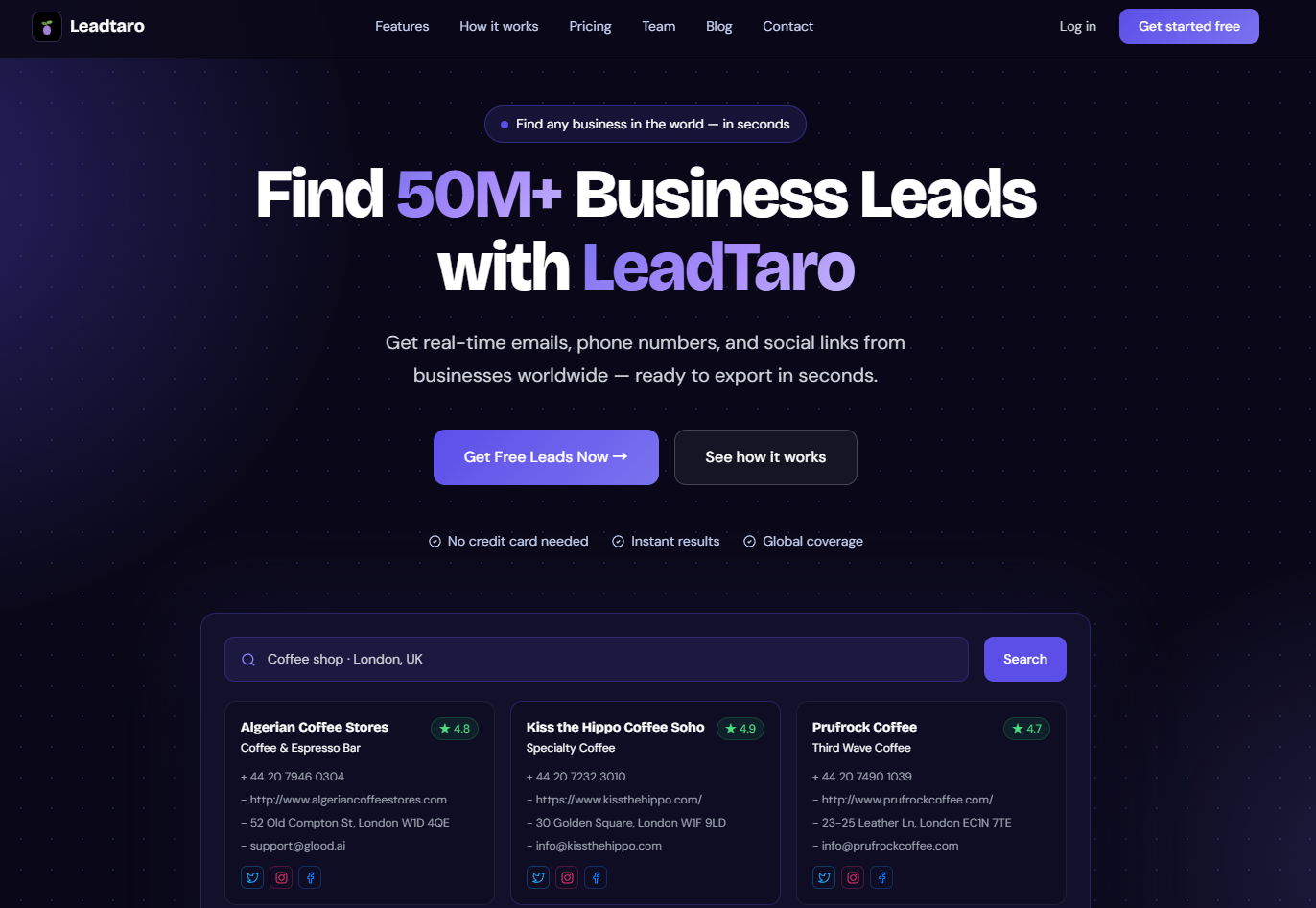
A recruiter can spend hours building a list of local employers by hand. Company names, business addresses, contact details and potential hiring opportunities all need to be researched individually. By the time the list is ready, some businesses may already be in the company's CRM, and others may not be relevant at all.
This is one of the biggest challenges in modern recruitment: finding the right companies and people without wasting time on repetitive research.
Professional networks, job boards and candidate databases remain valuable sourcing channels. However, recruitment agencies and staffing firms also need to identify new employer opportunities, understand local markets and build relationships with businesses that may need their services.
A more structured approach to business prospecting can help.
In this guide, we'll explain candidate sourcing, explore six sourcing strategies for 2026 and show how B2B lead generation tools such as LeadTaro can help recruitment businesses discover potential employer clients, organize prospect data and manage outreach.
What's Inside
What Is Candidate Sourcing?
Active vs. Passive Candidates
Why Traditional Candidate Sourcing Is Challenging
The Role of Business Data in Recruitment
6 Candidate Sourcing Strategies That Work in 2026
How to Find Hiring Companies with LeadTaro
Candidate Sourcing Tools Compared
Is Sourcing from Public Business Data Legal?
Build a Repeatable Employer Sourcing Process
FAQ
What Is Candidate Sourcing? (And How Is It Different from Recruiting?)
Candidate sourcing is the proactive process of finding, identifying and engaging potential candidates before they apply for a specific role.
Recruiting is broader. It includes managing the hiring process, screening applicants, arranging interviews, evaluating candidates and supporting the final hiring decision.
The distinction is straightforward: sourcing builds the pipeline, while recruiting moves candidates through the hiring process.
Sourcing can include searching professional networks, reviewing candidate databases, exploring industry communities, researching referrals and building relationships with potential candidates.
For recruitment agencies and staffing firms, there is another important activity: finding companies that may need recruitment services. This is employer prospecting rather than candidate sourcing itself, but both activities contribute to a successful recruitment business.
A staffing agency needs suitable candidates to fill vacancies and employer clients who have those vacancies. Building both pipelines helps reduce dependence on last-minute searches and unpredictable inbound opportunities.
Active vs. Passive Candidates
Recruiters generally distinguish between active and passive candidates.
Active candidates are looking for work. They may be applying for vacancies, updating their CVs or engaging with recruiters.
Passive candidates are not actively searching for a new role. They may be satisfied with their current position but could consider a relevant opportunity if approached appropriately.
Both groups can be valuable. Active candidates may be easier to engage for an immediate vacancy, while passive candidates can help recruiters reach people who are not applying through conventional channels.
The best sourcing strategy depends on the role, industry, urgency and candidate profile.
For example, a recruiter hiring software engineers may benefit from professional networks and technical communities. A recruiter filling hospitality or construction roles may need local networks, referrals, industry-specific platforms and direct relationships with employers.
No single channel provides complete coverage of the talent market.
Why Traditional Candidate Sourcing Is Challenging in 2026
Candidate sourcing has become increasingly dependent on data, speed and personalization. Recruiters need to find relevant people, understand their experience and contact them in ways that encourage a response.
Several challenges make this difficult.
1. Competition for the Same Candidates
Popular professional networks make it easier to find people with specific skills and job titles. They also make those people visible to many other recruiters.
Candidates in high-demand occupations may receive repeated approaches, making generic outreach less effective.
The solution is not necessarily to abandon established platforms. Instead, combine them with niche communities, referrals, specialized databases and a clear understanding of the candidate's professional interests.
2. Too Much Manual Research
Recruiters may need to verify company information, identify relevant contacts, check websites and organize records before they can begin outreach.
When this research is performed manually for every prospect, it can consume time that would otherwise be spent building relationships and evaluating candidates.
Structured prospecting workflows can reduce repetitive administrative work.
3. Incomplete or Outdated Information
Company details and candidate records change over time. Businesses open new locations, people move roles, and contact information becomes outdated.
A record in a database should not automatically be treated as current or verified. Recruiters should check important information before relying on it.
4. Limited Visibility into Local Employers
Some recruitment businesses specialize in local or regional markets. Their potential clients might include independent care providers, logistics businesses, manufacturers, hospitality companies and construction firms.
Not every relevant business maintains a detailed profile on a professional network.
Researching businesses by industry and location can help recruiters identify potential employer clients beyond their existing network.
5. Poorly Targeted Outreach
A large prospect list is not necessarily a valuable one.
Sending the same message to hundreds of unrelated companies can produce low engagement and damage a recruiter's reputation.
A better approach starts with a clear target market, identifies relevant businesses and explains why the recruitment service could be useful to each prospect.
The Role of Business Data in Recruitment
Business data can support recruitment in two important ways: employer prospecting and local market research.
It is important to distinguish this from finding individual candidates. A business directory can help identify employers, but it does not automatically reveal which employees are open to new opportunities or whether a particular company is actively hiring.
Finding Potential Employer Clients
Recruitment agencies often specialize in particular industries, such as healthcare, construction, technology, logistics or hospitality.
Business prospecting tools can help agencies research companies within these sectors and build a list of potential clients.
For example, a logistics recruitment agency might focus on businesses operating in its service area. It can then research each company, identify appropriate decision-makers and assess whether the agency's services are relevant.
Useful business information may include:
Company name and business location.
Website and publicly available contact information.
Industry or business category.
Public social profile links, where available.
Other information that helps determine whether the business fits the agency's target market.
Availability and accuracy vary by company and data source. Additional research may be necessary to establish whether an employer is currently hiring.
Mapping a Local Recruitment Market
Suppose a staffing agency wants to expand into a new city.
Instead of contacting businesses at random, it can define a target market, identify relevant industries and research potential employer clients within that region.
A practical process might look like this:
Choose the industries the agency serves.
Define the target geography.
Identify businesses that fit the agency's ideal employer profile.
Research available contact information.
Prioritize companies with a plausible need for recruitment support.
Organize outreach and follow-ups in a CRM.
This process creates a more repeatable way to develop employer relationships.
How LeadTaro Fits into Employer Prospecting
LeadTaro is a B2B lead generation platform that helps users find business prospects, work with available business contact information, create AI-assisted cold email drafts and manage leads through a CRM pipeline.
For recruitment agencies, these capabilities can support business development by helping them organize potential employer clients and manage outreach.
For example, an agency specializing in temporary warehouse staff could research logistics and warehousing businesses in its target market, review the available business information and organize potential clients for follow-up.
LeadTaro is not a substitute for a candidate database or applicant tracking system. Its role in this workflow is business prospecting and outreach management, rather than independently identifying candidates who are ready to change jobs.
6 Candidate Sourcing Strategies That Work in 2026
A strong sourcing operation combines several channels instead of depending on one database.
1. Professional Networks and Boolean Search
Professional networks can help recruiters identify people by job title, skills, industry, location and experience.
Boolean search makes this process more precise by combining search terms with operators such as AND, OR and NOT.
For example, a recruiter searching for experienced software developers might combine relevant programming languages, job titles and geographic terms.
This approach is especially useful for professional and technical roles. However, recruiters should also consider the cost of access, the quality of available profiles and competition for the same candidates.
2. Employee Referrals
Referrals can introduce recruiters to candidates through trusted professional relationships.
They may be particularly useful when hiring managers or existing employees know people with the required skills.
To make referrals more consistent, establish a clear process for collecting recommendations, communicating role requirements and following up with referred candidates.
Referrals should complement other channels because the number of potential candidates available through personal networks is limited.
3. Niche Communities and Industry Networks
Industry-specific communities can help recruiters reach people with specialized skills or professional interests.
Examples include technical forums, professional associations, industry events and relevant online communities.
These channels are most effective when recruiters participate constructively and build relationships over time. Treating a community solely as a place to advertise vacancies can undermine trust.
4. Candidate Databases and Job Boards
Job boards and candidate databases are useful when recruiters need to identify people who have shared their professional information or expressed interest in employment.
They can be particularly effective for roles with a large candidate pool or an urgent hiring deadline.
Before selecting a platform, consider the types of roles it covers, the freshness of its data, search functionality and the cost of contacting candidates.
5. Local Employer Mapping and Business Prospecting
Local employer mapping is particularly relevant to recruitment agencies that need to win new clients.
The objective is to identify businesses that may require recruitment services, rather than assuming that every company in a sector is currently hiring.
For example, a recruitment firm focused on hospitality could research hotels, restaurants and catering businesses within its target region.
A construction staffing company might prioritize contractors and construction-related businesses that fit its service offering.
Once potential employers have been identified, recruiters can investigate business activity, locate appropriate contacts and qualify each opportunity.
B2B lead generation tools such as LeadTaro can support this workflow by helping users find prospects, organize business contact information and manage outreach.
6. AI-Assisted Sourcing and Outreach
AI can help recruiters summarize information, draft messages, categorize prospects and reduce repetitive administrative work.
For candidate sourcing, AI-assisted research can help organize information about skills, experience and role requirements when appropriate data is available.
For employer prospecting, AI-assisted email drafting can help recruitment agencies tailor their messages to different industries and business needs.
However, AI-generated information should be checked. A tool should not invent candidate qualifications, assume someone is actively job hunting or claim that an employer is hiring without supporting evidence.
Human judgment remains essential for assessing suitability, communicating with candidates and making hiring decisions.
How to Find Hiring Companies with LeadTaro
Finding companies that might need recruitment support starts with defining your ideal employer profile. From there, you can research relevant businesses, review available contact details and build an organized outreach process.
The following workflow is suitable for recruitment agencies and staffing firms looking to develop their employer client pipeline.
Step 1: Define Your Ideal Employer Profile
Start by identifying the companies your recruitment business serves best.
Consider:
Industry: Healthcare, construction, logistics, hospitality, technology or another specialization.
Geography: The cities, regions or countries where you operate.
Business type: Independent businesses, larger companies, multi-location operators or specialist firms.
Recruitment offering: Permanent recruitment, temporary staffing, executive search or contract hiring.
Potential client needs: Roles, skills or workforce challenges your agency is equipped to address.
For example, a recruitment agency might specialize in temporary warehouse workers for logistics businesses in Yorkshire.
This is a much more useful starting point than targeting every employer in the region.
Step 2: Find Relevant Business Prospects
Use a B2B lead generation workflow to research businesses that match your target industry and location.
LeadTaro can help you discover business prospects and work with the available company information.
Start with a manageable segment, such as logistics businesses in one city or healthcare providers in a defined service area.
A focused list is easier to review and helps you learn which types of businesses are most relevant to your agency.
Step 3: Review Contact Details
Check the available business records before beginning outreach.
Depending on the business, information may include company names, websites, email addresses, phone numbers and public social links.
Use these details as starting points for research, not as proof that a specific company has an open vacancy.
Where possible, verify the company's current operations, recruitment needs and the appropriate person to contact.
Step 4: Qualify Potential Employer Clients
Not every company in your target industry will need recruitment support.
Prioritize businesses according to their fit with your services and any credible evidence of potential demand.
Possible qualification criteria include:
The company operates in your specialist sector.
It is within your service area.
Its likely hiring requirements match your capabilities.
You can identify an appropriate business contact.
There is a plausible reason it may benefit from an external recruiter.
You can deliver the required service at an appropriate cost.
Public signs of expansion or business activity can provide useful context, but they should not be treated as confirmation of an active vacancy.
Step 5: Prepare Relevant Outreach
Once you have identified suitable businesses, explain how your agency can help.
For example, a logistics recruitment agency might introduce its experience supplying temporary warehouse staff and ask whether the company uses external recruitment support during busy periods.
Keep the message concise, specific and truthful. Avoid claiming to know about a vacancy unless you have verified that information.
LeadTaro's AI-assisted cold email creation can help draft initial messages for different prospect segments. Review each draft and adapt it to the recipient before sending.
Step 6: Manage Employer Prospects in Your CRM
Business development doesn't end when the first email is sent.
Record your outreach, follow-up dates, responses and next actions so that interested employers don't disappear into an unorganized spreadsheet.
LeadTaro's CRM pipeline can help you organize prospects and track their progress through your business development process.
For example, your stages might include:
New prospect.
Contacted.
Responded.
Qualified opportunity.
Meeting scheduled.
Client acquired.
Not a fit.
Adapt these stages to your agency's workflow.
Try LeadTaro for Free
LeadTaro offers a free plan with 60 verified B2B leads and no credit card required. You can explore the platform's prospecting, AI-assisted email creation and CRM workflow to see whether it fits your employer business development process.
For recruitment agencies, the objective is to create a more organized route from identifying potential employer clients to starting relevant conversations and developing long-term relationships.
Remember that finding a potential employer is not the same as confirming that it has an open role. Verify hiring needs before making vacancy-specific claims.
Candidate Sourcing Tools Compared
Different sourcing tools solve different problems. Before choosing a platform, distinguish between tools for finding individual candidates, systems for managing recruitment and tools for developing employer relationships.
Tool categoryPrimary purposeBest suited toProfessional networksFind and engage professional profilesSpecialist and professional rolesJob boards and candidate databasesFind people seeking or considering workActive candidate sourcingAI sourcing platformsSearch, organize or rank available candidate informationLarge or complex sourcing projectsApplicant Tracking Systems (ATS)Manage candidates and hiring stagesRecruitment process managementCRM systemsManage relationships and business developmentEmployer and client pipelinesB2B lead generation tools such as LeadTaroFind business prospects and organize outreachEmployer prospecting and recruitment agency growthThese categories can complement one another.
A recruiter might use a professional network to find a software engineer, an ATS to manage the application process and a B2B prospecting tool to identify companies that could become clients.
LeadTaro is most relevant to the employer prospecting side of recruitment. It supports business lead discovery, available contact information, AI-assisted cold email creation and CRM pipeline management. It should not be treated as a replacement for an ATS or a specialist candidate database.
How to Choose the Right Tool
Before investing in a sourcing platform, ask:
Does it support the type of roles or businesses I target?
Does it provide the information I actually need?
How current and reliable is the available data?
Can I organize records and track follow-ups?
Does it fit my existing recruitment workflow?
Are its data collection and outreach practices appropriate for my use case?
Can I test the workflow before committing to a larger investment?
The best technology is the one that solves a real bottleneck in your process rather than adding another disconnected database.
Is Sourcing from Public Business Data Legal?
Using business information for prospecting and recruitment-related business development can involve privacy, data protection and electronic marketing requirements.
The legal position depends on the data, its source, the purpose of processing and the jurisdiction involved. Public availability does not automatically mean that every use is permitted.
UK GDPR and GDPR
UK GDPR and the EU GDPR regulate the processing of personal data. Information about a company as a legal entity may be treated differently from information that identifies an individual.
For example, a general company contact address may raise different issues from a named employee's direct email address.
Where personal data is involved, businesses should identify an appropriate lawful basis, provide required privacy information, respect applicable rights and keep personal data secure.
For recruitment, additional considerations may arise when processing candidate CVs, employment histories and other information relating to individuals.
Electronic Marketing Rules
In the UK, electronic marketing may be subject to the Privacy and Electronic Communications Regulations (PECR), alongside data protection law.
Requirements can differ depending on whether the recipient is a corporate subscriber, an individual subscriber, a sole trader or a particular type of partnership.
Recruitment agencies should check the applicable rules before sending unsolicited commercial emails and ensure that their outreach practices meet the relevant requirements.
Practical Compliance Steps
Before using a prospect list:
Understand where the businesses and contacts are located.
Check whether the information identifies an individual.
Review the source and terms governing the data.
Determine which privacy and electronic marketing rules apply.
Use accurate sender information and honest subject lines.
Provide required privacy information and opt-out options.
Respect objections and maintain appropriate suppression records.
Avoid collecting or retaining unnecessary personal information.
This section is general information, not legal advice. If your agency operates across multiple jurisdictions or processes candidate data at scale, consult the relevant regulator's guidance or a qualified legal professional.
Build a Repeatable Employer Sourcing Process
Recruitment businesses often focus heavily on filling current vacancies. However, consistent employer prospecting can help reduce the pressure of finding new clients only when the sales pipeline becomes quiet.
A repeatable process can be built around five activities.
1. Choose a Target Market
Select a sector, geography and type of employer that matches your recruitment capabilities.
Avoid targeting every business simply because it could theoretically hire someone.
2. Build a Focused Prospect List
Use relevant business directories, professional networks, referrals and B2B lead generation tools to identify potential employers.
Keep the initial list manageable so that you can verify information and personalize outreach.
3. Qualify Each Business
Assess whether the company fits your service offering and whether there is a credible reason to start a conversation.
Do not confuse general business activity with evidence of a current vacancy.
4. Personalize and Track Outreach
Contact relevant business representatives with a clear explanation of your recruitment services.
Track responses and follow-ups in your CRM. Use the results to determine which industries and messages generate the most promising opportunities.
5. Improve Your Process with Data
Review your results regularly.
Measure how many prospects match your target profile, how many respond, how many meetings are booked and how many become paying clients.
If one industry consistently produces stronger results, focus more effort there. If another segment generates little engagement, investigate whether the target profile, contact data or message needs improvement.
This approach turns employer sourcing from an occasional task into an ongoing business development activity.
FAQ
What is candidate sourcing?
Candidate sourcing is the proactive process of finding and engaging potential candidates before they apply for a role. It can include professional networks, candidate databases, referrals, industry communities and other relevant research channels.
What's the difference between sourcing and recruiting?
Sourcing focuses on finding and engaging potential candidates. Recruiting covers the broader hiring process, including screening, interviews, selection and offer management. In recruitment agencies, employer prospecting is a related but separate activity that focuses on finding companies that may need recruitment services.
Can Google Maps help recruiters find candidates?
Business listings can help recruiters identify employers by industry and location, which is useful for local market research and employer prospecting. However, a business listing does not identify individual candidates or prove that an employer is hiring. Candidate discovery still requires suitable sourcing channels and appropriate verification.
How can recruitment agencies find new employer clients?
Define your ideal employer profile, research businesses in your target sectors and regions, identify relevant contacts, qualify potential opportunities and personalize your outreach. Professional networks, referrals, industry events and B2B lead generation tools can all support this process.
What are the best candidate sourcing tools in 2026?
The best choice depends on the role and workflow. Professional networks and candidate databases help find individual candidates, AI sourcing platforms can support candidate research, and ATS software manages the hiring pipeline. B2B lead generation tools such as LeadTaro can help recruitment agencies find potential employer clients and organize business development outreach.
Can AI help with candidate sourcing?
AI can help organize information, summarize profiles, draft outreach and reduce repetitive administrative work. Recruiters should verify important details, protect personal data and avoid relying on unsupported AI-generated assumptions when evaluating candidates.
How can I build a local employer prospect list?
Define your target industry and geography, research relevant businesses, review their public company information and identify appropriate contacts. Qualify the businesses against your agency's services, then manage outreach and follow-ups in a CRM.
Is employer prospecting the same as candidate sourcing?
No. Employer prospecting identifies companies that may purchase recruitment services, while candidate sourcing identifies individuals who may be suitable for vacancies. Recruitment agencies often need both processes to develop a healthy business pipeline.
Conclusion: Build Your Employer Pipeline Alongside Your Talent Pipeline
Candidate sourcing in 2026 requires more than searching the same databases as every other recruiter. Successful recruitment businesses combine appropriate candidate sourcing channels with organized employer prospecting and consistent relationship management.
Professional networks, candidate databases and referrals remain important for finding people. Business research and B2B lead generation tools can help recruitment agencies identify potential employer clients, particularly when expanding into new industries or local markets.
LeadTaro can support the employer prospecting side of this process by helping users discover business prospects, work with available contact information, prepare AI-assisted cold emails and manage leads through a CRM pipeline.
Start with a clear target market, verify your prospect data and focus on building relevant business relationships rather than collecting contacts indiscriminately.
Find the right employers. Start better conversations. Build a more consistent recruitment business development pipeline.