Many B2B businesses focus on generating more leads, sending more emails, and filling their sales pipelines as quickly as possible. But a large prospect list does not automatically translate into profitable, long-term customer relationships.
Consider a marketing agency that spends months contacting thousands of local businesses. It closes several new clients, but most leave within a few months. The agency has generated sales, yet its acquisition costs and the time spent replacing lost customers continue to grow.
Now imagine the agency studies its most profitable existing accounts instead. It identifies common characteristics, such as industry, company size, recurring service requirements, and long-term growth potential. It uses those insights to find similar businesses and prioritizes prospects that fit its ideal customer profile.
The goal is no longer to contact the largest possible number of businesses. It is to find customers who are more likely to stay, spend more over time, and generate sustainable revenue.
That is where customer lifetime value (CLV) becomes useful for B2B prospecting.
This guide explains how to calculate customer lifetime value, compare CLV with customer acquisition cost, identify high-value prospects, and build a more focused B2B prospecting strategy using business data and lead management tools such as LeadTaro.
Table of Contents
What Is Customer Lifetime Value and Why Does It Matter in B2B?
How to Calculate Customer Lifetime Value: B2B Formulas
CLV Benchmarks Every B2B Team Should Understand
How CLV Transforms Your B2B Prospecting Strategy
Practical Examples of CLV-Based Prospecting
How to Increase Customer Lifetime Value in B2B
CLV and Compliance: What B2B Prospectors Must Know in 2026
FAQ: Customer Lifetime Value for B2B Prospecting
What Is Customer Lifetime Value and Why Does It Matter in B2B?
Customer lifetime value, commonly abbreviated as CLV, LTV, or CLTV, estimates the total value a business can generate from a customer throughout the relationship.
Depending on the calculation, that value can refer to total revenue or the gross profit earned after accounting for the direct costs of delivering a product or service. The distinction matters because a customer generating substantial revenue is not necessarily a profitable customer.
For B2B companies, customer lifetime value may include:
Revenue from the initial contract or purchase.
Recurring subscription or service payments.
Contract renewals and extensions.
Upsells and cross-sells.
Additional purchases from expanding customer accounts.
A business that sells a £500 one-off service has a different customer economics model from a software company that earns £500 per month from an account for several years.
Understanding this difference helps sales teams determine how much they can reasonably invest in acquiring a customer.
Why CLV Matters for B2B Prospecting
Traditional prospecting often prioritizes lead volume. Sales teams build lists, send outreach messages, and measure success through response rates, meetings, and closed deals.
These metrics are useful, but they do not tell the entire story.
A prospect who signs a small contract and leaves after one month may be less valuable than a company that signs a larger contract, renews annually, and purchases additional services.
CLV gives businesses a way to connect prospecting decisions with long-term profitability.
For example, consider two potential customers:
- Customer A: Generates £3,000 in gross profit before leaving after six months.
- Customer B: Generates £1,500 in gross profit each year and remains a customer for five years.
Customer B generates £7,500 in gross profit over the relationship, compared with £3,000 from Customer A, before acquisition costs and other relevant expenses.
If Customer B costs only slightly more to acquire, targeting similar businesses could produce better long-term results.
This is why customer lifetime value should influence not only pricing and retention but also which prospects receive the most sales attention.
CLV vs. LTV: Is There a Difference?
CLV stands for Customer Lifetime Value, while LTV stands for Lifetime Value. CLTV, or Customer Lifetime Value, is another common variation.
In most business contexts, these terms describe the same general concept. Individual companies may define their calculations differently, especially when deciding whether to include revenue, gross profit, expansion revenue, or discounted future cash flows.
The important point is to choose a consistent definition and use it across your sales and finance teams.
How to Calculate Customer Lifetime Value: B2B Formulas
You do not need a sophisticated predictive model to start using CLV. A simple calculation based on historical customer data can provide a useful starting point.
The Basic CLV Formula
CLV = Average Purchase Value × Purchase Frequency × Customer Lifespan
Suppose a commercial cleaning company earns an average of £1,500 per month from each customer. Customers typically remain for three years.
The calculation is:
- Average monthly revenue: £1,500
- Payments per year: 12
- Average customer lifespan: 3 years
CLV = £1,500 × 12 × 3 = £54,000
The estimated customer lifetime revenue is £54,000.
However, this is revenue, not profit. The company must still account for labour, materials, service delivery, overheads, and customer acquisition costs when evaluating profitability.
The B2B-Adjusted CLV Formula
For subscription businesses and companies with recurring contracts, a common simplified formula is:
CLV = (Average Monthly Revenue per Account × Gross Margin) ÷ Monthly Customer Churn Rate
Consider a B2B software company with the following metrics:
- Average monthly revenue per account: £2,000
- Gross margin: 75%
- Monthly customer churn rate: 4%
The calculation is:
CLV = (£2,000 × 0.75) ÷ 0.04
CLV = £37,500
This estimates £37,500 in gross profit over the expected customer relationship under the model's assumptions.
The formula is useful for an initial estimate, but it assumes relatively stable revenue, margin, and churn. Expansion revenue, changing retention rates, and the time value of money can affect actual results.
Also, monthly churn and annual churn are not interchangeable. Always make sure the churn rate matches the period used in the calculation.
CLV vs. Customer Acquisition Cost
Customer acquisition cost (CAC) measures how much a business spends to acquire a customer.
A simple formula is:
CAC = Total Sales and Marketing Acquisition Costs ÷ Number of New Customers Acquired
Suppose a company spends £12,000 on sales and marketing and acquires 10 new customers.
CAC = £12,000 ÷ 10 = £1,200 per customer
If the estimated customer lifetime gross profit is £3,600, the CLV-to-CAC ratio is 3:1.
CLV Ratio = Customer Lifetime Value ÷ Customer Acquisition Cost
This ratio helps businesses evaluate whether their acquisition strategy is economically sustainable. However, a 3:1 ratio is a commonly used SaaS benchmark rather than a universal rule for every industry or business model.
The ratio should also be interpreted alongside cash flow, payback period, retention, and operating expenses.
Predictive CLV and Cohort Analysis
Historical CLV explains how valuable existing customers have been. Predictive CLV attempts to estimate how valuable a customer might become in the future.
Two approaches can help.
Cohort analysis
Group customers according to characteristics such as acquisition date, industry, company size, or acquisition channel. Compare retention, revenue, and expansion over time to identify which groups tend to produce better outcomes.
Predictive modelling
Use historical customer data to estimate future revenue or profit. Potential inputs include contract size, product usage, renewal history, company characteristics, and customer engagement.
For prospecting, the challenge is that a new lead has no customer history. You therefore need to distinguish between a true CLV prediction and a prospect score based on characteristics associated with valuable customers.
Business data can help identify promising prospects, but it cannot establish their future lifetime value with certainty.
CLV Benchmarks Every B2B Team Should Understand
There is no single CLV benchmark that applies to every B2B business. A software subscription, a consulting engagement, and a commercial maintenance contract have different revenue structures, margins, and retention patterns.
Rather than relying on an industry-wide number without context, assess your business using a consistent set of metrics.
MetricWhat it tells youCustomer lifetime valueEstimated revenue or gross profit over the relationshipCustomer acquisition costCost of acquiring a new customerCLV ratioRelationship between customer value and acquisition costGross marginRevenue remaining after direct delivery costsCustomer churnProportion of customers lost over a periodNet revenue retentionHow recurring revenue from existing accounts changes over timeCAC payback periodTime required to recover acquisition costsFor subscription businesses, a CLV ratio around 3:1 is often used as a starting reference. The appropriate target depends on margins, growth plans, capital availability, and the reliability of the underlying estimates.
Why CLV Varies by Industry
Customer lifetime value can vary significantly between industries and even between companies serving the same market.
Several factors explain these differences:
Contract duration: Long-term agreements can create more predictable revenue than one-off purchases.
Account size: Larger customers may purchase more services, although they can also require greater sales and support investment.
Gross margin: High revenue does not necessarily mean high profitability.
Retention: Customers who renew consistently can generate more value without requiring a completely new acquisition process.
Expansion opportunities: Companies that can sell additional products or services to existing accounts may increase revenue without acquiring an entirely new customer.
These factors should guide your own benchmarks. Instead of treating a published industry average as a target, compare your highest-value customers with your typical accounts and identify what makes them different.
Turn CLV Insights Into an Ideal Customer Profile
An ideal customer profile (ICP) describes the type of business most likely to become a suitable, valuable customer.
To develop one, analyse your strongest existing accounts and look for recurring characteristics:
Industry and business category.
Company size and operating locations.
Geographic market.
Typical budget and service requirements.
Website quality and business activity.
Likely need for your product or service.
Retention, expansion, and profitability history.
Not every characteristic will be available in a business database. Some require direct research, sales conversations, or internal customer records.
The objective is to turn your historical customer performance into practical criteria for discovering and qualifying new prospects.
How CLV Transforms Your B2B Prospecting Strategy
CLV becomes particularly useful when it changes how you select, prioritize, and manage prospects.
Stop Treating Every Lead the Same
Imagine your sales team has 1,000 prospects but enough time to research and contact only 200 this week.
You could select 200 businesses at random, or you could prioritize companies that closely match the profile of your most profitable customers.
The second approach gives your team a more defensible reason to allocate its time.
Start by reviewing your existing customer base. Identify which accounts generate strong gross profit, remain customers for longer, and offer opportunities for expansion. Then compare their characteristics.
For example, a B2B marketing agency might discover that its best customers tend to be established professional service firms with several employees, an active website, and recurring marketing requirements.
Those characteristics become prospecting criteria.
They are not proof that a new prospect will become a high-value customer. They are signals to help your team decide which businesses deserve further research.
Use Business Data to Segment Prospects
Business data can help sales teams build prospect lists that align with their ICP.
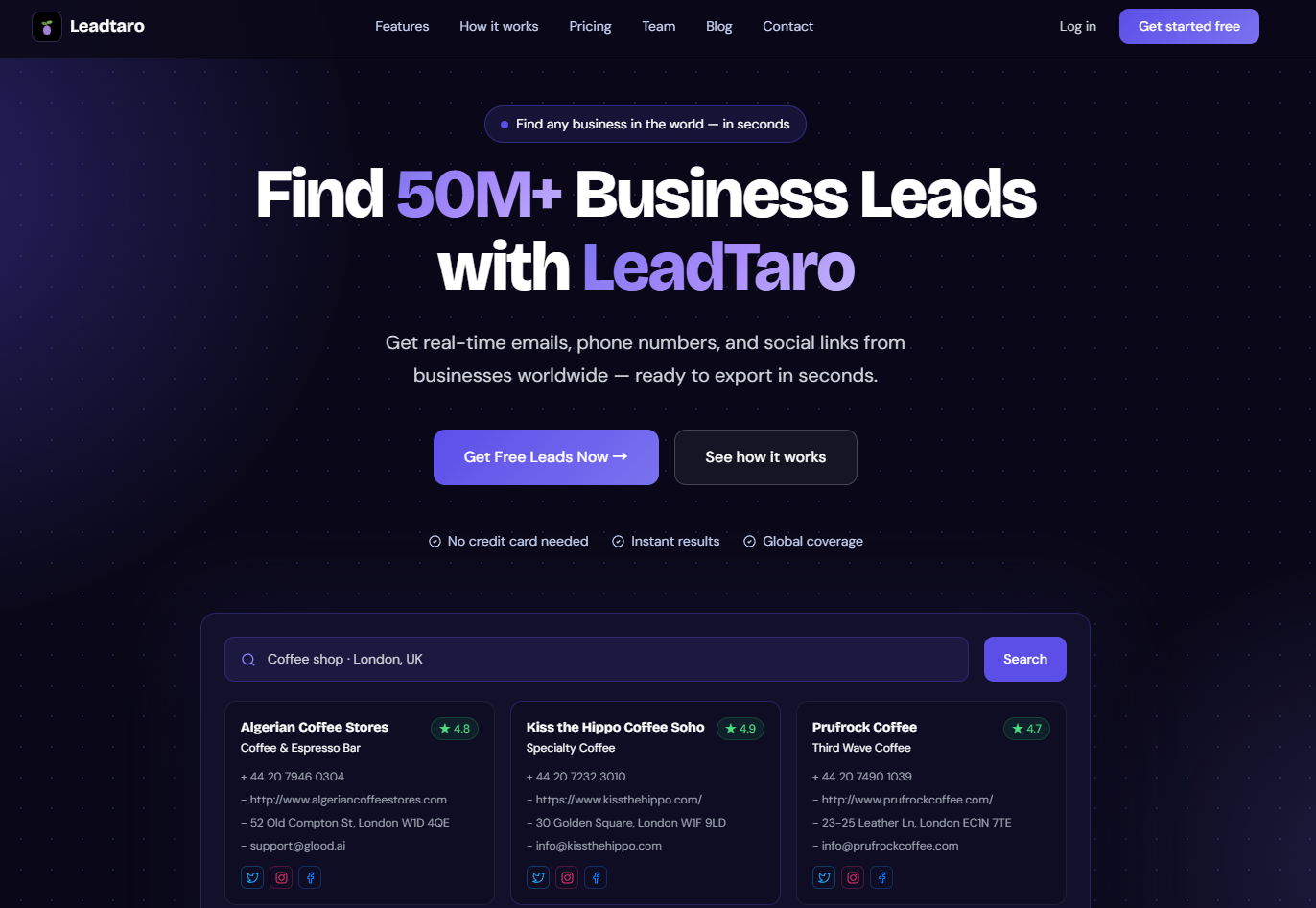
LeadTaro helps users discover businesses and organise relevant lead information, including available company details, business categories, locations, websites, and contact information. Depending on data availability, additional fields such as ratings, reviews, and social links may also help with qualification.
A practical workflow looks like this:
Define the industries and business types that match your best customers.
Narrow the search by location and other relevant business criteria.
Review available company information to identify potential fit.
Research whether each business has a genuine need for your offering.
Prioritize prospects using a consistent scoring framework.
Manage outreach and follow-up through your sales pipeline.
This approach can reduce time spent researching irrelevant companies and help sales teams concentrate on the prospects most aligned with their business goals.
Geographic Segmentation for Local B2B Prospecting
Location can affect customer profitability, particularly for businesses that deliver services in person or operate within defined territories.
For example, a commercial cleaning company may prefer customers within a manageable travel radius. A regional IT support provider might prioritize businesses in areas where it can respond quickly and deliver support efficiently.
Geographic prospecting can help answer questions such as:
Which areas contain the highest concentration of businesses in your target industry?
Which locations can your team serve profitably?
Where do your existing high-value customers operate?
Which markets have enough suitable prospects to support expansion?
Combine geographic information with your internal customer data to identify promising markets.
However, location alone does not determine CLV. A nearby prospect with poor fit may be less valuable than a more distant company with stronger requirements and a longer potential contract.
Apply the 80/20 Principle Carefully
The Pareto principle is often described as the idea that roughly 80% of outcomes can come from 20% of inputs. In customer analysis, this can be a useful hypothesis: a relatively small group of accounts may contribute a disproportionate share of revenue or profit.
But the exact distribution varies by business. Your own customer data should determine whether the pattern applies.
To use it for prospecting:
Rank existing customers by gross profit or another meaningful value measure.
Identify the accounts that contribute most to overall performance.
Compare their industries, sizes, locations, and purchasing patterns.
Build an ICP from the characteristics that consistently appear.
Use that profile to prioritize new prospects.
Measure whether the new cohort delivers stronger retention and profitability.
The aim is not simply to send fewer emails. It is to spend more of your sales team's time on businesses that are better aligned with your offer.
Practical Examples of CLV-Based Prospecting
The following scenarios illustrate how a business can apply CLV to prospecting. They are examples, not claims about specific companies or guaranteed outcomes.
Example 1: A B2B Marketing Agency
A marketing agency reviews its client records and finds that customers who purchase ongoing SEO and content services tend to stay longer than clients who purchase one-off projects.
The agency compares its recurring clients by industry, company size, service mix, and contract duration. It discovers that established professional service firms are a particularly strong segment.
It then builds a new prospect list focused on businesses with similar characteristics.
Instead of measuring success only by the number of emails sent, the agency tracks qualified meetings, proposal acceptance, average contract value, retention, and gross profit from the new customer cohort.
Over time, these metrics reveal whether the new targeting approach is improving customer quality.
Example 2: A Commercial Cleaning Company
A cleaning company finds that larger commercial contracts can generate recurring revenue, but some are unprofitable because of travel time and staffing costs.
The company adds service location, estimated contract size, staffing requirements, and expected travel costs to its qualification process.
It uses business discovery tools to identify potential commercial customers in suitable areas, then researches each prospect to establish whether it has a plausible need for regular cleaning services.
This combines prospecting data with operational economics. The company is not simply looking for the largest businesses; it is looking for contracts it can deliver profitably and retain.
Example 3: A B2B Software Company
A software company discovers that customers who adopt several features and integrate the product into their daily workflows tend to renew more consistently.
Its existing customer data reveals which industries and company profiles are associated with successful adoption.
The sales team uses these findings to prioritize similar businesses. During qualification calls, it asks about current workflows, team size, integration requirements, and the problem the prospect needs to solve.
The company then compares retention and expansion across newly acquired customer groups to refine its targeting.
How LeadTaro Fits Into a CLV-Based Workflow
LeadTaro can support the business-discovery and prospect-management stages of this process.
Sales teams can use it to find businesses that match their target industries and locations, review available company information, identify potential contacts where data is available, and organise prospects within a sales pipeline.
Personalized cold emails and structured follow-up can then help teams engage relevant prospects.
The key distinction is that LeadTaro supports prospect discovery and sales execution. Estimating actual customer lifetime value requires your own financial and customer-retention data, while predicting the value of a new prospect requires an appropriate scoring or modelling method.
Using these pieces together creates a more measurable approach to B2B prospecting.
How to Increase Customer Lifetime Value in B2B
Finding promising customers is only one part of the equation. Long-term value also depends on whether customers receive consistent results and have reasons to continue the relationship.
1. Improve Onboarding and Time to Value
Customers are more likely to remain engaged when they understand how to use your product or service and begin seeing meaningful results.
Create an onboarding process that establishes clear goals, assigns responsibilities, and measures progress.
For a B2B software company, this might mean helping a new account complete a key workflow quickly. For a service provider, it might mean delivering an agreed initial milestone and communicating the results.
Monitor activation, customer satisfaction, support requests, and early cancellations to identify where customers are struggling.
2. Use CLV-Informed Lead Scoring
Lead scoring helps teams rank prospects according to how closely they match the target customer profile.
A useful framework can include:
Business fit: Does the company operate in your target industry?
Company suitability: Does its size and operating model match your offer?
Need: Is there evidence that the business could benefit from your product?
Commercial potential: Is the likely contract size sufficient to justify the acquisition cost?
Serviceability: Can your business serve the account profitably?
Engagement: Has the prospect expressed relevant interest or responded to outreach?
You can assign weights to these criteria based on what your historical customer data shows.
Publicly visible signals, such as a business website or online reviews, can support research, but they should not be treated as direct evidence of budget, purchase intent, or future CLV.
Review the scoring model regularly and compare predicted prospect quality with actual customer outcomes.
3. Build Better Customer Communication
Customer relationships need attention after the initial sale.
Use structured communication to share useful information, check progress, resolve problems, and identify new requirements. Make messages relevant to the customer's situation rather than relying on generic automated sequences.
For existing customers, track renewal dates and important milestones. For prospects, use personalized outreach that explains why your offer is relevant to their business.
A sales pipeline can help your team keep track of conversations, next steps, and opportunities without relying on scattered notes.
4. Identify Upsell and Cross-Sell Opportunities
Existing customers may generate additional value when their needs expand or when they become suitable for complementary services.
Monitor indicators such as:
Increased product usage.
New locations or business units.
Requests for additional capabilities.
Changes in operational requirements.
Renewal conversations and customer feedback.
Use these signals to identify relevant opportunities rather than pushing upgrades that do not address a genuine need.
Measure expansion revenue alongside retention and gross margin. An upsell is not automatically beneficial if its delivery costs exceed the value it creates.
5. Use Data to Improve Prospect and Customer Prioritization
You do not need machine learning to begin improving prospect selection.
Start with a clear spreadsheet or CRM report containing customer revenue, gross margin, acquisition cost, contract duration, and retention. Compare these results by industry, company size, acquisition channel, and other meaningful segments.
Once you have enough reliable data, you can evaluate whether a more advanced predictive model would improve decisions.
Business discovery tools such as LeadTaro can help identify new companies that fit your target profile. Your customer records can then help you determine which profiles are associated with stronger commercial outcomes.
Keep the process iterative: form a hypothesis, build a targeted list, engage suitable prospects, and compare the results with your expectations.
CLV and Compliance: What B2B Prospectors Must Know in 2026
High-value prospecting should also respect privacy, marketing rules, and the expectations of recipients.
The relevant requirements depend on where your business operates, where the recipient is located, whether the contact is an individual or a company, and which communication channel you use.
UK GDPR and the Data Protection Act 2018
Where personal data is involved, businesses need an appropriate lawful basis for processing, must provide required privacy information, and must respect applicable data subject rights. Legitimate interests may be appropriate in some circumstances, but it is not a blanket permission for all prospecting.
PECR in the UK
Rules for electronic marketing differ between corporate subscribers and individual subscribers, including certain sole traders and some partnerships. Consent and other requirements depend on the recipient and circumstances. Screen against applicable suppression lists and honour objections and opt-outs.
GDPR in the European Economic Area
Direct marketing must comply with applicable data protection requirements. A lawful basis for processing personal data does not automatically mean that an email or other marketing message is permitted under the relevant electronic communications rules.
CAN-SPAM in the United States
Commercial email must comply with applicable requirements, including accurate sender information, non-deceptive subject lines, a valid postal address, and a functioning opt-out process.
Rules can change and may differ across jurisdictions. Verify the requirements that apply to your specific campaign before sending outreach.
Good prospect data can improve relevance and reduce avoidable errors, but no database can guarantee compliance. Maintain accurate records, use appropriate contact data, explain why outreach is relevant, and provide a clear way to stop future marketing.
FAQ: Customer Lifetime Value for B2B Prospecting
What is a good customer lifetime value?
There is no universal target. A good CLV depends on your pricing, gross margin, retention, acquisition costs, and business model.
Instead of comparing your business with an unrelated industry average, assess whether your customer relationships generate enough gross profit to justify the costs and risks of acquiring and serving them.
How do you calculate customer lifetime value for B2B?
A simple formula is:
CLV = Average Purchase Value × Purchase Frequency × Customer Lifespan
For recurring-revenue businesses, a common simplified formula is:
CLV = (Average Monthly Revenue per Account × Gross Margin) ÷ Monthly Churn Rate
Choose the formula that fits your business model and use consistent measurement periods. For more accurate estimates, consider expansion revenue, changing churn, acquisition costs, and the time value of money.
How do you predict customer lifetime value before contacting a prospect?
You generally cannot calculate a reliable individual CLV from a basic business listing alone.
Instead, develop a prospect score using characteristics associated with your best existing customers. Depending on your business, these may include industry, company size, location, likely requirements, and commercial suitability.
Treat the result as a prioritization estimate, then improve it using actual sales and customer outcomes.
What is the 80/20 rule in customer lifetime value?
The 80/20 principle suggests that a relatively small proportion of customers may generate a large share of revenue or profit.
It is a useful hypothesis, not a guaranteed distribution. Analyse your own accounts to determine whether your business has a similar pattern and which customer characteristics are associated with higher value.
How can CLV improve my B2B prospecting strategy?
CLV connects prospecting with long-term profitability. By examining your best customers, you can develop a more precise ICP, find businesses with similar characteristics, and prioritize outreach based on fit and potential commercial value.
Then measure the results using qualified meetings, conversion rates, CAC, retention, and gross profit rather than lead volume alone.
What is the difference between CLV and LTV?
CLV, LTV, and CLTV are commonly used to describe customer lifetime value. Companies may calculate the metric differently depending on whether they measure revenue, gross profit, or discounted future cash flows.
The abbreviation matters less than using a consistent definition.
Can LeadTaro calculate customer lifetime value automatically?
LeadTaro helps users discover businesses, review available lead information, and organise prospects for sales outreach and follow-up. These capabilities can support a CLV-informed prospecting workflow.
Calculating actual CLV requires financial and customer-retention information. Predicting the future value of a new prospect requires an appropriate scoring method or predictive model, and the available business data alone cannot guarantee that prediction.
Final Thoughts: Focus on Customer Value, Not Just Lead Volume
A large prospect database can help your sales team discover opportunities, but more leads do not automatically mean more profitable customers.
Start by calculating the value of your existing customer relationships. Identify the industries, company profiles, and commercial characteristics associated with strong retention and healthy margins. Use those findings to refine your ideal customer profile, prioritise prospects, and make outreach more relevant.
Then track the entire process, from the first contact to conversion, retention, and expansion. Over time, your own results will reveal which prospecting criteria are worth keeping.
With LeadTaro, you can support the business-discovery and pipeline-management stages of this process while using your customer data to guide prioritization.
The objective is simple: build a prospecting process that finds better-fit customers, makes more effective use of sales time, and supports sustainable long-term growth.