Finding new clients is one of the biggest challenges for B2B SaaS companies. Customer acquisition costs continue to put pressure on growing businesses, while crowded markets make it harder to stand out. At the same time, buyers expect personalized communication, relevant solutions, and clear evidence that a product can solve their problems.
For early-stage SaaS companies, spending thousands on advertising is not always realistic. The challenge is finding a repeatable way to reach the right prospects, start meaningful conversations, and turn those conversations into paying customers.
The good news is that effective customer acquisition does not depend on a single channel. Companies can combine targeted prospecting, content marketing, cold email, partnerships, and product-led growth to build a more predictable sales pipeline.
This guide covers 12 B2B SaaS client acquisition strategies for 2026, including practical ways to find prospects, improve outreach, and build a sustainable customer acquisition process.
Table of Contents
Why B2B SaaS Client Acquisition Is Getting Harder
Understanding Your SaaS Customer Acquisition Fundamentals
12 Proven B2B SaaS Lead Generation Strategies for 2026
Real-World B2B SaaS Growth Examples
Measuring and Optimizing Your Acquisition Efforts
Common B2B SaaS Client Acquisition Mistakes to Avoid
FAQ: B2B SaaS Client Acquisition
Why B2B SaaS Client Acquisition Is Getting Harder
Rising Customer Acquisition Costs and Market Saturation
The B2B SaaS market has become increasingly competitive. New software products launch every year, established companies expand into adjacent markets, and buyers have more alternatives than ever.
For a small SaaS business, this creates a difficult environment. Competing with established brands on advertising budgets alone is rarely sustainable. Prospects also receive a constant stream of sales emails, LinkedIn messages, and marketing campaigns, making generic outreach easy to ignore.
The solution is not necessarily to spend more. It is to improve targeting, identify prospects who have a genuine need, and communicate a specific reason why your product deserves their attention.
For example, a sales automation platform targeting small recruitment agencies should focus on agencies struggling with manual prospecting rather than sending the same pitch to every business in its database.
Longer Sales Cycles and Multiple Decision-Makers
B2B software purchases often involve more than one person. A business owner may evaluate the product, a sales manager may test its features, and a finance manager may approve the subscription.
The larger the company and the more expensive the software, the more complicated the buying process can become.
This makes consistent prospecting and follow-up particularly important. A single email rarely closes a complex B2B deal. Businesses need a process for identifying potential customers, tracking conversations, recording objections, and following up at the right time.
A structured lead pipeline helps prevent promising opportunities from disappearing simply because nobody remembered to follow up.
Understanding Your SaaS Customer Acquisition Fundamentals
Defining Your Ideal Customer Profile (ICP)
One of the most common SaaS marketing mistakes is trying to sell to everyone.
An ideal customer profile (ICP) describes the type of business most likely to benefit from your product and become a valuable customer.
A useful ICP includes four elements:
Company characteristics: Industry, location, employee count, and business model.
Operational needs: Problems your product can solve or workflows it can improve.
Buying potential: Budget, purchasing authority, and ability to adopt the product.
Buying signals: Hiring activity, expansion, new locations, or other indicators of a relevant business need.
For example, a B2B lead generation tool might target marketing agencies, sales teams, consultants, and small business owners who need to build prospect lists regularly.
Once the ICP is defined, prospecting becomes more focused. Instead of collecting thousands of unrelated contacts, you can prioritize businesses that match your target criteria.
Understanding Customer Acquisition Cost
Customer acquisition cost (CAC) measures how much a business spends to acquire a new paying customer.
The basic formula is:
CAC = Total Sales and Marketing Costs ÷ Number of New Customers Acquired
Suppose a SaaS company spends £2,000 on sales and marketing in a month and acquires 10 new customers. Its blended CAC is £200 per customer.
However, this figure becomes more useful when broken down by channel. Cold email, organic search, paid advertising, referrals, and partnerships may produce different acquisition costs and conversion rates.
Tracking performance by channel helps you decide where to invest more time and money.
LeadBoba supports the prospecting side of this process by helping users discover business leads, access available contact information, organize prospects, and manage opportunities through a sales pipeline.
The 3:1 LTV-to-CAC Ratio
The lifetime value-to-customer acquisition cost ratio compares the revenue a customer generates over their relationship with a business against the cost of acquiring that customer.
A 3:1 LTV-to-CAC ratio is a commonly used SaaS benchmark, although the appropriate target depends on margins, retention, growth stage, and cash flow.
For example, if a customer generates £900 in lifetime gross profit and costs £300 to acquire, the ratio is 3:1.
It is also important to consider CAC payback period. A company may have attractive projected lifetime value but still struggle if it takes too long to recover its acquisition costs.
The objective is to find customers profitably while maintaining enough cash flow to support continued growth.
12 Proven B2B SaaS Lead Generation Strategies for 2026
1. Content Marketing and Strategic SEO
Content marketing helps SaaS companies attract potential customers who are already researching a problem or evaluating possible solutions.
Instead of publishing generic articles about an industry, create content that addresses specific questions your ideal customers ask.
Examples include:
How to Build a B2B Prospect List for Cold Email
Best Lead Generation Tools for Small Sales Teams
How to Improve Cold Email Reply Rates
B2B Lead Database vs. Manual Prospecting
How to Organize Sales Leads in a CRM Pipeline
A well-structured content strategy covers the entire buying journey.
Top-of-funnel articles introduce a problem. Comparison pages help readers evaluate solutions. Product guides, use cases, and detailed tutorials help potential customers decide whether your software fits their needs.
SEO takes time, but relevant articles can attract visitors long after publication. The key is to create genuinely useful content that matches search intent rather than publishing large volumes of repetitive pages.
For LeadBoba, this means focusing on practical lead generation, business prospecting, sales pipeline management, and outreach workflows that appeal to agencies, sales professionals, freelancers, and founders.
2. Product-Led Growth: Freemium and Free Trials
Product-led growth uses the product itself as a primary driver of acquisition, activation, and expansion.
A free tier or trial gives potential customers an opportunity to experience the product before committing to a paid subscription.
The strongest freemium strategies usually have three characteristics:
A clear initial benefit that users can experience quickly.
A straightforward onboarding process.
Usage limits that encourage upgrades when customers need additional capacity.
For a lead generation platform, the initial experience might involve searching for businesses, reviewing available lead details, or building a small prospect list.
Once users understand the value, features such as additional lead access, contact details, exports, or more extensive prospecting capabilities can support conversion to paid plans.
The free experience should be useful enough to demonstrate real value. If users cannot accomplish anything meaningful before upgrading, they may leave before understanding why the product matters.
3. Cold Email Outreach Done Right
Cold email remains a potential acquisition channel for B2B SaaS companies, particularly when the target audience is clearly defined and the message is relevant.
However, sending more emails does not automatically produce more customers. Poor targeting, generic copy, invalid addresses, and aggressive follow-ups can damage deliverability and waste time.
A more effective approach starts with a targeted prospect list.
First, identify businesses that fit your ICP. Next, find relevant contacts and available business email addresses. Then, write a concise message explaining why the product may be useful to that specific audience.
A practical cold email structure includes:
A relevant opening that shows why you selected the prospect.
A clear explanation of the problem you help solve.
A concise value proposition.
A low-friction call to action.
For example, a lead generation tool might contact a small sales agency that regularly researches new businesses for client campaigns. The message could focus on reducing manual prospecting time and organizing leads more efficiently.
LeadBoba can support this workflow by helping users discover prospects, access available contact details, and generate personalized cold email drafts. Users can then refine their messages before sending them.
For additional effectiveness, test different audience segments, subject lines, and value propositions instead of changing every element at once.
Compliance is equally important. Businesses should follow applicable privacy and electronic marketing laws, including UK GDPR, PECR, and relevant rules in the recipient's jurisdiction. Requirements vary depending on the recipient, business type, and communication method.
4. LinkedIn Social Selling
LinkedIn provides access to professional communities, business owners, sales leaders, and decision-makers.
The most effective social selling strategies prioritize relevance and credibility over immediate pitching.
Start by identifying people who match your ICP. Follow their updates, contribute useful comments, and share practical insights related to their work.
When a natural opportunity arises, start a conversation about a specific challenge rather than immediately sending a generic product pitch.
For example, if a sales manager discusses difficulties keeping their prospect database organized, a relevant conversation about lead research and pipeline management may be more effective than an unsolicited message asking for a demo.
LinkedIn works particularly well when combined with other channels. A prospect might discover an article through search, see a useful LinkedIn post, and later respond to a personalized email.
The objective is to create multiple relevant touchpoints without overwhelming the prospect.
5. Referral and Partner Programs
Referrals can be an efficient way to acquire customers because recommendations from trusted people reduce uncertainty.
Existing customers, consultants, agencies, and complementary software providers may all introduce your product to relevant prospects.
A referral program should be simple to understand and easy to use. Depending on your business model, you might offer account credits, subscription discounts, or other appropriate rewards.
Timing also matters. Asking for a referral after a customer has achieved a meaningful result is generally more sensible than asking immediately after registration.
Strategic partnerships can extend the same principle. For example, a sales consultant who helps businesses improve their outbound process may be a natural partner for a tool that supports lead discovery and prospect organization.
Track the number of referred leads, conversion rates, customer retention, and rewards paid to determine whether the program is profitable.
6. Community-Led Growth
Online communities can help SaaS companies build trust with potential customers before asking them to buy anything.
Relevant communities may include Reddit, Indie Hackers, industry forums, specialist Slack groups, and professional discussion boards.
The strategy is straightforward: participate where your target customers already discuss their problems.
Answer questions, share lessons learned, explain useful workflows, and contribute resources that solve real problems.
For example, a founder asking how to build a prospect list on a limited budget may benefit from a practical explanation of business directories, lead databases, contact verification, and outreach planning.
Avoid turning every discussion into an advertisement. Communities tend to respond better to useful contributions than repeated promotional links.
Over time, consistent participation can create brand recognition, generate qualified visitors, and reveal the challenges your product should address.
7. Targeted Business Prospecting and Lead Databases
Finding potential customers is often the first operational challenge in B2B sales.
If your SaaS sells to businesses rather than individual consumers, you need a reliable way to discover companies that match your ICP and gather the information necessary to contact them.
Relevant prospects might include marketing agencies, recruitment firms, software companies, consultants, local service providers, or businesses operating in a particular industry.
A practical prospecting workflow includes four steps.
Step 1: Define your target market.
Choose the industries, business types, locations, and company characteristics that matter most.
Step 2: Discover relevant businesses.
Use a business lead database or prospecting platform to search for companies matching your criteria.
Step 3: Review available contact information.
Check available phone numbers, email addresses, websites, and social profiles. Verify important details where possible rather than assuming every record is current or usable.
Step 4: Prioritize and organize prospects.
Identify the businesses most likely to need your product, then organize them into a manageable outreach list.
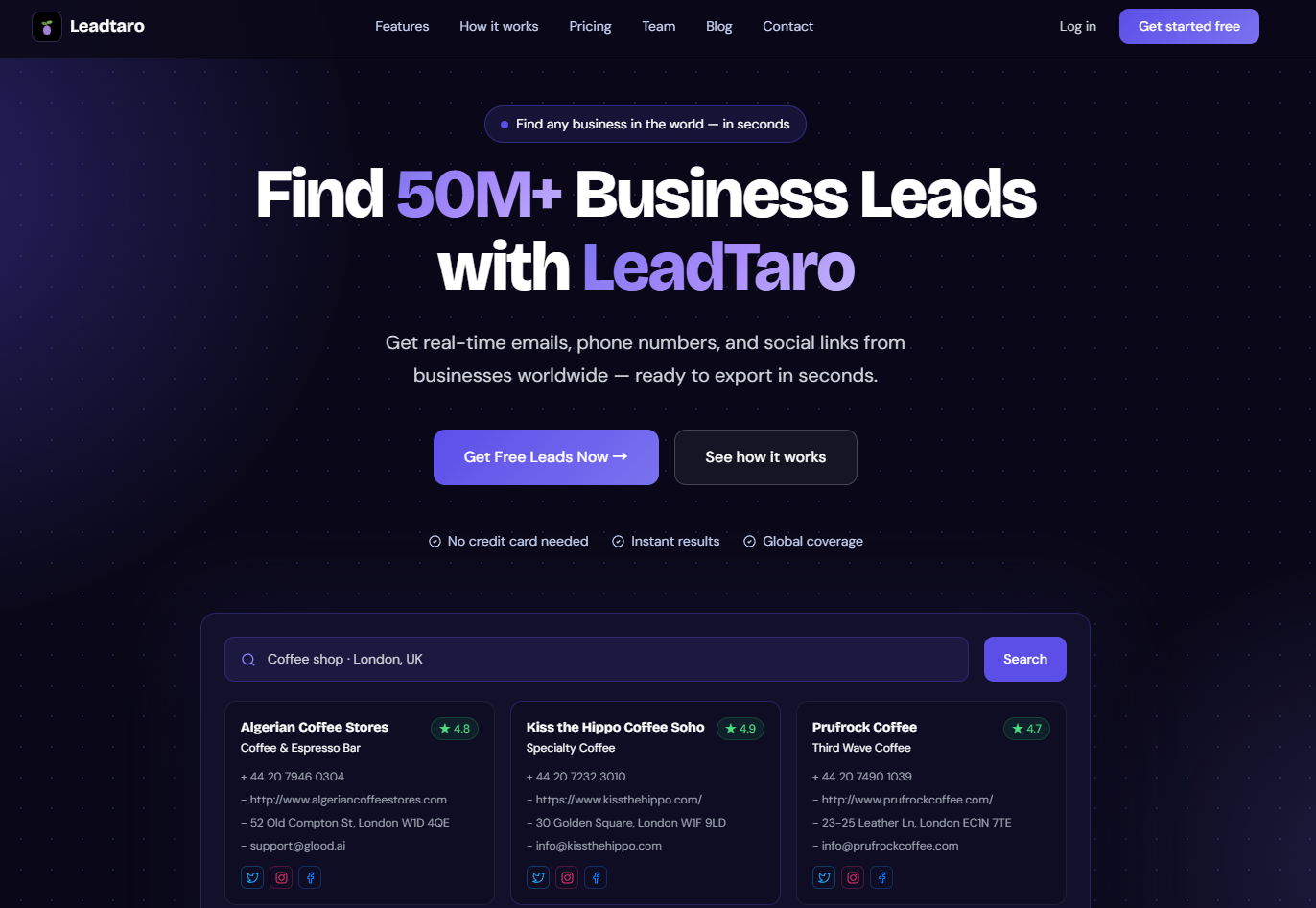
LeadBoba helps streamline this process through business lead discovery, a database containing millions of business records, available contact information, and lead search capabilities. Users can explore prospects across business categories and locations, then organize selected leads for further research and outreach.
For sales teams that need to work with prospect data outside the platform, CSV export provides a way to move eligible lead records into compatible spreadsheets and other workflows.
The goal is not to collect the largest possible list. It is to build a relevant, actionable list that gives your sales process a better chance of generating conversations.
8. Paid Acquisition: PPC, LinkedIn Ads, and Retargeting
Paid advertising can accelerate acquisition when a SaaS company already understands its audience and conversion funnel.
Google Ads can target people actively searching for a solution. LinkedIn Ads can reach professional audiences based on relevant business characteristics. Retargeting can reconnect with visitors who previously explored your product but did not register.
The main challenge is ensuring that the economics work.
Before increasing advertising spend, establish conversion tracking and measure the full journey from click to registration to paid subscription.
A campaign that generates inexpensive sign-ups may still be unprofitable if those users never become customers.
Create landing pages that match the promise of each campaign. A page targeting sales agencies, for example, should explain how the product supports their prospecting workflow rather than presenting an unfocused list of features.
Start with small experiments, identify the segments that convert, and scale only when the results justify additional spending.
9. Strategic Integrations and Partnerships
B2B SaaS products often become more valuable when they fit naturally into the tools customers already use.
Integrations can reduce repetitive work, improve data transfer, and make it easier for customers to adopt a new product without replacing their existing systems.
Start by identifying the applications your ICP uses most frequently. Then prioritize integrations based on customer demand, implementation effort, and potential business value.
For example, a prospecting workflow might involve finding business leads, exporting eligible records, reviewing them in a spreadsheet, and transferring qualified opportunities into a CRM.
A well-designed integration can reduce friction between those steps.
Partnerships can also include joint educational content, webinars, implementation services, and referrals. Choose partners whose audiences overlap with your target customers but whose products complement rather than directly compete with yours.
10. Event Marketing and Webinars
Webinars, online workshops, industry events, and specialist conferences provide opportunities to demonstrate expertise and meet potential customers.
The strongest events focus on a specific problem instead of delivering a long product pitch.
A lead generation SaaS company might host a workshop on building targeted prospect lists, improving cold email personalization, or organizing leads into a sales pipeline.
A useful event structure includes:
A clearly defined audience and problem.
Practical advice participants can apply immediately.
Time for questions and discussion.
A relevant next step for people who want additional help.
Record webinars when appropriate and repurpose the material into articles, short videos, email resources, and social posts.
This approach helps a single event generate value across several marketing channels.
11. Account-Based Marketing (ABM)
Account-based marketing focuses sales and marketing efforts on a selected group of high-value companies.
Instead of generating a large number of broad leads, the team identifies specific accounts with strong potential and creates outreach tailored to their needs.
ABM is particularly relevant for SaaS companies selling expensive products or serving organizations with complex purchasing processes.
A practical ABM process involves selecting target accounts, researching their business priorities, identifying relevant stakeholders, and developing a coordinated outreach plan.
Personalization might include industry-specific content, a tailored business case, relevant case studies, or an explanation of how the product could improve a particular workflow.
Smaller SaaS businesses can use a simplified version of ABM without investing in expensive enterprise software. A carefully researched list of 20 suitable companies can be more useful than thousands of poorly matched contacts.
12. AI-Powered Outreach and Sales Automation
AI can help SaaS companies manage repetitive sales tasks, prioritize prospects, and create more relevant communications.
However, automation works best when it supports a clear sales process rather than replacing research and judgment entirely.
Useful applications include:
Generating personalized first-draft emails.
Summarizing prospect information.
Categorizing leads by industry or business type.
Prioritizing prospects based on defined qualification criteria.
Preparing follow-up messages.
Summarizing sales conversations and recording next steps.
LeadBoba combines lead discovery and AI-assisted cold email creation to help users move from finding prospects to preparing outreach.
A practical workflow starts with a targeted search, reviews the available information, drafts a relevant message, and tracks the resulting opportunity through the sales pipeline.
Human review remains important. AI-generated claims should be checked, personalization should be accurate, and automated outreach should respect applicable marketing laws and recipient preferences.
The best use of AI is to reduce repetitive work while preserving the relevance and credibility that make B2B communication effective.
Real-World B2B SaaS Growth Examples
Several established SaaS companies illustrate how different acquisition models can support growth. Their results are examples of possible approaches, not guarantees that another company will achieve the same outcomes.
Slack: Product-Led Growth
Slack benefited from a collaborative product that spread naturally when teams invited colleagues to participate. Each additional team member could introduce the product to other potential users inside the organization.
The lesson is that products with genuine collaborative value can build distribution into the user experience.
Calendly: Product-Led Virality
Calendly's scheduling links expose recipients to the product as part of an everyday workflow. Someone booking a meeting can discover the tool without first encountering a conventional advertisement.
The lesson is to identify whether your product can deliver value to people who are not yet customers.
Dropbox: Referral-Driven Growth
Dropbox became well known for a referral mechanism that rewarded users with additional storage for inviting others.
The lesson is that incentives can encourage customers to introduce a product when the reward aligns with its core value.
HubSpot: Content-Led Acquisition
HubSpot invested heavily in educational content, inbound marketing resources, and free tools that helped potential customers understand marketing and sales challenges.
The lesson is that useful resources can attract an audience before that audience is ready to purchase software.
A More Focused Approach for Early-Stage SaaS Companies
Smaller SaaS businesses do not need to replicate the budgets or scale of established companies.
A founder can start by identifying a narrow audience, building a targeted prospect list, contacting relevant businesses, and recording which messages produce meaningful responses.
For example, a SaaS founder targeting marketing agencies could begin with a focused list of agencies in a selected market, test two different value propositions, and track replies, demonstrations, conversions, and cancellations.
The results can inform both the sales process and product development.
For early-stage companies, the most useful acquisition strategy is often the one that creates a repeatable learning cycle without requiring substantial upfront spending.
Measuring and Optimizing Your Acquisition Efforts
Key Metrics Beyond CAC
Customer acquisition cost is important, but it should not be the only metric guiding your decisions.
CAC Payback Period
Measure how long it takes for a new customer's contribution margin to recover the cost of acquiring them.
Customer Lifetime Value (LTV)
Estimate the gross profit a customer generates over their relationship with the business. Include retention and expansion assumptions rather than relying only on revenue.
Conversion Rate
Track the percentage of prospects who move from one stage to the next, such as contacted to replied, replied to demo, or demo to paid subscription.
Sales Velocity
Measure how quickly qualified opportunities move through the pipeline and how much revenue they generate over time.
Retention and Churn
Acquiring customers is less valuable when those customers cancel quickly. Review cancellation patterns, onboarding completion, product usage, and recurring customer feedback.
Channel Attribution
Record where prospects originated and which interactions contributed to conversion. This helps distinguish channels that create awareness from those that directly support sales.
A/B Testing Your Acquisition Channels
Testing helps replace assumptions with evidence.
Start with a clearly defined hypothesis and change one major variable at a time.
For cold email, you might compare two subject lines while keeping the audience and message body consistent. For landing pages, compare two headlines while keeping the traffic source similar.
Evaluate results using relevant metrics, including qualified replies, demonstrations booked, paid conversions, and eventual revenue.
Avoid drawing conclusions from very small samples. Results can fluctuate considerably when a campaign reaches only a handful of prospects.
Document the outcome of each test so that successful approaches can be repeated and unsuccessful ones can be revised.
Building a Sustainable Acquisition System
A sustainable customer acquisition process should match the company's stage and available resources.
Early stage: Find a repeatable source of customers.
Focus on founder-led sales, targeted prospecting, direct customer conversations, and a small number of acquisition channels. Learn which customer problems generate genuine willingness to pay.
Growth stage: Improve consistency and conversion.
Develop repeatable outreach sequences, strengthen onboarding, publish targeted content, and establish clear sales pipeline stages. Introduce automation where it saves time without reducing quality.
Expansion stage: Diversify and scale.
Invest in channels with proven economics, explore partnerships, develop account-based campaigns where appropriate, and build reporting that connects acquisition activity with recurring revenue.
The objective is to build a system that can be measured and improved rather than relying on occasional marketing experiments.
Common B2B SaaS Client Acquisition Mistakes to Avoid
Targeting everyone.
A broad audience makes messaging less relevant and makes it difficult to identify which prospects are most likely to buy. Start with a clearly defined ICP.
Prioritizing lead volume over lead quality.
A database containing thousands of records is not automatically valuable. Focus on relevance, contactability, and the likelihood that a prospect needs your product.
Sending generic outreach.
Messages that could apply to any company give recipients little reason to respond. Use accurate research and explain why the product is relevant to the specific prospect.
Ignoring deliverability and compliance.
Poor contact data, excessive sending, and non-compliant outreach can damage sender reputation and create legal risks. Maintain responsible sending practices and follow applicable rules.
Neglecting follow-up.
Many prospects will not respond to the first message. Use a reasonable, relevant follow-up process and stop contacting people who opt out or clearly decline.
Measuring registrations instead of revenue.
Free sign-ups and website visits are useful indicators, but they do not prove that acquisition is profitable. Track activation, paid conversion, retention, and customer lifetime value.
Automating a broken process.
Automation cannot compensate for an unclear target market or a weak value proposition. Establish a workable process before scaling it.
Ignoring customer retention.
A business that constantly replaces customers who leave will struggle to build sustainable recurring revenue. Improve onboarding, product value, and customer support alongside acquisition.
FAQ: B2B SaaS Client Acquisition
What are the best customer acquisition strategies for B2B SaaS?
Effective strategies include content marketing, SEO, product-led growth, targeted cold email, LinkedIn social selling, referrals, community participation, business prospecting, paid advertising, integrations, webinars, account-based marketing, and AI-assisted automation.
Most early-stage companies should concentrate on two or three channels that match their target audience and resources rather than trying to execute every strategy simultaneously.
What is a good customer acquisition cost for B2B SaaS in 2026?
There is no universal CAC target for every SaaS business. Acquisition costs vary with pricing, contract value, sales cycle, margins, customer retention, and target market.
Compare CAC with customer lifetime value, payback period, and recurring revenue. Evaluate each acquisition channel separately to understand where spending produces sustainable returns.
What is the fastest way to acquire new B2B SaaS customers?
Targeted outbound prospecting can produce conversations relatively quickly when a company has a clear value proposition and an appropriate prospect list.
A practical starting point is to identify a narrow customer segment, research relevant businesses, send personalized outreach, and follow up appropriately. Partnerships and founder-led sales can also generate early opportunities.
SEO and content marketing generally require more time to build momentum, but they can become valuable long-term acquisition channels.
How do B2B SaaS companies find leads for cold outreach?
Common approaches include business lead databases, professional networks, industry directories, company websites, referrals, and relevant business communities.
The best source depends on the ICP. A company targeting local service providers may prioritize business category and location, while an enterprise software vendor may focus on company size, technology use, and decision-makers.
LeadBoba helps users discover business prospects, review available contact details, and organize leads for sales outreach.
Is cold email still effective for B2B SaaS in 2026?
Cold email can be effective when the audience is relevant, the message is useful, and the sender follows responsible outreach practices.
Results depend on data quality, deliverability, offer relevance, timing, and the recipient's needs. Test campaigns using qualified replies and conversions rather than relying on open rates alone.
Always follow applicable privacy and electronic marketing requirements.
What are the best low-cost B2B SaaS acquisition channels?
Founder-led sales, targeted cold outreach, referrals, organic content, SEO, and participation in relevant communities can all be suitable starting points for companies with limited budgets.
The lowest-cost channel is not necessarily the best one. Compare the time required, lead quality, conversion rate, and eventual customer value before deciding where to focus.
How can LeadBoba help with B2B customer acquisition?
LeadBoba is a B2B lead generation and sales prospecting platform designed to help users discover business leads and organize their prospecting workflow.
Its capabilities include business lead search, access to available contact information, lead management through a sales pipeline, CSV export, and AI-assisted cold email creation.
These features can help agencies, sales teams, freelancers, and founders reduce manual prospecting work and build a more organized process for finding potential customers.
The results still depend on selecting the right audience, validating contact information, delivering a relevant offer, and following up effectively.
Conclusion
Finding new B2B SaaS clients in 2026 requires more than sending additional emails or increasing advertising budgets. Sustainable acquisition starts with understanding your ideal customer, finding relevant prospects, communicating a clear value proposition, and measuring what happens after the first interaction.
For early-stage SaaS companies, a focused approach is often the most practical: choose a specific market, build a targeted prospect list, test personalized outreach, and track every opportunity through the sales pipeline.
LeadBoba supports this workflow by bringing business lead discovery, prospect management, CSV export, and AI-assisted cold email creation into one prospecting process.
By combining relevant data, consistent outreach, and continuous measurement, SaaS businesses can build a more repeatable approach to customer acquisition without relying on a single marketing channel.