Account-based marketing (ABM) takes a different approach to traditional marketing. Instead of trying to reach as many people as possible, businesses identify their ideal customers and build targeted campaigns around them.
Geo-targeted ABM takes this strategy further by adding geographic context. Where are your target businesses located? Which industries dominate their local markets? How many potential customers operate in a particular city or region? And which accounts are worth prioritising?
For B2B sales teams, agencies, consultants, and growing businesses, these questions can make the difference between a scattered prospecting effort and a focused lead generation strategy.
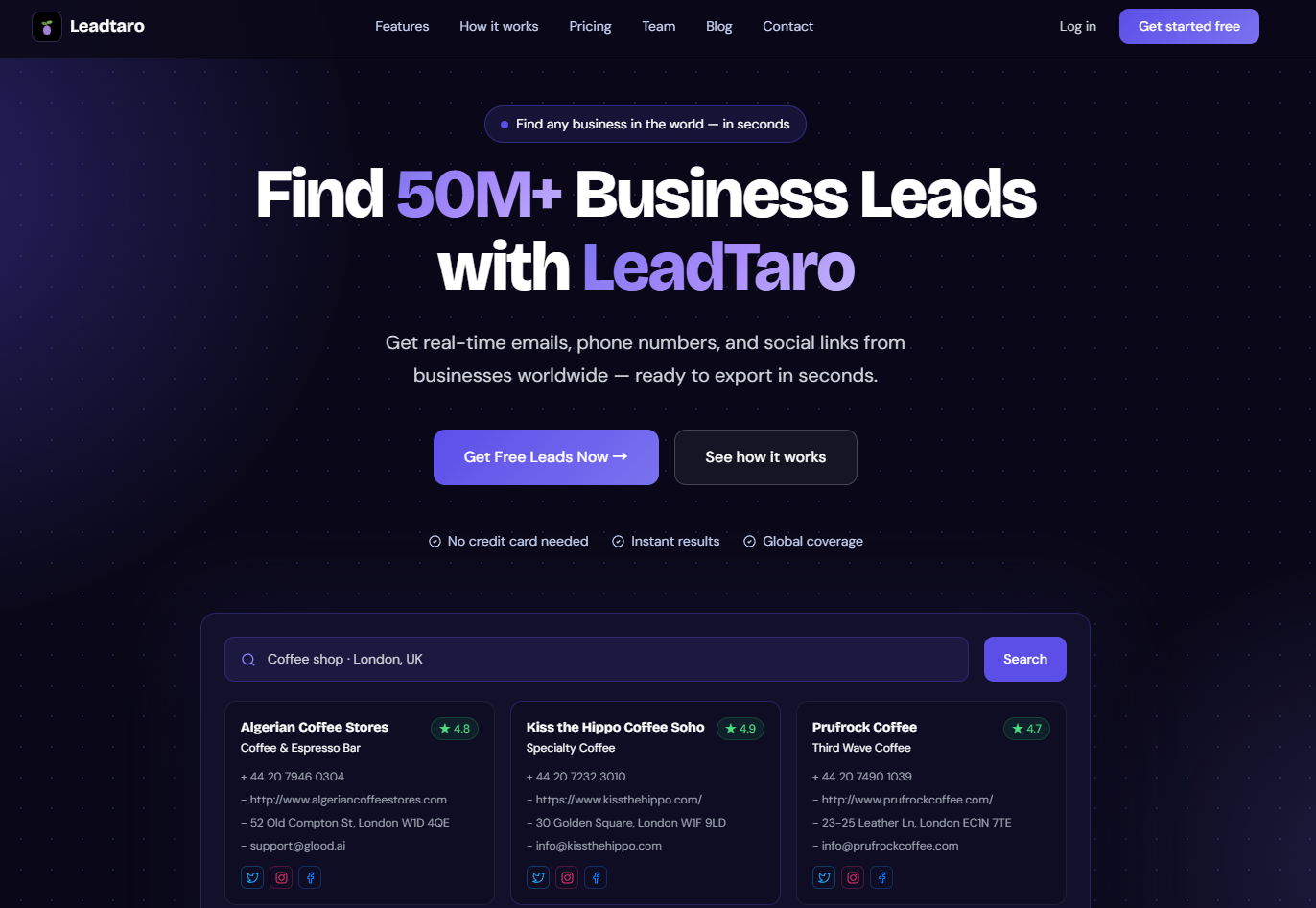
With LeadTaro, businesses can discover potential customers, search business information, identify contact details where available, and organise prospects into a sales pipeline. Combining business data with geographic targeting helps teams find relevant accounts and turn prospecting into a repeatable process.
Why Geographic Data Matters for Account-Based Marketing
Traditional lead generation often starts with a broad audience. Sales teams collect contact lists, send outreach campaigns, and filter responses to identify promising prospects.
Account-based marketing reverses this process. You define the types of companies you want to reach first, then focus your sales and marketing efforts on those accounts.
Geographic targeting adds another useful layer to this approach.
A marketing agency targeting independent restaurants, for example, might focus on businesses in Leeds before expanding into Manchester. A software provider serving dental practices might identify clinics across a specific region and prioritise those that match its ideal customer profile.
Instead of building one enormous list of loosely relevant companies, teams can create smaller, more actionable prospecting segments.
Geographic account selection can help businesses:
Identify potential customers within specific cities, regions, or markets.
Organise prospects by industry and business characteristics.
Prioritise territories with a high concentration of suitable accounts.
Personalise outreach using relevant business information.
Coordinate prospecting activities and follow-ups through a sales pipeline.
The objective is not simply to collect more leads. It is to identify the right businesses and give your sales team a clearer reason to contact them.
Building a Geographic Account List with LeadTaro
A successful ABM campaign begins with a clearly defined ideal customer profile (ICP). Before searching for leads, determine which businesses are most likely to benefit from your product or service.
For example, your ICP might include independent restaurants in major UK cities, dental practices with established customer bases, or small manufacturing companies within a particular region.
Once you understand your target market, LeadTaro can support the process of discovering and organising relevant business leads.
1. Define Your Ideal Customer Profile
Start by identifying the characteristics shared by your best customers.
Consider:
Industry: Which types of businesses need your product?
Location: Which cities, regions, or countries do you serve?
Business size: Are you targeting independent businesses, growing companies, or larger organisations?
Online presence: Does a website or active digital presence matter for your offer?
Contactability: Which business contact details are necessary for your outreach?
A specific ICP makes it easier to separate promising prospects from businesses that are unlikely to convert.
For instance, a web design agency might target independent businesses with an established local presence but an outdated website. A CRM consultant might focus on growing service businesses that need a more structured sales process.
2. Discover Businesses in Your Target Market
Once your ICP is defined, build a prospect list around the industries and locations you want to pursue.
LeadTaro supports business lead discovery across different markets, helping users identify potential customers without relying exclusively on manually assembled spreadsheets.
Depending on your search requirements, you can use Bulk Search to explore the available business database or Fresh Search to discover businesses through a live search workflow.
These approaches serve different purposes. Bulk Search is useful when you want to explore existing records at scale, while Fresh Search is intended for finding business information through a fresh search process.
The distinction matters when planning campaigns: existing database records and newly discovered results are different data sources, and neither should be assumed to guarantee that every contact detail is current.
3. Organise Leads into Geographic Segments
Avoid treating every prospect as part of one undifferentiated list.
Instead, divide your leads into manageable segments, such as:
Independent restaurants in Leeds.
Dental clinics across West Yorkshire.
Marketing agencies in London.
Manufacturing businesses in Manchester.
Professional service firms in Birmingham.
This approach helps sales teams plan campaigns around a particular market and evaluate which geographic segments generate the strongest response.
You can also compare results across territories to understand where your offer resonates most strongly.
Geographic Account Prioritisation and Territory Planning
Geographic account prioritisation helps sales teams allocate their time more effectively.
Imagine a software company targeting 500 independent businesses across three cities. Contacting all 500 companies in an arbitrary order provides little insight into which market deserves the most attention.
A more structured approach divides the accounts into geographic groups and measures their performance separately.
For each territory, track:
Number of suitable businesses identified.
Number of prospects with usable contact information.
Outreach volume and response rates.
Meetings booked and qualified opportunities created.
Customers acquired and revenue generated.
These metrics help you distinguish a territory with a large number of businesses from one that actually produces qualified opportunities.
For field sales teams, geographic grouping can also make in-person prospecting more efficient. For remote sales teams, it provides a practical framework for organising campaigns and comparing market performance.
With LeadTaro , discovered prospects can be organised through the sales pipeline, allowing teams to track their progress from new lead to contacted, interested, meeting, and closed.
Using Business Intelligence to Improve ABM Targeting
Geographic information becomes more useful when combined with other business characteristics.
A business address alone does not tell you whether an account is a good prospect. Industry, website information, available contact details, and other relevant signals help you decide which companies deserve attention.
Industry and Market Segmentation
Different industries have different needs, buying cycles, and decision-making processes.
A campaign targeting independent gyms should not use the same messaging as a campaign targeting accountancy firms. Even within one industry, businesses in different markets may face different competitive conditions.
Segmenting your prospects by industry and location allows you to create campaigns that reflect those differences.
For example, a company selling booking software might create separate campaigns for salons in Leeds, independent gyms in Manchester, and beauty clinics in Birmingham.
Each campaign can address the specific workflow problems and business priorities relevant to its audience.
Website and Contact Information
Business websites can provide useful context for personalisation. They may reveal a company's services, target audience, locations, and areas where your product could add value.
LeadTaro helps users discover business information and access available contact details, including website information and, where available, phone numbers and email addresses.
Before launching a campaign, review the contact data and confirm that the prospect is relevant to your offer. A large database is most valuable when it supports meaningful targeting rather than indiscriminate outreach.
Competitive and Market Research
Geographic prospecting can also help businesses understand their markets.
Mapping potential customers by industry and location can reveal areas with a high concentration of suitable accounts, underserved customer segments, or opportunities to expand into new territories.
For example, an agency specialising in restaurant websites might discover that a particular city contains a large number of independent restaurants that fit its service offering.
This does not automatically establish that those businesses need a new website. It provides a starting point for further research and qualified outreach.
Step-by-Step: Building a Location-Based ABM Campaign
The following workflow combines geographic research, lead discovery, outreach, and sales pipeline management.
Step 1: Select a Target Territory
Choose one city, region, or country to begin with.
Starting with a manageable territory makes it easier to test your assumptions and measure campaign performance before expanding.
Step 2: Define the Businesses You Want to Reach
Specify your target industries, business characteristics, and required contact information.
The more clearly you define your ICP, the easier it becomes to identify relevant accounts and avoid wasting time on unsuitable prospects.
Step 3: Build Your Prospect List with LeadTaro
Use LeadTaro's search workflows to discover businesses that match your targeting criteria.
Choose Bulk Search when exploring existing database records or Fresh Search when you need a fresh discovery workflow.
Review the available information before treating a business as a qualified prospect. Data availability and completeness can vary between records.
Step 4: Export and Organise Your Leads
Export eligible leads to CSV when you need to work with the data in a spreadsheet or transfer it into another system.
Organise the list by location, industry, and campaign. Remove irrelevant records and review duplicates before starting outreach.
If you manage a larger prospecting operation, establish consistent naming conventions so that different campaigns and territories can be compared later.
Step 5: Personalise Your Outreach
Use relevant business information to explain why you are contacting each prospect.
Avoid generic messages that simply insert a company name or city into a template.
For example, a marketing agency might contact an independent restaurant after reviewing its website and identifying a specific improvement opportunity. A software provider might explain how its product addresses a workflow challenge common to the prospect's industry.
LeadTaro's AI cold email tools can help you draft personalised outreach. Review each message for factual accuracy and relevance before sending it.
Personalisation should demonstrate a genuine understanding of the business, not imply that you know private information about the recipient.
Step 6: Track Opportunities in Your Sales Pipeline
Prospecting does not end when an email is sent.
Use LeadTaro's sales pipeline to organise leads by stage, track follow-ups, and monitor which accounts progress towards a meeting or sale.
This creates a clearer view of the entire prospecting process, from initial discovery to conversion.
Step 7: Measure and Expand
After running the first campaign, compare performance across your target segments.
Identify which locations and industries generate the strongest qualified response, then adjust your ICP and expand into similar markets.
Repeat the process rather than assuming that a larger prospect list will automatically produce better results.
Integrating Lead Generation with Your Sales Workflow
A lead generation tool becomes more useful when it fits into the rest of your sales process.
LeadTaro supports several stages of that workflow, helping users move from finding businesses to organising prospects and preparing outreach.
Bulk Search and Fresh Search
The two search approaches support different prospecting needs.
Bulk Search is suited to exploring LeadTaro's existing business database at scale.
Fresh Search is designed for live business discovery when you want to find additional prospects through a fresh search workflow.
The appropriate option depends on your target market, the availability of existing records, and how much emphasis you place on discovering new businesses.
Neither workflow should be treated as a guarantee that every record is complete or that every contact detail has been recently verified.
CSV Export and Data Management
CSV export allows eligible lead data to be moved into spreadsheets and compatible sales or marketing systems.
This is particularly useful for agencies managing several clients, consultants maintaining separate prospect lists, and sales teams dividing accounts by territory.
Before importing records into a CRM, standardise company names, review duplicates, and check that the data fields map correctly.
AI-Assisted Cold Email
Relevant outreach is more effective than sending the same message to every business.
AI-assisted drafting can help sales teams create initial email versions based on a prospect's industry, business offering, and relevant publicly available information.
Human review remains important. Verify any claims about the recipient's business, avoid fabricated observations, and ensure that every message has a clear purpose.
Sales Pipeline Management
Once outreach begins, a structured pipeline helps you maintain visibility over every prospect.
LeadTaro's pipeline stages can help you distinguish new leads from contacted prospects, interested accounts, scheduled meetings, and closed opportunities.
That structure makes it easier to identify bottlenecks and determine whether the problem lies in targeting, messaging, follow-up, or the underlying offer.
Measuring the Success of Geographic ABM
A location-based campaign should be evaluated by the quality of the opportunities it creates, not simply the number of businesses in its database.
Focus on a small set of meaningful KPIs.
Account coverage: What proportion of your selected target accounts have been researched or contacted?
Contactability rate: What percentage of your target list contains usable contact information?
Positive reply rate: How many recipients respond with genuine interest?
Meeting conversion rate: How many contacted prospects progress to a qualified meeting?
Pipeline generated by territory: Which geographic segments produce the most valuable opportunities?
Customer acquisition cost: How much does it cost to acquire a customer from each campaign or territory?
For example, one city might produce twice as many leads as another but fewer qualified meetings. A smaller, more carefully targeted segment may therefore be the better investment.
Tracking these metrics in your sales workflow helps you make decisions based on actual campaign performance rather than assumptions about market size.
Compliance Considerations for B2B Lead Generation
Publicly available business information is not automatically unrestricted for every use.
Before collecting, storing, or using business contact information, consider the applicable laws, the source's terms, and the purpose of your processing.
For businesses operating in the UK or European Economic Area, relevant requirements may include UK GDPR or EU GDPR and applicable electronic marketing rules, including PECR in the UK. Requirements can differ depending on whether you contact a limited company, a sole trader, or an individual subscriber.
In particular:
Establish and document an appropriate lawful basis where required.
Check whether the contact method is permitted for the type of recipient.
Identify your business appropriately in outreach.
Provide a valid way to object or unsubscribe where required.
Maintain suppression lists and respect opt-out requests.
Avoid collecting or using unnecessary personal information.
Using public business information does not remove these responsibilities. Review the rules that apply to your business and seek professional advice when necessary.
The Future of Geographic Account-Based Marketing
As businesses adopt more data-driven sales workflows, geographic context can help them make better decisions about where to prospect and which accounts to prioritise.
Three developments are particularly relevant.
More focused account selection. Businesses can combine industry, geography, and business characteristics to build prospect lists that are more closely aligned with their ICP.
AI-assisted prospecting. AI tools can help sales teams research businesses, draft outreach, and organise prospecting workflows. The quality of the result still depends on the accuracy of the underlying information and appropriate human review.
Connected sales workflows. Businesses increasingly want lead discovery, contact research, outreach preparation, and pipeline tracking to work together instead of being spread across disconnected spreadsheets and tools.
LeadTarobrings business lead discovery, contact information, AI-assisted cold email, CSV export, and sales pipeline management into a single prospecting workflow.
For small businesses, agencies, and sales teams, this can make it easier to test new territories, organise target accounts, and build a more consistent approach to B2B lead generation.
Frequently Asked Questions
What is geographic account-based marketing?
Geographic account-based marketing is an approach to ABM that uses location as an additional way to identify, segment, and prioritise target businesses. Instead of treating all accounts as one list, teams organise prospects by territory and tailor their campaigns to the markets they serve.
How can LeadTaro help with account-based marketing?
LeadTaro helps users discover business leads, access available business contact information, export eligible lead data, prepare AI-assisted cold emails, and organise prospects through a sales pipeline. These capabilities support the prospecting and outreach stages of an ABM campaign.
How do I build a geographic B2B prospect list?
Define your ideal customer profile, select a target territory, identify businesses in your target industries, and review their available information. Use LeadTaro to support lead discovery, organise relevant prospects, and prepare targeted outreach. Measure campaign results before expanding into additional territories.
What is the difference between Bulk Search and Fresh Search?
Bulk Search is designed for exploring existing LeadTaro database records. Fresh Search is designed for discovering businesses through a live search workflow. The best choice depends on your prospecting objectives and the data available for your target market.
Can small businesses benefit from geographic ABM?
Yes. Small businesses can start with one city or a narrow industry segment, identify a manageable group of suitable prospects, and test a focused campaign before expanding. This approach helps limited sales and marketing resources go towards the accounts most relevant to the business.
How should I measure geographic ABM performance?
Track qualified replies, meetings booked, opportunities created, conversion rates, and customer acquisition costs by territory. Lead volume is useful for understanding market coverage, but the quality and commercial value of the resulting opportunities matter more.
Is using public business data for B2B outreach legal?
It depends on the information, how it was collected, the recipient, the intended use, and the applicable laws. Public availability does not automatically establish permission for every type of marketing. Businesses should review applicable data protection and electronic marketing requirements before conducting outreach.
Start Building a More Focused B2B Prospecting Workflow
Effective account-based marketing starts with knowing which businesses you want to reach and why they are relevant to your offer.
LeadTaro helps bring business discovery, available contact information, CSV exports, AI-assisted email preparation, and sales pipeline management into one workflow.
Whether you are a founder building your first prospect list, an agency researching a new market, or a sales team expanding into additional territories, start with a clearly defined ICP, test one geographic segment, and use the results to improve your next campaign.
Discover relevant businesses, organise your prospects, and build a more focused B2B sales pipeline with LeadTaro.