Finding potential customers is only the first step in lead generation. The real challenge is turning business data into conversations, qualified opportunities, and paying customers.
For agencies, freelancers, and sales teams targeting local businesses, Google Maps can be a useful starting point. Business listings help identify companies by category and location, while available information such as websites, phone numbers, reviews, and business details can help sales teams decide which prospects deserve further research.
But collecting a list of businesses is not the same as building a sales pipeline.
Without a clear process, teams can spend hours researching companies, sending generic messages, and following up inconsistently. A structured workflow makes it easier to prioritize relevant prospects, personalize outreach, and understand where potential deals are getting stuck.
In this guide, we'll explain how to build a seven-step Google Maps lead pipeline, qualify local business prospects, track conversion metrics, and use LeadTaro to support business discovery and sales pipeline management.
Why Google Maps Leads Need a Dedicated Sales Pipeline
How Google Maps Leads Differ from Other Lead Sources
Different lead sources provide different levels of context.
Someone who submits a demo request has already expressed interest in a particular product. Someone who discovers a business through a local search may simply be comparing nearby providers. Meanwhile, a business owner identified through a public listing may not be actively looking for your service at all.
These differences affect how you should approach each prospect.
For example, a marketing agency searching for local businesses may discover a company with an outdated website. That observation can provide a relevant starting point for outreach, but it does not automatically mean the owner wants a redesign.
A good pipeline helps you distinguish between:
Businesses that fit your target market
Prospects with an observable business need
Companies that have expressed interest
Qualified opportunities with a realistic chance of becoming customers
The goal is not to treat every listing as a ready-to-buy lead. It is to turn business discovery into a repeatable qualification and follow-up process.
Why Local Context Matters
A local business operates within a particular market. Its location, competitors, customers, opening hours, and online presence can all affect the relevance of your offer.
A web design agency targeting restaurants, for example, could prioritize businesses with websites that are difficult to use on mobile devices. A local SEO consultant might research businesses whose online presence appears incomplete. A commercial supplier could focus on companies within its delivery area.
This is more effective than sending the same generic pitch to every business in a database.
LeadTaro helps users discover businesses based on relevant search criteria and organize prospects for sales follow-up. By combining business research with a structured pipeline, teams can move beyond collecting names and focus on identifying opportunities.
The 7-Step Google Maps Lead Pipeline Framework
Step 1: Discover relevant businesses
Step 2: Qualify and score prospects
Step 3: Make personalized first contact
Step 4: Understand the prospect's needs
Step 5: Present a relevant proposal
Step 6: Handle objections and follow up
Step 7: Close the deal and build referrals
Step 1: Prospecting and Business Discovery
The traditional approach to local prospecting is straightforward but time-consuming: search for businesses manually, copy their details into a spreadsheet, visit each website, and repeat the process for every new location or category.
This can work for a small list, but it becomes difficult to manage as your target market grows.
A business search tool can make the discovery process more structured by allowing you to search for companies according to criteria relevant to your campaign.
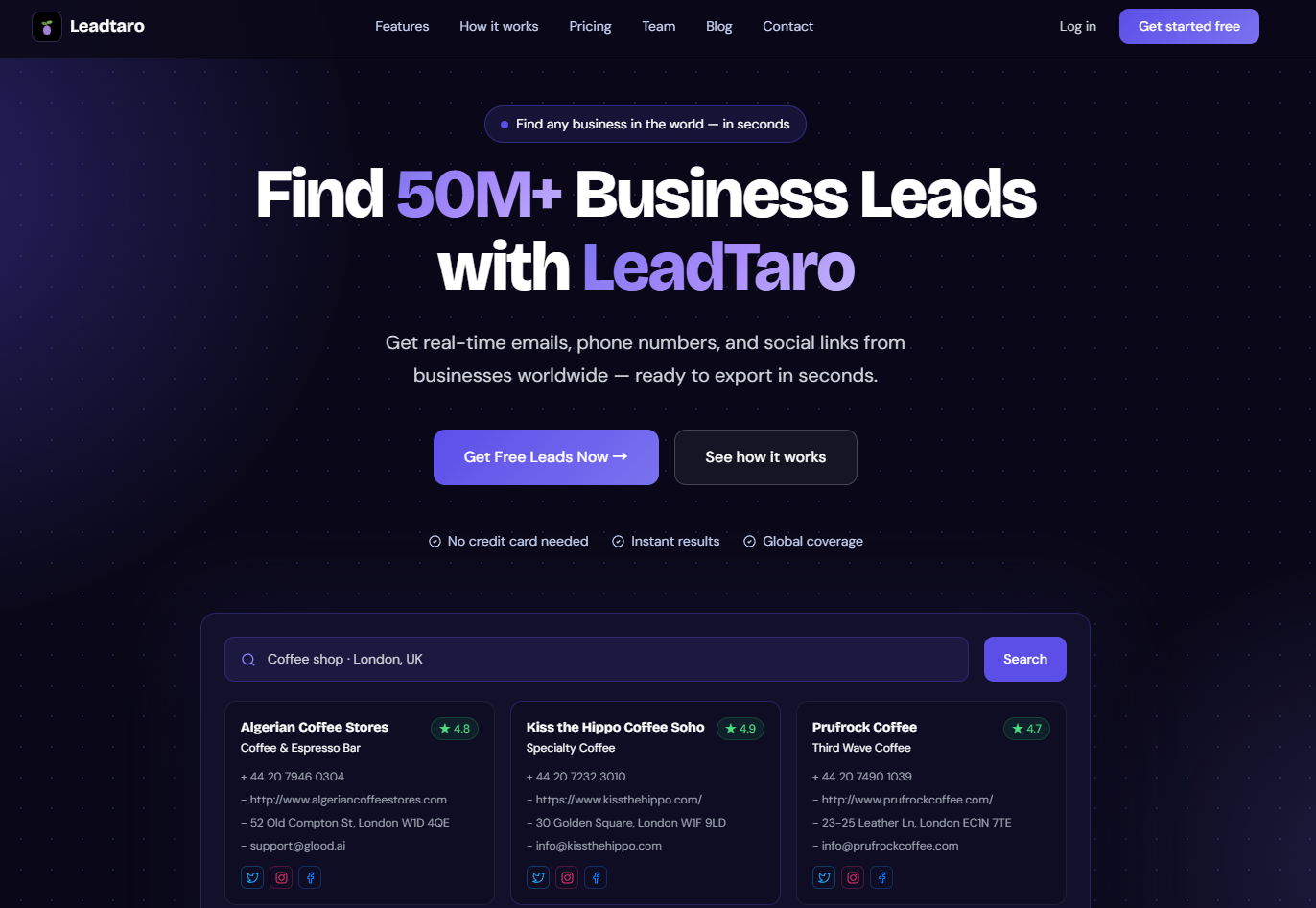
With LeadTaro, users can search for businesses by category and location, review the information available for each result, and identify potential prospects for further qualification.
What should you filter for?
The best criteria depend on the service you sell.
Business category: Focus on the types of companies most likely to benefit from your offer.
Location: Target businesses within your service area or desired sales territory.
Website availability: Identify companies that may be relevant to website design, development, or digital marketing services.
Available contact information: Prioritize prospects for whom suitable contact details are available.
Online presence: Review websites and other available business information to identify potential opportunities.
Business fit: Consider whether the company matches your ideal customer profile.
For example, a freelance web designer might search for independent restaurants in a specific city and then review their websites. A commercial cleaning company might focus on offices and retail businesses within a manageable travel distance.
The search results are the starting point. Review the businesses before adding them to an active outreach campaign.
Build a focused prospect list
A list of 200 relevant companies can be more useful than a list of 2,000 businesses that have little in common with your offer.
Start with a manageable segment. Review the quality of the results, identify which criteria produce the most suitable prospects, and expand the search once the process is working.
LeadTaro can help streamline the discovery and organization of business leads without requiring you to treat every search result as a qualified sales opportunity.
Step 2: Lead Qualification and BANT-L Scoring
A common prospecting mistake is assuming that every business matching a search is worth contacting.
Some companies will be too small, too far away, or unlikely to need your service. Others may already have a provider or lack the budget to move forward.
Lead qualification helps you prioritize the prospects that deserve the most attention.
What is BANT-L?
BANT is a qualification framework based on Budget, Authority, Need, and Timeline. For local prospecting, you can add Location as another factor.
FactorWhat to evaluateBudgetIs the prospect likely to afford the service?AuthorityAre you speaking with the owner or a relevant decision-maker?NeedIs there a problem your product or service can realistically solve?TimelineIs the prospect considering a change soon, or is the need long-term?LocationCan you serve the business effectively in its geographic area?You can use these criteria to create a simple internal scoring system. For example, assign points for a strong business fit, an observable need, access to a decision-maker, and a relevant location.
The precise scoring thresholds should be based on your own sales process rather than assumed to be universal.
Add visible business signals
Local business listings and websites may reveal useful research signals.
A business with no website could be relevant to a web design agency. A company with incomplete online information might be worth researching for a digital marketing service. A business with recent reviews may have an active customer base.
However, these signals need context. A company without a website may rely successfully on referrals, and a business with many reviews may already have a strong marketing partner.
Use observable signals to guide research, not to assume that a company has a problem.
Verify contact information
Before beginning outreach, review the available phone numbers and email addresses. If you plan to send email campaigns, use an appropriate verification process and remove invalid addresses.
Business information can be incomplete or outdated, so do not assume that every listing includes a valid contact method.
For a broader qualification process, define your ideal customer profile before building the list. The clearer your target audience, the easier it becomes to assess whether a prospect is relevant.
Step 3: First Contact and a Relevant Value Proposition
Once you have identified a suitable prospect, the next step is to make contact with a message that gives the business a reason to respond.
A generic message such as "We help businesses grow" does not explain why you chose that particular company.
A more relevant message connects your offer to something you have genuinely observed.
Three elements of effective first contact
1. A specific observation
Reference a real detail about the business, such as its website, service offering, location, or online presence. Avoid inventing problems or claiming to have reviewed something you have not checked.
2. A clear connection to your service
Explain why that observation may be relevant. If you provide website design, for example, you might point out a specific usability issue and explain how addressing it could improve the customer experience.
3. One simple next step
Ask whether the owner would be open to a brief conversation, a review of the website, or another reasonable next step.
Example cold email
Subject: A quick idea for your business website
Hi [Name],
I came across [Business Name] while researching businesses in [Location].
I noticed [specific, verified observation about the business]. We help businesses with [relevant service], and I thought there might be an opportunity to improve [specific area].
Would you be open to a short conversation about it?
Best,
[Your Name]
The example should be adapted to each recipient. Do not claim results for previous customers unless you can substantiate those claims.
Create a consistent follow-up cadence
Not every prospect will reply to the first message. A structured follow-up process helps prevent promising leads from being forgotten.
An example cadence could be:
Day 1: Make an appropriate first contact.
Day 3: Follow up with additional context or a relevant question.
Day 5–7: Share a useful observation, such as a brief website review.
Day 10: Send a final, polite follow-up if appropriate.
Adjust the timing to the prospect, channel, and urgency of the offer. Respect opt-out requests and do not continue contacting people who have asked you to stop.
LeadTaro's AI-assisted cold email functionality can help draft outreach messages. Review and personalize the final message before sending it.
Step 4: Discovery and Understanding Local Business Needs
When a prospect responds, resist the temptation to launch immediately into a sales pitch.
The purpose of a discovery conversation is to understand the business, identify its priorities, and determine whether your offer is a good fit.
A local business owner may care about saving time, increasing enquiries, reducing operational costs, improving the customer experience, or simply solving an immediate problem.
Ask questions that reveal those priorities.
Useful discovery questions
What is your main priority for the business over the next few months?
How do customers currently find you?
What is working well with your existing website or marketing?
Are there any areas you would like to improve?
What have you already tried?
Who is involved in deciding whether to move forward?
Is there a particular deadline or event driving the decision?
What would a successful outcome look like?
Not every question will be relevant to every business. Choose the ones that help you understand the prospect's situation without making the conversation feel like an interrogation.
Match your offer to the prospect's needs
A company looking for more online enquiries may need a different solution from one trying to reduce administrative work.
A restaurant may care about mobile usability and local visibility. A contractor may prioritize a steady flow of suitable enquiries. A professional services firm may care more about credibility and lead quality.
The better you understand the actual need, the easier it becomes to recommend a relevant solution.
The purpose of discovery is not to persuade every business to buy. It is to identify the businesses where there is a genuine fit.
Step 5: Proposal and Demonstration
A proposal should make it easy for the prospect to understand what you recommend, what it costs, and what happens next.
Small business owners often have limited time, so a concise proposal can be more effective than a long presentation full of jargon.
What to include in a proposal
Summary: Describe the prospect's main challenge and the proposed solution.
Scope: Explain what you will deliver and what is excluded.
Timeline: Give a realistic schedule with clear milestones.
Pricing: State the cost, payment terms, and any relevant additional charges.
Evidence: Include relevant examples, demonstrations, or substantiated case studies where available.
Next steps: Explain how the prospect can approve the proposal or ask questions.
Demonstrate value using relevant examples
If you sell website design, show how a proposed improvement could make the website easier to use. If you provide marketing services, explain which activities you would prioritize and how you would evaluate their performance.
A useful demonstration should be specific to the prospect's situation. It should not rely on fabricated statistics or promise outcomes you cannot guarantee.
You can also explain how your approach differs from alternatives, but keep the comparison factual and focused on the customer's needs.
Step 6: Objection Handling for Local Prospects
Objections are a normal part of selling. They often indicate that a prospect needs more information, has a concern about risk, or does not yet see enough value to commit.
The best response is to understand the concern before trying to overcome it.
"Your competitor is cheaper."
Ask what the prospect is comparing. The difference may involve scope, support, delivery time, or the expected outcome.
Explain the value of your offer clearly, but do not dismiss competitors or pressure the prospect into paying more.
"Let me think about it."
Give the prospect space while clarifying what they need to decide.
You could ask: "Of course. Is there anything about the proposal you'd like me to clarify before you decide?"
If they identify a specific concern, address it directly. Agree on a follow-up only if they are comfortable with that.
"We're too small for this."
Explain whether your service is appropriate for businesses of their size. If you offer a smaller package or a phased approach, outline the options and their limitations.
Avoid making unsupported claims about the percentage of your customers who resemble the prospect.
"We already have a provider."
Ask whether they are satisfied with the current arrangement and whether there are any gaps they would like to address.
If they are happy with their provider, respect that decision. If they identify a genuine unmet need, explain how your service could help without misrepresenting the alternative.
"We already have a list of leads."
A purchased or previously collected list may still be useful, depending on its quality and age.
Rather than automatically dismissing it, ask whether the list covers the right businesses, whether the contact information is still usable, and whether the team has a process for follow-up.
LeadTaro can support business discovery and sales pipeline organization. Whether you should build a new list or work with an existing one depends on your coverage needs and the quality of the available data.
Step 7: Closing and Post-Sale Referrals
Once the prospect understands the proposal and is ready to proceed, make the next step straightforward.
Summarize what has been agreed, confirm the scope and pricing, and explain the onboarding or delivery process.
Avoid treating closing as an opportunity to pressure the customer. A clear agreement helps both parties understand what happens next.
Keep the pipeline active after the sale
The relationship should not end when the contract is signed.
A simple post-sale process might include:
Initial setup: Confirm access, requirements, and responsibilities.
Early check-in: Make sure the customer understands the next steps.
Progress review: Discuss what has been delivered and any outstanding issues.
Results review: Evaluate the work against the agreed objectives.
Referral request: Ask satisfied customers whether they know another business that could benefit, where appropriate.
Local business communities can create opportunities for referrals, but referrals should be earned through good service rather than assumed.
Record the customer's status, agreed actions, and follow-up dates in your sales workflow. This makes it easier to maintain relationships and identify opportunities for future work.
Pipeline Metrics and KPIs to Track
A sales pipeline is useful only if it helps you understand what is happening to your leads.
Instead of relying solely on the total number of businesses collected, measure how prospects progress through each stage.
Stage-by-Stage Conversion Rates
The following table provides a measurement framework. It is not a set of verified industry benchmarks or a guarantee of Google Maps lead performance.
Pipeline stageWhat to measureDiscovered → QualifiedPercentage of discovered businesses that meet your criteriaQualified → ContactedPercentage of qualified prospects you successfully attempt to reachContacted → RespondedPercentage of contacted prospects who respondResponded → DiscoveryPercentage of responding prospects who agree to a discovery conversationDiscovery → ProposalPercentage of discovery conversations that lead to proposalsProposal → ClosedPercentage of proposals that become customersOverall conversionPercentage of original leads that become customersCalculate each rate consistently. For example:
Overall lead-to-customer conversion rate
Number of leads that became customers ÷ total leads in the original cohort × 100.
Use the same time period and lead definition when comparing campaigns. Otherwise, your conversion figures may be misleading.
Additional Metrics Worth Tracking
Response time: How long it takes to respond to an inbound enquiry or follow up with an active prospect.
Contact rate: The proportion of prospects you successfully reach.
Qualification rate: The percentage of discovered businesses that meet your criteria.
Proposal win rate: The proportion of proposals that become customers.
Sales cycle length: The average time from first contact to a decision.
Cost per qualified lead: Prospecting and acquisition costs divided by the number of qualified leads.
Revenue per customer: The revenue associated with customers acquired through the campaign.
Lost-lead reasons: Common reasons prospects do not progress, such as poor fit, timing, budget, or choosing another provider.
These metrics can help you identify where improvements are needed. A low qualification rate may indicate that your search criteria are too broad. A low response rate may suggest that your messaging, contact data, or target audience needs review. A low proposal win rate may indicate that the offer does not match the prospect's priorities.
Use Your Pipeline to Identify Bottlenecks
Suppose your team discovers many businesses but very few qualify. The problem may be the search criteria or the definition of your ideal customer.
If prospects qualify but rarely respond, review the contact details, channel, and message.
If prospects take discovery calls but do not accept proposals, examine whether you understand their needs and whether the proposed solution fits their budget and priorities.
A pipeline helps you diagnose the process rather than simply collecting more data.
LeadTaro's sales pipeline can help organize leads by stages such as New Lead, Contacted, Interested, Meeting, and Closed, making it easier to keep track of progress and follow-up.
Optimizing the Sales Cycle for Local Leads
The length of a sales cycle depends on the type of product or service, the urgency of the customer's problem, the cost, and the number of people involved in the decision.
A customer seeking urgent repair work may decide quickly. A business considering a website redesign or a long-term marketing contract may take longer to compare options and approve the budget.
Do not assume that every local lead should close within a fixed number of days.
How to Reduce Unnecessary Delays
Make the next step clear. After every conversation, agree on what happens next and who is responsible.
Keep proposals focused. Explain the recommended solution without overwhelming the prospect with unrelated options.
Offer a suitable starting point. If appropriate, provide a clearly defined initial engagement rather than requiring the customer to commit to a large project immediately.
Follow up consistently. Use reminders and pipeline stages to prevent qualified opportunities from being forgotten.
Address concerns early. Discuss budget, timing, scope, and decision-making before investing too much time in a proposal.
Review stalled opportunities. If a deal has stopped progressing, find out whether the prospect's priorities have changed or whether a specific question remains unresolved.
The goal is to make the decision easier, not to rush a customer into a purchase.
Tools for Your Google Maps Lead Pipeline
A practical pipeline often requires several connected activities: business discovery, lead qualification, outreach, and follow-up management.
You do not need the most complicated technology stack to begin. Start with the tools that solve your biggest problems.
Business Discovery and Lead Data
LeadTaro helps users discover businesses based on search criteria such as category and location and review the available business information.
Depending on the results, users may be able to review company names, addresses, websites, phone numbers, and other available details. Data coverage varies by business, so check the fields returned rather than assuming that every lead includes every contact method.
For a new campaign, begin with a focused search and assess the quality of the results before expanding your prospect list.
Lead Management and Sales Pipeline
After discovering prospects, organize them according to their current status.
A simple pipeline could include:
New Lead: Discovered but not yet reviewed or contacted.
Contacted: Initial outreach has been attempted.
Interested: The prospect has expressed interest or agreed to continue the conversation.
Meeting: A discovery call or meeting has been scheduled.
Closed: The opportunity has reached its final outcome.
Adapt these stages to your business. Some teams may need additional statuses for unqualified leads, proposals, follow-up, or lost opportunities.
The important point is that every lead should have a clear status and a next action where appropriate.
AI-Assisted Cold Email
AI can help draft first-contact messages and follow-ups, especially when you need to tailor the wording to a particular business category or service.
LeadTaro includes AI-assisted cold email functionality to help users prepare outreach drafts.
However, automation should not replace research. Review the business information, make sure every observation is accurate, and personalize the message before sending it.
Avoid generating unsupported claims, misleading subject lines, or messages that pretend to have a relationship with the recipient.
Email and CRM Workflow
Your outreach process should connect with the way you already manage customers and conversations.
Before choosing additional software, determine whether you need automated sequences, advanced reporting, territory management, or integrations with an existing CRM.
For smaller teams, a simple search-to-pipeline workflow may be enough. Larger sales organizations may need a more extensive system with integrations and automation.
Check the features and limits available in your current subscriptions before designing the workflow.
Data Quality, Privacy, and Responsible Outreach
A successful lead pipeline depends on more than the ability to find businesses. It also depends on how you use the information.
Review and Validate Your Leads
Before contacting a prospect, check that:
The business is relevant to your target market.
The company appears to be operating.
The website and contact details are appropriate for your purpose.
The record is not a duplicate.
The person or business is suitable for the intended communication.
Any previous opt-out or suppression request is respected.
Business records can become outdated. Reviewing the list before outreach can help reduce wasted effort and improve the relevance of your messages.
Understand Marketing and Privacy Requirements
The rules for electronic marketing depend on the recipient, jurisdiction, communication channel, and intended use of the information.
In the UK, relevant requirements may include UK GDPR and the Privacy and Electronic Communications Regulations (PECR). The rules can differ depending on whether the recipient is a corporate subscriber, an individual, or a particular type of business. Other countries have their own requirements.
Publicly available business information is not automatically free of privacy, platform-term, or marketing restrictions.
Before launching a campaign, establish the applicable legal basis and requirements for the intended activity. Provide appropriate identification and opt-out mechanisms where required, keep suppression lists up to date, and stop contacting recipients who object.
This is general information, not legal advice.
Is It Legal to Collect Google Maps Leads?
The legal position depends on how data is accessed, what information is collected, the source's terms and restrictions, the jurisdiction, and how the data is subsequently used.
The fact that a business listing is publicly visible does not by itself establish that every method of automated collection or every use of the resulting data is permitted.
Review the applicable terms, laws, and restrictions for your particular workflow. Seek qualified legal advice if your campaign involves significant volumes of personal data or cross-border marketing.
Common Mistakes That Reduce Lead Conversion
Treating Every Business the Same
A prospect's location, industry, size, and needs affect whether your offer is relevant.
Use search criteria to identify a suitable audience, then tailor your message to the actual business.
Collecting Data Without a Qualification Process
A large list is not useful if most of the companies do not fit your ideal customer profile.
Set qualification criteria before searching and review the results before outreach.
Sending Generic Messages
Messages that could be sent to any business usually provide little reason to respond.
Reference a genuine observation, explain why it matters, and connect it to the service you offer.
Failing to Follow Up
Prospects may miss the first message or need time to decide. A consistent and respectful follow-up process helps you keep track of opportunities.
Use reminders and pipeline stages, while respecting opt-outs and avoiding excessive contact.
Making Unsupported Claims
Do not promise a particular conversion rate, revenue increase, or number of new customers unless you have reliable evidence that supports the claim.
Use measurable objectives, track the results of your own campaigns, and communicate what you can realistically deliver.
Ignoring the Post-Sale Relationship
Closing a deal is not the end of the customer journey. Delivery, support, and ongoing communication can affect retention and referrals.
Build customer follow-up into your process rather than treating it as an optional extra.
Frequently Asked Questions
How do you build a sales pipeline from Google Maps leads?
Start by searching for businesses in your target category and location. Review the results, qualify prospects using your ideal customer profile, and prioritize those with a relevant potential need. Make personalized contact, conduct discovery conversations, send suitable proposals, follow up, and track the final outcomes.
A lead management tool such as LeadTaro can help organize business discovery and pipeline follow-up.
What is the conversion rate for Google Maps leads?
There is no single conversion rate that applies to all Google Maps leads. Results depend on the industry, offer, target audience, data quality, qualification criteria, outreach method, and definition of conversion.
Rather than relying on a general percentage, track your own results from the original prospect list through to closed customers. Compare campaigns using consistent definitions and time periods.
How can I automate lead generation from Google Maps?
Begin by defining your target category and location, then use an appropriate business discovery tool to identify potential prospects. Organize the results, qualify the businesses, and connect the workflow to your outreach and lead management process where supported.
Automation can help reduce repetitive tasks, but business suitability and message accuracy still require review. Check each tool's capabilities, integrations, and applicable data-use requirements before automating collection or outreach.
What CRM is best for Google Maps leads?
The best CRM is the one that fits your team's sales process and reporting needs. Look for customizable stages, reminders, notes, contact history, reporting, and integrations with your lead source and email workflow.
LeadTaro includes sales pipeline functionality for organizing leads. Teams with more advanced requirements should compare the integration and reporting features of their existing CRM options.
How long should the sales cycle be for local business leads?
It depends on the service, cost, urgency, and decision-making process. Urgent services may close quickly, while marketing contracts, software purchases, and larger projects can take considerably longer.
Track the time each lead spends in every stage to establish realistic expectations for your own business.
Should I verify email addresses before sending cold emails?
Yes. Checking contact information can help identify invalid email addresses and reduce avoidable delivery problems. Verification does not guarantee inbox placement or make a campaign compliant by itself. You should also ensure that your outreach follows the applicable marketing rules and respects opt-out requests.
Can LeadTaro help manage the sales process after lead discovery?
Yes. LeadTaro combines business lead discovery with sales pipeline functionality, helping users organize prospects and track their progress through stages such as New Lead, Contacted, Interested, Meeting, and Closed. It also offers AI-assisted cold email drafting to support outreach preparation.
What is the most important metric in a lead pipeline?
There is no single metric that explains every problem. Overall lead-to-customer conversion is useful for evaluating results, while stage-by-stage conversion rates help identify bottlenecks.
For example, a low qualification rate may indicate that your search criteria are too broad, while a low proposal win rate may indicate a mismatch between the offer and the prospect's needs.
Build a More Structured Google Maps Lead Pipeline with LeadTaro
Finding businesses is only the beginning. The real value comes from identifying suitable prospects, understanding their needs, communicating a relevant offer, and following up consistently.
A structured seven-step pipeline gives you a practical way to manage that process:
Discover relevant businesses.
Qualify and prioritize prospects.
Make personalized first contact.
Understand the prospect's needs.
Present a clear proposal.
Address concerns and follow up.
Close the deal and maintain the customer relationship.
LeadTaro helps connect business discovery with lead organization and sales pipeline management. By combining focused searches, careful qualification, and relevant outreach, you can build a more repeatable process for finding potential customers.
Explore LeadTaro to discover business leads and organize your sales pipeline.