Articles » Lead Generation » How to Get Local Business Leads with Contact Information in 2026
Table of Contents
What Counts as a Local Business Lead?
Where to Find Local Business Leads in 2026
Four Ways to Get Local Business Leads with Contact Information
How to Find Local Business Leads Step by Step
Scaling Lead Generation from One City to Multiple Markets
Why Contact Information Matters
Turning Business Leads into Replies with Email and Calls
Is Collecting Local Business Leads Legal?
Frequently Asked Questions
Build Your Local Business Lead List with LeadTaro
Finding local businesses is easier than ever. Finding the right businesses with useful contact information is a different challenge.
A business name in a directory gives you a starting point, but it does not necessarily give you a way to reach the owner or decision-maker. If you are running a marketing agency, selling professional services, building a sales pipeline, or offering software to small businesses, you need more than a list of company names.
You need relevant prospects, accessible contact information, and a reliable process for turning research into conversations.
That is where a structured B2B lead generation strategy makes a difference. Instead of manually researching every business, you can use a lead generation platform such as LeadTaro to discover businesses across different industries and locations, review available contact details, organize prospects, and prepare personalized outreach.
This guide explains how to find local business leads in 2026, which methods are worth considering, and how to turn a list of businesses into a practical sales pipeline.
What Counts as a Local Business Lead?
A local business lead is a company or organization in a particular geographic area that could be a potential customer for your product or service.
For example, if you operate a web design agency in Leeds, potential leads might include restaurants without modern websites, independent retailers, tradespeople, professional service providers, and other businesses that could benefit from your services.
However, not every business listing is a qualified lead.
A useful local business lead usually includes several elements:
Business name: The company you want to contact.
Location: Its city, region, or service area.
Website: A place to learn about its services and customers.
Email address: A potential channel for business communication, when available.
Phone number: An alternative way to contact the business.
Social profiles: Additional context about its services, activity, and brand.
Qualification information: Details that help you decide whether the business fits your target market.
The more relevant information you have, the easier it becomes to prioritize prospects and personalize your approach.
Consider two examples.
The first is a list of 500 businesses with names and addresses but no additional information. You would need to research each company before deciding whether to contact it.
The second is a list of businesses in your target industry, with locations, websites, available contact details, and information that helps you identify potential opportunities.
The second list is generally more useful because it reduces manual research and supports better targeting.
The goal is not simply to collect as many records as possible. It is to identify businesses that are likely to benefit from what you offer and that you can appropriately reach.
Where to Find Local Business Leads in 2026
Local businesses maintain an online presence across many different channels. The best source depends on your target market, the type of information you need, and how many prospects you want to research.
1. Business directories and online listings
Business directories can help you discover companies by industry, location, and business type.
They are particularly useful when you are researching local service providers, restaurants, retailers, tradespeople, and other organizations with physical locations.
However, a listing may contain only basic details. You may need to visit the company's website to find an email address, identify its services, or determine whether it matches your ideal customer profile.
2. Company websites
A company's website is often one of the most valuable sources of qualification information.
You can review its services, customer segments, locations, pricing, recent projects, and published business contact details.
For example, a marketing agency prospect might have an outdated website, limited service pages, or no clear lead capture process. Those observations could help you develop a relevant pitch for your web design or marketing services.
Always distinguish between information published for business contact purposes and private personal information.
3. Professional networks and social platforms
Professional networks can help you identify companies, understand their markets, and discover people who work in relevant roles.
They are especially useful for B2B sales involving managers, founders, procurement teams, and other decision-makers.
However, relying on one platform can leave gaps in your prospecting. Many small businesses have limited professional-network activity, so combining several research methods can improve market coverage.
4. Referrals and local networking
Referrals remain valuable because introductions from trusted contacts can make initial conversations easier.
Local business events, industry associations, trade groups, and professional communities can help you build relationships with potential customers.
The limitation is scale. Referrals are difficult to predict, and building a network takes time. A structured business lead list can complement networking by giving you a repeatable way to identify new prospects.
5. B2B lead generation platforms
Lead generation platforms help organize business discovery and contact research into a more repeatable process.
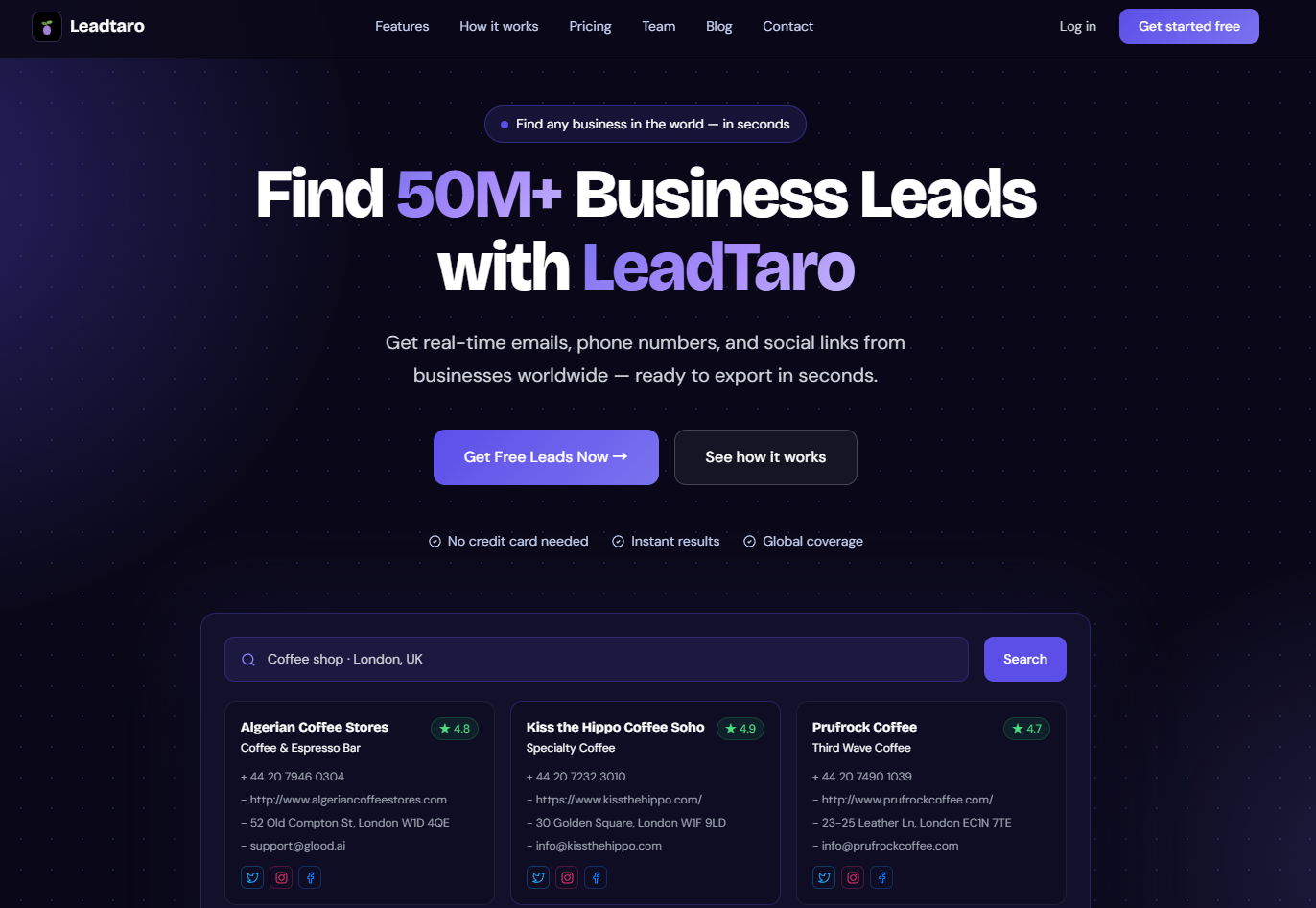
LeadTaro is designed to help users find B2B business leads across industries and locations. Depending on the available information for each business, records can include details such as company names, websites, phone numbers, email addresses, and social links.
Instead of building every prospect list from scratch, you can use business search to identify potential customers and then organize relevant leads for follow-up.
For teams that need to manage prospects beyond a spreadsheet, LeadTaro also provides a CRM pipeline and AI-assisted personalized email generation.
Four Ways to Get Local Business Leads with Contact Information
There are four common approaches to local business lead generation. Each has advantages and limitations.
MethodMain advantageMain limitationManual researchLow direct cost and detailed reviewTime-consumingPaid advertising and lead marketplacesCan generate inbound enquiriesCosts may rise, and access depends on the providerPurchased B2B databasesFast access to existing recordsCoverage and accuracy varyB2B lead generation platformsRepeatable prospect discovery and organizationAvailable contact details vary by businessMethod 1: Manual research
Manual research involves searching for businesses, opening their websites, locating contact information, and recording everything in a spreadsheet.
This approach can work well when you need a small, carefully selected list.
For example, a freelance designer might research 30 independent businesses in a particular town and write a tailored message to each one.
The problem appears when the list grows.
If every prospect requires several minutes of research, collecting hundreds or thousands of records can consume hours that could otherwise be spent selling or serving customers.
Manual research is best used for high-value prospects, qualification, and personalized research rather than every stage of large-scale list building.
Method 2: Paid advertising and lead marketplaces
Advertising platforms and lead marketplaces can connect businesses with people actively looking for certain services.
This approach can be useful for companies that want inbound enquiries rather than building outbound prospect lists.
However, the economics depend on the industry, competition, customer lifetime value, and cost per enquiry. You may also have limited control over the underlying data or the ability to reuse a marketplace's lead information.
These channels are worth considering when customers are already searching for your service. They are not necessarily the most efficient choice when your goal is to identify a defined group of businesses and approach them directly.
Method 3: Purchased B2B databases
Purchased databases provide preassembled business and professional contact records.
They can save research time, especially when you need contacts in established industries or specific job roles.
Before purchasing a list, examine the provider's coverage, data sources, update practices, permitted uses, and refund policy. Ask whether the database is suitable for your target geography and whether the contact fields you need are actually included.
A large database is not automatically a better database. Outdated email addresses, irrelevant companies, and poor targeting can reduce the value of an otherwise impressive record count.
Method 4: Use a B2B lead generation platform
A lead generation platform provides a more repeatable way to discover and organize potential business customers.
With LeadTaro, you can explore B2B leads across different business categories and countries, review available business contact information, and build lists relevant to your target market.
A practical workflow is straightforward:
Define the type of business you want to reach.
Search for companies relevant to your target market.
Review the available business information and contact fields.
Prioritize prospects that match your ideal customer profile.
Organize suitable leads in your CRM pipeline.
Prepare personalized outreach and track follow-up activity.
This approach combines scalable discovery with human qualification. Rather than treating every record as equally valuable, you can focus your attention on companies that are more likely to need your services.
How to Find Local Business Leads Step by Step
The best process starts with a clear target market. Collecting thousands of unrelated companies is rarely as useful as building a smaller list of relevant prospects.
Step 1: Define your ideal customer
Before searching for businesses, identify who is most likely to buy from you.
Consider the following questions:
Which industries need your product or service?
Which locations can you serve?
Are you targeting small businesses, growing companies, or larger organizations?
Who is likely to make the purchasing decision?
What problem does your product or service solve?
For example, a company selling appointment scheduling software might target salons, clinics, fitness studios, and other service businesses.
A web development agency might prioritize local businesses with outdated websites or weak online booking experiences.
A B2B software company might focus on companies operating in industries that match its product's use cases.
Specific targeting makes it easier to build relevant lists and write outreach messages that address real business needs.
Step 2: Search by business category and location
Once you know your ideal customer, search for companies that fit your criteria.
You might target:
Accountants in Manchester.
Roofing contractors in Yorkshire.
Restaurants in Birmingham.
Recruitment agencies across the United Kingdom.
Marketing agencies in the United States.
Independent retailers in selected European markets.
LeadTaro helps users discover B2B business leads across different categories and locations. This makes it possible to explore new markets without relying exclusively on referrals or manual directory searches.
Start with a manageable segment, such as one industry in one city. You can expand to additional locations once you understand which prospects generate the best results.
Step 3: Review contact information
A business name alone may not be enough for your sales process.
Review the available information for each prospect, including its website, published business email, phone number, and social profiles where available.
Do not assume that every business will have every field. Some companies publish an email address, while others prefer phone enquiries or contact forms.
You should also distinguish between general inboxes, such as info@company.com, and named professional contacts. They serve different purposes and may require different outreach approaches.
Before contacting a business, check that the information is relevant to your intended purpose and that your planned communication is permitted.
Step 4: Qualify your prospects
Not every company in your target category is a good fit.
Use the available information to identify businesses that appear relevant to your offer.
For example, a digital agency might prioritize companies with outdated websites, limited online booking options, or services that could benefit from improved conversion rates.
A software provider might focus on businesses whose operations appear to match the software's intended use.
Qualification can include:
Industry and location fit.
Business size, where reliably available.
Relevance of the company's services.
Publicly visible business needs.
Availability of appropriate contact channels.
Potential value of the relationship.
Avoid assuming that a business needs your product simply because it belongs to a particular industry. Treat visible signals as reasons to investigate, not proof of a purchasing need.
Step 5: Organize leads in a CRM
Once you have identified suitable prospects, organize them so you can track conversations and follow up consistently.
LeadTaro includes a CRM pipeline that helps users manage business prospects as they move through the sales process.
A simple pipeline might include:
New Lead
Contacted
Interested
Meeting
Closed
Record relevant notes, the last contact date, and the next action for each prospect.
This prevents promising opportunities from disappearing into a spreadsheet and makes it easier to understand which industries, locations, and outreach approaches are performing well.
Step 6: Personalize your outreach
The first message should explain why you are contacting that particular business.
Avoid sending the same generic pitch to every company. Use relevant observations about its services, market, or publicly visible business needs to explain how your offer might help.
LeadTaro's AI-assisted email generation can help you prepare personalized business outreach more efficiently. Review every generated message before sending it to ensure that the details are accurate, the offer is relevant, and the wording sounds natural.
The goal is to make outreach more relevant, not merely faster.
Scaling Lead Generation from One City to Multiple Markets
Building a list of 50 businesses in one town is relatively simple. Building a repeatable prospecting process across several cities or countries requires more planning.
The first step is to divide the market into useful segments.
For example, a marketing agency might create separate prospect lists for:
Restaurants in Leeds.
Dental practices in Manchester.
Home service companies in Birmingham.
Independent retailers in London.
This makes it easier to tailor the message to each industry and compare results across locations.
Expand in stages
Rather than immediately collecting every business you can find, use a staged approach.
Stage 1: Test one market. Build a small, relevant list and contact suitable businesses using an appropriate outreach method.
Stage 2: Measure the results. Track replies, meetings, qualified opportunities, and sales. A large list does not guarantee strong results.
Stage 3: Refine your targeting. Identify the industries and business characteristics associated with positive responses.
Stage 4: Expand to similar markets. Apply the lessons from your first campaign to additional locations and business categories.
Stage 5: Standardize your workflow. Use a CRM pipeline, consistent qualification criteria, and clear follow-up procedures to keep prospecting organized.
LeadTaro can support this process by helping you discover business leads, review available contact information, and organize prospects for outreach.
Keep in mind that actual coverage, record counts, and contact-field availability depend on the selected market and the information available for individual businesses. Check the results for your intended category and location before planning a campaign around a particular volume.
Why Contact Information Matters
The usefulness of a lead list depends on more than the number of companies it contains.
Imagine that you collect 1,000 businesses for a campaign. Some have a published email address, some provide only a phone number, and others may have no suitable contact channel.
Those differences affect what you can do next.
If your campaign relies on email, prioritize relevant businesses for which you have an appropriate email contact. If your offer is better suited to a phone conversation, review the available business phone details instead.
A practical way to evaluate your lead list is to track these metrics:
MetricWhat it tells youContact coverageThe proportion of records with the contact fields you needQualification rateThe proportion of businesses that fit your target marketDelivery rateThe proportion of emails successfully deliveredReply rateThe proportion of contacted prospects who respondMeeting rateThe proportion of prospects who book a meetingConversion rateThe proportion that become customersThese metrics help you identify where your process needs improvement.
For example, a low contact coverage rate may indicate that you need a different source or a narrower target market. A low reply rate may indicate that your messaging, timing, or qualification needs work.
Do not treat the presence of an email address as proof that it is valid, monitored, or appropriate for every type of outreach. Where accuracy matters, check contact details and monitor delivery results.
Turning Business Leads into Replies with Email and Calls
Collecting leads is only the beginning. The next challenge is starting conversations with the right businesses.
A good outreach process combines relevant targeting, useful messaging, and consistent follow-up.
Write an email that focuses on the business
A useful first email should be concise and specific.
Explain who you are, why the business is relevant to your offer, and what practical benefit you may be able to provide.
For example, a web design agency could write to a local business after reviewing its publicly available website and identifying an opportunity to improve mobile usability or simplify its enquiry process.
Avoid making unsupported claims about the business. If you have not verified a problem, frame it as a potential improvement rather than a fact.
Use AI to improve preparation
AI tools can help you summarize public business information, draft initial messages, and adapt the tone of your outreach for different industries.
LeadTaro's AI email generation can help streamline this work, while its CRM pipeline provides a place to organize prospects and track progress.
AI should support your judgment rather than replace it. Verify factual details, remove irrelevant statements, and ensure that each message accurately represents your product or service.
Combine email and phone outreach thoughtfully
Email is not always the most suitable channel for every business.
Depending on your offer and the recipient's published contact preferences, a phone call or another appropriate business communication channel may be more effective.
Use contact details for their intended purpose. Do not assume that a publicly available number is a mobile number or that a business email gives you permission to send unlimited marketing messages.
Measure the whole funnel
Do not judge a campaign solely by the number of messages sent.
Track how many prospects are qualified, how many messages are delivered, how many recipients respond, how many meetings are booked, and how many opportunities become customers.
Use these results to improve the next campaign.
A smaller, well-targeted list with relevant messaging can be more valuable than a much larger list of poorly matched businesses.
Is Collecting Local Business Leads Legal?
Collecting and using business information requires attention to the source of the data, the type of information collected, the method used to obtain it, and how it will be used.
Public availability does not automatically mean that every form of collection, storage, or marketing outreach is lawful.
In the United Kingdom and European Economic Area, the GDPR and related data protection laws may apply when information identifies an individual, including some business contact details. A company may be able to rely on legitimate interests for certain processing activities, but this requires an appropriate assessment and does not remove other legal obligations.
In the United Kingdom, electronic marketing is also subject to PECR. Rules can differ depending on whether the recipient is a corporate subscriber, a sole trader, or a particular kind of partnership. Personal data and individual subscriber rights must be considered separately.
In the United States, the CAN-SPAM Act establishes requirements for commercial email, including accurate sender information, non-deceptive subject lines, a valid postal address, and a functioning opt-out mechanism. Other federal and state rules may also apply.
Before collecting or contacting business leads:
Use appropriate, legitimate data sources and respect applicable terms.
Collect only information relevant to your business purpose.
Distinguish corporate contact details from personal information.
Identify the appropriate lawful basis where required.
Follow applicable email, telephone, and electronic marketing rules.
Provide required privacy information and honor opt-outs.
Maintain reasonable data security and retention practices.
LeadTaro can help users discover and organize B2B business leads, but using a lead generation platform does not automatically make every subsequent marketing activity compliant. You remain responsible for evaluating your own collection methods and outreach practices.
If you are running campaigns across multiple countries or handling substantial volumes of personal data, obtain advice appropriate to your jurisdiction and use case.
Frequently Asked Questions
How do I find local business leads?
Start by defining your target industry and location. Search for relevant businesses, review their websites and available contact information, and qualify prospects against your ideal customer profile. A platform such as LeadTaro can help you discover B2B leads and organize suitable prospects for follow-up.
How can I get local business leads for free?
You can research business directories and company websites manually, record relevant information in a spreadsheet, and qualify prospects yourself. This can be effective for small lists, although it requires time and manual effort.
LeadTaro offers a free plan that includes 60 B2B leads without requiring a credit card. Check the current plan details for any limits on lead access, contact unlocking, and export functionality.
Where can I find business email addresses and phone numbers?
Start with contact details that businesses publish on their websites and appropriate business listings. B2B lead generation platforms can also help you discover business records with available contact fields.
Coverage varies by industry and location, and not every business publishes an email address or phone number. Check the relevance and accuracy of contact information before using it.
Can I use LeadTaro to find businesses in different countries?
LeadTaro is designed to help users discover B2B business leads across different industries and locations. You can use it to explore potential markets and organize relevant prospects for your sales process. Available coverage and contact information may vary, so review the results for your intended market.
Can ChatGPT generate business leads?
ChatGPT can help you define an ideal customer profile, evaluate information you provide, draft outreach messages, and plan a prospecting workflow. However, it should not be treated as a guaranteed source of current, verified business contact information.
For actual prospect discovery, use an appropriate business data source or lead generation platform. You can then use AI to help qualify the information and prepare relevant outreach.
How many local business leads do I need?
There is no universal number. It depends on your target market, offer, sales cycle, contact coverage, and conversion rates.
Start with a manageable group of qualified businesses, measure the results, and expand when you have evidence that your targeting and outreach are working.
Is it legal to contact local businesses by email?
It depends on the recipient, jurisdiction, type of address, purpose of the message, and applicable marketing rules. Publicly listed contact information does not automatically authorize every type of marketing email. Check the relevant requirements, provide required identification and opt-out mechanisms, and honor objections.
What is the difference between a business lead list and a CRM?
A business lead list contains records of potential customers and relevant information about them. A CRM helps you manage those prospects throughout the sales process, including contact history, follow-up tasks, meetings, and opportunities.
LeadTaro combines B2B lead discovery with a CRM pipeline, helping users move from finding businesses to organizing sales activity.
Build Your Local Business Lead List with LeadTaro
Finding local business leads does not have to mean spending hours copying information into spreadsheets.
The most effective process starts with a clear target market, uses suitable business data sources, prioritizes relevant prospects, and follows up with personalized communication.
LeadTaro helps simplify this workflow by providing B2B lead discovery across industries and locations, available business contact information, AI-assisted email generation, and a CRM pipeline for managing prospects.
You can start with a focused market, evaluate the quality of the results, and expand your prospecting process as you learn which businesses are most likely to become customers.
Our free plan includes 60 B2B leads with no credit card required, giving you a way to explore the platform before deciding whether it fits your workflow.
Start building your B2B lead list with LeadTaro and turn business discovery into a more organized sales process.