Many B2B businesses don't have a lead generation problem. They have a targeting problem.
Sales teams spend hours contacting companies that will never become customers. Marketing campaigns attract the wrong audience. Cold emails receive few replies because the offer isn't relevant to the businesses receiving them.
A clearly defined Ideal Customer Profile (ICP) can help solve these problems by identifying the types of companies most likely to benefit from your product or service.
But understanding what an ICP is isn't enough. You need a practical template, a repeatable scoring system and a way to turn your profile into a list of real businesses to contact.
This guide includes a free seven-section B2B ICP template, a step-by-step process for completing it, a scoring rubric, practical examples and a workflow for turning your ICP into qualified sales opportunities.
Table of Contents
What Is an Ideal Customer Profile (ICP)?
ICP vs Buyer Persona: What's the Difference?
Why Your Business Needs a Documented ICP
The Free ICP Template: 7 Sections
How to Build Your ICP in 6 Steps
ICP Scoring Rubric: Prioritize Your Best Accounts
Ideal Customer Profile Examples for B2B
From ICP Template to Sales Pipeline with LeadTaro
5 Mistakes That Can Ruin Your ICP
FAQ
Conclusion
What Is an Ideal Customer Profile (ICP)?
An Ideal Customer Profile is a description of the type of company that is most likely to benefit from your product or service and become a valuable long-term customer.
In B2B sales, an ICP describes an organization rather than an individual. It typically includes characteristics such as industry, company size, location, technology stack, business challenges and potential buying signals.
For example, a CRM software company might target service businesses with 10–100 employees that manage customer information in spreadsheets and need a more organized sales process.
That description is much more useful than simply saying, "We sell to small businesses."
A practical ICP answers one important question:
Which companies should we prioritize because our product solves a problem they genuinely have?
Your ICP also helps define which prospects to avoid. Companies that are too small, operate in unsupported markets or lack the necessary infrastructure may be poor fits even if they initially appear interested.
What Should an Ideal Customer Profile Include?
A B2B ICP commonly includes the following characteristics:
Industry: The sectors most likely to need your solution.
Company size: Employee count, revenue range or number of locations.
Geography: Countries, regions or cities you can serve.
Technology: Existing tools, platforms and infrastructure.
Business challenges: Problems your product can solve.
Buying signals: Events or behaviors that suggest a potential need.
Qualification criteria: Conditions that make an account worth pursuing.
Disqualification criteria: Conditions that indicate a poor fit.
Your first version doesn't need to be perfect. Start with the information you already have, test it against real prospects and refine it as you learn which companies convert.
ICP vs Buyer Persona: What's the Difference?
An ICP and a buyer persona are related, but they serve different purposes.
An ICP describes the company you want to sell to. A buyer persona describes the person within that company who participates in the purchasing decision.
For example, a software company might target professional-services businesses with 20–100 employees. Its buyer persona could be an operations manager responsible for improving internal workflows.
The ICP identifies the right account. The persona helps you understand how to communicate with the people inside it.
Ideal Customer ProfileBuyer PersonaDescribes a company or accountDescribes an individualFocuses on industry, size, location and needsFocuses on role, goals and challengesAnswers: Which companies should we target?Answers: Who should we contact and how?Guides account selectionGuides messaging and outreachUsually developed firstDeveloped after the ICPBoth are important in B2B sales. However, building a buyer persona before deciding which companies to target can lead to wasted effort.
Start by defining your ideal accounts. Then identify the decision-makers, influencers and users you need to reach within those organizations.
Why Your Business Needs a Documented ICP
Without a documented ICP, different teams can have different ideas about what makes a good prospect.
Marketing might prioritize website traffic and form submissions. Sales might prioritize companies with an immediate need. Customer success might know that some customer types require significantly more support than others.
An ICP gives everyone a shared definition of a valuable account.
1. Improve Lead Quality
When you know which companies are a good fit, you can focus your prospecting on relevant accounts rather than collecting as many contacts as possible.
A smaller, targeted list can be more useful than a large database filled with businesses that are unlikely to buy.
2. Make Cold Outreach More Relevant
A defined ICP makes it easier to tailor messages to a specific industry, company type or business challenge.
For example, a message to a small accounting firm might focus on reducing manual administration, while an email to a growing agency might emphasize managing more clients efficiently.
3. Use Your Sales Team's Time More Effectively
Sales representatives have limited time for research, calls, follow-ups and meetings.
An ICP helps prioritize accounts that meet your qualification criteria and avoid spending excessive time on prospects that are unlikely to convert.
4. Improve Marketing Efficiency
When marketing understands which businesses are most likely to become successful customers, it can create more relevant content, campaigns and landing pages.
The result is a more consistent connection between the audience you attract and the customers your business wants to acquire.
5. Learn from Your Best Customers
Your existing customers provide valuable evidence about which ICP characteristics matter.
Look at which customers generate recurring revenue, remain with your business, expand their accounts and achieve the greatest value from your product.
Use those patterns to improve your profile rather than relying entirely on assumptions.
The Free ICP Template: 7 Sections
Use the following template to build your own Ideal Customer Profile. You can copy it into Google Sheets, Excel, Notion or a document and complete it with your team.
Section 1: Firmographics
Firmographics describe the characteristics of a company.
FieldYour ICPTarget industries[List your preferred industries]Company size[Employee or revenue range]Target locations[Countries, regions or cities]Business model[B2B, B2C, subscription, services, etc.]Company maturity[Startup, growing business, established company]Ownership type[Independent, franchise, subsidiary, etc.]Growth characteristics[Hiring, expansion, new locations, etc.]Example: Independent marketing agencies in the UK with 5–50 employees that serve small businesses and want to improve client acquisition.
Be as specific as your market and available data allow. If company revenue is difficult to establish, use other practical indicators such as employee count, number of locations or business type.
Section 2: Technographics
Technographics describe the technologies a company uses.
These details are particularly valuable when your product integrates with, replaces or complements existing software.
FieldYour ICPCRM[Current CRM or no CRM]Marketing software[Tools currently in use]Website platform[Relevant CMS or website technology]Sales tools[Prospecting, email or automation software]Technology gaps[Missing or outdated capabilities]Required integrations[Technologies your product must support]Example: B2B service companies using spreadsheets to manage prospects, without a dedicated CRM or automated follow-up process.
Do not make technology requirements unnecessarily restrictive. A company that doesn't use your preferred platform may still be an excellent customer if your product can solve its underlying problem.
Section 3: Buying Committee
Identify the people who influence or approve a purchase.
RoleTypical responsibilityDecision-makerApproves the purchase or budgetChampionAdvocates for the solution internallyInfluencerEvaluates options and provides recommendationsEnd userUses the product in daily workBlockerRaises objections or controls access to the decision-makerIn a small business, the owner may fill several of these roles. In a larger company, purchasing decisions may involve operations, IT, finance and department leadership.
Your outreach strategy should reflect the likely buying process instead of assuming that every contact can approve a purchase.
Section 4: Pain Points and Buying Triggers
Document the problems your product solves and the events that might make a company more likely to consider a solution.
Common business challenges:
Too much manual administration.
Inconsistent lead generation.
Poor visibility into the sales pipeline.
High customer acquisition costs.
Outdated business systems.
Difficulty managing growth.
Potential buying triggers:
A new office or business location.
Rapid hiring or expansion.
A change in leadership.
A new product or service launch.
An increase in sales activity.
A publicly announced funding round.
A trigger is a reason to investigate a prospect, not proof that the company is ready to buy. Verify important details before using them in outreach.
Section 5: Buyer Motivations and Priorities
Although the ICP focuses on the company, understanding the priorities of its decision-makers makes your targeting more useful.
Consider these questions:
What is the decision-maker trying to achieve?
Which business problems create the most pressure?
What outcomes would justify purchasing your product?
What risks could prevent a purchase?
What objections are likely to arise?
Which alternatives might the company consider?
Example: An agency owner wants to grow revenue without hiring additional researchers. They value reliable prospect data, a repeatable outreach process and clear visibility into follow-ups.
These insights help you explain the value of your offer in terms that matter to the prospect.
Section 6: Qualification Criteria
Define the minimum conditions a company should meet before your team invests significant sales effort.
For example:
The company operates in a target industry.
It is located in a supported market.
It has the size and business model your product serves.
It has a plausible need for your solution.
You can identify an appropriate contact route.
Your offer can realistically deliver value.
There is no obvious technical or regulatory barrier.
Separate essential requirements from desirable characteristics. Otherwise, your team may exclude promising prospects because they do not match every preference.
Section 7: Disqualification Criteria
A strong ICP defines who not to target as clearly as who to pursue.
Possible disqualification criteria include:
The company operates outside your service area.
Its industry is incompatible with your product.
It is too small or too large for your current offering.
It requires features your product does not support.
It has no plausible need for your solution.
It cannot meet essential purchasing requirements.
Its business model creates unacceptable delivery costs.
Use evidence from lost deals, failed onboarding and customer churn to refine this list.
The objective of the template is simple: make your target market specific enough to guide real decisions, without making it so restrictive that you miss viable customers.
How to Build Your ICP in 6 Steps
A useful ICP should be based on evidence from your market and customers, not just a brainstorming session.
Step 1: Analyze Your Best Existing Customers
Start with your closed-won deals and current customers.
Look beyond company size and revenue. Consider retention, profitability, expansion opportunities, onboarding effort and how successfully customers use your product.
Ask:
Which customers achieve the best results?
Which accounts are easiest to serve?
Which customers renew or purchase additional services?
Which industries produce the strongest opportunities?
Which customer types frequently churn?
If you are launching a new business and don't have enough customer data, use customer interviews, competitor research and a small prospecting campaign to create an initial hypothesis.
Step 2: Identify Common Characteristics
Look for patterns across your best accounts.
Perhaps your strongest customers are all professional-services firms with 10–50 employees. Perhaps they use a particular software category or face similar operational problems.
Prioritize characteristics that consistently relate to customer success, purchasing behavior or profitability.
Avoid assuming that a characteristic is important just because several customers share it. Test whether it actually helps predict better outcomes.
Step 3: Document Firmographics and Technology
Record the business attributes that can help you find similar companies.
Use information that is reasonably available and relevant to your market. For some businesses, industry and location may be enough to create an initial prospect list. Others may require detailed technology or organizational criteria.
Be realistic about what you can reliably determine before contacting a company.
Step 4: Identify Triggers and Pain Points
Ask what happened before your best customers decided to buy.
Did they expand into a new market? Replace an inefficient process? Hire a new team? Reach a point where manual work became too expensive?
These patterns can help you recognize similar opportunities in your target market.
Use public information and verified research to investigate potential triggers. Do not treat an assumption about a business as a confirmed fact.
Step 5: Define Disqualifiers
Review deals that failed, customers who churned and accounts that required excessive support.
Identify the factors that repeatedly predict a poor fit.
For example, if your product requires a dedicated sales team, very small businesses without sales responsibilities may not be suitable customers.
Disqualification criteria help reduce wasted prospecting effort and improve the consistency of your sales process.
Step 6: Test and Update Your ICP
Turn your draft profile into a practical campaign.
Find a manageable group of companies that match your criteria, contact relevant prospects and measure what happens.
Track metrics such as:
Percentage of prospects that match your ICP.
Valid contact rate.
Positive reply rate.
Meetings booked.
Qualified opportunities created.
Conversion to paying customers.
Customer retention and profitability.
Review these results regularly. If your highest-scoring prospects rarely convert, your criteria or scoring weights may need adjustment.
ICP Scoring Rubric: Prioritize Your Best Accounts
An ICP describes your target market. A scoring rubric helps you decide which accounts to contact first.
The following 100-point model is a starting point. Adapt it to your product, sales cycle and available information.
CategoryMaximum pointsWhat to evaluateFirmographic fit40Industry, company size and locationTechnology fit20Relevant tools, integrations and technology gapsBusiness need25Evidence of a problem your product solvesBuying readiness15Relevant triggers, timing and access to decision-makersTotal100How to Assign Points
Firmographic fit — 40 points
- Industry fit: 15 points.
- Company size fit: 15 points.
- Geographic fit: 10 points.
Technology fit — 20 points
- Compatible existing systems: up to 10 points.
- Relevant technology gaps or integration fit: up to 10 points.
Business need — 25 points
- Evidence of a relevant problem: up to 15 points.
- Potential value from solving the problem: up to 10 points.
Buying readiness — 15 points
- Relevant buying trigger: up to 10 points.
- Appropriate contact or decision-maker identified: up to 5 points.
Only award points when you have reasonable evidence. If a detail is unknown, mark it as unknown rather than automatically treating it as a positive signal.
Create Three Prospect Tiers
TierScoreRecommended actionTier A80–100Prioritize personalized research and outreachTier B50–79Use structured prospecting and follow-upTier C0–49Research further, nurture or deprioritizeThese thresholds are a starting point, not universal benchmarks. Review actual conversion results and adjust your scoring model accordingly.
For a small business with a short sales cycle, a simple checklist may be sufficient. More complex scoring is useful when you have many accounts, multiple sales representatives or a longer buying process.
Ideal Customer Profile Examples for B2B
The best ICP depends on the problem your product solves. Here are three practical examples you can adapt.
Example 1: B2B SaaS Company
Product: Workflow automation software.
FieldIdeal customer profileIndustryB2B SaaS and professional servicesCompany size50–500 employeesGeographyUK and EuropeDecision-makerHead of Operations or RevOpsMain challengeRepetitive manual processesBuying triggerTeam expansion or operational inefficiencyTechnology fitUses a CRM and several business applicationsDisqualifierRequires unsupported integrationsWhy this ICP works: It connects company characteristics to a specific operational problem. Prospecting can focus on organizations that are likely to benefit from automation rather than every company with a software budget.
Example 2: Digital Marketing Agency
Service: Website design and digital marketing.
FieldIdeal customer profileIndustryLocal service businessesCompany size5–50 employeesGeographySelected UK citiesDecision-makerOwner, director or marketing managerMain challengeWeak online presence or limited lead generationBuying triggerBusiness expansion or a new service launchTechnology fitWebsite or marketing capabilities that could be improvedDisqualifierOutside the agency's service areaWhy this ICP works: The agency can define a clear target market and investigate which businesses may benefit from its services. Each prospect should still be assessed individually before making claims about its online presence.
Example 3: CRM Software for Small Businesses
Product: Sales pipeline and customer management software.
FieldIdeal customer profileIndustryB2B service businessesCompany size10–100 employeesGeographyUK, US and other supported marketsDecision-makerBusiness owner or sales managerMain challengeDisorganized leads and inconsistent follow-upsBuying triggerGrowing sales team or increasing lead volumeTechnology fitSpreadsheet-based or fragmented sales processesDisqualifierRequires enterprise functionality not offeredWhy this ICP works: It focuses on companies that have a recognizable problem and could benefit from a more organized sales workflow.
What These Examples Have in Common
Each profile combines company characteristics with a business problem and a reason the product might be valuable.
A list of industries alone is not enough. A useful ICP explains why those businesses are good prospects, what makes them suitable and which conditions might disqualify them.
From ICP Template to Sales Pipeline with LeadTaro
Completing your ICP is only the beginning. The next step is finding real businesses that fit your profile and organizing your outreach.
This is where a B2B lead generation workflow can help.
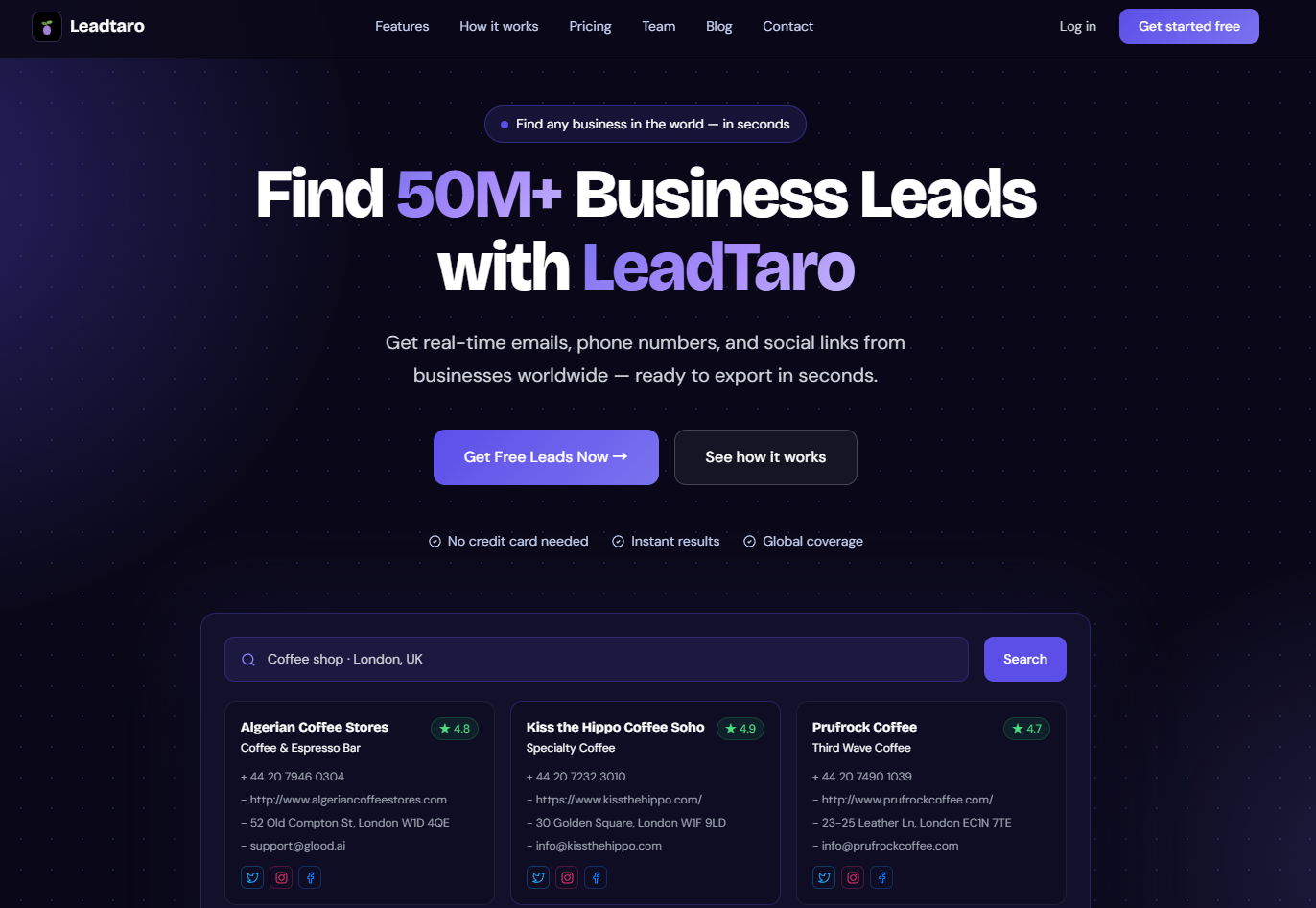
LeadTaro helps users discover business prospects, work with available business contact information and manage sales activity through a CRM pipeline. It also supports AI-assisted cold email creation, helping users prepare outreach based on their prospecting goals.
Here's how to connect your ICP to your lead generation process.
Step 1: Translate Your ICP into Search Criteria
Turn your template into practical criteria you can use when researching businesses.
For example, a marketing agency might define its ICP as:
Independent businesses in selected industries.
Located in specific UK cities.
Likely to benefit from website or marketing services.
With an accessible business contact method.
Without an obvious mismatch with the agency's services.
Not every ICP attribute will be available as a searchable filter. Treat your criteria as a research guide and verify details that cannot be established from the initial search.
Step 2: Find Businesses That Match Your Target Market
Use LeadTaro to support your B2B prospect research and identify businesses relevant to your campaign.
Rather than building one enormous list, start with a focused segment. For example, you could begin with accounting firms in one region or contractors in a particular market.
A narrow first campaign makes it easier to assess the quality of your targeting and refine your ICP.
Step 3: Review Available Contact Information
Depending on the business and available records, prospect information may include company names, websites, email addresses, phone numbers and public social links.
Review the fields you intend to use and validate contact details where possible. An available email address does not guarantee deliverability or permission to send a particular type of marketing message.
Prioritize the information that is most relevant to your sales process.
Step 4: Score and Segment Your Prospects
Apply your ICP scoring rubric to the businesses you find.
Separate high-fit accounts from prospects that need more research. You can then tailor your outreach to different segments instead of sending an identical message to every contact.
For example, an agency might create separate campaigns for restaurants, professional-services firms and home-service businesses.
Step 5: Create Personalized Outreach
Use LeadTaro's AI-assisted cold email creation to help draft messages for your target audience.
Give the AI a clear description of your offer, your ICP and the business problem you solve. Review the resulting draft carefully, verify any company-specific statements and make sure the message is appropriate for the recipient.
Effective personalization is about relevance, not simply inserting a company name into a template.
Step 6: Manage Your Leads in a CRM Pipeline
Once outreach begins, track each prospect through your sales process.
A pipeline can help you organize new leads, record follow-ups, identify interested prospects and track opportunities as they progress.
Review the results by ICP segment. If one industry consistently produces more qualified meetings or better customers, use that evidence to refine your targeting.
Try LeadTaro for Free
LeadTaro offers a free plan with 60 verified B2B leads and no credit card required. You can explore the platform and see how its lead generation, AI-assisted email creation and CRM workflow fit your prospecting process.
The goal is not to export the maximum number of businesses. It is to build a repeatable process that turns your ideal customer profile into relevant conversations and measurable sales opportunities.
5 Mistakes That Can Ruin Your ICP
Even a well-designed template can fail if it is based on poor assumptions or never gets used.
1. Making Your ICP Too Broad
"Small businesses that want to grow" is not a useful ICP.
It includes too many different industries, company sizes and business needs to guide effective prospecting.
Narrow the profile using evidence about which companies benefit most from your product.
2. Confusing an ICP with a Buyer Persona
A profile describing a marketing manager's age, goals and daily challenges is not a complete company-level ICP.
Start with the organization, then define the people involved in purchasing decisions.
3. Using Assumptions Instead of Evidence
It is easy to assume that large companies are better customers or that businesses using a particular technology are more likely to buy.
Validate those assumptions against closed-won deals, customer interviews and campaign results.
4. Never Updating the Profile
Markets change. Products evolve. New competitors emerge, and the characteristics of your best customers may shift.
Review your ICP regularly, especially when entering a new market or changing your product positioning.
5. Never Turning the ICP into Action
A document that sits in a folder will not improve your pipeline.
Use your ICP to guide prospect searches, qualification, lead scoring, messaging and sales reporting. Then compare your assumptions with the results.
The ultimate test of an ICP is whether it helps your team find better prospects and win more suitable customers.
FAQ
What is an Ideal Customer Profile example?
A B2B workflow software company's ICP might include professional-services firms with 50–500 employees that rely on several disconnected applications and need to reduce manual processes. Its decision-makers could include operations leaders, and a key disqualifier might be a requirement for unsupported integrations.
What should an ICP template include?
A practical B2B ICP template should cover firmographics, technographics, buying committee, pain points and triggers, buyer motivations, qualification criteria and disqualification criteria. A scoring rubric can help prioritize accounts based on their fit and potential value.
What is the difference between an ICP and a buyer persona?
An ICP describes the organization most likely to benefit from your product. A buyer persona describes the individual or role involved in evaluating and purchasing it. The ICP helps identify target accounts, while the persona helps shape messaging and outreach.
How do I create an ICP from scratch?
Start with your best customers if you have them. Identify shared characteristics, document the problems your product solves, define qualification and disqualification criteria, and test the profile against a real group of prospects. If you are a new business, use interviews and small prospecting experiments to validate your initial assumptions.
How often should I update my ICP?
Review it whenever your product, target market or sales results change significantly. A quarterly review can work well for fast-changing markets, while a stable business may need less frequent revisions. Use actual sales and customer outcomes to guide updates.
How do I turn my ICP into a lead list?
Translate your profile into practical search criteria, find businesses that match, review available contact details and score each prospect. B2B lead generation platforms such as LeadTaro can support prospect discovery and help organize outreach through AI-assisted cold email creation and CRM pipeline management.
Can AI create an Ideal Customer Profile?
AI can help organize customer data, identify potential patterns and draft an initial ICP. However, its recommendations should be checked against real customer outcomes. AI cannot reliably determine your ideal market without relevant evidence about your product, customers and business goals.
Conclusion: Build Your ICP, Then Put It to Work
An Ideal Customer Profile should do more than describe your dream customer. It should guide the decisions your team makes every day.
Use the seven-section template to document your target market, define qualification and disqualification criteria, and build a scoring model that reflects your business goals.
Then test your assumptions against real prospects. Track which companies respond, which opportunities progress and which customers ultimately achieve the best results.
Finally, turn your profile into an operational sales process. Use a B2B lead generation platform such as LeadTaro to support prospect research, prepare relevant outreach and manage leads through your pipeline.
Document your ICP. Find the right businesses. Qualify your prospects. Improve your pipeline with evidence.
That's how a customer profile becomes a practical growth tool rather than another forgotten document.