Inbound and outbound lead generation are two of the most important ways B2B companies attract potential customers. Inbound helps businesses attract prospects through content, search engines, referrals, and other channels. Outbound allows sales teams to proactively identify suitable businesses and initiate conversations.
But which approach works better in 2026?
The answer depends on your business model, budget, sales cycle, and growth objectives. Inbound can create a sustainable source of qualified opportunities over time, while outbound gives you more control over which prospects you target and when you approach them.
For many B2B companies, the most effective strategy is not choosing one over the other. It's building a system in which inbound and outbound support the same sales process.
In this guide, we'll explain the differences between inbound and outbound leads, compare their advantages and disadvantages, explore practical lead generation strategies, and show how businesses can combine both approaches using business data, CRM workflows, and AI-assisted outreach.
Table of Contents
What Are Inbound and Outbound Leads?
Inbound vs. Outbound Leads: Key Differences
Inbound Lead Generation Strategies That Work in 2026
Outbound Lead Generation Strategies for B2B
Why the Best B2B Teams Combine Both
How to Build a Hybrid Lead Generation Workflow
Choosing the Right Lead Generation Tools
Compliance for Inbound and Outbound Lead Generation
Frequently Asked Questions
What Are Inbound and Outbound Leads?
What Is an Inbound Lead?
An inbound lead is a potential customer who discovers your business and initiates contact or expresses interest in your offering.
This can happen when someone:
Finds your website through a Google search.
Reads a blog post and requests more information.
Downloads a useful resource.
Subscribes to your newsletter.
Contacts your company through a website form.
Discovers your business through social media or a referral.
For example, imagine a business owner searching for a CRM to manage sales prospects. They discover your website through an article comparing CRM software, explore your product, and request a demonstration.
That person becomes an inbound lead because their interest brought them to your business.
Inbound leads can be valuable because prospects may already understand the problem they're trying to solve. However, downloading a resource or submitting a form does not automatically mean someone is ready to buy. Qualification is still necessary.
What Is an Outbound Lead?
An outbound lead is a potential customer your business identifies and proactively approaches.
Instead of waiting for someone to discover your company, you research suitable prospects and initiate contact through appropriate channels.
Common outbound lead generation methods include:
Cold email outreach.
B2B cold calling.
LinkedIn prospecting.
Targeted account-based marketing.
Industry-specific prospect lists.
Direct outreach to local businesses.
For example, a marketing agency may identify 500 independent dental practices in its target region, review their websites, find appropriate business contact information, and contact selected practices with a relevant offer.
These are outbound prospects because the agency initiated the relationship.
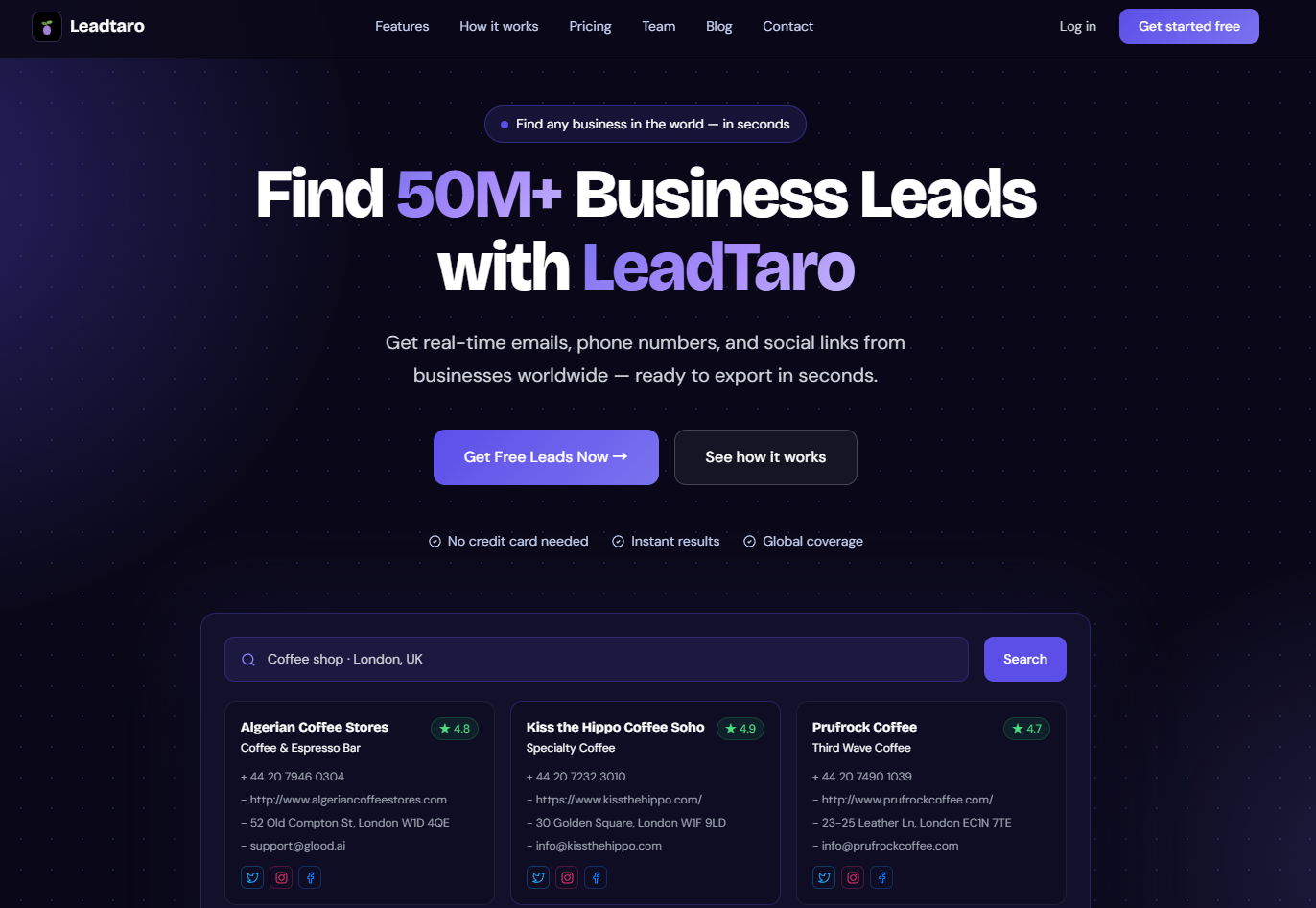
Tools such as LeadTaro can support this workflow by helping users discover businesses, collect available lead information, organize prospects, and prepare personalized outreach.
Inbound vs. Outbound Leads: Quick Comparison
CriteriaInbound leadsOutbound leadsWho initiates contact?The prospectYour sales teamTypical starting pointSearch, content, referrals, formsBusiness research, prospect lists, targeted outreachPurchase intentMay be higher, depending on the sourceOften unknown until the prospect respondsTargeting controlDepends on who discovers your businessYou select the businesses to approachTime to launchContent and SEO may take time to gain tractionTargeted campaigns can launch relatively quicklyUpfront investmentContent, SEO, website, and distributionResearch, data, outreach tools, and sales timeLong-term potentialContent can continue attracting prospectsRequires ongoing prospecting and follow-upMain challengeGenerating consistent qualified demandReaching the right people with relevant messagesNeither channel automatically produces better customers. Results depend on the quality of your targeting, the relevance of your offer, and how effectively your team qualifies and converts prospects.
Inbound vs. Outbound Leads: Key Differences
Understanding the practical differences between inbound and outbound helps you allocate resources more effectively.
1. Cost Per Lead
Inbound marketing can become cost-efficient over time because useful content may attract visitors and generate leads long after publication.
For example, a detailed article ranking for a relevant search query can continue bringing potential customers without requiring a separate advertising payment for every visitor.
However, content creation, technical SEO, distribution, and ongoing maintenance all require investment. Organic traffic is not free simply because there is no direct cost per click.
Outbound prospecting has a different cost structure. Each campaign requires research, contact data, outreach preparation, follow-up, and sales time.
A targeted outbound campaign may generate opportunities quickly, but poor-quality data and irrelevant messaging can make it expensive.
Which is cheaper? Neither is universally cheaper. Compare the full cost of acquiring a qualified opportunity or paying customer rather than looking only at the cost per lead.
2. Time to Results
Outbound can be useful when a business needs to generate conversations quickly.
A sales team can define its target market, identify suitable businesses, prepare a campaign, and begin outreach without waiting for its website to gain search visibility.
Inbound usually requires more time to establish consistent organic traffic. The timeline depends on competition, website authority, content quality, search demand, and distribution.
This creates a practical distinction:
If you need to validate a new offer or start conversations this month, outbound can help.
If you want to build a sustainable source of inbound demand, invest in content, SEO, and other discovery channels.
If you want immediate learning and long-term growth, run both in parallel.
3. Lead Quality and Conversion Rates
Inbound leads may demonstrate stronger initial interest because they have actively searched for information or contacted your company.
However, not all inbound leads are qualified. Some visitors are researching, comparing options, looking for free resources, or simply exploring a topic.
Outbound prospects may have little initial awareness of your business, but they can be carefully selected to match your ideal customer profile.
For instance, an outbound campaign targeting accounting firms with a specific operational problem may produce more relevant opportunities than an inbound form receiving inquiries from unrelated industries.
To compare the two channels fairly, track:
Percentage of leads matching your ICP.
Positive reply and engagement rates.
Qualified meetings booked.
Sales opportunities created.
Opportunity-to-customer conversion.
Customer acquisition cost.
Revenue generated per channel.
These metrics reveal whether a channel generates commercially valuable prospects rather than merely producing a large number of contacts.
4. Deal Size and Targeting Control
Outbound gives your team greater control over which companies enter the prospecting process.
You can target a particular industry, company size, location, or business type. You can also create a focused list of high-value accounts and develop outreach around their specific needs.
Inbound attracts people who discover your business. You can influence that audience through content topics, SEO, positioning, and distribution, but you cannot completely control which companies arrive.
For account-based selling, outbound can be especially useful because the team starts with a defined set of target accounts.
Inbound remains valuable for building credibility with those same accounts. A prospect who receives an outbound email may later search for your company, read your content, and review your website before agreeing to a meeting.
5. Long-Term Growth
Inbound and outbound operate on different timelines.
Inbound content can continue generating traffic and leads after the initial work has been completed. Over time, a strong library of useful content may reduce reliance on paid acquisition and direct prospecting.
Outbound creates opportunities through ongoing targeting and outreach. Campaigns can be adjusted quickly when your target market or offer changes, but they require continued effort.
The most useful comparison is therefore not which channel wins every metric. It's which combination produces the best results for your business over time.
Inbound Lead Generation Strategies That Work in 2026
Inbound lead generation works best when you consistently help the right audience discover your business and understand how you solve its problems.
1. SEO and Content Marketing
Search engine optimization helps potential customers find your website when they search for relevant questions, problems, and solutions.
For B2B companies, useful content includes:
Practical industry guides.
Product and service comparisons.
Step-by-step tutorials.
Templates and calculators.
Case studies with verifiable results.
Answers to specific customer questions.
For example, a CRM platform targeting small sales teams could publish content about organizing prospect lists, qualifying leads, improving follow-up, and measuring sales pipeline performance.
The objective is not simply to publish more articles. It is to attract the right audience and help readers progress toward a relevant next step.
Include clear calls to action, such as exploring a product, trying a workflow, requesting a demonstration, or reading a related guide.
2. Lead Magnets and Useful Resources
A lead magnet is a resource offered in exchange for contact information or another action.
Examples include:
Prospecting templates.
Industry-specific checklists.
Sales email examples.
CRM setup guides.
Lead qualification worksheets.
Market research reports.
The resource should solve a real problem for the intended audience.
A generic ebook may attract visitors without generating qualified prospects. A practical template designed for your ideal customer is more likely to attract people who can benefit from your product.
3. Social Media and Community Participation
Social platforms can help businesses distribute content, demonstrate expertise, and build relationships with potential customers.
LinkedIn can be particularly relevant for B2B companies, while other platforms may be more effective for particular industries and audiences.
Useful activities include sharing practical insights, explaining customer problems, discussing industry developments, and answering relevant questions.
Avoid treating every interaction as a direct sales opportunity. Inbound social activity is most valuable when it establishes credibility and encourages the right people to learn more about your business.
4. Referrals and Customer Advocacy
Satisfied customers can become a valuable source of new business.
A structured referral process can include requesting introductions after successful projects, encouraging reviews where appropriate, and creating partnerships with complementary service providers.
Referral leads often arrive with useful context or an existing level of trust. However, the volume of referrals may be difficult to control, so they work best alongside other acquisition channels.
5. Website Conversion Optimization
Attracting visitors is only one part of inbound lead generation. Your website also needs to help relevant visitors take the next step.
Consider whether your site clearly explains:
Who your product or service is for.
Which problems it solves.
How it works.
What evidence supports your claims.
What a visitor should do next.
Measure form submissions, qualified inquiries, booked meetings, and eventual sales. A page that attracts less traffic but generates more qualified opportunities may be more valuable than a high-traffic page with poor conversion.
Outbound Lead Generation Strategies for B2B
Outbound lead generation is particularly useful when you know which businesses you want to reach and can explain why your offer is relevant to them.
1. Cold Email Outreach
Cold email involves contacting a potential business customer who has not previously engaged with your company.
An effective campaign starts with targeting rather than writing.
First, define your ICP. Then identify suitable prospects, verify relevant business information, and create a message that connects a specific problem to your offer.
For example, a web design agency contacting an independent dental practice might reference a verified issue with its online appointment process and explain how the agency could improve the experience.
A practical cold email should:
Explain why the message is relevant to the recipient.
Communicate one clear potential benefit.
Avoid unsupported assumptions.
Use a simple, low-friction call to action.
Identify the sender accurately.
Respect applicable marketing and data protection rules.
Follow-up messages can improve visibility, but repeated outreach should remain relevant and proportionate. Stop when a recipient opts out or otherwise indicates that they do not want further contact.
2. B2B Cold Calling
Cold calling allows sales representatives to initiate a direct conversation with a potential customer.
It can be effective when the target audience is reachable by phone and the offer is relevant enough to justify a conversation.
Research matters. Before calling, understand what the business does, why it matches your ICP, and what problem your offer could address.
Rather than delivering a long generic pitch, open with a concise explanation of the reason for the call and ask whether the topic is relevant.
Cold calling can also complement email outreach. An email can introduce the topic, while a subsequent call may help determine whether the prospect is interested.
Always consider applicable calling restrictions, consent requirements, and suppression or do-not-call lists.
3. Business Data and Targeted Prospecting
One of the main advantages of outbound is the ability to select your target audience before contacting anyone.
Instead of collecting random contacts, build lists around specific industries, geographic markets, and business characteristics.
For example, a marketing agency could target:
Independent restaurants in selected cities.
Dental practices with websites that need specific improvements.
Accountancy firms serving small businesses.
Local service providers within a defined service area.
Companies that match the profile of existing successful customers.
Useful information may include business name, category, location, website, available contact details, and relevant public business information.
LeadTaro can support business discovery and lead collection, helping teams organize prospects around their target markets.
Once the records are collected, prioritize the businesses that best match your offer rather than sending the same message to every contact.
4. LinkedIn and Account-Based Outreach
LinkedIn can help B2B sales teams research companies, understand professional roles, and initiate relevant conversations.
For account-based marketing, select a group of high-value businesses and research the people involved in the purchasing decision.
An account-based campaign might combine:
Company research.
Relevant industry content.
Personalized email outreach.
Appropriate professional networking.
Sales calls where permitted.
Follow-up based on genuine engagement.
The purpose is to coordinate outreach around a defined account rather than treating every prospect as an isolated contact.
5. Multi-Channel Outreach
Different prospects prefer different communication channels.
A coordinated campaign may combine email, phone, LinkedIn, and useful content, provided each channel is appropriate for the recipient and permitted under applicable rules.
For example, a prospect might receive a relevant introduction, visit your website to learn more, and later respond to a follow-up message.
Track the results of each channel and the combined campaign. Avoid assuming that a channel caused a sale simply because it was the final interaction before conversion.
Why the Best B2B Teams Combine Both
Inbound and outbound solve different problems, which makes them complementary rather than mutually exclusive.
Inbound helps prospects discover your company, understand your expertise, and develop confidence in your offer.
Outbound helps you identify specific businesses that match your ICP and initiate conversations before they actively search for a solution.
When coordinated, these channels can reinforce each other.
Inbound Builds Credibility for Outbound
Imagine your sales team contacts a business owner about a relevant service.
The owner may not reply immediately. Instead, they search for your company and explore your website.
If they find helpful articles, clear product information, and credible examples of your work, they have more information to evaluate your offer.
Your outbound message initiated the discovery process, while your inbound content helped establish credibility.
Outbound Helps You Learn Which Inbound Content to Create
Outbound conversations can reveal recurring customer questions, objections, and unmet needs.
If multiple prospects ask how to organize sales leads across several locations, that topic may deserve a detailed article or practical guide.
The resulting content can support future inbound acquisition while also giving sales representatives a useful resource to share with prospects.
Inbound and Outbound Support Different Stages of Growth
A new B2B company may use outbound to validate its positioning, identify early customers, and learn which market segments respond.
At the same time, it can begin building inbound assets such as product guides, SEO articles, and educational resources.
As organic traffic and brand awareness grow, inbound may contribute a larger share of qualified opportunities. Outbound can remain focused on strategic accounts, new markets, and specific customer segments.
The right balance depends on performance, not a universal rule about which channel should receive the most budget.
How to Build a Hybrid Lead Generation Workflow
Combining inbound and outbound becomes easier when both channels feed into one organized sales process.
Step 1: Define Your Ideal Customer Profile
Identify the industries, company characteristics, geographic areas, and business needs associated with your best customers.
Use the same core ICP to guide both inbound content and outbound targeting.
Step 2: Build Your Inbound Foundation
Create useful website content, improve your product pages, and develop resources that answer your audience's questions.
Make it easy for interested visitors to understand your offer and contact your business.
Step 3: Discover and Qualify Outbound Prospects
Use business discovery and lead data tools to identify companies that match your ICP.
Collect relevant information, verify important details, and prioritize prospects based on fit and identifiable opportunities.
Step 4: Personalize Outreach
Create messages that connect each prospect's business context to a relevant problem your product or service can solve.
AI-assisted writing can speed up drafting and personalization, but review every message to ensure its claims are accurate and its content is appropriate.
Step 5: Centralize Lead Management
Store inbound inquiries and outbound prospects in an organized CRM workflow.
Useful fields include:
Lead source.
Company and contact details.
Industry and location.
Qualification status.
Outreach history.
Last contact and next action.
Sales stage.
Outcome and reason for disqualification.
LeadTaro supports business prospecting, lead organization, CRM pipeline management, and AI-assisted email writing, making it relevant to teams that want to connect prospect discovery with subsequent outreach.
Step 6: Measure Results by Channel
Track both channel-level and combined performance.
KPIWhat it tells youQualified leadsWhether the channel attracts suitable prospectsCost per qualified leadHow efficiently you generate relevant opportunitiesPositive reply rateWhether outbound messaging creates interestLead-to-meeting rateWhether prospects progress to conversationsMeeting-to-opportunity rateWhether conversations produce genuine sales opportunitiesOpportunity-to-customer rateWhether the pipeline converts into customersCustomer acquisition costHow much it costs to acquire a customerRevenue by sourceWhich channels contribute to business resultsUse consistent definitions and compare results over an appropriate period. Inbound and outbound may have different sales cycles, so evaluating both over the same short window can produce misleading conclusions.
Step 7: Improve the System Continuously
Use the results to refine your strategy.
If inbound traffic is high but few visitors become qualified leads, improve your targeting, content relevance, and conversion process.
If outbound produces many replies but few meetings, review your messaging and call to action.
If meetings happen but deals rarely close, revisit your qualification criteria, offer, and sales process.
The objective is to improve the entire customer acquisition system rather than optimizing a single metric in isolation.
Choosing the Right Lead Generation Tools
Your technology stack should support the workflow you actually need.
ToolPrimary purposeBest suited forLeadTaroBusiness discovery, lead data collection, CRM pipeline management, and AI-assisted outreachB2B teams prospecting businesses and organizing outbound salesHubSpotCRM, inbound marketing, and marketing automationTeams managing content-driven acquisition and customer relationshipsSalesforceCRM, account management, and sales operationsOrganizations with complex sales processesLinkedIn Sales NavigatorProfessional prospect research and account discoveryTeams targeting specific companies and decision-makersGoogle Analytics and Search ConsoleWebsite and organic search measurementTeams evaluating inbound traffic and search performanceEmail marketing platformsSubscriber communications and campaign managementBusinesses nurturing contacts who can lawfully receive their communicationsThe best combination depends on your requirements, budget, integrations, and existing workflow. Check current features and pricing before selecting a product.
Where LeadTaro Fits
LeadTaro is particularly relevant to the outbound side of a hybrid lead generation strategy.
Teams can use business discovery to identify companies in their target markets, collect available lead information, organize prospects, manage sales pipeline activity, and prepare personalized outreach with AI assistance.
Inbound content and website analytics can then help support the broader acquisition strategy by attracting prospects and establishing credibility.
For a small team, the practical objective is to avoid unnecessary fragmentation: discover suitable businesses, organize the records, prioritize the next action, and track what happens after outreach.
Explore LeadTaro to learn more about its business prospecting and lead management workflow.
Compliance for Inbound and Outbound Lead Generation
Both inbound and outbound lead generation involve responsibilities around how contact information is collected, stored, and used.
Email Marketing and Cold Outreach
In the United States, commercial email is subject to CAN-SPAM requirements.
For UK and European campaigns, relevant rules may include UK GDPR, EU GDPR, the UK's Privacy and Electronic Communications Regulations (PECR), and applicable national legislation.
The exact requirements depend on the recipient, communication channel, type of contact information, jurisdiction, and purpose of the campaign.
Before contacting prospects:
Identify the applicable rules for the target market.
Establish an appropriate lawful basis for processing personal data where required.
Provide required privacy information.
Follow applicable consent and electronic marketing requirements.
Identify the sender accurately.
Provide effective opt-out mechanisms where required.
Maintain suppression lists and honor objections.
Avoid collecting or retaining unnecessary personal information.
A publicly visible business listing does not automatically authorize every type of marketing communication. Public availability, data protection compliance, and permission to send electronic marketing are separate considerations.
Inbound Data and Privacy
Inbound lead generation also requires appropriate handling of personal data.
If visitors submit forms, subscribe to a mailing list, or request information, explain how their data will be used and apply the relevant privacy and marketing rules.
Collect only the information needed for the stated purpose, protect it appropriately, and honor applicable rights and preferences.
When using external prospecting or enrichment tools, review their data sources, processing terms, and available compliance documentation.
Frequently Asked Questions
What is the main difference between inbound and outbound leads?
Inbound leads discover your business and initiate contact or express interest. Outbound leads are prospects your team identifies and approaches proactively.
Inbound focuses on attracting demand, while outbound focuses on targeting and initiating conversations.
Which is better, inbound or outbound lead generation?
Neither is universally better.
Inbound can build a sustainable source of qualified leads over time. Outbound offers more control over which prospects you approach and can be launched without waiting for organic search visibility.
The right approach depends on your goals, budget, sales cycle, and target audience.
Is cold email inbound or outbound marketing?
Cold email is an outbound marketing method because the sender initiates contact with a prospect who has not necessarily expressed interest.
Email newsletters and promotional messages sent to an appropriately established subscriber audience are generally associated with inbound marketing or customer nurturing, subject to applicable consent and marketing rules.
Are inbound leads more qualified than outbound leads?
Inbound leads may show stronger initial interest, but that does not guarantee they match your ICP or have purchasing authority.
Outbound prospects may initially be unfamiliar with your business but can be selected according to relevant company characteristics.
Qualification and conversion data are more useful than assuming one channel always produces better leads.
How much does inbound lead generation cost?
Costs vary by industry, competition, content production, SEO investment, advertising, and conversion performance.
Inbound campaigns may require substantial initial investment before generating meaningful organic traffic. Evaluate cost per qualified lead and customer acquisition cost rather than relying on a universal price per lead.
How much does outbound lead generation cost?
Outbound costs depend on prospect research, data quality, tools, sales time, messaging, and follow-up.
A well-targeted campaign can be efficient, but large lists of unsuitable contacts can waste resources. Focus on the cost of generating qualified opportunities and customers.
Can small businesses use both inbound and outbound?
Yes. A small business can begin with a focused outbound campaign to identify potential customers while publishing useful content that supports credibility and future inbound demand.
It does not need an extensive marketing department to start. A clear ICP, a manageable prospect list, a simple CRM workflow, and a consistent content plan can provide a foundation.
How can AI improve inbound and outbound lead generation?
AI can help research prospects, summarize business information, draft personalized emails, categorize leads, analyze campaign results, and identify patterns in historical sales data.
However, generated information should be verified, and AI-generated personalization should not include unsupported claims. Human review remains important for relevance, accuracy, and compliance.
Can LeadTaro help with outbound lead generation?
LeadTaro supports business discovery, available lead data collection, prospect organization, CRM pipeline management, and AI-assisted email writing.
These capabilities can help teams organize their outbound workflow from identifying suitable businesses to preparing outreach and tracking prospects through the sales process. Review the current product offering for the specific features and integrations available to your account.
Final Thoughts: Build a Lead Generation System, Not a Channel Debate
Inbound and outbound lead generation are not competing strategies that require you to choose one forever.
Inbound helps potential customers discover your business, understand your expertise, and develop confidence in your offer.
Outbound allows you to identify suitable prospects, approach specific markets, and initiate conversations with businesses that may benefit from your solution.
The strongest strategy connects both approaches through a shared ideal customer profile, consistent lead management, relevant messaging, and reliable performance measurement.
Start with the channel that best addresses your immediate constraints. If you need to validate an offer and generate conversations, targeted outbound may be a practical starting point. If you want to build long-term organic demand, invest in useful content and SEO. Whenever resources permit, develop both and let performance determine how you allocate your effort.
With the right process and tools, inbound creates opportunities for prospects to find you, outbound helps you find the right prospects, and your CRM connects both into a measurable sales pipeline.
Ready to organize your B2B prospecting workflow? Explore LeadTaro to discover businesses, collect lead information, manage your pipeline, and prepare personalized outreach with AI assistance.