Expanding into international markets gives B2B companies the opportunity to reach new customers, explore different industries, and diversify their sales pipelines. However, finding relevant prospects in another country requires more than translating your existing sales emails.
You need to understand your target market, discover suitable businesses, review available contact information, and adapt your outreach to local business expectations.
The good news is that international prospecting can be organized into a repeatable process. With the right research methods, B2B lead generation tools, and a structured CRM workflow, businesses can identify prospects across different markets without managing every step manually.
In this guide, we'll explain how to find international B2B leads, evaluate potential markets, personalize cross-border outreach, and use LeadTaro to support business lead discovery and sales pipeline management.
Table of Contents
Why International Lead Generation Matters for B2B
The Challenges of Finding Quality Leads Across Borders
Choosing the Right Sources for International B2B Leads
Step-by-Step: How to Find B2B Leads in Any Country
5 International Lead Generation Strategies That Work in 2026
How to Build an International Lead Generation Workflow
Measuring International Lead Generation Performance
Compliance and Legal Considerations
FAQ: International Lead Generation
Why International Lead Generation Matters for B2B
A company that sells successfully in one country may eventually reach a point where its domestic market becomes more difficult to grow. Expanding internationally can create new opportunities by introducing its products or services to businesses with different needs.
For example, a UK software company might explore customers in Germany, France, or the Netherlands. A marketing agency could offer its services to businesses in other English-speaking markets. A manufacturer might identify distributors or commercial buyers in countries where demand for its products is growing.
International lead generation helps businesses identify those opportunities and turn broad market research into a list of potential customers.
The Benefits of International B2B Prospecting
Access to new markets
Discover businesses beyond your existing geographic area and evaluate whether your offering fits their needs.
Diversified sales opportunities
Expanding into multiple markets may reduce dependence on a single customer segment or geographic region.
More focused market research
Organizing prospects by country, industry, and business type helps you compare markets and identify promising segments.
A more structured sales process
A consistent approach to lead discovery, outreach, and CRM tracking makes it easier to manage prospects across multiple regions.
International expansion does require preparation. Different markets have different languages, buying expectations, competition, regulations, and customer acquisition costs. Start by validating demand in a focused segment before expanding your outreach too broadly.
The Challenges of Finding Quality Leads Across Borders
International B2B prospecting introduces several challenges that may be less noticeable when you operate in a familiar domestic market.
1. Business Data Can Be Fragmented
Business information is distributed across company websites, directories, professional networks, industry associations, and other sources.
The availability and completeness of that information can vary significantly by country and industry. Some businesses publish detailed contact information, while others provide only a website or general telephone number.
A useful prospecting process should bring the available information together in a format that makes it easier to review and prioritize companies.
2. Your Ideal Customer May Differ by Market
A product that appeals to one customer segment in your home country may attract a different audience abroad.
For example, a software company targeting small professional service firms in the UK might discover that a different company size or industry is more suitable in another market.
Before building a large international prospect list, define the business characteristics that indicate a potential fit and test whether they apply to your chosen country.
3. Language and Cultural Differences Matter
Translating a message word for word does not guarantee that it will sound natural or relevant.
Business communication styles, preferred contact methods, decision-making processes, and expectations around follow-ups can differ between markets.
International outreach should account for those differences instead of assuming that a successful domestic campaign will work unchanged everywhere.
4. Contact Data Needs Review
An email address or telephone number is useful only if it is relevant to the business and suitable for your intended communication.
International prospect lists may contain outdated details, incomplete records, duplicate companies, or contacts that do not fit your ideal customer profile.
Reviewing the available information before outreach can reduce wasted effort and help you focus on more relevant prospects.
Choosing the Right Sources for International B2B Leads
There is no single source that provides complete, accurate information about every business in every country. The best approach depends on your target audience and the type of information you need.
Business Search Engines and Online Directories
Business search engines and directories can help you discover companies by industry, location, and business category.
They are useful starting points for finding local businesses, particularly when your target audience includes retailers, restaurants, professional service providers, contractors, and other small or medium-sized companies.
However, information availability varies, and some records may require additional verification.
Company Websites
Company websites can help you confirm what a business does, which markets it serves, and whether its services fit your offer.
They may also provide official contact information, product details, company announcements, and other useful context for personalized outreach.
Professional Networks
Professional networks can help you research decision-makers, understand their roles, and establish professional relationships.
They can complement business-level research when you need to identify the people responsible for purchasing decisions.
B2B Lead Generation Platforms
B2B lead generation platforms can help users discover business prospects and organize available company contact information.
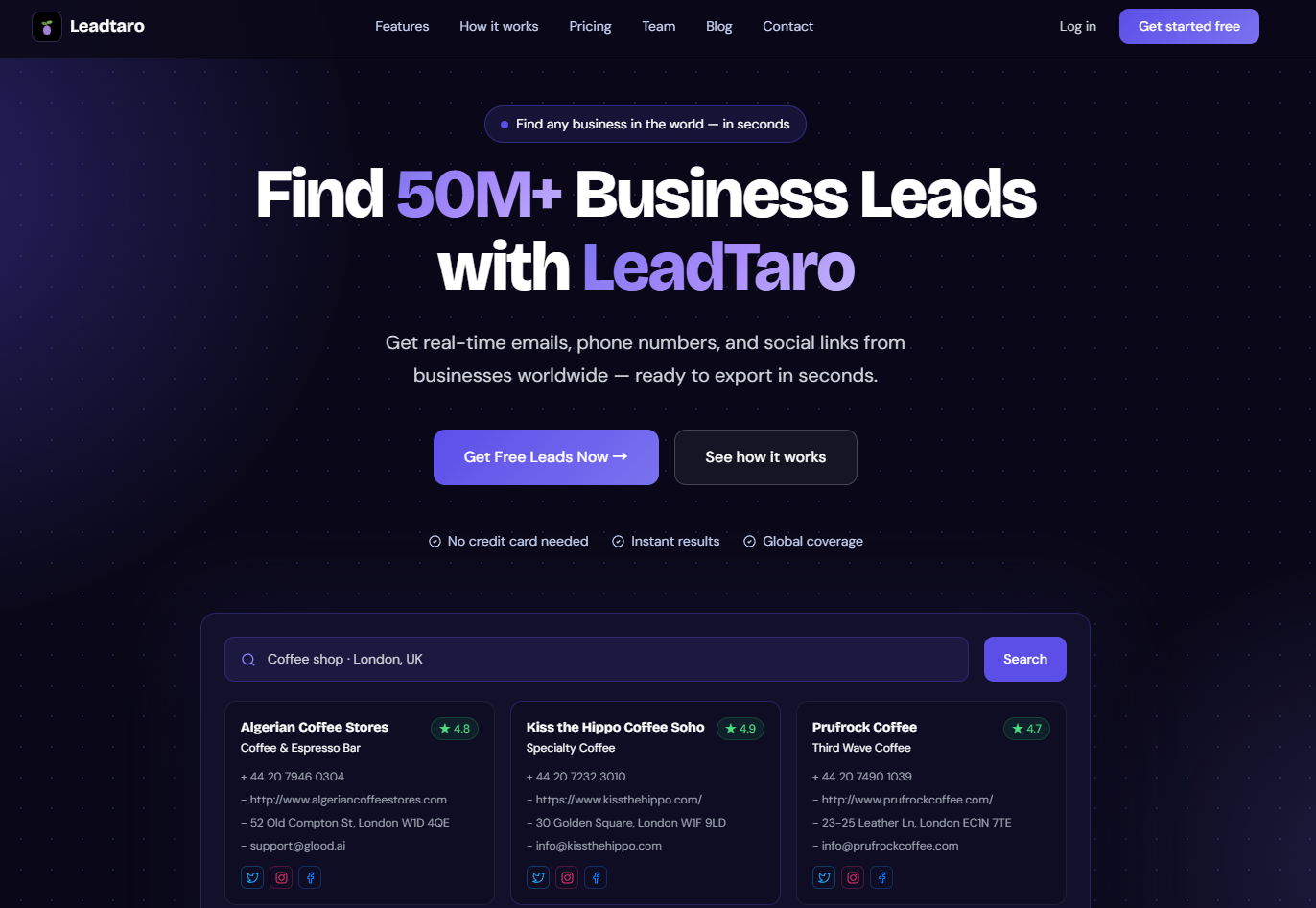
LeadTaro supports B2B lead discovery and provides access to available business information, which can include company names, websites, phone numbers, email addresses, and social links, depending on the record.
You can use this information to build a prospect list around your target market and prepare for the next stage of your sales process.
The important consideration is not simply the number of records available. It is whether the businesses are relevant to your product, service, and chosen market.
Step-by-Step: How to Find B2B Leads in Any Country
An effective international lead generation process begins with market selection and ends with organized follow-up. Here is a practical workflow.
Step 1: Choose a Target Country and Industry
Avoid treating an entire continent or multiple countries as one undifferentiated market.
Instead, select a specific country and define the type of business you want to reach.
For example:
Dental practices in Spain.
Marketing agencies in Germany.
IT service providers in the Netherlands.
Independent retailers in Australia.
Manufacturing companies in Canada.
These examples provide a clear starting point for research. Your actual target should reflect your product, service, resources, and business objectives.
Consider language, competition, purchasing power, local regulations, and the availability of relevant business information before committing significant resources to a market.
Step 2: Define Your Ideal Customer Profile
Your ideal customer profile (ICP) describes the businesses most likely to benefit from your offering.
Useful criteria may include:
Industry or business category.
Country, city, or service region.
Company size or business model.
Products or services offered.
Relevant operational or commercial needs.
Availability of appropriate business contact details.
For example, a web development agency might target professional service firms in a selected European market. A SaaS company might focus on businesses with specific operational requirements.
A clear ICP helps you avoid building large lists of companies that have little connection to your offer.
Step 3: Discover Relevant Businesses
Use suitable business directories, search engines, company websites, professional networks, and B2B lead generation platforms to find businesses that match your criteria.
With LeadTaro, you can search for B2B business leads and review the information available for relevant records.
As you build your list, organize prospects by country, industry, and other useful criteria. Keeping markets separate can make it easier to adapt your outreach and compare results later.
Do not assume that every company you discover is automatically qualified. Treat the initial list as a source of potential prospects that still need review.
Step 4: Review and Qualify Your Prospects
Once you have discovered potential leads, assess whether they fit your intended audience.
Review available business details, such as the company's website, services, industry, location, and contact information.
You can then prioritize prospects using a simple qualification framework.
Fit: Does the business match your ideal customer profile?
Relevance: Can you explain why your product or service might be useful to this company?
Contactability: Is there an appropriate, usable contact channel?
Market suitability: Does your offer make sense for the business and the country it operates in?
This approach helps you focus on prospects that deserve further research rather than treating every record equally.
Step 5: Prepare Localized Outreach
Before contacting prospects, adapt your message to the market.
Localization may involve translating the message, adjusting terminology, using the appropriate currency or measurement units, and explaining your offer in a way that makes sense for the recipient's business context.
Where relevant, consider local purchasing expectations, industry terminology, and business communication norms.
LeadTaro's AI-assisted cold email generation can help you prepare initial outreach drafts. You can develop different message versions for different industries or markets, then review each draft before use.
Verify any company-specific claims and avoid making assumptions about a prospect's needs. AI-generated content should be a starting point for personalization, not a replacement for accurate research.
Step 6: Track Responses and Sales Opportunities
International prospecting becomes more difficult to manage when your contacts are spread across multiple countries and campaigns.
Use a structured CRM process to record who has been contacted, what happened, and what should happen next.
LeadTaro's CRM pipeline helps you organize prospects through stages such as:
New Lead: The prospect has been identified.
Contacted: Initial outreach has taken place.
Interested: The prospect has shown interest.
Meeting: A sales discussion or meeting is scheduled or underway.
Closed: The opportunity has reached a final outcome.
Consistent records help you avoid duplicate outreach, identify interested prospects, and review performance across different markets.
Step 7: Evaluate Before Expanding
Start with a manageable test campaign in your selected market.
Track the relevance of your prospects, the usability of contact information, positive responses, meetings, qualified opportunities, and customer conversions.
Use those results to decide whether to refine your target audience, adjust your messaging, or test another market.
Expanding gradually allows you to learn from actual campaign performance instead of assuming that one country's results will apply everywhere.
5 International Lead Generation Strategies That Work in 2026
The following strategies can complement one another. Select the combination that best fits your audience and the resources available to your business.
1. Use B2B Lead Generation Tools to Discover Businesses Across Markets
Business lead discovery can help you build a more organized prospect list when entering a new country.
Instead of searching for every business individually, use relevant search criteria to identify companies that match your target industry and geographic market.
LeadTaro supports B2B lead discovery and provides access to available business information, depending on the record. You can use the information to organize prospects and prepare your sales outreach.
For best results:
Select a target country.
Choose an industry or business category.
Define your ideal customer profile.
Review the available business records.
Remove irrelevant or duplicate prospects.
Prepare the remaining prospects for qualification and outreach.
Do not assume that any platform has complete coverage of every country. Review the records available for your intended market before relying on a source for a large campaign.
Best for: Businesses that want a repeatable way to discover and organize potential B2B customers across different markets.
2. Localize Your Outreach Beyond Translation
International outreach should reflect the needs and context of the intended audience.
Start by translating your message accurately when necessary, then consider whether the offer itself needs to change.
For example, a product's most relevant benefit may differ between industries or markets. A service that saves administrative time may appeal to one audience, while another audience may care more about improving reporting or coordinating a distributed team.
You should also consider:
Local terminology and professional titles.
Appropriate greetings and levels of formality.
Relevant industry examples.
The recipient's preferred language.
Local expectations around sales follow-ups.
If possible, have a fluent speaker or qualified reviewer check important outreach materials before launching a large campaign.
Best for: Businesses whose product or service can serve customers in multiple countries but needs market-specific messaging.
3. Prioritize Prospect Quality Over List Size
A large international contact list can be difficult to manage if many records are irrelevant.
Rather than maximizing the number of prospects, define the characteristics that make a business worth contacting.
Depending on your offering, these may include company type, location, service category, website information, business size, or other verifiable indicators.
For example, a software company serving recruitment agencies should prioritize relevant recruitment businesses rather than collecting unrelated companies from the same country.
Create a simple qualification score if it helps your team apply consistent criteria. Treat that score as an internal prioritization method, not as a guarantee of buying intent.
Best for: Teams that want to spend more time on relevant opportunities and less time on poorly matched contacts.
4. Combine Business Research With Personalized Cold Email
Cold email can introduce your business to relevant prospects in another market, but a message that ignores local context is unlikely to communicate your value clearly.
Use business research to understand what the company does, who it serves, and why your offer might be relevant.
Then write a concise message that includes:
A clear introduction.
A credible reason for contacting the company.
A relevant explanation of your offer.
A straightforward next step.
Appropriate identification and contact details.
LeadTaro's AI-assisted cold email generation can help prepare initial drafts for different audiences. Review the result carefully and ensure that any details about the company are accurate.
Avoid sending the same generic message indiscriminately to every prospect. Targeting and relevance should guide the process.
Best for: B2B companies that need a repeatable approach to preparing outreach across industries and markets.
5. Manage International Prospecting Through a Structured CRM
Finding prospects is only the beginning. Your team also needs a reliable way to manage conversations and identify which opportunities are progressing.
A CRM pipeline helps you keep track of prospects, outreach status, meetings, and final outcomes.
With LeadTaro, you can organize business leads through stages such as New Lead, Contacted, Interested, Meeting, and Closed.
For international campaigns, you can also organize your own workflow around country, industry, or campaign so that you can compare results more effectively.
For example, you might discover that a particular industry responds more positively in one market, while another market requires a different offer or longer sales cycle.
Use those observations to refine your targeting and messaging.
Best for: Freelancers, agencies, and sales teams managing prospects across multiple markets.
How to Build an International Lead Generation Workflow
The most useful international prospecting strategy is one your team can repeat, measure, and improve.
Here is an example of how the process fits together.
Step 1: Research the Market
Choose one country and one target segment. Review local competition, potential demand, language requirements, and the types of businesses that might benefit from your offer.
Step 2: Build a Focused Prospect List
Use appropriate lead generation sources to discover businesses that fit your ideal customer profile.
Organize the results by market and industry, and review the available information before outreach.
Step 3: Qualify the Businesses
Assess whether each prospect matches your audience, has a credible reason to consider your offer, and has an appropriate contact channel.
Prioritize the businesses with the strongest fit.
Step 4: Prepare Market-Specific Messages
Create a reusable message framework, then adapt it for the relevant country, industry, and business context.
LeadTaro can help you draft cold emails using AI-assisted writing. Review the content for accuracy, clarity, tone, and compliance before sending.
Step 5: Record Outreach and Follow-Ups
Keep a record of the communication, the current prospect status, and the next action.
Use your CRM pipeline to organize opportunities and make sure interested prospects receive appropriate follow-up.
Step 6: Measure and Refine
Track positive responses, meetings, qualified opportunities, customer conversions, and acquisition costs.
If your results are weak, investigate whether the issue is market fit, prospect quality, messaging, pricing, or your sales process before increasing outreach volume.
Step 7: Expand Gradually
Once you have a clearer understanding of the market, test another segment or country.
Reuse the parts of your process that work, but continue adapting your approach to local conditions.
Measuring International Lead Generation Performance
International campaigns should be compared using meaningful business metrics rather than the number of records collected alone.
Useful measures include:
MetricWhat it tells youProspect relevanceHow closely the businesses match your ideal customer profile.Contact data usabilityHow often available contact details are usable for your intended purpose.Positive response rateHow often contacted prospects express genuine interest.Meeting conversionHow many prospects progress to a sales meeting.Opportunity conversionHow many qualified prospects become active sales opportunities.Customer conversionHow many opportunities become paying customers.Cost per qualified leadHow much you spend to generate a relevant sales prospect.Customer acquisition costHow much you spend to acquire a customer.Compare markets only when you have enough consistent data to draw a useful conclusion.
For example, a country may produce fewer responses but generate higher-value opportunities. Another may produce more replies but require more time to convert them into customers.
Consider the entire sales process when deciding where to invest next.
Compliance and Legal Considerations
International lead generation can involve collecting business information, processing personal data, and contacting prospects in different jurisdictions.
The rules depend on the type of information collected, its source, the recipient, the communication channel, and the purpose of the outreach.
Publicly available information is not automatically exempt from privacy, data protection, or marketing requirements.
European Union
The GDPR may apply when processing personal data relating to identifiable individuals. Direct marketing may be possible in certain circumstances, but a lawful basis, transparency, the right to object, and other applicable requirements must be considered.
Electronic marketing is also subject to national rules implementing the ePrivacy framework. Requirements can differ between countries and recipient types.
United Kingdom
UK GDPR, the Data Protection Act 2018, and PECR may apply to prospect research and electronic marketing.
Rules for corporate subscribers can differ from those for individual subscribers, including sole traders and certain partnerships. Do not assume that every business email address can be contacted under the same conditions.
United States
CAN-SPAM establishes requirements for commercial email, including accurate sender information, non-deceptive subject lines, a valid physical postal address, and a functioning opt-out process.
Other state and federal laws may also be relevant depending on your activities and the information you process.
Canada and Other Markets
Canada's CASL generally imposes stricter requirements on commercial electronic messages, including consent requirements and specific exceptions. Other countries have their own privacy and electronic marketing frameworks.
Before starting an international campaign:
Identify the source of your prospect data.
Determine which privacy and marketing rules apply.
Collect and use information for an appropriate purpose.
Provide required privacy information.
Identify yourself accurately.
Respect objections and unsubscribe requests.
Maintain records that support your compliance process.
Check platform terms and any restrictions on data collection or reuse.
For complex or large-scale campaigns, consult current guidance from the relevant regulator or seek qualified legal advice.
FAQ: International Lead Generation
How do you generate international B2B leads?
Start by selecting a target country and industry. Define your ideal customer profile, discover relevant businesses through suitable research sources or B2B lead generation platforms, review the available information, and qualify prospects before outreach. Localize your messages and track the results in a structured sales pipeline.
How do I find B2B leads in another country?
Choose a specific market and identify the types of businesses you want to reach. Use business directories, company websites, search engines, professional networks, and lead generation platforms to discover prospects. Review each record and confirm that the business fits your intended audience.
Can I use LeadTaro for international lead generation?
LeadTaro supports B2B lead discovery, AI-assisted cold email generation, and CRM pipeline management. You can use these capabilities to find relevant business prospects, prepare outreach drafts, and organize sales opportunities. The availability and completeness of business information can vary by record and target market.
What is the best way to find business leads worldwide?
There is no single source that is best for every industry and country. The most suitable approach depends on your target market, the type of business you want to reach, the contact information available, and your budget. Combining business research with a structured qualification and outreach process can help you evaluate opportunities more effectively.
How do I personalize international cold emails?
Research the recipient's business, adapt your message to the local language when appropriate, explain why your offer may be relevant, and use a clear next step. Avoid unsupported claims and have important translations reviewed when necessary. AI-assisted writing can help prepare drafts, but human review remains important.
Is international B2B lead generation legal?
It can be lawful, but requirements depend on the information, recipient, country, and communication method. Data protection and electronic marketing laws may apply even when business contact details are publicly available. Review the applicable rules before collecting or contacting prospects.
How much does international lead generation cost?
Costs vary by source, market, tools, research time, and campaign execution. Consider subscription costs, contact data quality, outreach expenses, and the time required to qualify prospects. Measure cost per qualified lead and customer acquisition cost rather than focusing only on the price of an individual contact.
How can I manage leads from several countries?
Use a CRM process that records the prospect, country, industry, contact history, status, and next action. LeadTaro's CRM pipeline supports stages such as New Lead, Contacted, Interested, Meeting, and Closed, helping you organize opportunities as they progress.
Start Building Your International B2B Pipeline
International lead generation is most effective when market research, relevant business data, personalized outreach, and sales follow-up work together.
Start with a clearly defined target country and customer profile. Discover relevant businesses, review the available contact information, and prepare outreach that reflects each market's needs. Then measure the results and refine your approach before expanding further.
LeadTaro supports this workflow through B2B lead discovery, AI-assisted cold email generation, and CRM pipeline management.
Whether you are a freelancer exploring your first overseas clients, an agency entering a new region, or a sales team building a broader prospecting process, a structured workflow can make international expansion easier to manage.
Explore LeadTaro at https://www.leadtaro.com/ to support your B2B lead discovery, outreach preparation, and sales pipeline management.