Articles » Lead Generation » Lead Generation Cost in 2026: How to Reduce Your Cost Per Lead with Web Scraping
Table of Contents
What Does Lead Generation Actually Cost in 2026?
Cost Per Lead by Industry: 2026 Benchmarks
Lead Generation Cost by Channel: Where Your Budget Goes
Web Scraping vs Traditional Lead Generation: Comparing the Costs
How to Calculate and Optimize Your Cost Per Lead
How to Find B2B Leads at a Lower Cost with LeadTaro
Legal and Compliance: What You Need to Know
FAQ: Lead Generation Cost
What Does Lead Generation Actually Cost in 2026?
Lead generation costs vary significantly depending on your industry, target audience, acquisition channel, and sales process.
For some businesses, acquiring a lead through paid advertising can cost tens or hundreds of dollars. Others reduce their prospecting expenses by using organic search, business databases, referrals, and publicly available business information.
The real cost of lead generation in 2026 is not just the amount you spend acquiring a contact. It also includes the time your team spends researching prospects, verifying contact details, organizing leads, and following up with potential customers.
For B2B companies, these additional expenses can quickly become a significant part of the sales budget.
Consider a sales team that spends $1,000 on advertising and generates 20 qualified leads. Its cost per lead is $50. Another team might use a business database and targeted outreach to identify hundreds of relevant companies for a comparable budget.
The difference comes down to how efficiently each business identifies, qualifies, and contacts potential customers.
This is where web scraping and business lead databases can help.
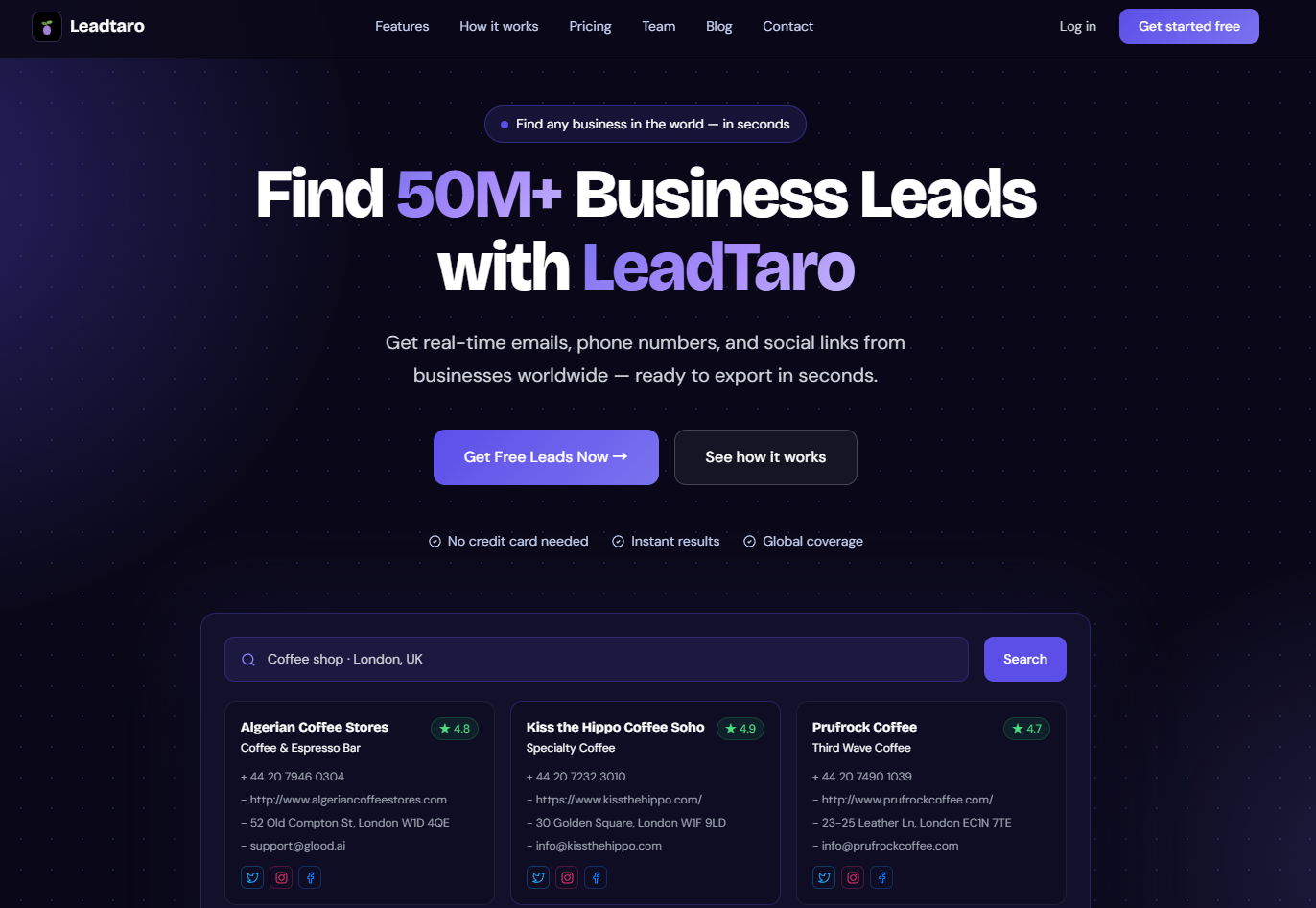
LeadTaro helps businesses discover B2B prospects, find publicly available business contact information, and organize leads for outreach. Its combination of business data search, real-time web crawling, AI-assisted cold email generation, and CRM pipeline management helps sales teams spend less time researching and more time engaging potential customers.
Instead of relying exclusively on expensive advertising campaigns or purchased contact lists, businesses can build a prospecting process around their target industries, locations, and ideal customer profiles.
The goal is not simply to find the cheapest leads. It is to find relevant prospects at a sustainable cost and turn them into paying customers.
Cost Per Lead by Industry: 2026 Benchmarks
The cost of acquiring a lead differs considerably between industries. Businesses selling high-value services can often justify higher acquisition costs, while companies with smaller average contract values need to control their prospecting expenses more carefully.
The following figures are illustrative planning ranges, not verified industry-wide 2026 averages. Actual costs depend on the market, channel, lead qualification criteria, and methodology used to calculate CPL.
IndustryIllustrative CPL RangeeCommerce$20–$150B2B SaaS$50–$400Real Estate$30–$320Financial Services$100–$900Legal Services$100–$982Healthcare$50–$600Higher Education$100–$982IT and Managed Services$50–$550Marketing Agencies$30–$280Construction and Industrial$40–$400These ranges should be validated against current benchmarks for your specific market before being used for financial forecasting.
One important distinction is the difference between a raw prospect and a qualified lead. A business contact found through a database is not automatically equivalent to someone who has requested a product demonstration or expressed an intention to buy.
For this reason, comparing acquisition channels requires consistent qualification criteria.
For example, a marketing agency targeting local businesses might find hundreds of potential customers through business research. A software company targeting enterprise accounts may need fewer prospects but substantially more qualification work.
Both businesses can benefit from reducing research costs, but their definitions of a valuable lead will be different.
Why B2B Companies Need to Measure Lead Quality
A low cost per lead does not guarantee profitable customer acquisition.
Suppose one channel generates 100 prospects for $100, while another generates 20 qualified prospects for the same amount. The first channel has a lower cost per raw contact, but the second may produce better results if its prospects convert at a higher rate.
Measure the following metrics together:
Cost per lead (CPL)
Cost per qualified lead
Email delivery and bounce rates
Positive reply rate
Meeting booking rate
Customer conversion rate
Customer acquisition cost (CAC)
LeadTaro supports the prospecting workflow by helping teams discover business contacts, generate personalized cold email drafts, and track prospects through a sales pipeline.
This makes it easier to connect lead generation activity with the sales outcomes that matter.
Lead Generation Cost by Channel: Where Your Budget Goes
Different acquisition channels involve different combinations of direct spending, labor, and ongoing maintenance.
ChannelMain Cost FactorsScalabilityGoogle AdsAdvertising budget, landing pages, optimizationDepends on budgetLinkedIn AdsAdvertising spend and audience targetingDepends on budgetSEO and Content MarketingContent production, technical SEO, timeHigh over timePurchased Lead ListsData subscriptions and list qualityHighManual ProspectingEmployee time and research toolsLimited by laborWeb ScrapingSoftware, infrastructure, data processingPotentially highReferral ProgramsIncentives and relationship developmentDepends on networkBusiness Lead DatabasesSubscription and data accessHighThere is no universally cheapest channel for every business. Paid advertising can reach people who are actively searching for a solution, while SEO can attract relevant visitors over time. Referrals may generate highly qualified opportunities, but their volume can be difficult to predict.
Business databases and web scraping address a different part of the problem: finding potential customers before they contact you.
The Hidden Cost of Manual Prospecting
Imagine a sales representative who spends three minutes researching each company and collecting its contact information.
Researching 500 businesses would take approximately 25 hours, before accounting for email verification, personalization, and follow-up.
For a small agency or startup, that time could be spent speaking with prospects, improving its offer, or closing deals.
A structured lead generation workflow can reduce repetitive research and make prospecting more consistent.
LeadTaro allows users to search for business prospects, access available contact information, and manage leads in one workflow. Depending on the data available for a particular business, users may be able to find its website, phone number, email address, and social links.
The result is a more organized approach to outbound sales without relying entirely on manual research.
Web Scraping vs Traditional Lead Generation: Comparing the Costs
Traditional lead generation often relies on advertising campaigns, third-party lead vendors, events, or manual research. Web scraping offers another approach by collecting publicly accessible information from websites and other permitted sources.
Each method has advantages, and the right choice depends on your target market and sales strategy.
FactorTraditional Lead GenerationWeb Scraping and Business DatabasesInitial costMay require advertising or data subscriptionsDepends on tools and infrastructureLead volumeInfluenced by budget and channelCan scale with data availability and processing capacityData freshnessDepends on the provider and update cycleDepends on source accessibility and crawl frequencyContact accuracyVaries by providerRequires validation and ongoing maintenanceSetup timeCampaign setup or manual researchSearch configuration, extraction, and filteringPersonalizationDepends on available prospect informationCan use collected business details as contextSales organizationOften requires separate toolsCan be integrated with a CRM workflowWeb scraping does not automatically produce qualified leads, and extracted email addresses are not guaranteed to be valid. Publicly available information can also be incomplete or outdated.
The advantage is the ability to build prospect lists around specific criteria rather than paying for a broad audience that may not match your ideal customer profile.
An Example: Comparing Two Prospecting Workflows
Consider a fictional B2B software company evaluating two ways to identify 1,000 potential business customers.
Workflow A: Manual research
The team searches for companies individually, visits their websites, copies contact details, and enters the results into a spreadsheet.
If each prospect takes three minutes to research, collecting 1,000 records requires approximately 50 hours.
Workflow B: Structured lead generation
The team defines its target industries and locations, searches a business database, uses available filters, and collects relevant records in batches. It then validates contact information and prioritizes prospects that match its ideal customer profile.
The second workflow may significantly reduce repetitive research time, although actual savings depend on the data source, filtering options, and verification requirements.
Neither workflow guarantees a sale. The real objective is to reduce the cost of finding suitable prospects while preserving data quality.
How LeadTaro Fits into This Process
LeadTaro combines B2B lead discovery with tools designed to support the next steps in outbound sales.
Its core workflow includes:
B2B lead search: Find potential customers by business category, location, and available search criteria.
Business contact discovery: Access available emails, phone numbers, websites, and social links.
Real-time web crawling: Research business information from accessible web sources when using the relevant search functionality.
AI-assisted cold emails: Generate personalized email drafts based on prospect and business context.
CRM pipeline management: Organize leads into stages such as New Lead, Contacted, Interested, Meeting, and Closed.
CSV export: Export lead data where supported by your plan and available features.
By connecting lead discovery with outreach and pipeline management, LeadTaro helps reduce the fragmentation that occurs when businesses use separate tools for research, email preparation, and sales tracking.
How to Calculate and Optimize Your Cost Per Lead
Many businesses calculate CPL using advertising expenditure alone. This can underestimate the real cost of acquiring a prospect.
A more complete calculation includes the expenses required to generate and qualify leads.
The Cost Per Lead Formula
CPL = Total Lead Generation Costs ÷ Number of Leads Generated
Total costs can include:
Advertising expenditure
Lead database subscriptions
Prospecting and scraping tools
Email verification services
Staff time spent on research
Content production and landing pages
Relevant infrastructure and software expenses
For a qualified-lead calculation, replace the total number of leads with the number of qualified leads.
For example, suppose a company spends $600 on prospecting tools and labor and generates 300 leads. Its cost per lead is $2.
If only 60 of those leads meet its qualification criteria, its cost per qualified lead is $10.
Both metrics are useful, but they answer different questions.
CPL vs CAC: What Is the Difference?
Cost per lead measures how much it costs to generate a prospect. Customer acquisition cost measures how much it costs to acquire an actual customer.
CAC = Total Sales and Marketing Acquisition Costs ÷ Number of New Customers Acquired
Suppose a business generates 200 leads at $5 each, spending $1,000 in total. If 10 leads become customers, the campaign's lead acquisition cost is $100 per customer before adding any other sales and marketing expenses.
If the business includes additional sales labor, onboarding, and other acquisition expenses, its fully calculated CAC will be higher.
This is why businesses should evaluate both lead generation costs and conversion performance.
Five Ways to Reduce Your Cost Per Lead
1. Define your ideal customer profile
Before collecting data, decide which industries, business sizes, locations, and company types are most likely to buy your product.
A focused prospect list helps reduce wasted research and improves the relevance of your outreach.
2. Use targeted searches and filters
Avoid collecting thousands of businesses without a clear purpose. Narrow your search using relevant categories, locations, and available contact information.
LeadTaro helps users find prospects based on their search requirements, making it easier to build focused lists rather than relying solely on broad, manually assembled spreadsheets.
3. Improve contact data quality
Incorrect email addresses waste time and can damage your sender reputation. Validate contact details where appropriate, monitor bounce rates, and remove invalid or unsuitable records.
Do not assume that every publicly listed email is current or deliverable.
4. Personalize your outreach
Generic messages often fail to explain why a business should respond. Use relevant information about a prospect's services, industry, or business needs to create a more specific message.
LeadTaro's AI-assisted email generation can help prepare personalized drafts that users review before sending.
5. Track the entire sales pipeline
Generating a lead is only the first step. Track whether prospects respond, express interest, book meetings, and become customers.
LeadTaro's CRM pipeline helps organize prospects throughout the sales process so teams can identify where leads are progressing and where follow-up is needed.
How to Find B2B Leads at a Lower Cost with LeadTaro
Businesses do not always need a larger advertising budget to build a stronger sales pipeline. Sometimes, the more important improvement is finding relevant prospects more efficiently.
LeadTaro is a B2B lead generation platform designed to help agencies, freelancers, sales teams, founders, and small businesses discover prospects and organize their outreach.
Rather than treating prospecting, email preparation, and pipeline management as disconnected activities, LeadTaro brings these steps together.
Step 1: Search for Your Target Businesses
Start with the types of businesses most likely to need your product or service.
For example, a web design agency might search for restaurants, dental practices, accountants, or local retailers in its target market.
A software company might focus on businesses within a specific industry or region.
A well-defined search makes it easier to prioritize relevant prospects and avoid collecting unnecessary records.
Step 2: Review Available Contact Information
Explore the contact information available for each business, including its website, phone number, email address, and social links when present.
Contact information varies between businesses, so verify important details before launching a campaign.
For high-volume campaigns, use appropriate email validation and monitor delivery performance.
Step 3: Generate Personalized Cold Email Drafts
Once you have identified suitable prospects, prepare an outreach message that explains the value of your offer.
AI-assisted email generation can help you create an initial draft using relevant business context. Review the result to ensure that the message is accurate, specific, and appropriate for its recipient.
Avoid sending identical, irrelevant messages to large lists. A smaller, well-targeted campaign can be more useful than a much larger campaign with poor qualification.
Step 4: Organize Leads in Your CRM Pipeline
Lead generation becomes more valuable when your team can follow up consistently.
Use the CRM pipeline to organize prospects by their current status:
New Lead
Contacted
Interested
Meeting
Closed
This gives you a clearer view of your sales activity and helps prevent promising prospects from being forgotten.
Step 5: Measure Results and Optimize
Review the number of qualified leads generated, outreach responses, meetings booked, and customers acquired.
Compare the costs of different prospecting approaches and focus on the methods that produce suitable customers at an acceptable acquisition cost.
The best lead generation system is not necessarily the one that produces the largest list. It is the one that consistently helps you find the right businesses and turn relevant conversations into revenue.
Start Generating B2B Leads with LeadTaro
LeadTaro offers a free plan that lets users get up to 60 B2B leads without requiring a credit card.
You can explore lead discovery, access available business contact details, prepare AI-assisted cold emails, and manage prospects through a CRM pipeline, subject to the features and limits of your plan.
Whether you are building a prospect list for a new agency, growing a SaaS business, or developing an outbound sales process, LeadTaro provides a starting point for a more organized approach to B2B lead generation.
Start with 60 free B2B leads and build a more efficient prospecting workflow with LeadTaro.
Legal and Compliance: What You Need to Know
Before collecting business information or contacting prospects, understand the laws and platform rules that apply to your activities.
The fact that information is publicly accessible does not automatically mean that every method of collecting, storing, or using it is lawful.
Consider the following principles when building a B2B lead generation workflow.
Respect applicable privacy laws.
If you process personal data, including information relating to identifiable business owners or employees, UK GDPR, EU GDPR, and applicable national privacy laws may apply. Identify an appropriate lawful basis, provide required privacy information, and respect applicable data protection rights.
Follow website terms and access restrictions.
Review the relevant website's terms, access controls, and technical restrictions before collecting data. Do not bypass authentication or technical safeguards, and ensure your collection methods comply with applicable laws and contractual obligations.
Use responsible email outreach practices.
Commercial email requirements vary by jurisdiction. In the UK, PECR rules differ depending on whether a recipient is a corporate subscriber, a sole trader, or a particular type of partnership. UK GDPR may also apply when personal data is involved.
In the United States, CAN-SPAM imposes requirements on commercial email, including truthful sender information, appropriate identification, and an effective opt-out mechanism.
Provide an appropriate way to opt out.
Keep records of objections and suppression requests, and ensure that recipients who should no longer receive marketing messages are excluded from future campaigns.
Protect and maintain your data.
Collect only information that is relevant to your business purpose, maintain reasonable security, and remove data when it is no longer needed.
LeadTaro can support business prospecting and outreach workflows, but users remain responsible for ensuring that their data collection, storage, and marketing activities comply with applicable laws and the terms of the services they use.
For complex campaigns, seek advice from a qualified legal or data protection professional.
FAQ: Lead Generation Cost
How much does lead generation cost in 2026?
Lead generation costs vary by industry, channel, and qualification criteria. Paid advertising can cost tens or hundreds of dollars per lead in some markets, while organic marketing, referrals, business databases, and web scraping offer different cost structures.
Calculate your actual CPL using total relevant costs and the number of leads generated, rather than relying on a single industry-wide average.
What is a good cost per lead for B2B companies?
A good CPL depends on your customer lifetime value, conversion rate, gross margin, and sales expenses.
A $50 lead may be expensive for a low-value product but attractive for a business that regularly closes high-value contracts. Evaluate cost per qualified lead and customer acquisition cost alongside raw CPL.
How can I reduce lead generation costs?
Define your ideal customer profile, focus on relevant prospects, improve contact data quality, automate repetitive research where appropriate, and track conversions throughout the sales pipeline.
LeadTaro combines B2B lead search, available contact information, AI-assisted email generation, and CRM pipeline management to help businesses organize these activities.
Is web scraping cheaper than buying lead lists?
It can be, depending on the data source, software costs, verification requirements, and the amount of manual work involved.
Web scraping can help businesses collect relevant publicly accessible business information without relying entirely on purchased lists. However, data quality, maintenance, compliance, and staff time must still be included in the calculation.
Does a low cost per lead guarantee more sales?
No. A low CPL only measures the cost of generating a lead. It does not guarantee that the prospect needs your product, responds to outreach, or becomes a customer.
Measure qualified leads, positive replies, meetings, conversion rates, and CAC to understand whether your prospecting strategy is profitable.
Can LeadTaro help small businesses find B2B leads?
Yes. LeadTaro is designed to help businesses discover B2B prospects, access available business contact information, generate AI-assisted cold email drafts, and organize leads through a CRM pipeline.
Its free plan offers up to 60 B2B leads without requiring a credit card, subject to the plan's terms and feature limits.
What is the cheapest way to generate B2B leads?
There is no universally cheapest method. Organic referrals may have low direct costs, while business databases and web scraping can help reduce repetitive prospect research.
The best approach depends on your target audience, available resources, contact data requirements, and ability to convert prospects into customers.
For businesses that want to combine lead discovery with outreach and pipeline management, LeadTaro provides a practical starting point for building a more structured B2B prospecting process.