Meta Title: 15 Best Lead Generation Software Tools in 2026
Meta Description: Compare the 15 best lead generation software tools in 2026. Explore B2B prospecting, Google Maps lead generation, CRM automation, pricing, and free options.
Suggested URL Slug: /best-lead-generation-software
Primary Keyword: lead generation software
Secondary Keywords: B2B lead generation tools, free lead generation software, sales lead generation software, lead generation tools for small businesses, Google Maps lead generation, AI lead generation tools
What Is Lead Generation Software?
Lead generation software helps businesses identify potential customers, collect contact information, qualify prospects, and move them into a sales pipeline. Depending on the platform, it can support outbound prospecting, inbound marketing, email capture, website visitor identification, or lead enrichment.
In 2026, businesses have more options than ever. Tools such as Apollo.io and ZoomInfo focus on B2B contact databases, HubSpot supports inbound marketing and CRM workflows, and Google Maps-based prospecting tools help businesses discover local companies by location and industry.
The best lead generation software depends on who you want to reach, how you sell, and how much you can spend.
For example, a SaaS company targeting enterprise decision-makers may need company intelligence and professional contact data. A marketing agency targeting restaurants, dentists, contractors, or independent retailers may benefit more from local business data and geographic targeting.
This guide compares 15 lead generation software tools, explains what each does best, and helps you choose the right combination for your business.
How We Evaluated These Lead Generation Tools
Choosing a lead generation platform involves more than comparing database sizes or advertised prices. A tool is useful only when its data and workflows match your prospecting strategy.
The following criteria provide a practical framework for comparing the platforms in this guide:
Data quality: How useful and accurate are the available business and contact records?
Targeting: Can you filter prospects by industry, location, company attributes, or buying signals?
Ease of use: Can a small team get started without a complicated technical setup?
Workflow capabilities: Does the tool support prospecting, enrichment, outreach, or lead capture?
Integrations: Can you move information into your CRM and existing sales tools?
Pricing: Are the available plans suitable for your team size and expected usage?
The tools below serve different purposes, so they should not all be judged as direct substitutes. Some find new prospects, while others capture website visitors, enrich existing contacts, or manage marketing campaigns.
The 15 Best Lead Generation Software Tools in 2026
1. LeadTaro: Best for B2B Lead Generation and Local Prospecting
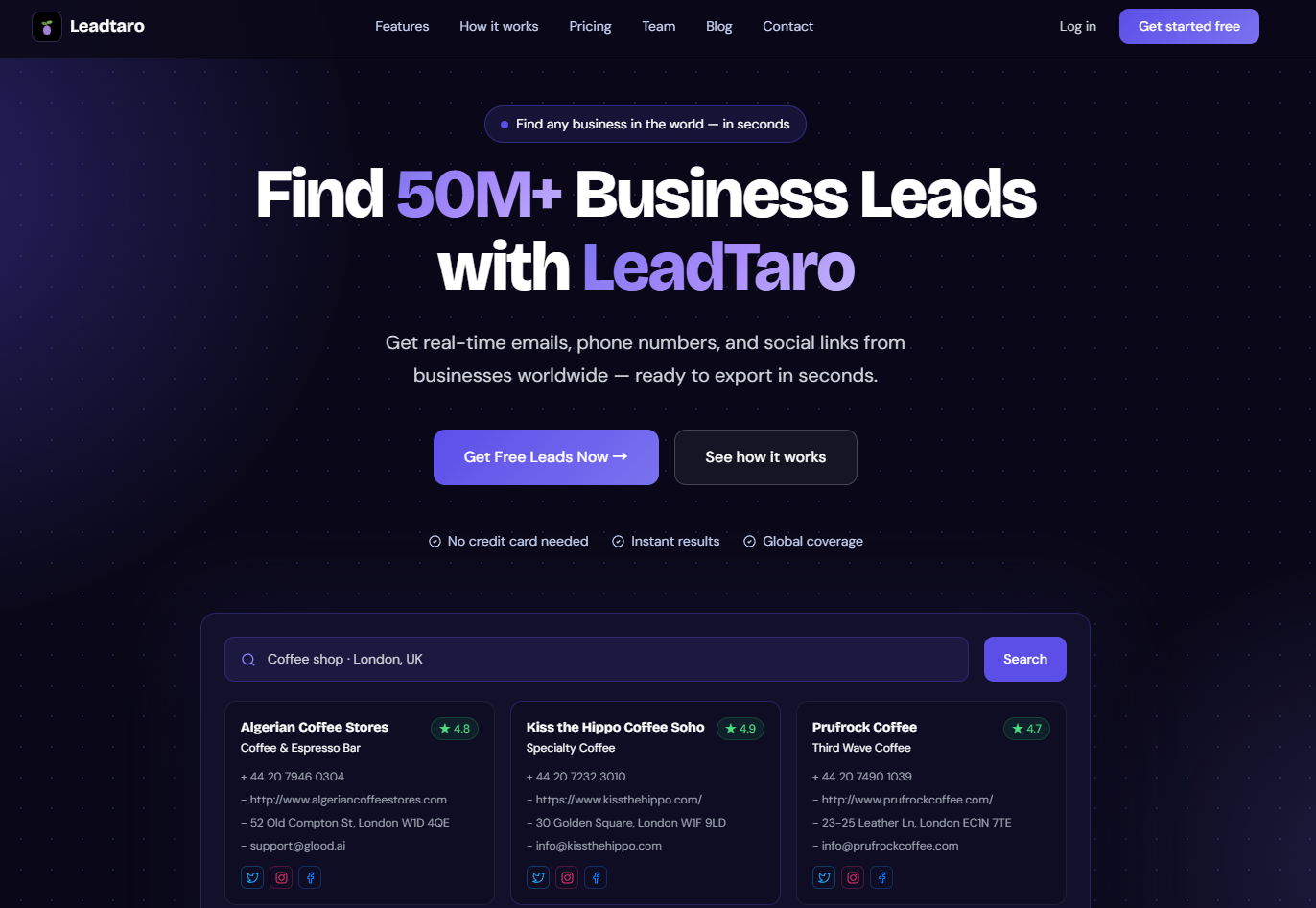
LeadTaro helps businesses discover B2B prospects and makes local business prospecting more accessible. It is worth considering if your sales strategy involves identifying potential business customers rather than relying entirely on inbound enquiries.
For example, a digital marketing agency could research restaurants in a target city, while a software provider might build a prospect list of local service businesses that fit its ideal customer profile.
A structured prospecting workflow can help you narrow a broad market into a more relevant list of potential customers. Instead of contacting every business in a category, define the industry, geography, and other criteria that make a company a good fit before beginning outreach.
Best for:
Small businesses and startups building an outbound sales pipeline
Agencies looking for potential business customers
Sales teams researching local markets
Businesses that want to test a prospecting workflow before committing to a paid plan
Getting started: LeadTaro offers a free plan that lets users access 60 verified B2B leads without providing a credit card. This gives new users an opportunity to test the prospecting process before deciding whether they need more data.
Explore LeadTaro to get started.
2. Apollo.io: Best All-in-One B2B Prospecting
Apollo.io combines B2B prospecting data with sales engagement capabilities. Depending on your plan, you can use it to discover contacts, research companies, organize prospect lists, and run outbound email sequences.
Its integrated workflow is useful for sales development representatives who want prospecting and outreach in one platform instead of switching between multiple applications.
However, database coverage and contact accuracy can vary by geography, industry, and individual record. Teams should verify important contact details before launching large campaigns.
Best for: Startups, sales development teams, and outbound-focused B2B companies.
Consider it if: You want contact discovery and sales engagement in a single platform.
Website: https://www.apollo.io/
3. ZoomInfo: Best for Enterprise B2B Intelligence
ZoomInfo is an enterprise-focused B2B data platform that supports company research, contact discovery, buying signals, and sales intelligence.
Large sales organizations may benefit from its company information, organizational insights, and prospecting workflows. These capabilities can be particularly valuable when selling complex products to multiple stakeholders within large organizations.
The main consideration is cost. Enterprise data platforms may require substantial budgets and contractual commitments, making them less suitable for early-stage businesses.
Best for: Enterprise sales teams and organizations with established prospecting operations.
Consider it if: You need extensive B2B intelligence and have the budget to support it.
Website: https://www.zoominfo.com/
4. LinkedIn Sales Navigator: Best for Relationship-Based Prospecting
LinkedIn Sales Navigator helps sales professionals identify relevant people and companies through advanced search and professional-network information.
It is useful when your ideal buyers have identifiable professional roles, such as marketing directors, founders, procurement managers, or technology executives.
Sales teams can research prospects, identify potential decision-makers, and use professional context to make outreach more relevant. However, it is primarily a prospect research tool rather than a complete lead database export and outreach system.
Best for: Account-based selling, professional services, and relationship-driven B2B sales.
Consider it if: Your prospects are active on LinkedIn and professional relationships matter to your sales process.
Website: https://business.linkedin.com/sales-solutions/sales-navigator
5. HubSpot: Best for Inbound Lead Management
HubSpot combines CRM functionality with marketing, sales, and customer service tools. Its ecosystem can help businesses capture website enquiries, manage contacts, track deals, and automate parts of the customer journey.
For businesses generating leads through SEO, landing pages, forms, and content marketing, HubSpot can provide a central place to manage prospects from their first interaction through the sales process.
Some advanced marketing and automation capabilities require paid plans, so review the feature limits carefully before choosing a subscription.
Best for: Businesses focused on inbound marketing and centralized lead management.
Consider it if: You want to connect website leads, CRM records, and marketing campaigns.
Website: https://www.hubspot.com/
6. Cognism: Best for European B2B Prospecting
Cognism focuses on B2B sales intelligence, including company information and professional contact data. It is particularly relevant to organizations prospecting across European and international markets.
Businesses selling into multiple countries should evaluate coverage by region, contact verification methods, available integrations, and compliance support.
Remember that using a commercial data platform does not automatically make every outreach campaign lawful. Your team still needs to follow applicable data protection and electronic marketing rules.
Best for: B2B sales organizations prospecting across Europe and other international markets.
Website: https://www.cognism.com/
7. Lusha: Best for Quick Contact Lookups
Lusha helps sales professionals find business contact information and enrich existing prospect records.
It can be useful when a salesperson already knows which company or person they want to contact and needs additional information to complete a prospect record.
Compared with broader sales platforms, its appeal is a relatively straightforward contact lookup workflow. Review the current plan limits and available credits before relying on it for high-volume prospecting.
Best for: Individual sales representatives and teams that need contact enrichment.
Website: https://www.lusha.com/
8. Seamless.AI: Best for High-Volume Prospect Research
Seamless.AI is designed to help sales teams discover B2B contacts and build prospect lists. It may suit organizations that need to research large numbers of potential customers for outbound campaigns.
As with any large contact database, the usefulness of the results depends on the target market and the quality of individual records. Verify email addresses and review bounce rates before increasing campaign volume.
Best for: Sales teams that need to build substantial prospect lists.
Website: https://seamless.ai/
9. Dealfront Leadfeeder: Best for Website Visitor Identification
Dealfront's Leadfeeder helps businesses identify organizations visiting their websites and understand which companies may be showing interest.
This approach differs from conventional outbound prospecting. Instead of starting with an external list of companies, you use website activity to identify accounts that may already be researching your products or services.
Visitor identification has limitations: not every visitor can be identified, and company-level identification does not necessarily reveal the individual person behind a visit.
Best for: B2B companies with established website traffic and account-based marketing strategies.
Website: https://www.dealfront.com/
10. OptinMonster: Best for Converting Website Visitors
OptinMonster focuses on lead capture and conversion optimization. It provides website campaigns such as pop-ups, slide-ins, and other opt-in forms designed to encourage visitors to subscribe or submit their details.
It is most useful when your website already attracts relevant visitors but too few of them become leads.
Unlike a prospecting database, OptinMonster does not primarily help you discover businesses that have never visited your website.
Best for: Content marketers, ecommerce businesses, and websites seeking more conversions.
Website: https://optinmonster.com/
11. LeadIQ: Best for Sales Development Workflows
LeadIQ supports sales teams with prospect capture, contact research, and workflows designed to reduce manual data entry.
It can help representatives move from researching potential buyers to organizing those prospects in their sales systems. Its usefulness depends on your team's existing CRM, sales tools, and preferred prospecting channels.
Best for: SDR teams that need a more efficient prospect research workflow.
Website: https://leadiq.com/
12. 6sense: Best for Intent-Based Account-Based Marketing
6sense uses account intelligence and buying signals to help businesses prioritize organizations that may be researching relevant products or services.
It is designed for more sophisticated marketing and sales strategies, especially when teams need to coordinate campaigns around target accounts and buying stages.
The platform may be more than a small business needs if its immediate challenge is simply finding suitable prospects and starting conversations.
Best for: Enterprise demand generation and account-based marketing teams.
Website: https://6sense.com/
13. HubSpot's Breeze Intelligence: Best for Contact and Company Enrichment
HubSpot offers data enrichment capabilities through its Breeze Intelligence ecosystem. These capabilities can help businesses add context to existing records and improve the information available to sales and marketing teams.
Enrichment is different from prospect discovery. If you already have a list of companies, enrichment can make those records more useful. If you have no prospect list at all, you may need a separate tool to identify potential customers first.
Features and pricing depend on the current HubSpot offering and plan.
Best for: Businesses already using HubSpot that want additional context on their contacts and companies.
Website: https://www.hubspot.com/
14. Hunter.io: Best for Professional Email Discovery
Hunter.io helps users find professional email addresses associated with business domains and verify email deliverability.
It is useful for sales teams, recruiters, marketers, and public relations professionals who already know which organizations they want to contact.
Hunter is primarily an email-focused tool. If your workflow also requires extensive phone data, local business discovery, or advanced company intelligence, you may need additional tools.
Best for: Email discovery, domain research, and email verification.
Website: https://hunter.io/
15. Intercom: Best for Conversational Lead Capture
Intercom combines customer messaging, live chat, and AI-assisted support and engagement capabilities.
For SaaS businesses, website conversations can help identify visitors who need product information, pricing details, or assistance before making a purchasing decision.
Intercom is not primarily an external prospect database. Its main value is engaging and qualifying people who interact with your website or customer communication channels.
Best for: SaaS companies and businesses that generate leads through website conversations.
Website: https://www.intercom.com/
Lead Generation Software Comparison Table
The following table compares each platform by its primary use case. Pricing and feature availability change frequently, so check each vendor's official website for current plan details.
ToolBest ForPrimary FunctionTypical Use CaseLeadTaroB2B and local prospectingLead discoveryFinding potential business customersApollo.ioOutbound B2B salesContact data and engagementBuilding prospect lists and running sequencesZoomInfoEnterprise salesB2B intelligenceResearching companies and decision-makersLinkedIn Sales NavigatorRelationship-based salesProfessional prospect researchFinding relevant people and accountsHubSpotInbound marketingCRM and marketing automationCapturing and managing inbound leadsCognismInternational B2B salesContact intelligenceProspecting across international marketsLushaContact lookupData enrichmentFinding contact informationSeamless.AIHigh-volume prospectingContact discoveryBuilding large outbound listsLeadfeederWebsite visitor analysisAccount identificationIdentifying companies visiting a websiteOptinMonsterWebsite conversionLead captureTurning visitors into subscribers and enquiriesLeadIQSDR workflowsProspect captureMoving prospect data into sales systems6senseEnterprise ABMIntent and account intelligencePrioritizing target accountsBreeze IntelligenceCRM enrichmentCompany and contact enrichmentAdding context to existing CRM recordsHunter.ioEmail discoveryEmail finding and verificationFinding professional email addressesIntercomConversational lead captureChat and customer engagementQualifying website visitorsHow Google Maps Data Can Improve Lead Generation
Many B2B sales teams focus on professional networking platforms and corporate databases. Those sources are useful, but they do not always cover the local businesses that certain companies need to reach.
Consider businesses that sell to restaurants, dentists, roofers, gyms, property services, repair shops, and independent retailers. These potential customers may be easier to identify through local business listings than through traditional corporate contact databases.
Google Maps can help with market research because business listings often include information such as:
Business name and category
Address and geographic location
Publicly listed phone number
Website, when available
Customer ratings and review counts
Opening hours and other listing details
The availability and accuracy of individual fields vary. An email address, for example, should not be assumed to exist for every listing.
Why Local Business Prospecting Is Different
Traditional B2B prospecting often starts with a person's job title, employer, or professional profile. Local prospecting often starts with a business category and location.
A marketing agency might target independent restaurants in Manchester. A supplier might look for automotive repair shops across Yorkshire. A software provider might focus on independent clinics in a specific region.
In these cases, geographic coverage and business-category filters can matter just as much as individual contact information.
Local business listings can also provide useful research signals. For example, a business with many customer reviews but a limited website presence may be worth investigating if you sell website development services. A company with consistently poor reviews might be relevant to a reputation management agency, although its suitability should be assessed individually rather than assumed.
How to Build a Local B2B Prospect List
A practical process looks like this:
Define your ideal customer profile. Choose the industries, locations, and business characteristics that align with your product.
Research the local market. Estimate how many businesses match your target criteria and identify the most promising areas.
Collect relevant business data. Use an appropriate business data source or prospecting platform.
Filter and validate the results. Check website availability, contact information, location, and other relevant criteria.
Segment your prospects. Group companies by industry, location, or the problem your product solves.
Personalize your outreach. Use relevant business context to explain why your offer may be useful.
Measure the results. Track replies, qualified conversations, meetings, and conversions to improve targeting.
LeadTaro can be part of this workflow when you need to find and evaluate B2B prospects. Start with a focused target segment instead of collecting as many records as possible.
How to Choose the Right Lead Generation Software
There is no single best platform for every business. The right choice depends on your sales model, target market, and current bottleneck.
1. Start With Your Ideal Customer Profile
Before purchasing a tool, define the customer you want to reach.
Include details such as:
Industry or business category
Geographic location
Company size, where relevant
Decision-maker or contact type
The problem your product solves
The signals that make a prospect a strong fit
A clear ideal customer profile helps you compare platforms based on actual needs rather than marketing claims.
2. Match the Tool to Your Lead Generation Strategy
Choose tools based on the job you need done.
Finding new B2B prospects: LeadTaro, Apollo.io, ZoomInfo, or LinkedIn Sales Navigator, depending on your target market.
Capturing inbound leads: HubSpot, OptinMonster, or Intercom.
Enriching existing records: Lusha, Hunter.io, or HubSpot enrichment capabilities.
Identifying website visitors: Dealfront Leadfeeder.
Prioritizing accounts using buying signals: 6sense.
Managing professional email discovery: Hunter.io.
Some businesses need only one platform to get started. Others benefit from combining a prospecting tool with a CRM and an outreach platform.
3. Evaluate Data Quality Before Scaling
A large database does not guarantee useful leads.
Test a representative sample of records and check whether the data matches your target market. Where appropriate, validate email addresses, check phone numbers, and confirm that the businesses are still operating.
Monitor your own campaign metrics too. Bounce rate, response rate, qualified meeting rate, and conversion rate provide more meaningful evidence than a vendor's advertised database size alone.
4. Check Integration and Workflow Requirements
Consider how prospect data will move through your sales process.
Ask whether the platform supports your CRM, whether exports are available, and whether your team can avoid unnecessary manual data entry. If you need automation, confirm the integrations and plan restrictions before purchasing.
A tool that produces excellent data but creates hours of manual work may not be the best option for a small team.
5. Compare Total Cost, Not Just the Starting Price
Lead generation software may charge per user, per contact, per credit, or by subscription tier.
Before committing, check:
Monthly versus annual billing
Credit limits and expiration rules
Data export restrictions
Email verification costs
Minimum seat requirements
Paid add-ons and integration fees
Cancellation and renewal terms
If you are a startup or small business, use a free plan or trial to test the actual workflow. Confirm that the tool can identify the prospects you need before paying for additional capacity.
6. Treat Compliance as Part of the Buying Decision
Business contact data can still be subject to privacy and electronic marketing laws. Public availability does not automatically make every collection method or marketing campaign lawful.
If you target businesses in the UK or European Economic Area, assess the applicable data protection requirements and electronic marketing rules. For US commercial email, review CAN-SPAM requirements. Keep records of data sources, respect objections and opt-outs, and make sure your team understands the rules for each market.
Frequently Asked Questions About Lead Generation Software
Which software is used for lead generation?
Popular options include Apollo.io for outbound B2B prospecting, ZoomInfo for enterprise sales intelligence, LinkedIn Sales Navigator for professional prospect research, HubSpot for inbound marketing and CRM, and LeadTaro for B2B prospect discovery. The best choice depends on the businesses you want to reach and the workflow you need.
What is the best free lead generation software?
The best option depends on your use case. HubSpot offers CRM tools, Apollo.io has offered a limited free plan, and Hunter.io provides email discovery capabilities subject to plan limits. LeadTaro also offers a free plan with 60 verified B2B leads and no credit card requirement.
Free plans have restrictions, so compare the available features and test whether the data suits your target audience.
How much does lead generation software cost?
Costs range from free plans to subscriptions and enterprise contracts that may cost substantially more. Pricing depends on database access, user seats, usage credits, integrations, and automation features.
Compare the total cost of generating a qualified opportunity rather than focusing only on the monthly subscription price.
Can AI replace lead generation software?
AI can help research markets, organize prospect information, draft personalized outreach, and automate parts of a sales workflow. However, AI still needs reliable source data and clear qualification criteria.
A useful setup combines accurate prospect data with AI-assisted research and human review. This helps reduce repetitive work without treating every automatically generated lead as a qualified opportunity.
What is the difference between lead generation software and CRM software?
Lead generation software helps discover, capture, or qualify potential customers. A CRM manages customer and prospect relationships, including contact records, communication history, deals, and follow-up tasks.
Some platforms provide both capabilities, but many businesses use a dedicated prospecting tool alongside a CRM.
Is Google Maps useful for B2B lead generation?
Yes. Google Maps can be useful when your target audience consists of local businesses, such as restaurants, contractors, clinics, gyms, and repair shops. Business listings can help you research locations, categories, websites, phone numbers, ratings, and other available information.
The data available for each business varies, and you should verify important details before contacting prospects.
How do I generate B2B leads for a small business?
Start by defining your ideal customer profile and selecting a focused industry or geographic area. Find businesses that match your criteria, validate their contact details, segment them into relevant groups, and use personalized outreach.
Track the results and refine your criteria based on which segments produce qualified conversations. A small, relevant prospect list can be more useful than a large list of poorly matched contacts.
Are free lead generation tools enough to get started?
Often, yes. Free plans can help small businesses test a prospecting strategy, research a market, and learn which types of leads convert. You may need paid features as your outreach volume, team size, or automation requirements grow.
Start with the smallest plan that lets you test your assumptions, then upgrade based on measurable results.
Final Thoughts
The best lead generation software is not necessarily the platform with the largest database or the most features. It is the tool that helps your business consistently find the right prospects and turn them into qualified sales conversations.
For enterprise sales teams, platforms such as ZoomInfo, Cognism, and 6sense may support sophisticated research and account prioritization. For inbound teams, HubSpot, OptinMonster, and Intercom can help capture and manage demand. For businesses selling to local companies, geographic research and local business prospecting can provide a useful alternative to relying exclusively on professional networking databases.
If you are building an outbound pipeline, start with a clear ideal customer profile, test a focused list of prospects, and measure the results before scaling.
Ready to start finding potential customers? Try LeadTaro with its free plan of 60 verified B2B leads and see whether the prospecting workflow fits your business.