What's in This Guide
What Is Lead Nurturing and Why Does It Matter?
The B2B Lead Nurturing Landscape in 2026
The 7-Step Lead Nurturing Strategy: From Cold to Closed
B2B Lead Nurturing Campaign Examples and Lessons
Lead Nurturing Software and Tools for 2026
Staying Compliant: CAN-SPAM, GDPR, and Email Best Practices
FAQ
Build a Lead Nurturing System That Converts
Generating leads is only the beginning of B2B sales. A prospect might download a resource, visit your website, reply to an outreach email, or express interest during a sales call without being ready to buy.
What happens next determines whether that initial interest becomes a genuine sales opportunity or disappears into your CRM.
Many businesses focus heavily on finding new prospects but spend too little time building relationships with the ones they've already identified. They send one email, make a single phone call, and move on when they don't receive an immediate response.
The problem is that B2B buyers often need time to evaluate their options, understand the potential return on investment, discuss decisions internally, and establish trust with a new provider.
Lead nurturing provides a structured way to stay relevant throughout that process. By combining useful content, thoughtful follow-ups, audience segmentation, and timely outreach, businesses can turn more potential customers into qualified opportunities.
This guide explains how to build a practical lead nurturing strategy in 2026, from sourcing the right prospects to measuring results and automating follow-ups. It also covers how LeadTaro can support the prospecting side of a more organized B2B sales workflow.
1. What Is Lead Nurturing and Why Does It Matter?
Lead Nurturing Definition
Lead nurturing is the process of building relationships with potential customers through relevant, timely communication until they are ready to take the next step in the buying process.
That next step might be booking a meeting, requesting a demonstration, asking for a proposal, starting a trial, or purchasing a product.
Lead nurturing can include email campaigns, phone calls, professional networking, educational content, retargeting, and other appropriate interactions.
The goal isn't to contact prospects as frequently as possible. It's to give them useful reasons to continue the conversation.
Imagine you sell HR software to small and medium-sized businesses. A prospect downloads your guide to improving employee onboarding but doesn't book a demonstration.
A weak follow-up strategy sends a generic sales email and then stops.
A better approach might look like this:
Day 1: Send the requested guide and a brief explanation of what it covers.
Day 3: Share a practical resource about reducing onboarding administration.
Day 6: Explain how businesses can evaluate the effectiveness of their onboarding process.
Day 10: Offer a demonstration focused on the prospect's specific challenges.
Day 14: Ask whether improving onboarding is a current priority or something to revisit later.
The sequence provides value before asking for a commitment. It also creates opportunities for the prospect to explain their needs.
The timing is only an example. Your actual schedule should reflect the buying cycle, prospect engagement, communication preferences, and applicable marketing rules.
Why Leads Need Nurturing
Not every prospect is ready to buy when you first contact them.
Some are researching possible solutions. Others already have a provider but are considering alternatives. Some recognize a problem but haven't decided whether solving it is worth the investment.
Without a follow-up process, these prospects can become difficult to distinguish from leads that were never interested in the first place.
A structured nurturing system helps your business:
Maintain contact with prospects who aren't ready to purchase.
Educate potential customers about relevant problems and solutions.
Identify which accounts deserve more sales attention.
Keep sales and marketing aligned around the same opportunities.
Reduce the number of promising leads that receive no follow-up.
Understand which outreach activities contribute to revenue.
Nurturing won't turn every lead into a customer. Its purpose is to make your sales process more consistent and help you recognize genuine opportunities.
Lead Nurturing vs. Drip Campaigns: What's the Difference?
The terms are related, but they describe different approaches.
A drip campaign usually sends a predefined series of messages according to a schedule. Lead nurturing is the broader strategy of developing a relationship and moving a prospect toward a decision.
A drip campaign can be one component of a nurturing program, especially when messages adapt to the recipient's situation.
FactorBasic drip campaignLead nurturing strategyPrimary triggerTime-based scheduleTime, behavior, lifecycle stage, or sales activityContentOften follows a fixed sequenceTailored to needs and engagementSegmentationMay be limitedGroups prospects by fit, needs, and buying stageChannelsFrequently emailEmail, phone, professional networks, content, and other suitable channelsAdaptationUsually follows predefined rulesCan change based on responses and new informationGoalDeliver a sequence consistentlyBuild trust and progress qualified opportunitiesFor example, a drip campaign might send five emails to everyone who downloads a guide. A more developed nurturing program could stop promotional emails when someone books a meeting, notify sales when a qualified prospect requests a demonstration, and move unresponsive leads into a different follow-up path.
The distinction is important: automation delivers messages, while nurturing determines which messages are appropriate and why.
2. The B2B Lead Nurturing Landscape in 2026
B2B buyers have access to more information and more potential suppliers than ever. They can research competitors, compare pricing, evaluate reviews, and explore alternatives before speaking to a salesperson.
That changes the role of nurturing. Sales teams need to provide useful information and build credibility rather than relying on repeated promotional messages.
Why Lead Nurturing Can Improve Results
Several benefits make nurturing valuable for B2B businesses.
Better use of existing leads. When a business has already invested in acquiring a prospect, relevant follow-up can help it make better use of that investment.
More informed buyers. Educational content can help prospects understand their problem, compare possible solutions, and identify what they need from a provider.
Improved sales prioritization. Segmentation and engagement signals can help sales teams distinguish between prospects who are actively evaluating a solution and those who may need more time.
More consistent communication. A documented process reduces the likelihood that prospects will be forgotten when a salesperson becomes busy or a lead changes hands.
Greater visibility into performance. Tracking conversions across the funnel helps businesses identify where prospects disengage and which activities contribute to sales.
These benefits depend on the quality of the leads, the relevance of the communication, and the effectiveness of the underlying offer. Nurturing is not a substitute for product-market fit or good sales execution.
Why Many Businesses Struggle With Lead Nurturing
Common problems include:
No documented follow-up process.
Generic emails that could apply to any company.
Inconsistent contact records and outdated prospect information.
Marketing and sales teams using different qualification criteria.
Too many messages without a clear purpose.
No system for recording objections or agreed next steps.
Measuring email activity without connecting it to sales outcomes.
One particularly important problem occurs before nurturing even begins: businesses often collect leads without establishing whether those prospects are a reasonable fit.
A large list of irrelevant contacts creates extra work for marketing and sales. A smaller, better-targeted list can make personalization and follow-up more manageable.
This is why a strong nurturing strategy starts with prospect quality and a clear ideal customer profile.
Why Speed and Relevance Both Matter
When someone requests a demonstration or asks for pricing, a timely response can help preserve their interest. The same is true when a prospect replies to an outreach message with a specific question.
However, speed alone is not enough. Sending a fast, irrelevant response won't build trust.
Establish response-time expectations for high-intent actions, such as demo requests and direct enquiries. For colder prospects, focus on relevant timing, appropriate frequency, and clear reasons for reaching out.
A good nurturing system combines prompt responses to active interest with thoughtful follow-up for prospects who need more time.
3. The 7-Step Lead Nurturing Strategy: From Cold to Closed
A successful lead nurturing process doesn't require dozens of tools or a complicated automation system from day one.
Start with a clear target market, a reliable prospect list, a few useful messages, and a way to track what happens next. Improve the process as you learn which prospects respond and which activities generate qualified opportunities.
Step 1: Source Qualified Leads
Every nurturing campaign begins with the people you choose to contact.
If your target audience is poorly defined, even excellent emails can produce disappointing results. Prospects may have no need for your product, lack the resources to purchase it, or operate in markets your business doesn't serve.
Before building a list, define your ideal customer profile (ICP).
Consider:
Industry: Which sectors experience the problem your product solves?
Location: Which geographic markets can you serve?
Business size: Which company sizes are most likely to benefit?
Business model: What characteristics distinguish good-fit customers?
Potential need: What observable circumstances might indicate a relevant use case?
Buying context: Is there a reason the business might consider a solution now?
For example, a company selling appointment-management software might target independent clinics, salons, and other appointment-based businesses. A B2B lead generation platform might focus on sales teams, agencies, consultants, and companies that regularly prospect for new business.
The more clearly you define your target audience, the easier it becomes to personalize outreach and qualify opportunities.
Build a structured prospect list
Use a repeatable process to identify and organize businesses that match your ICP.
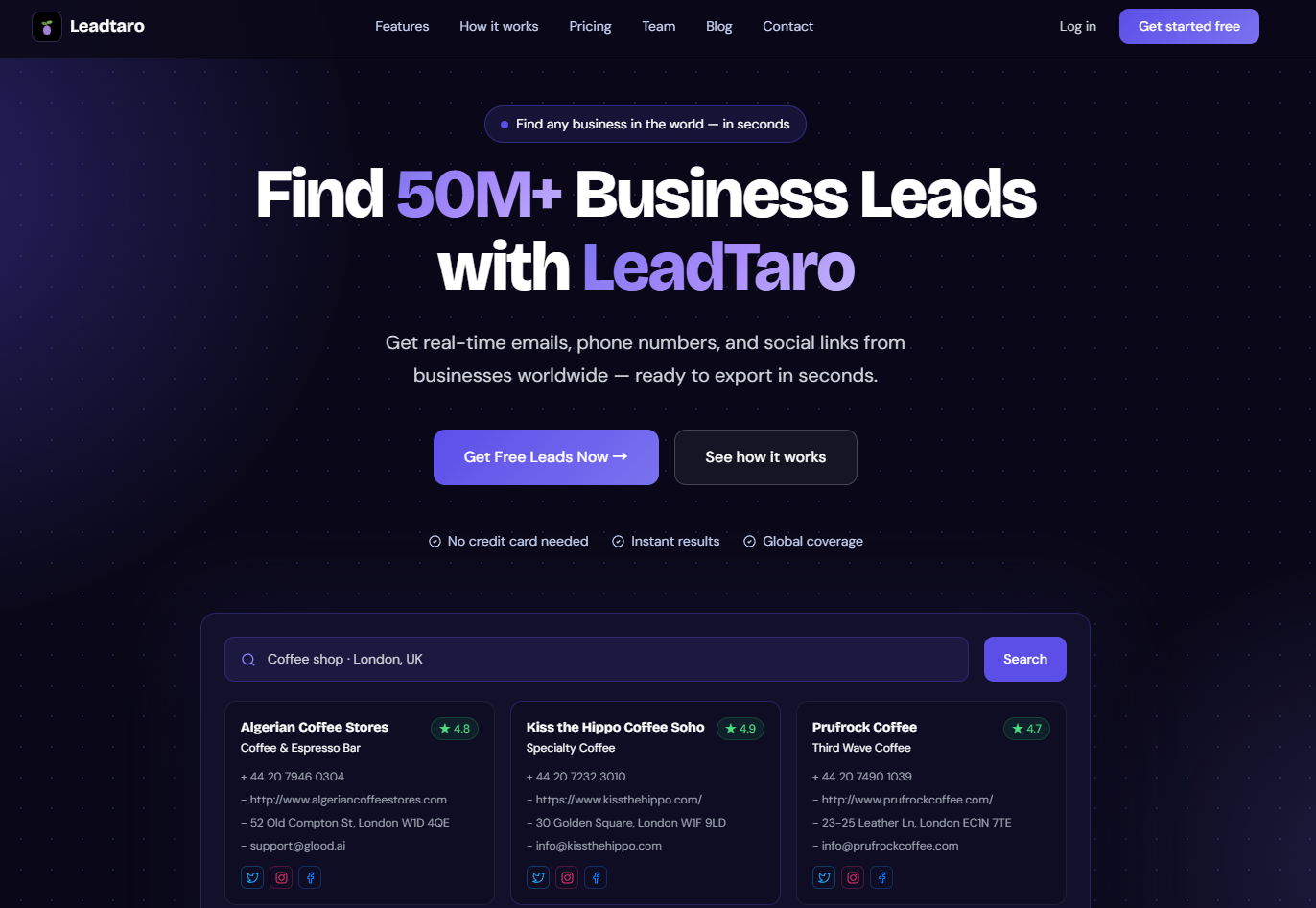
LeadTaro can support your B2B prospecting workflow by helping you organize target businesses and approach outreach with a clearer process.
Before adding a prospect to a nurturing campaign, establish why it belongs on your list. Record relevant business information, the reason it fits your target market, and any details that could help make the first interaction more useful.
Avoid assuming that a business needs your product simply because it matches an industry or location. Qualification still requires context and, ultimately, a conversation.
Practical tip: Start with a focused list of businesses that share a clear set of characteristics. It's easier to learn from a tightly defined campaign than from a large campaign targeting unrelated industries.
Step 2: Segment and Score Your Leads
Not every prospect should receive the same message or level of attention.
A business owner who has requested pricing is at a different stage from someone who has never interacted with your company. Treating them identically can lead to missed opportunities and unnecessary follow-ups.
Lead segmentation and lead scoring help solve this problem.
Segment leads by relevant characteristics
Useful segmentation criteria include:
Industry and business type.
Company size or operational complexity.
Geographic market.
Problem the prospect is trying to solve.
Buying stage.
Previous conversations or enquiries.
Stated budget or implementation timeline, when known.
Communication preferences and engagement.
For example, a marketing agency could create separate segments for dental practices, home-service companies, and professional service firms. Each segment could receive examples and educational resources that reflect its industry.
The goal isn't to create as many segments as possible. It's to identify differences that genuinely change the message or next action.
Use lead scoring to prioritize attention
Lead scoring assigns values to characteristics or behaviors that indicate potential fit or buying interest.
A simple illustrative model might look like this:
SignalExample scoreMatches the target industry+10Fits the ideal business size+10Requests a product demonstration+25Asks about pricing+20Replies with a specific business challenge+15Has no relevant use case-20Confirms they are not interestedRemove from active sales outreachThese scores are examples, not universal benchmarks. Adjust them according to your sales process and historical conversion data.
Also distinguish between fit and engagement. A prospect can be highly engaged but a poor fit, or an excellent fit who has not yet shown buying intent.
Use both dimensions when deciding what should happen next.
Step 3: Build Your Email Nurturing Sequence
Email remains a useful channel for B2B nurturing because it allows you to share information, explain your offer, and invite prospects to take the next step.
The key is to give each message a clear purpose.
A five-touch sequence can be a practical starting point for an appropriate campaign. The schedule below is an example for a prospect who is a plausible fit but has not yet engaged. Adapt the frequency to the context and applicable rules.
Day 1: Introduce the reason for reaching out
Start with a concise, relevant message. Explain why you contacted the prospect and how the subject relates to their business.
Example:
Subject: A question about your prospecting process
Hi [First Name],
I work with businesses looking to make their B2B prospecting more organized.
I was reaching out to ask how your team currently identifies and manages potential customers.
If improving that process is on your radar, I'd be happy to share a few ideas.
Best,
[Your Name]
The purpose is to start a relevant conversation, not force a demonstration into the first message.
Day 3: Share something useful
Offer a practical insight, checklist, short guide, or other resource related to the prospect's likely challenge.
For example, a company selling sales software might share a short framework for organizing follow-ups or qualifying new opportunities.
Make sure the resource is genuinely useful and appropriate for the recipient. Avoid pretending you know the prospect has a problem that you haven't verified.
Day 6: Explain a relevant solution
Once you've established the context, explain how your product or service addresses a particular challenge.
Focus on the outcome and the process rather than a long list of features.
If you use a case study, ensure it is real, relevant, and accurately presented. Never invent customer names, performance figures, or results.
Day 10: Offer a low-friction next step
Invite the prospect to take a reasonable next step.
Depending on your sales process, that could mean:
A short introductory call.
A product demonstration.
A review of their current workflow.
A response to one specific question.
A relevant resource or comparison.
Make the invitation clear and easy to understand.
Day 14: Close the loop respectfully
If the prospect hasn't responded, send a brief final message that gives them an easy way to clarify their interest.
For example:
Subject: Should I close the loop?
Hi [First Name],
I wanted to follow up once more on my earlier message about your prospecting process.
If improving it is a priority, I'm happy to continue the conversation. If the timing isn't right, no problem.
Best,
[Your Name]
A lack of response isn't permission to contact someone indefinitely. Follow applicable marketing rules, honor opt-outs, and stop when a prospect clearly declines.
Measure the sequence before extending it
Don't assume that adding more emails will improve performance.
Review positive replies, qualified meetings, opt-outs, complaints, and downstream sales. If the campaign doesn't produce meaningful engagement, investigate the audience, offer, message, and deliverability before increasing the volume.
Step 4: Personalize at Scale
Adding a first name to an email is useful, but it isn't the same as meaningful personalization.
Effective personalization makes the message relevant to the recipient's business, responsibilities, or stated needs.
Compare these two examples.
Generic:
"Hi [First Name], we help businesses grow. Would you like a demo?"
More relevant:
"Hi [First Name], I work with B2B teams that want a more organized way to identify prospects and manage follow-ups. How does your team currently handle that process?"
The second message explains the reason for reaching out and gives the recipient something specific to respond to.
Four ways to personalize B2B outreach
1. Personalize by industry.
Use examples and language that reflect the recipient's sector. A message for a recruitment agency should not automatically sound identical to one for a commercial cleaning company.
2. Personalize by business context.
Use relevant, reliable observations about the company. Avoid drawing firm conclusions from incomplete information.
3. Personalize by role.
A sales director may care about pipeline quality and conversion rates. An operations manager may care more about time savings and process consistency.
4. Personalize by previous interactions.
If a prospect previously explained a challenge or requested information, use that context in your next message. Don't make them repeat information you've already recorded.
Use automation without losing relevance
Templates, CRM fields, and AI-assisted drafting can reduce repetitive work. However, personalization is only as accurate as the information behind it.
Before sending an automated message, check that:
The recipient is a good fit.
The details in the message are accurate.
The problem or outcome is relevant.
The message doesn't imply a relationship that doesn't exist.
The call to action is appropriate for the prospect's stage.
Automation should make relevant communication easier, not make irrelevant communication faster.
Step 5: Use Multiple Channels Thoughtfully
Email is only one way to maintain a B2B relationship.
Depending on the audience and the nature of your offer, an appropriate nurturing process might also include phone calls, professional networking, educational content, webinars, or paid retargeting.
The important point is that each channel should serve a purpose.
ChannelPotential role in nurturingEmailShare useful information and maintain a conversationPhoneClarify needs and discuss opportunities directlyProfessional networksBuild familiarity and share relevant insightsWebsite contentHelp prospects evaluate problems and possible solutionsWebinars or demonstrationsExplain complex products and answer questionsRetargetingRemind eligible audiences about relevant resources or offersDirect mailProvide a personal touch for selected high-value accountsYou don't need to use every channel. Start with the channels your audience uses and your team can manage well.
Example: A coordinated nurturing process
Imagine you're targeting a business that fits your ICP.
You send a relevant introductory email.
The prospect visits your website and reads a product overview.
You follow up with a useful resource related to the problem.
The prospect replies with a question.
A salesperson responds and arranges a conversation.
The exact steps will differ between businesses. The principle is to use each interaction to make the next one more relevant.
Don't treat every website visit or email open as proof of buying intent. Engagement signals can be incomplete or misleading. Prioritize meaningful actions such as direct replies, demo requests, and explicit statements of interest.
Step 6: Measure the KPIs That Matter
A lead nurturing campaign can generate impressive email activity without producing meaningful sales.
To understand whether your strategy is working, measure performance across the entire funnel.
Core lead nurturing metrics
KPIWhat it tells youDelivery and bounce ratesWhether messages are reaching valid recipientsReply rateHow often recipients respondPositive reply rateHow often replies indicate genuine interestMeeting-booking rateHow effectively outreach generates conversationsLead-to-opportunity conversionHow many leads become qualified sales opportunitiesOpportunity-to-customer conversionHow often qualified opportunities become paying customersTime to conversionHow long prospects take to move from initial contact to purchaseRevenue per leadHow much revenue is associated with each leadCost per qualified opportunityHow much you spend to generate a sales-ready opportunityUnsubscribe and complaint ratesWhether the campaign is unwanted or poorly targetedDefinitions should remain consistent across reports. For example, a meeting booked is not necessarily a qualified opportunity, and an email open is not a sale.
Establish a baseline
Before changing your nurturing strategy, measure your current results.
Record how many prospects enter the process, how many respond, how many become qualified opportunities, and how many eventually become customers.
Then test one meaningful change at a time.
For example, you could compare two opening messages for the same audience, or compare different educational resources for a defined segment.
Keep the audience and other conditions as consistent as possible so that you can interpret the results.
Review performance regularly
A weekly review can help you identify operational issues, while longer reporting periods may be necessary to evaluate revenue and closed deals in businesses with longer sales cycles.
Ask questions such as:
Which prospect segments generate the most qualified conversations?
Which messages lead to positive replies?
Where do prospects drop out of the funnel?
Are sales representatives following up on high-intent enquiries?
Are unsubscribes or complaints increasing?
Which campaigns generate revenue rather than just activity?
Use the answers to improve the process, not simply to send more messages.
Step 7: Scale With Automation
Once a nurturing process works consistently on a manageable scale, automation can help you apply it more reliably.
The goal is to automate repetitive tasks while preserving the judgment needed for qualification, personalization, and relationship building.
Useful automation workflows
New lead workflow: When a suitable prospect enters the system, record the source, relevant business information, and next action.
Enquiry follow-up: When someone requests a demonstration or submits a sales enquiry, notify the responsible salesperson and establish an appropriate response-time target.
Engagement workflow: When a prospect takes a meaningful action, such as requesting pricing, route the opportunity for review.
Meeting workflow: When a meeting is booked, stop any conflicting promotional sequence and send relevant meeting information.
Re-engagement workflow: When a prospect has gone quiet, review whether a different resource or a later follow-up is appropriate. Respect opt-outs and other communication restrictions.
Customer handoff: When a deal closes, stop prospecting messages and move the account into the relevant onboarding or customer communication process.
Keep the rules simple
A common mistake is building complex automation before the business understands which messages and segments actually work.
Start with a few clear triggers and actions. Confirm that contacts move through the process correctly, and make sure the system stops sending messages when the context changes.
Automation should reduce manual work, improve consistency, and help your team respond to meaningful buying signals.
It should not become an excuse to send large volumes of generic outreach.
4. B2B Lead Nurturing Campaign Examples and Lessons
Campaign examples can help illustrate the principles behind effective nurturing. However, reported results depend on the audience, product, campaign design, and measurement method. Treat individual case studies as examples rather than guaranteed outcomes.
Here are three useful campaign models you can adapt.
Example 1: The Educational Email Sequence
Scenario: A B2B software company attracts leads through educational content, but many people aren't ready to request a demonstration.
Approach:
Send the resource the prospect requested.
Follow up with a practical guide related to the same problem.
Explain common approaches to solving the problem.
Share an accurate example of how a customer addressed it, if available.
Offer a relevant next step.
Why it can work: The sequence helps prospects understand their options before asking them to make a buying decision.
What to measure: Positive replies, qualified meetings, conversion to opportunities, and eventual revenue.
Example 2: The High-Intent Follow-Up
Scenario: A prospect requests pricing but doesn't complete the buying process.
Approach:
Respond promptly to the enquiry.
Confirm the prospect's requirements.
Ask whether any important questions remain unanswered.
Provide relevant information about pricing, implementation, or product fit.
Agree on a specific next step when appropriate.
Why it can work: The follow-up responds to an action that directly indicates interest, rather than relying on a generic campaign schedule.
What to measure: Response time, meetings booked, opportunity creation, and conversion to customers.
Example 3: The Targeted Account Nurturing Campaign
Scenario: A B2B agency wants to reach businesses in a specific industry and geographic market.
Approach:
Define the ideal customer profile.
Build a focused list of relevant businesses.
Research each account using appropriate public and authorized information.
Prepare messages that reflect the recipient's industry and likely business context.
Track interactions and record objections.
Follow up when appropriate and prioritize accounts showing genuine interest.
Why it can work: The process combines targeted prospecting with structured follow-up instead of treating every business as an identical lead.
What to measure: Qualified conversations, opportunity creation, sales cycle length, and customer acquisition cost.
What These Examples Have in Common
Effective nurturing is not defined by the number of emails sent. It depends on the fit between the audience, the message, the timing, and the next step.
The strongest campaigns typically have:
A clearly defined audience.
A specific purpose for each interaction.
Relevant content or useful information.
A process for recording responses.
Clear qualification criteria.
Metrics that connect activity to commercial outcomes.
Start with a simple campaign that you can measure. Expand it only when the results justify the additional complexity.
5. Lead Nurturing Software and Tools for 2026
You don't need a huge technology stack to build an effective nurturing process.
Most B2B teams need a way to organize prospects, manage communication, automate appropriate tasks, and measure results.
The tools you choose should fit your sales process, team size, budget, and data-handling requirements.
CRM and Marketing Automation
A customer relationship management system helps you keep track of prospects, conversations, opportunities, and follow-up tasks.
Marketing automation tools can manage predefined sequences, segment audiences, and trigger actions based on selected events.
Examples include:
HubSpot: Offers CRM and marketing capabilities that can suit teams looking for a connected platform.
ActiveCampaign: Provides email marketing and automation capabilities for businesses that want to build structured communication workflows.
Encharge: Focuses on lifecycle messaging and automation, particularly for digital products and SaaS businesses.
These products differ in pricing, features, integrations, and suitability. Review their current plans and capabilities before choosing one.
At a minimum, your system should let you record the prospect's source, qualification status, previous interactions, and next action.
Prospecting and Lead Organization
Nurturing tools manage communication, but they don't automatically solve the problem of finding the right businesses to contact.
Prospecting is a separate but closely related part of the process.
LeadTaro can be incorporated into a B2B prospecting workflow to help teams approach target-business research and lead organization more systematically.
Before choosing a prospecting tool, evaluate how well it supports your actual workflow. Consider the relevance of the available business information, geographic coverage, export options where applicable, data quality, and compatibility with your existing processes.
Don't assume that every prospecting tool provides the same contact fields or integrations. Verify the capabilities you need before committing to a plan.
Email Deliverability and Validation
Even relevant messages can fail if your sending setup is unreliable.
Good email operations include:
Configuring SPF, DKIM, and DMARC appropriately.
Using accurate sender information.
Validating email addresses where appropriate.
Monitoring hard bounces and spam complaints.
Maintaining a clear suppression list.
Avoiding sudden, unexplained increases in sending volume.
Sending only messages that are relevant and permitted.
A high bounce rate can harm sender reputation and reduce future deliverability. A clean list is important, but list quality alone does not guarantee inbox placement.
How to Choose the Right Stack
Use the following checklist when evaluating tools:
RequirementWhat to look forProspect managementCan you organize target businesses and qualification details?CRMCan your team record conversations and next actions?AutomationCan workflows respond to relevant events and stop when appropriate?SegmentationCan you group prospects by meaningful business characteristics?ReportingCan you track qualified opportunities and revenue?DeliverabilityCan you manage bounces, opt-outs, and sending practices?ComplianceCan you manage data access, retention, suppression, and applicable privacy obligations?CostDoes the total cost make sense for your volume and expected results?Start with the smallest stack that reliably supports your workflow. Add tools only when they solve a real operational problem.
6. Staying Compliant: CAN-SPAM, GDPR, and Email Best Practices
Lead nurturing must account for privacy, marketing, and communication rules. These requirements vary by country, recipient type, channel, and the data involved.
Publicly available business information is not automatically exempt from privacy or marketing law.
CAN-SPAM in the United States
The CAN-SPAM Act applies to commercial email and establishes requirements that include accurate header information, non-deceptive subject lines, identification of commercial messages where required, a valid physical postal address, and a functioning opt-out mechanism.
Businesses must honor opt-out requests within the legally required period and remain responsible for compliance when they use third parties to send email on their behalf.
Consult the US Federal Trade Commission's CAN-SPAM guidance for the current requirements.
GDPR and UK Data Protection Rules
The EU GDPR and UK GDPR regulate the processing of personal data. Their application depends on the circumstances, and information about an identifiable individual may be personal data even when publicly accessible.
Relevant obligations can include:
Establishing an appropriate lawful basis for processing.
Providing required privacy information.
Collecting only necessary information.
Respecting data subject rights.
Keeping data secure and accurate.
Limiting retention to an appropriate period.
For UK marketing, the Privacy and Electronic Communications Regulations (PECR) can impose additional requirements. The rules for corporate subscribers may differ from those for sole traders and certain individual subscribers.
Legitimate interests under data protection law do not automatically override direct marketing rules or create permission to use every communication channel.
Consult the UK Information Commissioner's Office and the European Commission's data protection guidance for jurisdiction-specific guidance.
Practical Best Practices for B2B Nurturing
Be transparent. Identify yourself and your business accurately. Don't pretend that a cold contact has an existing relationship with you.
Use relevant data. Collect only information that serves a legitimate business purpose, and handle it appropriately.
Respect objections and opt-outs. Maintain suppression records and ensure that future campaigns honor them.
Review your contact sources. Understand where your data comes from and whether the collection and intended use are permitted.
Protect your records. Restrict access where appropriate and avoid retaining unnecessary personal data.
Monitor third-party tools. Check how providers process, store, and transfer information before using them in your workflow.
Review messages before sending. Make sure claims are accurate, personalization is genuine, and the message is appropriate for the recipient.
When requirements are unclear, seek qualified legal advice. Compliance depends on the details of your process, not simply on whether a business's information can be found online.
7. FAQ: Lead Nurturing
What is lead nurturing?
Lead nurturing is the process of developing relationships with potential customers through relevant communication and follow-up. It helps prospects understand their options and allows businesses to identify opportunities as buying needs develop.
How many emails should a lead nurturing sequence have?
There is no universal ideal. A short sequence of around four to six messages can be a reasonable starting point for some campaigns, while longer B2B buying cycles may require a different approach.
The right length depends on the audience, offer, buying cycle, and response patterns. Measure qualified engagement and commercial outcomes rather than assuming that more messages produce better results.
What's the difference between lead nurturing and drip campaigns?
A drip campaign usually delivers a predefined series of messages according to a schedule. Lead nurturing is the broader strategy of building relationships and adapting communication to a prospect's needs and buying stage.
A drip campaign can be one component of a lead nurturing program.
How do you measure lead nurturing success?
Track metrics across the funnel, including delivery rates, positive replies, qualified meetings, lead-to-opportunity conversion, opportunity-to-customer conversion, sales cycle length, and revenue.
Email opens and clicks can provide supporting context, but they shouldn't be treated as direct proof of buying intent or revenue.
How quickly should you follow up with a lead?
Respond promptly when someone submits a high-intent enquiry, requests pricing, or asks for a demonstration. Set response-time targets that your team can realistically meet.
For colder prospects, use a relevant and respectful schedule rather than sending repeated messages simply because a certain amount of time has passed.
Is cold email legal?
Cold email requirements depend on the recipient's location, subscriber type, the information used, and the applicable privacy and marketing laws.
For example, US CAN-SPAM requirements differ from the UK and EU frameworks. Review the relevant rules before launching a campaign, provide required information, honor opt-outs, and ensure that your data practices are lawful.
How can you personalize lead nurturing at scale?
Segment prospects by meaningful business characteristics, use accurate information, create relevant message templates, and adapt follow-ups based on genuine interactions.
Automation can reduce repetitive work, but review your personalization carefully. Incorrect or fabricated details can undermine trust.
What is lead scoring?
Lead scoring assigns values to characteristics or behaviors to help prioritize prospects. A business that fits your target market and has requested a demonstration may deserve more attention than an unrelated contact who opened an email.
Scoring should support human judgment rather than replace it. Review whether high-scoring leads actually become qualified opportunities and customers.
What is the best lead nurturing software?
The best software depends on your workflow. A small team may need only a CRM and basic email automation, while a larger organization may need more sophisticated segmentation, reporting, and multi-channel workflows.
Evaluate tools based on the capabilities you need, ease of use, integration requirements, cost, and compliance controls.
How does prospecting connect to lead nurturing?
Prospecting identifies potential customers who may fit your target market. Nurturing develops those relationships through relevant communication and follow-up.
A reliable process connects the two: research and qualify businesses, record useful context, initiate appropriate outreach, track responses, and prioritize prospects who show genuine interest.
8. Build a Lead Nurturing System That Converts
Lead nurturing isn't about sending the maximum number of emails or building the most complicated automation workflow.
It's about ensuring that promising prospects receive relevant communication, useful information, and appropriate follow-up throughout their buying journey.
A practical starting point is straightforward:
Define your ICP. Identify the industries, business types, and characteristics that make a prospect a good fit.
Build a focused prospect list. Use a structured process to identify and organize relevant businesses.
Segment your audience. Group prospects by meaningful differences in fit, needs, and buying stage.
Create a useful sequence. Give every message a clear purpose and a relevant next step.
Personalize responsibly. Use accurate information to make communication more relevant.
Track outcomes. Measure qualified conversations, opportunities, conversions, and revenue.
Automate what works. Introduce automation after you've validated your process and established appropriate controls.
The most effective systems connect prospecting, outreach, qualification, and follow-up instead of treating them as isolated activities.
That's where LeadTaro fits into the wider B2B workflow: supporting a more organized approach to identifying and managing prospects so your team can spend less time dealing with an unstructured list and more time pursuing relevant opportunities.
Start small, learn from actual responses, and improve the process over time.
The objective isn't simply to nurture more leads. It's to build stronger relationships with the right prospects and turn more qualified opportunities into paying customers.