Articles » Lead Generation » Lead Qualification in 2026: How to Prioritize the Right B2B Prospects Using Data-Driven Signals
Poor lead qualification wastes more than your sales team's time. It leads to irrelevant outreach, low reply rates, missed opportunities, and a pipeline full of prospects who were never a good fit in the first place.
You can build a list of thousands of businesses, send hundreds of cold emails, and spend hours researching potential customers. But if those prospects don't match your ideal customer profile, have no relevant business need, or cannot make purchasing decisions, more outreach won't solve the problem.
The solution is a systematic lead qualification process.
In 2026, B2B sales teams can combine verified business contact data, company research, lead scoring, and AI-assisted workflows to identify the prospects most likely to become customers. Instead of treating every contact equally, you can prioritize businesses that match your target market and focus your outreach where it has the greatest potential.
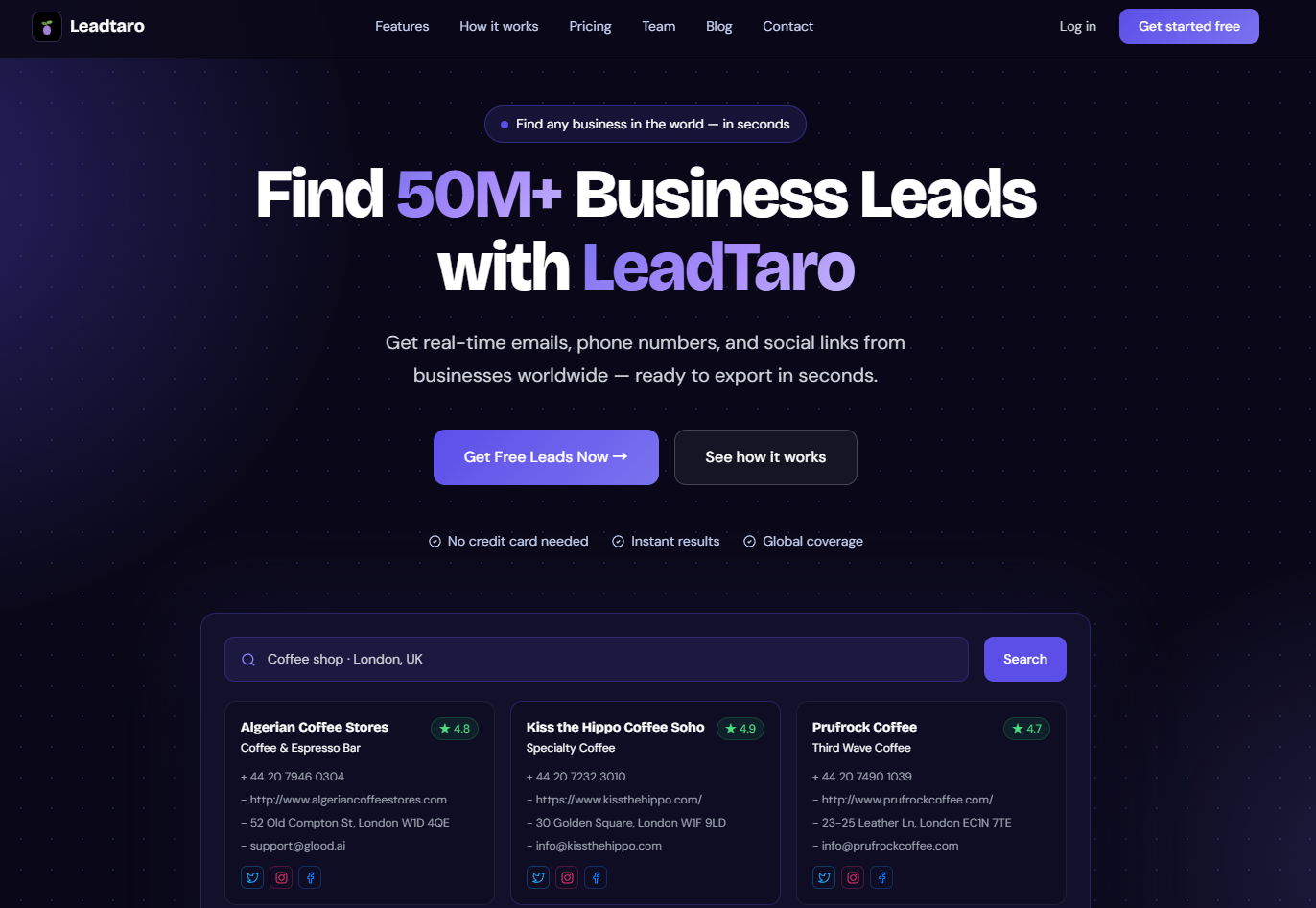
In this guide, we'll explain what lead qualification means, compare the most effective qualification frameworks, show you how to build a practical lead scoring model, and explain how tools like LeadTaro can help you find and organize relevant B2B prospects.
Table of Contents
What Is Lead Qualification?
Why Lead Qualification Matters for B2B Sales
The Best Lead Qualification Frameworks for 2026
The Lead Qualification Process: Step by Step
How to Build a Data-Driven Lead Scoring Model
Using Business Data to Identify High-Quality Prospects
How AI Can Improve Lead Qualification
Real-World Lead Qualification Examples
Your Lead Qualification Checklist for 2026
Compliance and Best Practices for B2B Outreach
Frequently Asked Questions About Lead Qualification
What Is Lead Qualification?
Lead qualification is the process of evaluating potential customers to determine whether they match your ideal customer profile and are likely to purchase your product or service.
Rather than contacting every business you can find, qualification helps you identify prospects based on relevant criteria such as:
Industry: Does the company operate in a market you serve?
Company size: Does it have the right number of employees or locations?
Business need: Is there a problem your product can solve?
Decision-making authority: Can you reach the owner, manager, or relevant buyer?
Budget: Can the company realistically afford your solution?
Timing: Is there a reason to consider a purchase now?
Contact data quality: Do you have accurate, usable business contact information?
The objective is straightforward: spend less time pursuing unsuitable prospects and more time building relationships with businesses that have a genuine reason to buy.
MQL vs. SQL: What's the Difference?
Two common terms in lead qualification are Marketing Qualified Lead (MQL) and Sales Qualified Lead (SQL).
A Marketing Qualified Lead has demonstrated interest or engagement that suggests it may be worth pursuing. Examples include downloading a resource, requesting information, or repeatedly visiting a product page.
A Sales Qualified Lead has been assessed more thoroughly and is considered ready for direct sales engagement based on your qualification criteria.
For outbound B2B prospecting, there is another important distinction: a company that matches your target market is not automatically a qualified buyer.
A business may fit your industry and company-size requirements while having no immediate need for your product. Firmographic fit is an excellent starting point, but meaningful qualification requires additional evidence.
Why Lead Qualification Matters for B2B Sales
An unqualified prospect list creates problems throughout your sales process.
When your team contacts businesses that are unlikely to buy, you spend more time researching irrelevant accounts, sending poorly targeted emails, handling objections, and following up with people who have little interest in your offer.
A structured qualification process helps you:
Improve targeting. Focus on businesses that match your ideal customer profile instead of building lists based on volume alone.
Personalize outreach. Use relevant company information to explain why your product could be useful to each prospect.
Prioritize sales activity. Identify high-fit prospects that deserve immediate attention while placing lower-priority accounts into appropriate follow-up workflows.
Improve data quality. Reduce wasted outreach caused by inaccurate company details, outdated contact information, or unsuitable prospects.
Measure performance. Compare reply rates, positive responses, meetings booked, and conversions across different prospect segments.
The important principle is that a large prospect database is only valuable when it helps you identify the right potential customers.
The Best Lead Qualification Frameworks for 2026
Several established frameworks can help sales teams evaluate prospects. The right choice depends on your product, average contract value, and sales cycle.
1. BANT: Budget, Authority, Need, Timeline
BANT is a straightforward qualification framework that evaluates four factors.
CriterionQuestionPositive SignalBudgetCan the prospect afford the solution?Available budget or realistic purchasing capacityAuthorityWho makes the purchasing decision?Access to the decision-makerNeedWhat problem needs to be solved?A specific business challengeTimelineWhen might the prospect buy?A defined purchasing windowBANT works well for relatively straightforward B2B sales where purchasing decisions are made quickly.
However, it can be difficult to establish budget and timeline information before an initial conversation. For outbound prospecting, begin with the information available from company research and confirm the remaining criteria during discovery.
2. CHAMP: Challenges, Authority, Money, Prioritization
CHAMP begins with the prospect's challenges rather than its budget.
This makes it useful for consultative sales, where understanding a company's problems is essential before discussing pricing.
For example, a growing recruitment agency may struggle to identify new corporate clients. A sales prospecting platform could help it find relevant businesses and decision-makers more efficiently.
The qualification process would begin by establishing whether the agency experiences this problem, then determining who owns the decision, whether funding is available, and how urgently the problem needs to be addressed.
3. MEDDIC: For Complex B2B Sales
MEDDIC is designed for complex sales involving multiple stakeholders and longer purchasing cycles.
It examines:
Metrics: What measurable business outcome matters?
Economic Buyer: Who controls the budget?
Decision Criteria: How will the solution be evaluated?
Decision Process: How will the purchase be approved?
Identify Pain: What business problem must be addressed?
Champion: Who inside the organization supports the purchase?
MEDDIC can be valuable for enterprise software and high-value contracts, but it may be unnecessarily complex for teams prospecting small and medium-sized businesses.
Which Framework Should You Use?
FrameworkBest ForComplexityBANTTransactional B2B salesLowCHAMPConsultative sellingMediumMEDDICEnterprise salesHighData-driven lead scoringProspect list prioritizationLow to mediumFor teams generating outbound leads at scale, a practical approach is to combine firmographic screening with a simple lead scoring model, then apply BANT or CHAMP to promising prospects during sales conversations.
The Lead Qualification Process: Step by Step
A repeatable process makes qualification easier to scale and measure.
Step 1: Define Your Ideal Customer Profile
Your Ideal Customer Profile (ICP) describes the type of business most likely to benefit from your product.
Include criteria such as:
Industry and business category
Company size and estimated revenue
Geographic market
Business model
Existing technology or workflow
Common operational challenges
Typical buyer or decision-maker
For example, a B2B sales automation platform might target recruitment agencies, marketing agencies, software companies, and other businesses with recurring outbound sales activity.
A specific ICP produces more useful prospect lists than broad criteria such as "all businesses in the United States."
Step 2: Build a Relevant Prospect List
Once you know your ICP, identify businesses that match those requirements.
Use business directories, company websites, professional networks, and B2B lead generation platforms to discover potential customers.
LeadTaro helps users find B2B business leads and access business contact information for prospecting. Instead of starting with an entirely manual research process, you can use a lead generation workflow to build a more relevant pool of potential customers.
The goal is not to collect as many contacts as possible. It is to create a list that matches your target market.
Step 3: Verify and Enrich Business Data
Before contacting a prospect, check the quality of the available information.
Useful fields include:
Company name and website
Industry or business category
Business location
Relevant contact name and role, where available
Business email address
Phone number, where available
Company size and other relevant firmographic details
Where possible, validate email addresses before sending outreach. An email address being present in a database does not automatically mean it is current, deliverable, or appropriate for your campaign.
Accurate data helps reduce avoidable bounces and makes personalized outreach easier.
Step 4: Score Each Prospect
Assign points based on how closely each business matches your ICP and how strong the available buying signals are.
A company in your target industry might receive a high fit score, while a company outside your service area receives a lower score.
Keep business fit separate from buying intent. A high-fit company is not necessarily ready to buy, especially when you have not yet spoken to a decision-maker.
Step 5: Segment and Prioritize
Group prospects into actionable categories.
High priority: Strong ICP fit, relevant contact information, and credible evidence of need or interest.
Medium priority: Good company fit, but some important qualification details remain unknown.
Low priority: Weak fit, insufficient data, or little evidence that your offer is relevant.
Your team can prioritize high-fit prospects for personalized outreach, research medium-priority accounts further, and exclude or revisit unsuitable prospects when circumstances change.
Step 6: Track Results and Improve
Measure performance at every stage.
Track qualified replies, meetings booked, opportunities created, conversion rates, email bounce rates, and closed revenue.
Review results by industry, company size, geographic market, and lead source. If one segment consistently generates better opportunities, adjust your ICP and scoring rules accordingly.
Qualification should improve as you learn which prospects actually become customers.
How to Build a Data-Driven Lead Scoring Model
Lead scoring assigns numerical values to prospect attributes and behaviors so that sales teams can prioritize their work consistently.
A useful model separates two categories of signals.
Fit signals describe how closely a company matches your target customer. These include industry, size, location, and relevant business characteristics.
Intent and engagement signals indicate whether a prospect may be considering a purchase. Examples include requesting a demo, replying positively to an email, asking about pricing, or confirming a relevant business problem.
For outbound campaigns, fit data is often available before the first contact. Buying intent may remain unknown until the prospect engages with your outreach.
Example: A 100-Point Lead Scoring Model
The following model is an illustrative starting point. Adjust the weights based on your product and historical conversion data.
Qualification CriterionPointsMatches target industry+20Fits target company size+15Operates in a target geographic market+10Has a relevant business use case+15Relevant decision-maker identified+10Business contact information validated+10Demonstrates buying intent or a relevant need+15Engages positively with outreach+5Total100Use the following tiers as an initial guideline:
80–100: High priority. Strong fit with meaningful qualification signals.
50–79: Medium priority. Potentially suitable, but more research or qualification is needed.
0–49: Low priority. Weak fit or insufficient evidence to justify immediate sales effort.
These thresholds are not universal benchmarks. Review actual conversion data before treating them as fixed rules.
A critical distinction: never assume that a prospect has a budget, urgent need, or purchasing authority simply because its company profile looks promising. Unknown information should remain unknown until it can be verified.
Using Business Data to Identify High-Quality Prospects
Business data provides the foundation for effective outbound lead qualification.
A company database can help you identify potential customers by industry, geography, company characteristics, and available contact information. These details allow you to screen prospects before investing time in individual research.
For example, imagine you sell customer relationship management software to small marketing agencies.
Instead of contacting every business in your database, you could:
Identify marketing agencies in your target market.
Screen companies based on your preferred size and business model.
Review their websites to understand their services and positioning.
Identify relevant owners, managers, or sales leaders where possible.
Validate available business contact details.
Prioritize companies that demonstrate a relevant operational challenge.
Personalize outreach around the specific problem your product addresses.
This workflow helps transform a broad collection of business records into a focused prospecting list.
How LeadTaro Fits Into Your Qualification Workflow
LeadTaro is designed to help users find B2B business leads and access contact information for prospecting.
You can incorporate LeadTaro into your qualification workflow by using it to build a relevant starting list, then applying your own ICP criteria and research process to prioritize the most suitable companies.
A practical workflow looks like this:
Find leads → Review business fit → Validate contact information → Score prospects → Personalize outreach → Track results.
Lead generation and lead qualification serve different purposes. LeadTaro helps with the prospect discovery stage, while your scoring criteria and sales process determine which prospects deserve the most attention.
This distinction matters because even a well-maintained lead database cannot guarantee that every contact has an immediate need or intends to purchase.
How AI Can Improve Lead Qualification
AI can help sales teams process prospect information faster, identify patterns, and prioritize research.
When used with reliable data and clear qualification rules, AI can support several tasks.
1. Automated Company Research
AI-assisted workflows can summarize a company's website, identify its main services, and highlight information relevant to your ICP.
A salesperson can use this research to determine whether a company is a plausible customer before spending time on detailed outreach.
2. Personalized Outreach
AI can help draft emails based on verified company information and a prospect's likely business needs.
The strongest personalization connects a genuine business observation to a relevant value proposition. Adding a company name to a generic template is not enough.
3. Lead Segmentation
AI can group prospects by industry, business model, company characteristics, and other relevant attributes.
This can help teams build more targeted campaigns instead of sending the same message to every contact.
4. Predictive Lead Scoring
With sufficient historical data, machine learning models can identify patterns associated with successful conversions.
For example, a model might learn that certain company sizes, industries, or engagement patterns correlate with a higher probability of booking a meeting.
However, predictive scores should be tested against real results. A model trained on biased or incomplete data can prioritize the wrong prospects.
5. Faster Sales Research
AI can help summarize account information, prepare discovery questions, and identify missing qualification details.
Human review remains important, particularly when the information affects purchasing decisions, compliance, or the accuracy of a sales message.
The best approach is to automate repetitive research while keeping qualification rules transparent and validating important information.
Real-World Lead Qualification Examples
The following examples illustrate how qualification can work across different B2B businesses.
Example 1: A SaaS Company Targeting Marketing Agencies
A SaaS company sells reporting software to digital marketing agencies.
Its ICP includes agencies with an established client base and recurring reporting requirements.
The team builds a list of agencies, reviews their services and company websites, identifies relevant decision-makers, and prioritizes businesses whose operations suggest a need for reporting automation.
Rather than sending the same email to every agency, the team segments prospects by service offering and personalizes the message around relevant reporting challenges.
Qualification lesson: Industry fit is a starting point. The strongest prospects also have a credible use case for the product.
Example 2: A Recruitment Agency Targeting Growing Businesses
A recruitment agency wants to identify businesses that may need additional hiring support.
It focuses on companies in relevant industries and markets, then researches public hiring information and company growth signals where available.
Prospects with evidence of active recruitment needs receive priority, while businesses with no apparent hiring requirements remain in a lower-priority segment.
Qualification lesson: Business characteristics help identify potential customers, but evidence of an active need makes prioritization more meaningful.
Example 3: A B2B Service Provider Expanding Into a New Market
A consulting firm plans to expand into a new geographic region.
It identifies companies that match its ICP, checks whether their locations fall within its service area, and researches their business models before initiating outreach.
The team tracks replies and qualified meetings by region to determine where its offer receives the strongest response.
Qualification lesson: Geographic relevance can improve targeting when location directly affects a company's ability to serve a customer.
Example 4: An Outbound Sales Team Improving Data Quality
A sales team notices that a significant portion of its outreach list contains outdated or unsuitable contacts.
Before launching its next campaign, it removes duplicates, validates available email addresses, reviews company fit, and separates incomplete records from qualified prospects.
It then compares bounce rates, positive replies, and booked meetings before and after the cleanup.
Qualification lesson: Better data can reduce wasted effort, but performance should be measured rather than assumed.
Your Lead Qualification Checklist for 2026
Use this checklist before adding a prospect to a priority outreach campaign.
The company matches your ideal customer profile.
Its industry and business model are relevant to your offer.
Its location is within your target market, where applicable.
You have reviewed its website or other relevant business information.
The contact has a relevant role or a credible path to the decision-maker.
Available business contact information has been checked.
You have identified a plausible reason the company might need your product.
Your outreach message explains a relevant business benefit.
The prospect meets your scoring threshold for the campaign.
The planned outreach complies with applicable privacy and marketing rules.
Not every prospect will have every detail available before the first contact. Record missing information honestly and use the initial conversation to establish whether the company is genuinely qualified.
Compliance and Best Practices for B2B Outreach
Lead qualification must be accompanied by responsible data handling and lawful outreach.
Follow Applicable Email Marketing Rules
In the United States, the CAN-SPAM Act establishes requirements for commercial email, including truthful header information, non-deceptive subject lines, and a functioning opt-out mechanism.
In the United Kingdom, B2B marketing is subject to rules under PECR and UK GDPR, with the requirements depending on the recipient, the type of contact details used, and the nature of the communication.
For example, marketing rules can differ between corporate subscribers and sole traders or certain partnerships. Legitimate interests under data protection law do not automatically override electronic marketing requirements.
Before launching a campaign:
Identify which laws apply to your target market and recipient type.
Document the basis for processing personal data where required.
Use relevant, accurate business information.
Provide the required sender identification and opt-out mechanisms.
Honor objections and suppression requests.
Retain only the data you need and protect it appropriately.
Check contact data and outreach practices against your organization's policies.
Finding a publicly available business contact does not automatically mean that every form of outreach is lawful. Review the applicable rules before contacting prospects.
Frequently Asked Questions About Lead Qualification
What does lead qualification mean?
Lead qualification is the process of assessing whether a potential customer fits your target market and has a realistic likelihood of purchasing your product or service. It helps sales teams prioritize relevant prospects instead of spending equal effort on every contact.
What is the difference between lead generation and lead qualification?
Lead generation focuses on finding potential customers and collecting relevant lead information. Lead qualification evaluates those prospects to determine which ones best fit your ICP and merit further sales attention.
Lead generation creates the prospect pool. Qualification determines where to focus.
What is the best lead qualification framework?
BANT is useful for straightforward sales, CHAMP works well for consultative selling, and MEDDIC is suited to complex enterprise deals. Teams conducting outbound prospecting can begin with firmographic screening and a simple scoring model before applying a more detailed framework during discovery.
How do you qualify B2B leads before contacting them?
Start by defining your ICP. Review company industry, size, location, website, available contact information, and other relevant business characteristics. Score prospects based on fit, then research their needs and decision-making structure where possible.
Some criteria, such as budget and purchase timing, may only become clear after direct engagement.
How does lead scoring work?
Lead scoring assigns points to prospect characteristics and behaviors. A company that matches your ICP may receive a high fit score, while a positive reply or demo request may provide additional evidence of buying intent. The combined score helps your team prioritize follow-up.
Can LeadTaro help with lead qualification?
LeadTaro helps users find B2B business leads and access business contact information for prospecting. You can use those leads as the starting point for your qualification workflow, then apply your ICP criteria, validate relevant details, and prioritize prospects according to your own scoring model.
How many leads should you qualify per day?
There is no universal target. The right number depends on your sales cycle, the complexity of your product, the quality of your data, and the amount of research required for each prospect.
Prioritize qualified opportunities and meaningful engagement over the number of records processed.
Does a verified email mean a lead is qualified?
No. Email verification can help establish whether an address is likely to accept messages, but it does not establish that the recipient needs your product, has purchasing authority, or intends to buy. Contact data quality and sales qualification are separate parts of the process.
Conclusion
Effective lead qualification starts with knowing exactly who you want to reach.
Define your ideal customer profile, build a relevant prospect list, validate business information, and score companies using criteria that reflect your actual sales process. Then use direct conversations and engagement data to determine which prospects have a genuine reason to buy.
AI and automation can make research and prioritization faster, but they work best when supported by reliable data and a clearly defined qualification process.
If you're building a B2B prospecting workflow, LeadTaro can help you get started by finding business leads and contact information for your target market. Combine lead discovery with thoughtful qualification, personalized outreach, and continuous performance measurement to build a more focused sales pipeline.
Start with better-targeted B2B leads using LeadTaro, and spend more time pursuing prospects that fit your business.