Lead scoring helps sales teams identify which businesses to contact first, which prospects deserve personalized outreach, and which leads are unlikely to become customers. For agencies, freelancers, SaaS companies, and B2B sales teams targeting local businesses, an effective scoring model can make prospecting more focused and efficient.
The challenge is that most traditional lead scoring systems were designed for inbound marketing. They rely on website visits, email clicks, form submissions, and other behavioral data that may not exist when you're prospecting businesses you've never contacted.
Local prospecting requires a different approach.
Instead of waiting for prospects to interact with your website, you can evaluate publicly available business information such as industry, location, website presence, contact availability, review activity, and digital marketing signals.
With a structured lead scoring framework and a workflow that combines business discovery, qualification, CRM management, and personalized outreach, you can turn a large list of businesses into an actionable sales pipeline.
In this guide, you'll learn how to build a lead scoring model for local businesses, calculate scores, prioritize prospects, compare tools, and use AI to improve the process.
Table of Contents
- What Is Lead Scoring for Local Businesses?
- Why Lead Scoring Matters in 2026
- How to Build a Local Lead Scoring Model
- The Fit, Digital Readiness, and Opportunity Framework
- How to Turn Scores Into Sales Actions
- Lead Scoring Tools: What Should You Use?
- AI Lead Scoring: Benefits and Limitations
- Data Quality, Privacy, and Compliance
- Frequently Asked Questions
What Is Lead Scoring for Local Businesses?
Lead scoring is the process of assigning numerical values to potential customers based on how closely they match your ideal customer profile and how likely they are to become paying customers.
A higher score indicates that a prospect deserves more attention, based on the criteria you've selected.
Traditional lead scoring often uses behavioral signals such as pricing-page visits, email engagement, webinar attendance, and form submissions. These signals are useful when a prospect has already interacted with your business.
However, consider a web design agency prospecting 5,000 restaurants.
The agency may know each restaurant's location, website, public contact information, review rating, and social media presence. It probably doesn't know whether the owner has visited its website or opened an email.
Waiting for behavioral data isn't a practical way to prioritize these prospects.
Instead, the agency can evaluate the businesses using information available before the first contact.
For example:
Does the business belong to the agency's target industry?
Is it located in a serviceable geographic area?
Does it have a website?
Is a usable business email address available?
Does its website appear outdated or lack important functionality?
Are there visible opportunities to improve its online presence?
Does the business have characteristics associated with previous successful customers?
These signals help sales teams make more informed decisions about which businesses to contact first.
Lead Scoring vs. Lead Qualification
Lead scoring and lead qualification are closely related, but they serve different purposes.
ConceptPrimary purposeExampleLead scoringRank prospects by priorityAssigning a restaurant 78 pointsLead qualificationDetermine whether a prospect is a genuine potential customerConfirming that the restaurant owner needs a new website and has an appropriate budgetLead nurturingDevelop relationships with prospects over timeSending relevant follow-up emailsLead managementOrganize and track the sales processMoving prospects through a CRM pipelineA high score doesn't guarantee that a business will buy. It indicates that the available evidence makes the prospect worth investigating or contacting.
The most effective prospecting process combines scoring with qualification and ongoing sales feedback.
Why Lead Scoring Matters in 2026
Finding business leads is only the beginning of the sales process.
A list of 10,000 businesses is not automatically more valuable than a carefully qualified list of 500. If your team spends its time contacting businesses that don't match your offer, have no relevant need, or fall outside your target market, additional lead volume may simply create more work.
Lead scoring helps solve this prioritization problem.
1. Reduce time spent on unsuitable prospects
Suppose you're selling website redesign services to independent dental practices.
Your ideal customers might be practices in specific locations with an established business, a functioning contact channel, and websites that show clear opportunities for improvement.
A large list containing unrelated retailers, businesses outside your service area, and practices that don't match your offer makes prospecting unnecessarily difficult.
Scoring lets you filter out poor-fit businesses before spending time researching or contacting them.
2. Personalize outreach around observable business needs
A generic email might say:
"Hi, we help businesses improve their online presence."
A more relevant email could identify a specific, publicly observable opportunity:
"I noticed your practice website doesn't appear to have an online appointment request form. We help dental practices make it easier for prospective patients to get in touch."
The second message gives the recipient a concrete reason to consider the offer.
However, observable problems should be verified before they are presented as facts. A low review rating, for example, doesn't necessarily mean that a business is losing customers or looking for marketing assistance.
3. Make large prospect lists manageable
Lead scoring becomes especially useful when prospecting across multiple industries or locations.
A structured process allows you to:
Rank businesses according to your ideal customer profile.
Separate high-priority prospects from lower-priority opportunities.
Assign leads to the right sales representative.
Track outreach and follow-up activity.
Compare the performance of different industries and locations.
Improve scoring rules using actual sales outcomes.
4. Measure whether your prospecting strategy works
A scoring model should improve as you collect results.
If businesses with outdated websites consistently become customers, website quality may deserve more weight for your particular service.
If a particular industry produces many replies but few paying customers, your industry-fit criteria may need adjustment.
The goal is not simply to generate scores. It is to discover which characteristics help predict successful sales outcomes.
How to Build a Local Lead Scoring Model
Before assigning points, establish what makes a business a good potential customer.
Step 1: Define your ideal customer profile
Your ideal customer profile, or ICP, describes the type of business most likely to benefit from your offer and become a valuable customer.
For example, a web design agency might target:
Independent restaurants and cafés.
Businesses in selected towns or cities.
Companies with an existing customer base.
Businesses with outdated websites or missing website functionality.
Owners who can be reached through an appropriate business contact channel.
A B2B software company might instead target accounting firms, recruitment agencies, or professional service providers that match its product's use case.
Your ICP should be based on the characteristics of successful customers whenever possible, rather than assumptions about an entire industry.
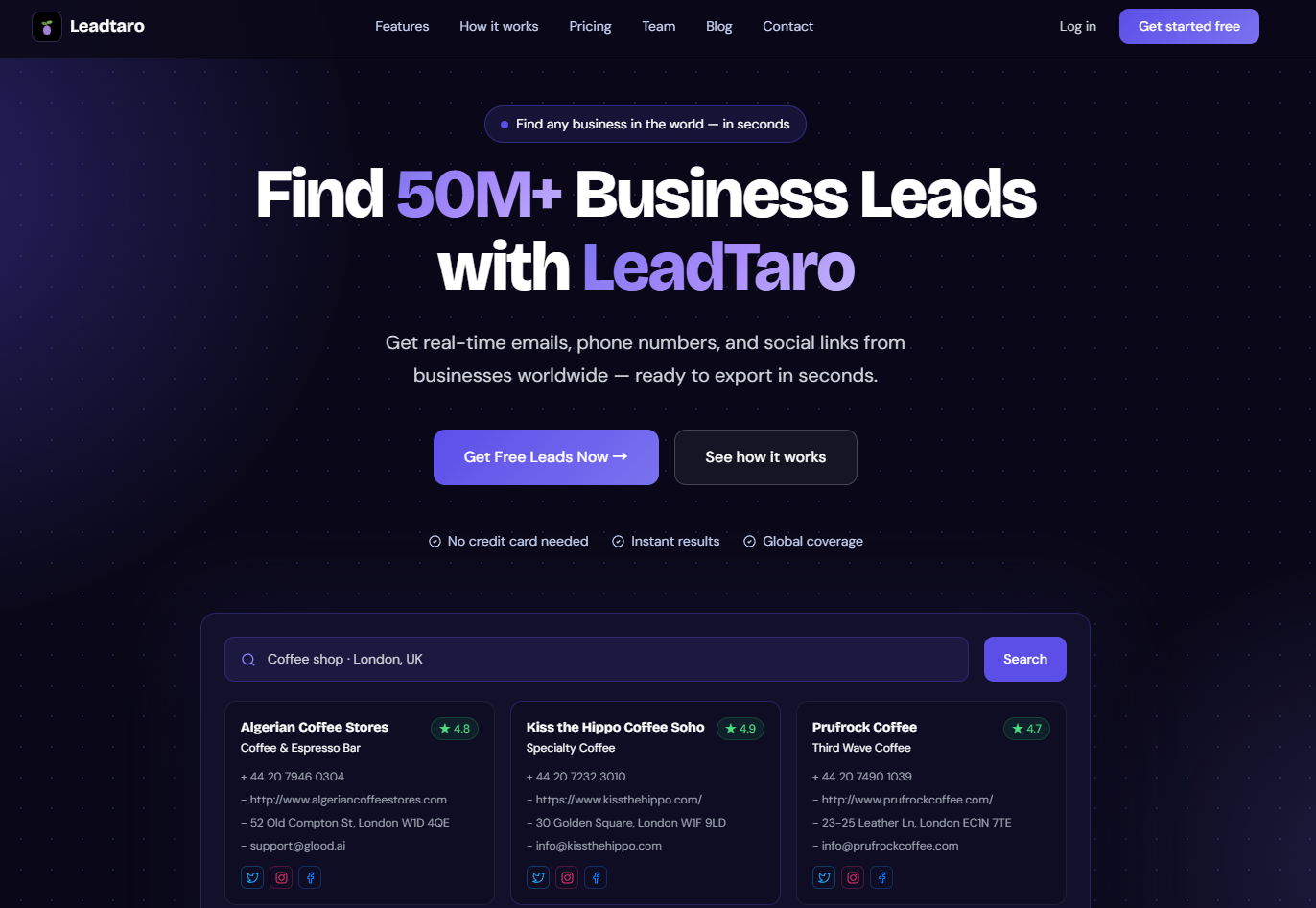
For a more complete prospecting workflow, see LeadTaro, which supports business discovery using industry and geographic searches.
Step 2: Collect relevant business data
Once you've defined your ICP, gather the information needed to evaluate each prospect.
Useful data points include:
Data pointHow it helpsBusiness categoryIdentifies industry fitGeographic locationConfirms service-area eligibilityWebsite URLHelps evaluate online presenceBusiness emailProvides a potential contact channelPhone numberSupports appropriate follow-up methodsGoogle rating and review countProvides context about public reputation and customer feedbackSocial profilesHelps assess visible online activityWebsite functionalityReveals possible opportunities for improvementAdvertising and tracking technologyCan indicate investment in digital marketingPrevious outreach resultsHelps estimate how similar prospects respondNot every field needs to be available for every business. Your scoring model should distinguish between a negative signal and missing information.
For example, an unavailable email address doesn't prove that a business is a poor prospect. It simply means that one potential contact channel hasn't been identified.
Step 3: Assign points to meaningful signals
Give each criterion a point value based on how relevant it is to your offer.
A business category that directly matches your target market may deserve more points than the presence of a social media account.
A website problem may be particularly important if you're selling web design services, while advertising technology might matter more to an agency selling conversion tracking or paid advertising services.
Start with a simple model. Add complexity only when your results justify it.
Step 4: Calculate the total score
Add the points assigned to the business.
For example, a restaurant in your target area may receive points for matching your ICP, having an available business email, and showing an identifiable website improvement opportunity.
The resulting score provides a consistent way to compare the restaurant with other prospects.
Step 5: Validate the model using real outcomes
Track which prospects become meaningful conversations, qualified opportunities, and paying customers.
Over time, compare conversion rates across score ranges.
If your highest-scoring prospects rarely become customers, your model may be rewarding signals that don't actually predict purchasing decisions.
Revise the weights based on evidence rather than simply adding more criteria.
The Fit, Digital Readiness, and Opportunity Framework
A practical local lead scoring model can use three dimensions: Fit, Digital Readiness, and Opportunity.
These dimensions separate the question of whether a business is a suitable customer from the question of whether it has an identifiable need.
Dimension 1: Fit Score
Fit measures whether the business matches your target customer profile.
SignalSuggested pointsBusiness category directly matches your ICP+20Located within your target service area+15Business type and size match your target customer+10Evidence of an established operation+5Maximum example score50These values are starting points, not universal benchmarks.
For example, a freelancer selling website design to independent restaurants might assign substantial weight to industry and location.
A SaaS company serving multi-location businesses might give greater weight to company size and operational complexity.
Dimension 2: Digital Readiness Score
Digital readiness measures whether the business has an identifiable online presence and the characteristics relevant to your service.
SignalSuggested pointsBusiness email is available+10Website is available+5Relevant social media profiles are present+5Website includes useful conversion features+5Relevant advertising or analytics technology is detected+10For offers that require an existing website, website availability may be a positive signal. For a website design agency targeting businesses without websites, the scoring logic should be reversed.
This is an important principle: the same signal can have different meanings depending on what you're selling.
A detected advertising pixel may suggest that a business has invested in digital marketing, but it doesn't prove that the business has a large budget, is actively running ads, or intends to purchase another service.
Similarly, an available email address improves reachability but doesn't establish buying intent.
Dimension 3: Opportunity Score
Opportunity measures whether there is a visible, relevant reason to contact the business.
SignalSuggested pointsWebsite has a verified, important usability issue+20No website, when a website is central to your offer+20Public reviews reveal a recurring issue your service can address+15Important contact or conversion functionality is missing+10Public business information suggests a relevant service gap+10Use these points only when the corresponding condition is actually present and relevant to your offer.
A business with a low review rating may be an interesting prospect for reputation management, but it isn't automatically a good prospect for accounting software.
Likewise, a business without a website may be an excellent web design opportunity but a poor prospect for a product that requires an established online sales operation.
Avoid treating review counts, low ratings, or unclaimed business profiles as proof that a company urgently needs help. These are research signals, not confirmed buying intent.
An example of calculating a lead score
Imagine you're a web design agency targeting independent restaurants in Austin.
Your research identifies a restaurant with the following characteristics:
CriterionPointsMatches your target industry+20Located in your target area+15Business email is available+10Website has a verified usability issue+20Important online contact functionality is missing+10Total75The restaurant receives 75 points out of a possible 100.
That makes it a high-priority prospect under the example framework. Before contacting the business, review the website issue, confirm that your offer addresses it, and prepare a personalized message.
The score is a prioritization aid, not a prediction that the restaurant will definitely buy.
How to Turn Scores Into Sales Actions
A scoring model becomes useful when each score leads to a clear next step.
The following thresholds are an illustrative starting point. Adjust them according to your lead volume, sales cycle, and conversion data.
ScoreTierRecommended action0–29Low priorityKeep the record available for future review or exclude it if it clearly falls outside your ICP30–49ModerateResearch further or send a relevant, low-friction introduction50–74HighPrioritize personalized outreach and track the response75–100Top priorityVerify the opportunity and contact promptly through an appropriate channelBuild a repeatable workflow
1. Discover businesses. Search by industry and location to create a prospect list that matches your ICP.
2. Enrich the records. Collect available contact details, websites, and relevant business signals.
3. Score and rank prospects. Apply your criteria consistently and flag missing or uncertain data.
4. Review the highest-priority leads. Verify that the opportunity is real before making claims in an outreach message.
5. Personalize your outreach. Explain the specific business problem you can help solve and why your offer is relevant.
6. Track outcomes in your CRM. Record contacts, replies, meetings, qualified opportunities, and sales.
7. Improve your model. Compare outcomes by score range, industry, location, and signal to identify what actually works.
LeadTaro can support several parts of this workflow through business discovery, lead data collection, saved prospects, CRM pipeline management, and AI-assisted email writing. The precise scoring rules and automation available in your setup should be checked against the product's current functionality.
Lead Scoring Tools: What Should You Use?
Different tools solve different parts of the lead scoring problem. The best setup depends on whether you need to discover new businesses, score inbound leads, manage an existing pipeline, or predict conversion probability.
ToolPrimary roleBest suited forLeadTaroBusiness discovery, lead data collection, CRM, and AI-assisted outreachTeams prospecting local businesses and organizing outbound salesHubSpotCRM, marketing automation, and lead scoringTeams managing inbound leads and customer relationshipsSalesforceCRM and sales management, with advanced scoring options depending on products and configurationLarger sales organizations with established CRM processesHighLevelCRM, marketing automation, and local-business prospecting featuresAgencies and businesses managing marketing and sales workflowsSpreadsheetManual scoring and analysisFreelancers and small teams testing an initial modelCustom machine-learning modelPredictive scoring based on historical dataOrganizations with sufficient reliable conversion data and technical resourcesFeatures, pricing, and plan availability change, so compare current product documentation before choosing a tool.
LeadTaro: Business Discovery and Lead Management
LeadTaro is designed to help users discover businesses and organize prospecting workflows.
Its capabilities include industry and geographic business searches, available business contact details, website and social profile information, saved leads, CRM pipeline management, and AI-assisted email writing.
For teams that start prospecting with businesses rather than inbound website visitors, this approach helps bring lead discovery and subsequent sales activities into a more connected workflow.
A practical process is to discover businesses matching your ICP, review their available data, prioritize the most relevant opportunities, and move qualified prospects into your CRM pipeline.
LeadTaro can also help with drafting outreach messages, while the final message should be reviewed for accuracy, relevance, and compliance before sending.
Explore LeadTaro to learn more about its business prospecting workflow.
HubSpot: CRM-Based Lead Scoring
HubSpot is a strong option for teams that already manage customer relationships and marketing activity in its CRM.
Depending on the plan and configuration, its scoring features can incorporate CRM properties and engagement data to help prioritize contacts.
For outbound prospecting, however, you may first need to collect and enrich business data before those prospects can be scored meaningfully in your CRM.
Salesforce: Sales Operations and Advanced Scoring
Salesforce can support complex sales processes, CRM-based prioritization, and integrations with external data sources.
It is particularly relevant when multiple sales representatives need shared records, defined qualification stages, reporting, and consistent follow-up processes.
The trade-off is that setup and administration can be more involved than a simple spreadsheet or a lightweight prospecting workflow.
Spreadsheets: A Good Starting Point
A spreadsheet is often sufficient for validating your first scoring model.
Create columns for company name, industry, location, website, contact information, fit score, digital readiness score, opportunity score, total score, and next action.
Use formulas to calculate the total automatically and sort prospects by priority.
Once you understand which signals matter, you can decide whether a dedicated CRM or more advanced automation is worth the investment.
AI Lead Scoring: Benefits and Limitations
AI can make lead scoring more sophisticated, but it doesn't automatically make a scoring model accurate.
There are two main approaches.
Rule-Based Scoring
Rule-based scoring assigns predefined points to specific characteristics.
For example:
Target industry: +20.
Target location: +15.
Verified website issue: +20.
Relevant business email available: +10.
The score is easy to explain, audit, and adjust.
This makes rule-based scoring an excellent starting point for small businesses, agencies, and teams that haven't collected enough historical sales data to train a predictive model.
Predictive Lead Scoring
Predictive lead scoring uses historical data to estimate which prospects are more likely to achieve a defined outcome.
Depending on the model, that outcome could be a positive reply, a qualified sales meeting, or a closed deal.
A model might examine patterns across industry, company size, website characteristics, location, outreach history, and previous conversion outcomes.
However, predictive scoring requires consistent data and a clearly defined target.
If a team records replies inconsistently or has only a small number of successful deals, an AI model may learn unreliable patterns.
How to Use AI More Effectively
A sensible progression looks like this:
Begin with a transparent, rule-based scoring model.
Record meaningful sales outcomes for each prospect.
Review which signals correlate with qualified opportunities and closed deals.
Remove criteria that add complexity without improving results.
Consider predictive scoring when sufficient reliable historical data is available.
Monitor the model for changes in conversion rates and performance across different prospect groups.
AI can also help research businesses, summarize website information, identify possible service gaps, and draft personalized outreach. Any generated observations should be checked before they're used in a sales message.
The goal is not to automate every decision. It is to help your team spend more time on promising prospects and less time on repetitive research.
Data Quality, Privacy, and Compliance
Lead scoring is only as reliable as the information behind it.
Business listings may be outdated, contact details may be incorrect, and website technology may be misidentified. Missing data should not automatically be interpreted as evidence of a poor-quality lead.
Before outreach, verify important details and avoid making unsupported claims about a business's performance or needs.
Follow Applicable Data Protection Rules
Public availability does not automatically make every use of business data lawful.
If you contact prospects in the UK or European Economic Area, consider the applicable data protection and electronic marketing rules, including UK GDPR, EU GDPR where relevant, and PECR in the UK.
For US outreach, CAN-SPAM requirements may apply to commercial email.
Depending on the jurisdiction, recipient type, data source, and outreach method, you may need to consider the lawful basis for processing, transparency obligations, consent requirements, opt-out mechanisms, and restrictions on certain types of communications.
Maintain accurate suppression lists and honor applicable objections and unsubscribe requests. Review the rules that apply to your particular audience and campaign rather than assuming one compliance approach works everywhere.
Frequently Asked Questions
What is lead scoring?
Lead scoring assigns numerical values to potential customers based on criteria such as ICP fit, business characteristics, available contact details, and relevant buying signals. It helps sales teams prioritize prospects instead of treating every lead equally.
How do you calculate a lead score?
Choose relevant criteria, assign points to each signal, and add the points together.
A basic model can use three categories:
Fit: how closely the business matches your ideal customer profile.
Digital readiness: whether its online presence and available contact channels fit your offer.
Opportunity: whether there is an identifiable problem your product or service can address.
Validate the scores against actual sales outcomes and revise the criteria as needed.
What is an example of a lead score?
Suppose a web design agency identifies a restaurant that matches its target industry and location.
The restaurant receives 20 points for industry fit, 15 for location, 10 for an available business email, 20 for a verified website usability issue, and 10 for missing contact functionality.
Its total score is 75 out of 100.
The agency prioritizes the restaurant for research and personalized outreach, then confirms that the identified issues are relevant before making a proposal.
What are the stages of lead scoring?
A practical process has five stages:
Define your ideal customer profile.
Collect relevant business information.
Select scoring criteria and assign points.
Set priority thresholds and corresponding actions.
Measure conversion outcomes and refine the model.
What is the five-minute rule for leads?
The five-minute rule is commonly used to encourage rapid responses to new inbound inquiries. It should not be treated as a universal guarantee of higher conversion rates.
For cold outbound prospecting, the more useful principle is to contact high-priority prospects promptly while respecting appropriate business hours, communication preferences, and legal requirements.
What is the 10-3-1 rule in sales?
The 10-3-1 rule is an informal prospecting heuristic suggesting that ten prospects may produce approximately three meaningful conversations and one conversion.
It is not a universal benchmark. Actual results depend on your market, offer, qualification criteria, sales process, and definition of conversion.
Use your own campaign data to establish realistic expectations.
Is lead scoring worth it in 2026?
Lead scoring can be valuable when your team handles enough prospects that prioritization makes a meaningful difference.
Its effectiveness depends on the quality of your data, the relevance of your criteria, and whether higher-scoring leads actually produce better sales outcomes.
Even a basic spreadsheet model can be useful if it consistently helps you identify suitable prospects and allocate outreach time more effectively.
Can you score leads using Google Maps data?
Yes. Business category, geographic location, publicly displayed ratings, review counts, website availability, and other observable business characteristics can contribute to a prospecting model.
However, these signals don't independently establish purchasing intent. Combine them with your ICP, verify important observations, and evaluate their relationship with actual sales results.
What is the difference between lead scoring and predictive lead scoring?
Rule-based lead scoring uses predefined criteria and point values. Predictive lead scoring uses statistical or machine-learning techniques to estimate the probability of a defined outcome from historical data.
Rule-based models are easier to explain and maintain. Predictive models can identify more complex patterns but require reliable data, validation, and ongoing monitoring.
Final Thoughts
Lead scoring helps transform business discovery into a more structured sales process.
Instead of contacting every business in the order it appears in a list, you can prioritize prospects according to ICP fit, relevant digital characteristics, and identifiable opportunities.
Start with a simple model. Collect reliable business information, apply consistent scoring rules, and connect each score to a clear next action. Track replies, qualified meetings, and closed deals so you can identify which signals actually predict success.
For agencies, freelancers, and B2B sales teams prospecting local businesses, combining business discovery with lead management and personalized outreach can make this process easier to organize and scale.
Ready to build a more organized prospecting workflow? Explore LeadTaro to discover businesses, organize leads, manage your sales pipeline, and prepare personalized outreach from one connected workflow.