Local business lead generation is about more than collecting names and phone numbers. It is about identifying businesses in a specific market, understanding their potential needs, and turning relevant prospects into real sales opportunities.
For agencies, freelancers, consultants, and B2B sales teams, local prospecting can create opportunities to reach businesses that need better websites, marketing support, software, professional services, or other business solutions.
The challenge is building a repeatable process. Random outreach, outdated contact lists, and generic sales messages can waste time without generating meaningful conversations.
This guide explores seven practical local business lead generation strategies, explains how to build a prospecting system, and shows how LeadTaro can help you discover business leads, prepare personalized outreach, and organize sales opportunities.
Table of Contents
What Is Local Business Lead Generation?
The Local Lead Generation Landscape in 2026
7 Proven Local Business Lead Generation Strategies
How to Build a Local Lead Generation System
Cost Considerations for Local Lead Generation
Measuring Local Lead Generation Performance
Is Local Lead Generation Legal?
Common Mistakes That Kill Local Lead Generation
FAQ
Start Finding Local Business Leads with LeadTaro
What Is Local Business Lead Generation?
Local business lead generation is the process of identifying, attracting, and engaging potential customers within a defined geographic area.
That area could be a city, a region, a group of towns, or an entire country, depending on the business model and target market.
For example, a web design agency in Leeds might target independent retailers and restaurants that need improved websites. A software company might identify local professional service firms that fit its ideal customer profile. A marketing consultant might focus on businesses that could benefit from more effective customer acquisition.
The objective is to find relevant prospects and create opportunities for meaningful business conversations.
Why Local Targeting Matters
Geographic targeting helps narrow a broad market into a more manageable prospect list.
Instead of contacting every business you can find, you can concentrate on companies that match your service area, industry focus, and ideal customer profile.
Local context can also make outreach more relevant. Understanding the market a business operates in, the services it offers, and the customers it serves gives you a stronger starting point for a conversation.
However, being nearby does not automatically make a prospect qualified. The best local prospecting combines geographic relevance with business fit and a clear reason to make contact.
The Local Lead Generation Funnel
A practical local lead generation funnel has three main stages.
1. Discovery
Identify businesses that match your target audience through business directories, search engines, professional networks, referrals, content, or B2B lead generation platforms.
2. Qualification
Review the available business information and decide whether the prospect is relevant to your offer. Consider industry, location, company details, potential needs, and the quality of the available contact information.
3. Outreach and conversion
Contact suitable prospects through appropriate channels, personalize your communication, and track conversations until they become customers or are disqualified.
This process gives your prospecting activity a clear purpose: move from finding businesses to identifying genuine sales opportunities.
The Local Lead Generation Landscape in 2026
Businesses can now use a combination of search engines, online directories, social media, email, CRM systems, and AI-assisted writing tools to support their prospecting activities.
The challenge is not simply finding more data. It is deciding which businesses to prioritize and how to approach them efficiently.
Lead Quality Matters More Than List Size
A list containing thousands of businesses may appear valuable, but its usefulness depends on whether those businesses fit your target market.
For example, a consultant selling website redesign services may gain more from a carefully researched list of businesses with relevant website needs than from a much larger list containing every business in a city.
Before building a list, define what makes a business a good prospect. This could include its industry, location, size, existing services, website, or other relevant business characteristics.
How AI Can Support Local Prospecting
AI-assisted tools can help sales teams draft emails, adapt messaging to different industries, and reduce repetitive writing tasks.
They can also support a more consistent workflow when prospecting across several business categories.
However, AI-generated content should be reviewed before use. It should not invent company information, assume that a business has a particular problem, or make unsupported claims about a prospect.
The most effective approach combines useful business data, human judgment, and a clear outreach process.
7 Proven Local Business Lead Generation Strategies
The following strategies can be used individually or combined into a broader lead generation system. The right mix depends on your audience, budget, geographic market, and business objectives.
1. Use B2B Lead Generation Tools to Discover Local Businesses
One of the most practical ways to start local prospecting is to build a structured list of businesses that fit your ideal customer profile.
Rather than collecting contact details manually from multiple pages, a B2B lead generation platform can help organize business discovery and make it easier to review potential prospects.
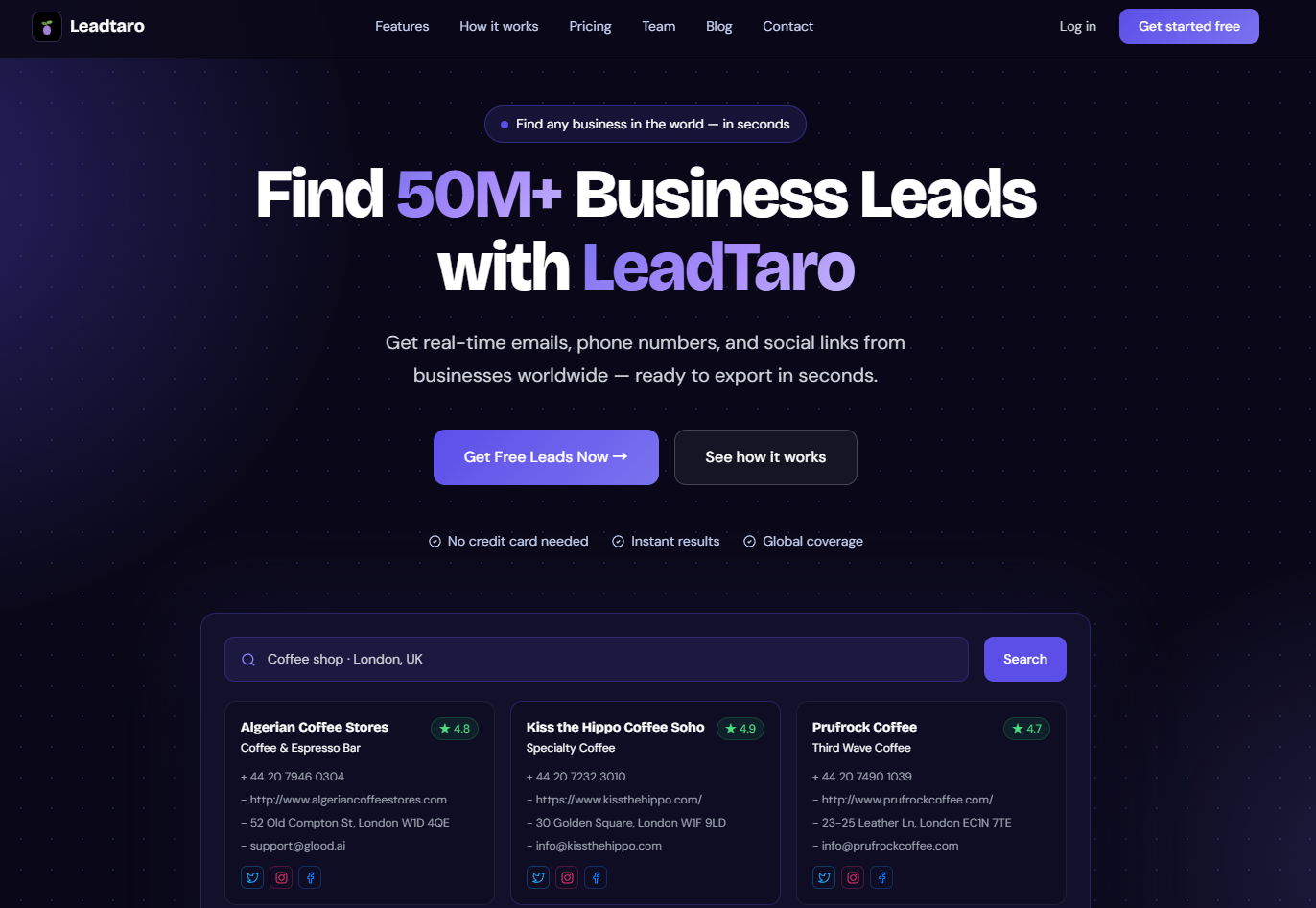
With LeadTaro, you can search for B2B business leads and review available information such as company names, websites, phone numbers, email addresses, and social links, depending on the record.
A practical workflow looks like this:
Choose your target industry and geographic market.
Define the types of businesses you want to reach.
Search for relevant business leads.
Review the available company and contact information.
Prioritize businesses that fit your offering.
Prepare an appropriate outreach message.
For example, a marketing agency might focus on independent retailers in a particular region. A recruitment firm might target businesses in industries where it specializes. A software consultant might focus on companies that match its service requirements.
The important point is to define your target audience before building your list.
Why this strategy works: It gives your outreach a clearer direction and reduces the time spent searching for prospects one business at a time.
2. Improve Your Local SEO
Local search engine optimization helps businesses become more discoverable when potential customers search for relevant products or services in a particular area.
If you sell services to local consumers, a strong local search presence can attract people who are already looking for what you offer.
If you sell services to other businesses, local SEO can also help potential clients discover your company when they search for agencies, consultants, software providers, or professional services nearby.
Practical improvements include:
Maintaining accurate business contact information.
Creating useful service pages for the locations you genuinely serve.
Publishing content that answers relevant customer questions.
Improving website speed and mobile usability.
Collecting authentic customer reviews where appropriate.
Making your services and contact options easy to understand.
Avoid creating large numbers of nearly identical location pages that offer little value. Each page should provide useful, specific information for its intended audience.
Why this strategy works: Local SEO can help attract relevant inbound interest over time, complementing outbound prospecting.
3. Use Personalized Cold Email Outreach
Cold email can introduce your services to businesses that may not know your company exists.
Its effectiveness depends on several factors, including audience relevance, contact data quality, message clarity, deliverability, and compliance with applicable marketing rules.
A generic email asking whether a business needs your services is easy to ignore. A more specific message that explains why your offer may be relevant gives the recipient a clearer reason to respond.
For example, a web design agency could write:
"Hi Alex, I work with independent businesses on improving their websites and online customer journeys. I came across your company while researching businesses in the area and wanted to introduce our services in case website improvements are something your team is considering."
This is a starting point, not a script to send unchanged to every prospect. Adapt the message to the actual business and avoid claiming that you identified a problem unless you have verified it.
Use LeadTaro to Support Email Preparation
LeadTaro includes AI-assisted cold email generation to help users create initial outreach drafts.
You can use this capability to develop messages for different industries, refine your introduction, and reduce the time spent writing repetitive emails.
A sensible workflow is to:
Find relevant business leads.
Review the available business information.
Decide why your offer could be relevant.
Generate or prepare an initial email draft.
Verify the message and personalize it.
Record the outreach and follow-up status.
AI can help with drafting, but the final message should remain accurate, appropriate, and relevant to the recipient.
Why this strategy works: It gives you a repeatable way to introduce your services while preserving the flexibility to personalize each message.
4. Run Targeted Social Media Advertising
Social media advertising can help businesses reach audiences in selected geographic areas.
For example, a local service provider might advertise to people within its operating area, while a B2B agency might run a campaign designed to attract business owners or professionals in a relevant market.
Before launching a campaign, define:
The audience you want to reach.
The geographic area you serve.
The offer or problem you want to address.
The landing page or contact method.
The budget and performance metrics.
How leads will be qualified and followed up.
Measure more than clicks and impressions. Track how many inquiries become qualified prospects and how many eventually become customers.
Where advertising platforms support customer-list or audience-matching features, review their eligibility requirements, terms, and data policies before uploading contact information. Having a business contact record does not automatically give you permission to use it for every advertising purpose.
Why this strategy works: Geographic and audience targeting can help focus advertising on a relevant market, while measurement helps you determine whether the investment is worthwhile.
5. Build Local Networking and Strategic Partnerships
Online prospecting is useful, but personal relationships can also create valuable business opportunities.
Local business groups, professional events, industry meetups, chambers of commerce, and referral partnerships can introduce you to potential customers who already have some context about your work.
To make networking more systematic:
Attend events relevant to your target market.
Explain clearly which businesses you help and how.
Build relationships with complementary service providers.
Follow up with people who have expressed a genuine interest.
Record agreed next steps so promising conversations do not disappear.
For example, a web design agency might build relationships with photographers, branding consultants, and marketing freelancers who serve similar clients but offer different services.
You can also use public business information to prepare for meetings and understand a company's services before following up. Make sure the information is accurate and relevant rather than relying on assumptions.
Why this strategy works: Trusted introductions can provide useful context and create opportunities that a cold message alone may not.
6. Use Reviews and Public Business Information to Qualify Prospects
Public business information can help you understand a company's services, customer feedback, and online presence.
For businesses selling reputation management, website development, marketing, or customer experience services, these details may provide a starting point for deciding whether a prospect is relevant.
For example, a company with incomplete service information on its website may be a possible fit for a web content service. A business that publicly responds to customer feedback may be relevant to a reputation management provider.
However, a rating or review count alone does not prove that a business needs your service. A company with excellent reviews might still need marketing support, while a company with fewer reviews might have no interest in buying it.
Use visible information as a reason to investigate further, not as proof of a prospect's needs.
A useful qualification process includes:
Confirming that the business fits your target market.
Reviewing its website and publicly available service information.
Checking whether the contact details are relevant and current.
Identifying a credible reason your offer could help.
Prioritizing prospects based on your own qualification criteria.
Why this strategy works: It encourages you to select prospects based on evidence rather than contacting every business in the same way.
7. Publish Location-Specific Content
Content marketing can help attract prospects who are researching services, comparing providers, or looking for answers to specific business problems.
Location-specific content is particularly useful when your business serves a defined geographic market.
Examples include:
A guide to choosing a web design agency in Leeds.
A comparison of marketing services for independent businesses in Manchester.
A checklist for restaurants improving their online presence.
An explanation of common website problems affecting local service companies.
A case study describing a real project and its documented results.
Good local content should answer a genuine question and offer information that is useful to the intended reader.
Avoid producing dozens of pages that simply replace one city name with another. Search engines and readers both benefit from original, relevant information.
Include clear next steps where appropriate, such as requesting a consultation, exploring your services, or contacting your team.
Why this strategy works: Useful content can attract relevant visitors, demonstrate expertise, and support lead generation beyond direct outreach.
How to Build a Local Lead Generation System
Individual strategies become more valuable when they work together as a repeatable process.
Consider a small marketing agency that wants to find more local business customers. Instead of purchasing a large, unfiltered contact list, the agency can define its ideal clients, discover relevant businesses, review their information, and organize outreach in a CRM pipeline.
Here is a practical framework.
Step 1: Define Your Ideal Customer Profile
Start by describing the businesses most likely to benefit from your services.
Consider:
Industry or business category.
Geographic location.
Company size or business type.
The problem your service solves.
Relevant company characteristics.
The contact or decision-maker you need to reach.
"Small businesses" is a broad audience. "Independent retailers in West Yorkshire that fit our website redesign service" is a more actionable starting point.
The more clearly you define your audience, the easier it becomes to identify relevant leads and tailor your messaging.
Step 2: Discover and Organize Prospects
Use appropriate lead generation sources to find businesses that match your criteria.
LeadTaro can support B2B lead discovery and provide access to available business contact details, depending on the record.
After finding prospects, organize the information needed for your sales process. This might include the business name, website, available contact details, location, industry, and the reason the business appears relevant.
Verify important details before outreach. Contact data can be incomplete or outdated, and not every business you discover will be a suitable prospect.
Step 3: Qualify and Prioritize Leads
Not every lead deserves the same amount of attention.
Create a simple qualification framework based on your business objectives. You might assess each prospect using three questions:
Fit: Does this business match the audience you serve?
Relevance: Is there a credible reason your product or service might be useful?
Readiness: Is there evidence that the business may be considering a relevant change or investment?
You can use a simple rating system to help organize the list, but treat it as a prioritization aid rather than a guarantee that a prospect will convert.
Focus first on the businesses that appear most relevant and for which you can explain the value of your offer clearly.
Step 4: Prepare Personalized Outreach
Select an appropriate channel for each prospect and prepare a message that reflects your offer and the recipient's business context.
For email, LeadTaro's AI-assisted writing capability can help generate an initial draft. Review it carefully, verify the details, and make any necessary changes before sending.
Avoid making unsupported claims about a prospect's performance or problems. A relevant question or concise introduction is usually a better starting point than an aggressive sales pitch.
Step 5: Track Every Opportunity in Your CRM Pipeline
Without a tracking system, it is easy to lose track of contacted prospects, interested businesses, and scheduled meetings.
LeadTaro's CRM pipeline helps you organize leads through stages such as:
New Lead: A prospect has been identified.
Contacted: Initial outreach has taken place.
Interested: The prospect has shown interest.
Meeting: A meeting or sales discussion is scheduled or underway.
Closed: The opportunity has reached a final outcome.
Keep your records accurate and update the status as conversations progress.
A structured pipeline helps you identify which opportunities need attention and makes it easier to review your prospecting process.
Step 6: Measure Results and Improve
Track the metrics that connect your activity to business outcomes.
Useful measures include:
Number of relevant prospects discovered.
Percentage of records with usable contact details.
Number of prospects contacted.
Positive response rate.
Meetings booked.
Qualified opportunities created.
Customers acquired.
Cost per qualified lead and cost per customer.
Use these measurements to identify where your process needs improvement.
If many prospects are irrelevant, refine your targeting. If messages generate little engagement, review your offer and personalization. If meetings do not turn into customers, examine your qualification and sales process.
A repeatable system should improve as you learn from actual results.
Cost Considerations for Local Lead Generation
The cost of generating local business leads depends on the channel, the market, the tools you use, the time required, and how you define a qualified lead.
A low-cost contact is not necessarily a good lead, and a high-cost lead does not automatically produce a sale.
ChannelMain cost considerationsB2B lead generation toolsSubscription fees, usage limits, and the time spent reviewing records.Cold emailResearch, contact data, email infrastructure, writing, and follow-up.Local SEOContent creation, website improvements, and ongoing optimization.Paid advertisingAdvertising spend, creative work, landing pages, and lead qualification.Networking and partnershipsMemberships, events, travel, and relationship-building time.Purchased lead listsData quality, freshness, relevance, exclusivity, and provider terms.How to Calculate Cost Per Lead
You can calculate cost per lead by dividing your total lead generation costs by the number of leads generated during the same period.
For example, if a campaign costs £300 and generates 60 leads, the cost per lead is £5.
However, if only 10 of those leads fit your ideal customer profile, the cost per qualified lead is £30.
This is why tracking qualified opportunities matters. It helps you compare channels based on the value they create rather than the number of contacts they produce.
Building Your Own Prospecting Process
Building a prospect list through your own research and lead generation workflow can give you greater control over your target audience and the information you collect.
A platform such as LeadTaro can help with business lead discovery, AI-assisted cold email preparation, and CRM pipeline organization.
When evaluating any tool, consider the quality and relevance of its data, the features you actually need, its usage limits, and the amount of manual work it can realistically reduce.
Measuring Local Lead Generation Performance
Local lead generation should be evaluated using business outcomes rather than activity alone.
A campaign that generates hundreds of contacts but few relevant conversations may be less useful than a smaller campaign that creates qualified opportunities.
Monitor These Key Metrics
Lead relevance: What percentage of discovered businesses fit your target audience?
Contactability: How many records contain usable contact information?
Response rate: How many contacted prospects respond?
Positive response rate: How many responses indicate genuine interest?
Meeting conversion: How many qualified prospects agree to a meeting?
Customer conversion: How many opportunities become paying customers?
Cost per acquisition: How much does it cost to acquire a customer through the campaign?
Compare these metrics across industries, locations, and outreach methods when you have enough reliable data to make the comparison meaningful.
Do not assume that a particular response rate or conversion rate is guaranteed. Results vary with the offer, audience, market conditions, data quality, and execution.
Is Local Lead Generation Legal?
Local lead generation can involve collecting business information, storing contact details, and communicating with prospective customers. The applicable rules depend on the information involved, the source, the recipient, the channel, and the country.
Public availability does not automatically make every use of personal data lawful. Likewise, having a business email address does not automatically mean that every marketing email is permitted.
If you operate in the UK or contact UK recipients, consider the requirements that apply under UK GDPR, the Data Protection Act 2018, and the Privacy and Electronic Communications Regulations (PECR). Requirements can differ between corporate subscribers, sole traders, and certain partnerships, particularly for electronic marketing.
Before launching a campaign:
Identify where your prospect information came from.
Collect only information relevant to your purpose.
Determine the lawful basis and marketing rules applicable to your activity.
Provide appropriate information about your use of personal data where required.
Identify yourself accurately in communications.
Respect objections and maintain suppression lists where appropriate.
Review the rules of the platforms and services you use.
If you operate internationally, check the relevant local requirements rather than assuming that one country's rules apply everywhere.
For complex campaigns, consult the relevant regulator's guidance or seek professional legal advice.
Common Mistakes That Kill Local Lead Generation
1. Targeting Too Broad an Audience
Trying to reach every business in a city can lead to irrelevant messages and wasted effort.
Define your ideal customer profile and narrow your initial campaigns to a manageable audience.
2. Prioritizing Quantity Over Quality
A large contact list does not guarantee a large number of qualified opportunities.
Review the available business information and focus on prospects that match your service and target market.
3. Sending Generic Messages
Messages that could apply to any business give recipients little reason to respond.
Use relevant information to explain why you are contacting a particular company, and verify the details before making claims.
4. Failing to Track Follow-Ups
Without organized records, you may forget interested prospects, repeat messages, or lose track of scheduled meetings.
Use a CRM pipeline to record contact history, current status, and next steps. Follow up when appropriate, and stop when someone objects or asks not to be contacted.
5. Ignoring Data Quality
Incorrect email addresses, outdated phone numbers, and incomplete company information reduce the value of your prospecting work.
Verify important details when possible and review results regularly.
6. Measuring Only Opens or Clicks
Opens and clicks can provide some context, but they do not necessarily indicate buying intent or revenue potential.
Track positive responses, qualified meetings, opportunities, and customers alongside activity metrics.
7. Ignoring Compliance
A prospecting strategy can create legal, reputational, and deliverability problems if it disregards applicable marketing rules or recipient preferences.
Review your data sources, communication methods, and follow-up practices before scaling a campaign.
FAQ
How do you generate leads for a local business?
Start by defining your ideal customer profile and geographic market. Discover relevant businesses through suitable lead generation tools, directories, search engines, referrals, and networking. Review the available information, prioritize qualified prospects, and reach out through appropriate channels. Track the results and refine your process over time.
What is local business lead generation?
Local business lead generation is the process of finding and engaging potential customers in a defined geographic market. It can involve outbound prospecting, local SEO, advertising, networking, content marketing, and business lead research.
What are the best local lead generation strategies in 2026?
Useful strategies include B2B lead discovery, local SEO, personalized cold email, targeted social advertising, networking, reviewing public business information, and location-specific content marketing. The right combination depends on your target audience and business goals.
How much does local business lead generation cost?
Costs vary by channel, market, tools, and the time required to qualify prospects. Calculate both cost per lead and cost per qualified lead so that you can compare the quality of opportunities generated by different methods.
Can I use AI for local lead generation?
AI can help draft cold emails, adapt messages for different audiences, and reduce repetitive writing work. Human review remains important for accuracy, relevance, and compliance. LeadTaro includes AI-assisted cold email generation to support outreach preparation.
How do I find local businesses to contact?
Define the industries and locations you want to target, then use relevant business directories, search engines, research methods, or B2B lead generation tools. LeadTaro supports business lead discovery and lets users review available business contact information.
How do I manage local business leads?
Organize your prospects in a CRM or another structured tracking system. Record contact details, outreach history, lead status, and next actions. LeadTaro's CRM pipeline helps users manage prospects through stages such as New Lead, Contacted, Interested, Meeting, and Closed.
Is local lead generation legal in the UK?
It can be lawful, but the requirements depend on the data, its use, the recipient, and the communication channel. UK GDPR, the Data Protection Act 2018, and PECR may apply. Review current guidance and make sure your prospecting and outreach practices meet the requirements relevant to your campaign.
Is local lead generation still useful in 2026?
Local prospecting remains a practical approach for businesses that serve specific geographic markets or sell to local companies. Its effectiveness depends on selecting relevant prospects, using appropriate communication channels, and measuring the quality and commercial outcomes of the opportunities generated.
Start Finding Local Business Leads with LeadTaro
Effective local business lead generation starts with knowing who you want to reach and why they might benefit from your offer.
Build a focused prospect list, review business information, personalize your outreach, and manage your opportunities through a consistent sales process.
LeadTaro brings together B2B lead discovery, AI-assisted cold email generation, and CRM pipeline management to help organize these activities in one workflow.
Whether you are a freelancer finding your first local clients, an agency expanding into new markets, or a sales team building a more structured prospecting process, start with relevant leads and a clear plan for turning them into conversations.
Explore LeadTaro at https://www.leadtaro.com/ and build a more organized B2B prospecting workflow.