Product-market fit is one of the biggest challenges for B2B SaaS founders. A product can have an impressive feature list, a polished interface, and a competitive price, yet still struggle to retain users. The problem is often not the technology itself. It is whether the product solves a problem that a specific group of customers urgently needs to solve.
For local prospecting tools, that challenge is particularly important. Agencies need reliable ways to find potential clients. Freelancers want to identify businesses that could benefit from their services. Sales teams need qualified prospects without spending hours building lists manually. Each group has different expectations, budgets, and workflows.
The opportunity is to build a tool that fits a clearly defined audience, helps users find relevant businesses, and turns prospecting into a repeatable sales process.
This guide explains how to measure product-market fit for local prospecting tools, identify the right customer segment, evaluate meaningful growth metrics, and build a sustainable B2B SaaS product in 2026.
Table of Contents
What Is Product-Market Fit for Local Prospecting Tools?
The Local Prospecting Market in 2026
How to Measure Product-Market Fit for Prospecting Tools
Examples of Companies That Found Product-Market Fit
Common Product-Market Fit Challenges
Strategies to Achieve and Maintain Product-Market Fit
Future Trends in Local Prospecting
Frequently Asked Questions
1. What Is Product-Market Fit for Local Prospecting Tools?
Product-market fit (PMF) describes the point at which a product effectively meets the needs of a specific market. Customers understand its value, use it consistently, and are willing to pay for the results it delivers.
Marc Andreessen popularized the concept in the startup world. Sean Ellis later introduced a widely used survey question to help founders assess whether customers would miss a product if it disappeared.
For local prospecting tools, product-market fit means more than providing a large business database. Users need to find relevant companies, access useful business information, qualify prospects, and take meaningful sales actions.
For example, a freelance web designer might want to identify restaurants with outdated websites. A marketing agency may need a list of independent businesses in a particular city. An outbound sales team may need company details and contact information before launching a targeted campaign.
All three users need prospecting capabilities, but their definitions of a successful product differ.
The key is to identify which customer segment receives the most value and build around its specific needs.
The 40% Rule for B2B Prospecting Tools
Sean Ellis popularized a product-market fit survey that asks users how disappointed they would be if they could no longer use a product.
The commonly cited benchmark is that 40% or more of respondents saying they would be "very disappointed" can indicate strong product-market fit.
However, this is a diagnostic signal, not a guarantee of sustainable growth.
For a B2B prospecting tool, survey results become more useful when customers are divided into meaningful groups:
Agencies: Do they regularly discover new prospects for themselves or their clients?
Freelancers: Does the tool help them find businesses they would otherwise struggle to reach?
Sales teams: Does it reduce prospect research time and improve their workflow?
Founders and small businesses: Does it make customer acquisition more accessible without requiring a large sales budget?
Suppose agency users report much stronger satisfaction than enterprise teams. That could indicate an opportunity to focus the product on agencies rather than adding expensive enterprise features prematurely.
The goal is not to achieve one impressive survey result. It is to discover who benefits most, why they benefit, and what makes them return.
Why Product-Market Fit Is Different for Location-Based Prospecting
A general productivity tool may solve a similar problem regardless of where its customers live. Local prospecting introduces additional variables.
Geographic coverage matters. A tool can be useful in one city but less effective in another if business coverage, contact availability, or search relevance differs.
Business categories matter. A product that works well for restaurants may be less useful for specialist manufacturers or professional services.
Data quality matters. Duplicate records, outdated phone numbers, missing websites, and incorrect business details can undermine the entire prospecting workflow.
The next action matters. Finding a company is only the beginning. Users may also need to organize leads, prioritize opportunities, contact prospects, and track conversations.
A strong product therefore combines relevant business discovery with a workflow that helps users act on the information they find.
2. The Local Prospecting Market in 2026
Businesses continue to invest in customer acquisition, sales automation, and B2B data. At the same time, competition for attention has made prospecting more demanding.
Sales professionals must identify suitable companies, personalize outreach, manage follow-ups, and avoid wasting time on irrelevant contacts.
Local prospecting tools address a practical problem: helping users identify potential customers by location, business type, and other relevant criteria.
But market demand alone does not establish product-market fit. A growing category can still contain products that struggle to retain customers because they do not solve a sufficiently specific problem.
What Customers Expect From Modern Prospecting Software
A useful prospecting platform should make it easier to move from a broad target market to an actionable list of potential customers.
Common requirements include:
Business discovery: Find companies by category, location, and relevant search criteria.
Useful company information: Access available business names, addresses, websites, phone numbers, and other relevant details.
Contact research: Find available email addresses and social profiles where supported, while making data limitations clear.
Lead qualification: Filter and prioritize prospects based on fit with the ideal customer profile (ICP).
Export and integration: Move suitable prospects into existing sales and marketing workflows.
Lead management: Organize prospects, record progress, and track follow-ups.
Outreach support: Create personalized messages and maintain a consistent prospecting process.
Not every user needs every feature. The most important question is which capabilities solve the target customer's most expensive or frustrating problem.
Choosing Between a Static Database and Fresh Research
Prospecting platforms often use different approaches to business data.
A database-based tool can make searching large collections of previously gathered records fast and convenient. Its usefulness depends on coverage, update frequency, and the quality of its underlying information.
Fresh research can help users investigate businesses whose information may have changed or whose records are missing from an existing database. However, fresh collection does not automatically guarantee accuracy. Information still needs to be checked, and available fields vary by business and source.
These approaches serve different needs. A customer searching for thousands of businesses may prioritize speed and broad coverage, while someone researching a narrow niche may value more recent information about individual companies.
For founders building prospecting software, the lesson is straightforward: understand which data approach delivers the best result for the intended use case instead of assuming that one approach is always superior.
Where LeadTaro Fits Into the Prospecting Workflow
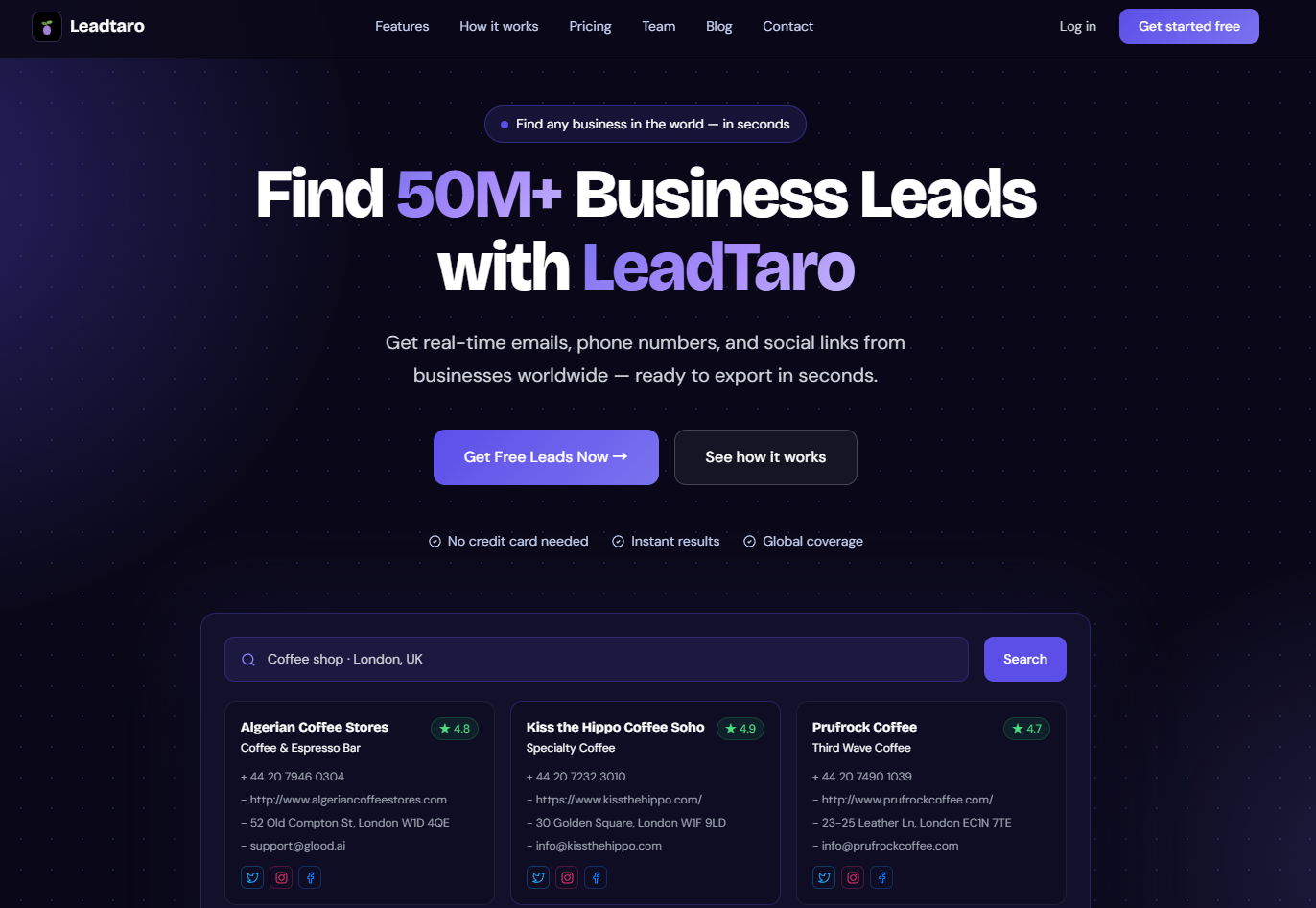
LeadTaro is designed around business lead discovery and sales prospecting. Users can search business records, identify potential customers, review available company information, and organize prospects through a sales pipeline.
The product's value is not simply the number of records available. It is how effectively users can turn those records into relevant opportunities.
A practical workflow looks like this:
Define an ideal customer profile.
Search for businesses matching the target category and market.
Review available business and contact information.
Prioritize suitable prospects.
Export or organize leads for follow-up.
Personalize outreach and track responses.
Use the results to improve future prospecting.
This workflow connects data discovery to an outcome that customers care about: finding potential clients and building a more consistent sales pipeline.
3. How to Measure Product-Market Fit for Prospecting Tools
Vanity metrics can make a product appear healthier than it really is. Website traffic, registrations, and monthly active users are useful indicators, but they do not necessarily demonstrate that customers receive enough value to keep using the product.
A prospecting tool needs measurements that reflect real customer behavior.
The Sean Ellis Survey Adapted for B2B
The core question is:
"How would you feel if you could no longer use this product?"
Typical answers include:
Very disappointed
Somewhat disappointed
Not disappointed
I no longer use the product
The result can help reveal how essential a product has become for active users. For a prospecting platform, it is useful to follow up with questions that identify the source of that value.
Consider asking:
What is the main benefit you receive from this tool?
What type of business or role would benefit most from it?
What task does it help you complete faster or more effectively?
What would you use instead if the product disappeared?
What is the most important improvement we could make?
Have you recommended the product to another person or business?
Survey users after they have had enough time to experience the core workflow. Someone who has only registered may not understand the product's real value.
Segment the responses by customer type, usage frequency, and subscription status. A high score among a small but well-defined customer segment may be more actionable than an average score across a broad audience.
Product-Market Fit Metrics That Matter
The following metrics can help founders evaluate whether a prospecting product is becoming part of customers' regular workflows.
MetricPositive signalWarning signalRepeat usageCustomers return to find and manage more leadsMost users search once and disappearActivationNew users reach a meaningful prospecting resultUsers register but never find relevant leadsRetentionCustomers continue using the product over timeUsage drops sharply after initial explorationSearch-to-action rateUsers save, export, or organize relevant prospectsSearches rarely lead to a practical next stepPaid conversionCustomers pay to solve a recurring problemUsers see little reason to upgradeChurnCustomers continue renewing subscriptionsUsers cancel after consuming initial valueReferral activityCustomers recommend the product without promptingAcquisition depends entirely on paid promotionCustomer acquisition costAcquisition costs are sustainable relative to revenueEach customer costs more to acquire than the business can recoverThese are diagnostic metrics rather than universal benchmarks. What counts as healthy performance depends on pricing, customer type, sales cycle, and product design.
Repeat Usage: A Particularly Important Signal
Prospecting is often a recurring activity. Businesses need new customers, agencies need new client opportunities, and sales teams continuously replenish their pipelines.
That makes repeat usage an important indicator of potential product-market fit.
However, repeat usage must be interpreted in context. A customer might search every day because the product is genuinely valuable, or because the search results are poor and require repeated attempts.
Combine usage data with qualitative feedback and downstream outcomes.
For example, track whether users:
Return to search for additional businesses.
Save prospects to a pipeline.
Export leads for actual sales activities.
Revisit the platform after their first campaign.
Invite teammates or use the product across multiple markets.
Continue paying after their initial trial or subscription period.
These behaviors help distinguish meaningful engagement from activity that produces little customer value.
Product-Market Fit Survey Questions for Prospecting Tools
The most useful questions investigate the problem customers are trying to solve.
Problem validation
- How do you currently find new businesses to contact?
- Which part of prospecting takes the most time?
- What makes your current process frustrating?
Value validation
- What can you accomplish with this product that was difficult before?
- How much time does it save compared with your previous process?
- Which feature would you miss most?
Retention validation
- How often do you need to find new prospects?
- What would cause you to stop using this product?
- What would make the product more valuable next month?
Willingness to pay
- Which part of the workflow is valuable enough to pay for?
- What alternatives are you paying for today?
- Which pricing structure would fit your usage?
Look for repeated patterns rather than treating every individual suggestion as a product requirement.
4. Examples of Companies That Found Product-Market Fit
Studying successful SaaS companies can help founders understand how product-market fit develops. The important lesson is not to copy their feature lists, but to understand how they identified a target audience and delivered distinctive value.
Superhuman: Focus on the Users Who Value the Product Most
Superhuman, the email productivity company, has described how it used the product-market fit survey associated with Sean Ellis.
The company used customer segmentation to understand which users valued its product most and then prioritized improvements for those users. Its approach is discussed in First Round Review's account of how Superhuman built a product-market fit process.
The lesson for prospecting software is to identify the users who experience the strongest benefit.
If small agencies consistently use a prospecting platform to find new clients, their needs may deserve priority over features requested by customer segments that rarely return.
Apollo.io: Connecting Prospect Data With Sales Workflows
Apollo.io illustrates the value of combining B2B prospect data with sales engagement capabilities.
Rather than treating prospect discovery as an isolated task, sales platforms can connect company research with contact information, outreach, and workflow management.
This creates a more complete experience for users who want to move from identifying potential customers to contacting and managing them.
The lesson for local prospecting products is that business data becomes more valuable when it supports the next stage of the sales process.
Slack: A Product That Became Part of the Workflow
Slack's growth demonstrates the importance of becoming a product that users rely on in their daily work.
For a prospecting tool, the equivalent is not simply getting users to perform more searches. It is becoming part of the routine through which customers identify opportunities, organize prospects, collaborate, and follow up.
When a product consistently solves a recurring problem, customers have a stronger reason to keep using it.
Applying These Lessons to LeadTaro
LeadTaro can evaluate product-market fit by testing which customer segments receive the greatest value from its business discovery and sales workflow.
For example, consider three potential segments:
Marketing agencies
Their central problem may be finding suitable businesses for client campaigns. Relevant filters, repeatable searches, and convenient exports may be especially valuable.
Freelancers and independent service providers
They may need to identify companies that could benefit from website development, SEO, design, or other services. Ease of use and affordable access to relevant business information may be decisive.
B2B sales teams
They may need consistent prospect research, lead qualification, pipeline organization, and support for personalized outreach. Team workflows and integrations may become more important as they scale.
These are hypotheses to validate, not assumptions about which audience will automatically succeed.
LeadTaro should compare activation, retention, paid conversion, customer feedback, and willingness to pay across these groups. The strongest segment is the one that repeatedly receives meaningful value and can be served sustainably.
5. Common Product-Market Fit Challenges for Local Prospecting Tools
Data Quality and Coverage Gaps
Business information is not static. Companies relocate, close, change websites, update phone numbers, and modify their contact details.
If users repeatedly encounter incorrect or incomplete records, they may lose confidence in the product even if the database is large.
Useful safeguards include:
Tracking when records were last checked or updated where possible.
Identifying duplicate business records.
Distinguishing verified information from unverified information.
Allowing users to report incorrect records.
Making missing contact fields clear.
Monitoring quality by business category and geography.
Coverage should also be evaluated against the customer's actual target market. A database may perform well for common business categories in major cities but provide less useful information for specialist industries or smaller locations.
Compliance and Responsible Prospecting
Prospecting software operates within a broader legal and ethical environment. The rules that apply depend on the type of data, the user's location, the recipient's location, and how the information is collected and used.
For example, UK and European users may need to consider data protection requirements, including GDPR and the UK GDPR where applicable. Marketing emails are also subject to relevant electronic marketing rules, such as PECR in the UK and CAN-SPAM in the United States.
Making business information publicly accessible does not automatically mean every collection or marketing use is lawful.
A responsible prospecting product should provide clear information about data sources and intended use, minimize unnecessary data collection, and help customers understand their own compliance obligations. Users should also respect opt-outs and applicable restrictions on marketing communications.
Compliance should be considered during product development rather than treated as an afterthought.
Expanding Into New Geographic Markets
A product that works well in one region may need adjustments before expanding internationally.
Business categories, naming conventions, address formats, contact availability, and customer expectations can differ significantly between markets.
Instead of launching everywhere at once, founders can test a new location with a defined group of users.
Measure whether customers can find enough relevant businesses, whether available information meets their needs, and whether the product performs as well as it does in established markets.
Expand when the evidence supports it, not simply because a larger geographic footprint sounds impressive.
SMB Versus Enterprise: Different Product Requirements
A small agency may prioritize fast searches, affordable pricing, and simple exports. An enterprise sales organization may require team permissions, API access, CRM integrations, security documentation, and administrative controls.
Trying to satisfy both groups from the beginning can create an unfocused product.
A more disciplined approach is to select a primary segment, identify its most important workflow, and build a strong experience around that use case. Additional capabilities can be introduced when customer demand and business economics justify them.
6. Strategies to Achieve and Maintain Product-Market Fit in 2026
Start With a Specific Ideal Customer Profile
A broad statement such as "any business that needs leads" is not a useful starting point for product development.
Define a more precise ideal customer profile by considering:
Industry or business category.
Company size and operating model.
Geographic market.
Current prospecting process.
Main source of frustration.
Budget and willingness to pay.
Frequency of the problem.
For example, a web design agency targeting independent businesses may need a very different experience from an enterprise sales department searching for corporate decision-makers.
The more clearly the problem is defined, the easier it becomes to prioritize features and evaluate whether the product solves it.
Improve the Entire Prospecting Workflow
A prospecting product should not measure success only by the number of records displayed.
Consider the full journey:
Discover: Help users find businesses that match their target market.
Evaluate: Provide useful company details to support qualification.
Prioritize: Help users identify which prospects deserve attention.
Organize: Let users save and manage leads in a structured workflow.
Contact: Support relevant, personalized outreach.
Learn: Use campaign outcomes and customer feedback to improve future prospecting.
Each stage creates an opportunity to remove friction.
For LeadTaro, this means evaluating how business search, available contact information, lead management, and cold email workflows work together. Improvements should be guided by where users abandon the process and which changes help them achieve their objectives.
Use Data to Guide Product Decisions
Product analytics can reveal where users experience friction.
Track the steps between registration and first value. If users create accounts but do not perform a search, onboarding may be unclear. If they search but rarely save or export leads, the results may not match their expectations. If they export records but do not return, the product may solve a one-time need rather than a recurring problem.
Combine these observations with customer interviews.
Analytics can show what users do. Interviews can help explain why.
Prioritize problems that appear repeatedly among your most valuable customers instead of building features based on isolated requests.
Treat Geographic Expansion as an Experiment
A disciplined expansion strategy begins with an existing area where customers already receive value.
For example, if a prospecting product performs well among agencies targeting businesses in one UK region, the next test could involve a comparable region with similar customer needs.
Evaluate:
Availability of relevant business records.
Search result relevance.
Contact information quality.
Customer activation and repeat usage.
Paid conversion and retention.
Support requests related to local coverage.
This approach reduces the risk of investing heavily in markets where the product does not yet deliver a sufficiently useful experience.
Build Trust Through Transparency
Trust is particularly important when a product supplies information that users rely on for business decisions.
Avoid presenting every record as complete or perfectly accurate. Explain which fields are available, acknowledge limitations, and provide a way to report errors.
Clear pricing also matters. Users should understand what they can search, what they can unlock, and which features require a paid plan before investing time in a workflow.
A transparent product may not promise perfection, but it can help customers make informed decisions and develop realistic expectations.
Build Retention Before Scaling Acquisition
Acquiring more users will not solve a retention problem.
If most new customers stop using the product after their first search, increasing advertising or publishing more SEO content may produce more registrations without building a sustainable business.
Before scaling acquisition, investigate:
Whether new users reach a meaningful result quickly.
Whether the product solves a recurring problem.
Whether customers trust the available data.
Whether the pricing aligns with perceived value.
Whether users understand how to turn prospects into opportunities.
Once retention improves within a defined segment, additional acquisition channels can amplify a stronger foundation.
7. Future Trends in the Local Prospecting Market
AI-Assisted Prospect Discovery
AI can make prospecting interfaces more accessible by allowing users to describe their ideal customers in ordinary language.
For example, a user might search for independent restaurants in a particular city that appear to need website improvements.
A useful AI-assisted system could translate that request into search criteria, help organize results, and explain why particular businesses may match the stated requirements.
However, AI-generated recommendations should not be confused with verified facts. Business details and inferred needs still require appropriate validation.
Better Lead Qualification and Personalization
Finding a list of businesses is only one part of customer acquisition. Users also need to decide which prospects are worth contacting and how to approach them.
AI can assist with summarizing available company information, suggesting relevant qualification criteria, and drafting personalized messages.
The strongest implementations will connect those capabilities to reliable source information and give users control over the final outreach. Generic automated messages may save typing time without improving the quality of prospecting.
Greater Attention to Data Quality
As more tools provide access to business information, customers may increasingly distinguish products by relevance, reliability, transparency, and workflow quality rather than raw record counts alone.
This creates an opportunity for products that help users understand what information is available, how current it may be, and which records are most relevant to their objectives.
Privacy and Compliance as Product Requirements
Data protection expectations and marketing regulations will continue to shape how prospecting products operate.
Businesses need to understand the limits of collecting, storing, sharing, and using personal information. Vendors that build appropriate safeguards into their workflows can help customers manage risk more effectively.
Compliance is not a substitute for product-market fit, but weak privacy practices can undermine customer trust and create barriers to adoption.
From Lead Databases to Complete Sales Workflows
The category is evolving beyond simple lists of company records.
Customers increasingly want tools that connect discovery, qualification, organization, outreach, and follow-up.
For LeadTaro and other B2B prospecting platforms, the strategic question is which parts of this workflow the target customer most needs in one place. The answer should come from customer behavior and willingness to pay, rather than from adding features simply because competitors offer them.
8. Frequently Asked Questions
What is the 40% rule for product-market fit?
The 40% rule is a commonly used product-market fit survey benchmark associated with Sean Ellis. It suggests that a product may have strong product-market fit when at least 40% of surveyed users say they would be "very disappointed" if they could no longer use it.
For B2B prospecting tools, segment the results by customer type and combine them with behavioral evidence such as retention, repeat searches, paid conversion, and customer feedback. The threshold is a useful indicator, not proof of business success.
How do you measure product-market fit for B2B prospecting tools?
Start with customer interviews and a product-market fit survey, then evaluate activation, repeat usage, cohort retention, paid conversion, churn, and referrals.
For prospecting platforms, also examine whether users find relevant businesses, save or export suitable records, and return for future prospecting. These metrics help show whether the product solves a recurring problem rather than attracting one-time curiosity.
What makes local prospecting tools different from other SaaS products?
Local prospecting depends heavily on geography, business categories, information quality, and the customer's target market.
A tool may perform well in one region but provide less value in another. Its users may also range from freelancers to enterprise sales teams, each with different requirements. Product-market fit should therefore be evaluated by customer segment and geographic market rather than through one blended metric.
How long does it take to achieve product-market fit for a B2B SaaS?
There is no universal timeline. Some products identify a promising customer segment quickly, while others require multiple rounds of interviews, experiments, and product changes.
Early signals can appear when customers repeatedly use a core feature and describe a clear benefit. Stronger evidence develops as retention, paid conversion, and sustainable acquisition improve over multiple customer cohorts.
The objective is not to reach product-market fit by a fixed deadline. It is to establish evidence that a specific audience consistently values the product.
What are the four stages of product-market fit for a prospecting tool?
One useful way to think about product development is through four practical stages:
Feature-problem fit: A specific feature solves a narrow problem.
Product-problem fit: The product addresses a broader prospecting task for a defined audience.
Solution-segment fit: The overall workflow works well for a particular customer segment.
Solution-market fit: The product delivers sustainable value across the intended market and can grow economically.
These are a practical framework, not a universally standardized classification. A business should expand to additional segments only when the evidence supports doing so.
How can LeadTaro help businesses evaluate their prospecting process?
LeadTaro provides a workflow for discovering business leads, reviewing available company information, and organizing prospects for sales activity. Depending on the user's needs and available features, this can help reduce manual research and make prospecting more structured.
To evaluate whether it fits a particular business, test it against a specific target market and measure the relevance of the results, the time required to build a useful prospect list, and whether the information supports actual outreach.
What is the biggest mistake when building a local prospecting tool?
Building around features rather than a clearly defined customer problem is a common mistake.
A large database, advanced filters, and AI features may look impressive, but they do not automatically create customer value. Founders should first identify a target audience, understand its current prospecting process, and determine which outcome the product can improve.
Product-market fit emerges when customers consistently receive that value and have a compelling reason to return.
Conclusion
Product-market fit for local prospecting tools comes from solving a specific customer problem reliably, not from maximizing the number of features or records available.
The most important steps are to choose a clear customer segment, understand its prospecting workflow, measure meaningful usage and retention, improve data quality, and validate demand before expanding into new markets.
For LeadTaro, the opportunity is to connect business discovery with the practical steps that follow: qualifying prospects, organizing leads, and supporting more consistent outreach.
The goal is simple: help customers find the right businesses, spend less time on manual research, and build a prospecting process they can rely on.