Two hundred dollars for a single lead. For many B2B teams, customer acquisition is becoming more expensive, and paying for a large contact list does not guarantee better results. A list can contain outdated email addresses, businesses outside your target market, and prospects who have no reason to buy.
Consider Maria, who runs a five-person web agency. Last quarter, she purchased a list of 2,000 business contacts. Many emails bounced, some companies were no longer operating, and most prospects had little interest in her services. She paid for volume but received very few genuine opportunities.
The problem was not necessarily the number of contacts. It was the quality of the leads.
In this guide, we'll explain what qualified leads are, how to identify them, which lead generation methods work in 2026, and when it makes sense to buy contact data or generate your own prospect lists. We'll also explore how tools like LeadTaro can help businesses find relevant prospects and organize their outreach.
Table of Contents
What Is a Qualified Lead?
The 3 Types of Qualified Leads: MQL vs SQL vs PQL
How Qualified Leads Are Scored: BANT, CHAMP and MEDDIC
How to Generate Qualified Leads in 2026
Buying Qualified Leads: When It Works and When It Doesn't
How B2B Lead Generation Tools Help You Find Better Prospects
Is It Legal? GDPR, CCPA and CAN-SPAM
Qualified Leads Checklist
FAQ
Conclusion
What Is a Qualified Lead?
A qualified lead is a potential customer who matches your Ideal Customer Profile (ICP) and has characteristics that make them a realistic sales opportunity.
These characteristics can include the right industry, company size, location, business needs, accessible contact information and signs of potential demand.
In simple terms, a qualified lead is a prospect worth spending time on, rather than just another name in a spreadsheet.
A common mistake in B2B sales is treating every contact as an opportunity. A business might have a valid email address but no need for your service. Another company might fit your target market perfectly but be impossible to reach through the contact information available.
Effective lead qualification considers both fit and potential buying intent.
Qualified vs. Unqualified Leads
The difference comes down to relevance, accessibility and intent.
An unqualified lead might belong to the wrong industry, operate outside your service area or lack a problem your product can solve.
A qualified lead matches your target market and has a plausible reason to consider your offer.
For example, a web design agency targeting independent restaurants might prioritize restaurants with an outdated website, a limited online presence or clear opportunities to improve their digital marketing.
A restaurant with a functioning website and an established online presence might still be a good prospect for another service. Qualification depends on what you sell and which problems you solve.
This is why defining your ICP before searching for leads is so important.
What Makes a Lead Qualified?
A practical qualification process considers these factors:
Industry fit: Does the business operate in a market you serve?
Location: Can you sell to businesses in that country, region or city?
Business fit: Is the company the right size and type for your offer?
Contactability: Can you reach an appropriate business contact?
Potential need: Is there a problem your product or service can solve?
Buying intent: Are there signals suggesting the business may be ready to act?
Timing: Is there a realistic opportunity to start a conversation now?
You don't need every answer before making initial contact. However, the more relevant information you have, the easier it becomes to prioritize prospects and personalize your outreach.
The 3 Types of Qualified Leads: MQL vs SQL vs PQL
Not all qualified leads are at the same stage of the buying process. Marketing, sales and product teams often use three categories to describe their readiness.
Marketing Qualified Leads (MQL)
A Marketing Qualified Lead has shown interest through marketing activity.
Examples include someone who downloads a guide, subscribes to a newsletter, visits a pricing page or repeatedly engages with relevant content.
These actions indicate interest, but they don't necessarily mean the prospect is ready to purchase.
Marketing teams generally nurture MQLs with useful content, targeted campaigns and follow-up communications.
Sales Qualified Leads (SQL)
A Sales Qualified Lead has been assessed as a realistic opportunity for direct sales engagement.
The prospect fits the target market, has a relevant business need and may have the authority, budget or timeline required to make a purchase.
Sales qualification varies by business. A small-business service provider may need only a short discovery call, while enterprise sales teams may require extensive evaluation.
Product Qualified Leads (PQL)
A Product Qualified Lead has experienced value through a product, often by using a free plan or trial.
For example, a user might test a B2B lead generation platform, find relevant businesses and discover that additional contact data or workflow features would help them scale their prospecting.
PQLs can be valuable because they have already experienced the product rather than relying solely on marketing claims.
Lead typeWhat qualifies themTypical ownerMain signalMQLMarketing engagementMarketingInterestSQLSales qualification and potential buying needSalesSales opportunityPQLMeaningful product usageProduct and salesDemonstrated valueThe key is to agree on definitions across your teams. If marketing considers every website visitor qualified while sales expects prospects with a clear buying need, the handoff will create friction.
The objective isn't simply to generate more leads. It's to identify the right prospects and move them toward a meaningful sales conversation.
How Qualified Leads Are Scored: BANT, CHAMP and MEDDIC
Lead scoring helps sales teams prioritize prospects instead of treating every contact equally. Three established qualification frameworks can help you structure that process.
BANT: Budget, Authority, Need and Timeline
BANT evaluates whether a prospect has the budget, decision-making authority, business need and purchase timeline required for a potential deal.
It works well for straightforward sales where the buying process is relatively short.
For example, a prospect looking for a website redesign, with an approved budget and a planned launch next month, may rank higher than a business that is only exploring possibilities.
CHAMP: Challenges, Authority, Money and Prioritization
CHAMP starts with the prospect's challenges rather than immediately focusing on budget.
This approach can work well when selling consultative services to small and medium-sized businesses. A prospect may not have allocated a budget yet, but a significant business problem can create a reason to explore solutions.
MEDDIC: Metrics, Economic Buyer, Decision Criteria, Decision Process, Identify Pain and Champion
MEDDIC is designed for complex B2B sales, particularly enterprise deals involving multiple stakeholders and longer evaluation periods.
It helps teams understand the measurable business impact of a solution, who controls the budget, how decisions are made and who supports the purchase internally.
FrameworkBest suited toTypical sales processBANTStraightforward B2B salesShorter and transactionalCHAMPConsultative salesProblem-led and flexibleMEDDICEnterprise dealsComplex and multi-stakeholderCombining Lead Data with Lead Scoring
A qualification framework is only as useful as the information behind it.
If your contact database contains outdated company details or incomplete records, your scores may be misleading. A large number of contacts does not automatically produce a large number of sales opportunities.
Start with accurate business information, define your ideal customer profile and prioritize the criteria that matter most to your offer.
You can then enrich your process with engagement signals, discovery-call information and sales outcomes.
AI can help summarize prospect information, suggest personalization and organize research. However, AI-generated scores should support human judgment rather than replace it.
How to Generate Qualified Leads in 2026
There is no single lead generation channel that works for every business. The best approach depends on your audience, sales cycle, budget and ability to convert prospects.
Here are six methods worth considering.
1. Referrals
Referrals can produce high-quality opportunities because someone has already introduced your business or recommended your services.
They are particularly useful for agencies, consultants and service businesses that rely on trust.
The main limitation is scalability. You cannot always predict when a referral will arrive, so referrals are best combined with more consistent prospecting methods.
2. Content Marketing and SEO
Content marketing attracts prospects who are actively researching a problem.
A useful article, comparison page or industry guide can reach potential customers through search engines and continue generating traffic over time.
For B2B companies, effective content often addresses specific customer questions, such as how to find business contacts, improve outbound sales or evaluate lead generation software.
SEO takes time and doesn't guarantee rankings, but it can become a valuable long-term acquisition channel.
3. Cold Email
Cold email allows businesses to approach relevant prospects directly without waiting for them to discover a website.
Its effectiveness depends heavily on targeting, contact data, message quality and compliance.
Instead of sending the same message to thousands of businesses, segment your prospects and explain why your offer may be relevant to each group.
Personalization should be meaningful. Mentioning a genuine business need is generally more useful than inserting a company name into a generic template.
4. LinkedIn and Professional Networks
Professional networks can help identify decision-makers, understand their roles and build relationships before making an offer.
They are particularly useful for B2B services that require trust or involve several stakeholders.
Paid advertising can increase reach, but costs vary considerably by audience, industry and campaign objectives. Measure performance using qualified opportunities and revenue, not just clicks.
5. Events and Industry Communities
Trade shows, conferences and industry communities provide opportunities to meet people with shared professional interests.
These channels can be effective when your target customers are concentrated in a specific industry. However, travel, sponsorship and attendance costs can make them difficult for smaller teams to scale.
6. Targeted Business Lead Generation
For businesses selling to other businesses, building a targeted prospect list can create a repeatable outbound sales process.
You might search for:
Restaurants that could benefit from digital marketing.
Contractors that need scheduling or CRM software.
Retailers that could improve their online presence.
Agencies looking for specialist software.
Local service businesses that match your company's ideal customer profile.
The important step is to filter by relevance before contacting prospects.
A list of 500 carefully selected businesses can be more valuable than a list of 10,000 unrelated contacts.
Buying Qualified Leads: When It Works and When It Doesn't
Buying leads can save research time, but the phrase "qualified leads" doesn't always mean the same thing across providers.
Before purchasing a list, understand how the data was collected, when it was updated, which fields are included and whether the contacts match your target market.
The Problem with Generic Contact Lists
A generic contact list may contain businesses from the wrong industries, outdated email addresses, duplicate records or contacts who have already been approached repeatedly.
Even if the information was accurate when collected, businesses change. Companies close, employees move roles and contact details become invalid.
A list can also be sold to multiple buyers, meaning your outreach competes with messages from other companies targeting the same prospects.
These problems can waste sales time and damage sender reputation.
When Buying Leads Makes Sense
Purchased data may be useful when:
The provider explains its data sources and update process.
The list matches your ICP and target geography.
Contact fields are relevant to your outreach strategy.
You can assess data quality before committing to a large purchase.
Your intended use complies with applicable privacy and marketing rules.
Ask for a small sample and test it before scaling. Track bounce rates, positive replies, meetings booked and qualified opportunities rather than evaluating a provider solely on the number of records delivered.
An Alternative: Generate Your Own Prospect Lists
Another option is to use a B2B lead generation platform to find businesses that match your criteria.
This gives you greater control over the industries, locations and types of businesses you target. You can build a list around a specific campaign instead of relying entirely on a broad, precompiled database.
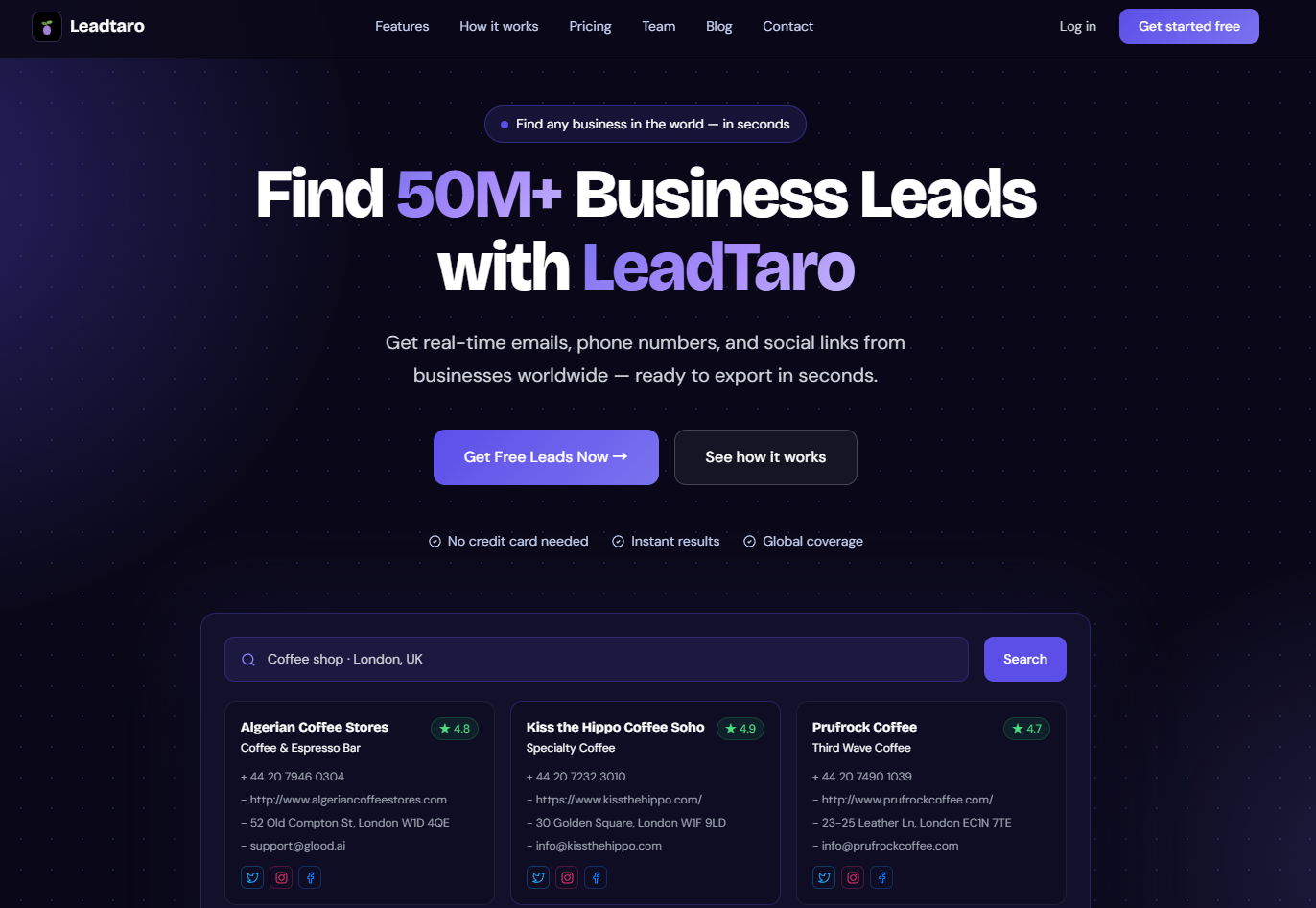
LeadTaro is a B2B lead generation platform designed to help users find business prospects, access available contact information and organize their sales workflow. Depending on your needs, you can use it to support prospect research, prepare targeted outreach lists and manage leads through a CRM pipeline.
The right approach depends on whether you need a ready-made list, a more targeted search process or a combination of both.
How B2B Lead Generation Tools Help You Find Better Prospects
Finding qualified leads requires more than collecting company names. You need a practical way to identify relevant businesses, review contact information and turn research into sales activity.
A B2B lead generation platform can bring several parts of this process together.
1. Define Your Ideal Customer Profile
Start by describing the businesses most likely to benefit from your offer.
For example, a marketing agency might target independent restaurants in a particular city that need help improving their websites or attracting more customers.
A software company might focus on small businesses in a specific industry that need better sales or customer management tools.
Your ICP should be specific enough to guide prospecting but flexible enough to avoid excluding good opportunities unnecessarily.
2. Search for Relevant Businesses
Use your lead generation workflow to identify businesses that match your target market.
Depending on the available search capabilities and data fields, you may be able to narrow your research by business type, location and other relevant criteria.
For example, if you sell accounting software to small professional-services firms, you should prioritize those businesses instead of exporting every company in a region.
The goal is to create a focused list that supports a clear sales strategy.
3. Review Contact Information
Business names alone are rarely enough for effective outreach.
Depending on availability, useful contact fields may include:
Company name and business address.
Website.
Business email.
Phone number.
Public social profile links.
Not every business will have every field. Treat contact information as something to validate, not as a guarantee that a prospect can be reached.
4. Prioritize Prospects by Opportunity
Once you have a list, rank prospects according to how well they match your ICP and how likely they are to benefit from your offer.
A simple scoring model might assign points for industry fit, location, company size, accessible contact information and an identifiable business need.
For example, a web agency might prioritize businesses with an outdated website over businesses that already have a modern website and a strong online presence.
The best scoring criteria are those connected to your actual product and sales results.
5. Personalize Your Outreach
A targeted list is only the beginning. Your message should explain why you're contacting that particular business.
AI-assisted email generation can help you create an initial draft, summarize prospect information or adapt messaging to different industries. Review every message for accuracy and relevance before sending it.
Avoid making unsupported claims about a business or pretending to have a relationship that doesn't exist.
6. Manage Leads Through a Sales Pipeline
Prospecting becomes more effective when you can track what happens after the first contact.
A CRM pipeline can help you organize leads by stage, record follow-up activity and identify which campaigns are producing real opportunities.
LeadTaro combines B2B lead generation with tools such as AI-assisted cold email creation and CRM pipeline management, helping users move from finding prospects to organizing outreach.
You can explore LeadTaro and start with 60 verified B2B leads on the free plan, with no credit card required.
The purpose isn't to collect as many records as possible. It's to build a repeatable process for finding relevant businesses, contacting them appropriately and learning which prospects convert.
Is It Legal? GDPR, CCPA and CAN-SPAM
Collecting business information and contacting prospects can involve privacy and electronic marketing laws. The rules depend on where you operate, who you contact, what information you collect and how you use it.
Public availability does not automatically make every use of personal data lawful.
GDPR and UK GDPR
The GDPR and UK GDPR regulate the processing of personal data. Information about a company as a legal entity may be treated differently from information that identifies an individual, such as a named employee's business email address.
Legitimate interests may be a lawful basis for certain processing activities, but it requires an appropriate assessment and does not automatically authorize every marketing campaign.
Depending on the circumstances, you may need to provide privacy information, respect objections, maintain appropriate records and meet additional requirements for direct marketing.
In the UK, electronic marketing rules under PECR may also apply. The requirements can differ between corporate subscribers and individuals, sole traders or certain partnerships.
CCPA and California Privacy Law
California privacy law can apply to qualifying businesses that collect or process personal information about California residents.
Whether information is publicly available, whether an exemption applies and what obligations a business has depend on the specific circumstances. Don't assume that every business contact record is automatically outside the law.
CAN-SPAM in the United States
CAN-SPAM establishes requirements for commercial email, including truthful header information, non-deceptive subject lines, required sender identification and a valid opt-out mechanism.
Businesses must honor applicable opt-out requests within the required timeframe. B2B commercial email is not automatically exempt.
Practical Compliance Checklist
Before launching an outreach campaign:
Understand where your prospects are located.
Check whether the contact information identifies an individual.
Determine which privacy and electronic marketing rules apply.
Use accurate sender details and honest subject lines.
Provide the required privacy information and a clear opt-out where applicable.
Keep suppression lists and respect opt-out requests.
Avoid collecting or retaining unnecessary personal information.
Review the data provider's terms and collection practices.
This section is general information, not legal advice. If you plan to run campaigns at scale, consult the relevant regulator's guidance or a qualified legal professional.
Qualified Leads Checklist
Use this checklist to evaluate a prospect before prioritizing it for outreach.
ICP fit: Is the business in the right industry and location?
Business fit: Does the company match your target size and customer profile?
Contactability: Is there a relevant, usable contact method?
Data quality: Have important contact details been checked where possible?
Potential need: Can you identify a problem your product or service may solve?
Opportunity: Is there a credible reason for the business to consider your offer?
Decision access: Can you identify an appropriate person or role to contact?
Personalization: Can you explain why your message is relevant to this business?
Compliance: Have you checked the applicable marketing and privacy requirements?
Follow-up: Can you record the contact and manage the next step in your CRM?
You can turn these criteria into a simple scoring system. Give each item one point, then prioritize prospects with the strongest overall fit.
Treat the score as a guide rather than a guarantee. A business can be an excellent fit without displaying obvious buying signals, and a high score cannot replace a real conversation.
FAQ: Qualified Leads in 2026
What is the difference between a lead and a qualified lead?
A lead is a potential customer or contact. A qualified lead has been assessed against criteria that make it a plausible sales opportunity, such as industry fit, business need, contactability and buying potential.
How do I generate qualified B2B leads?
Define your ideal customer profile, find businesses that match it, review available contact information, prioritize prospects and personalize your outreach. Referrals, SEO, professional networks, cold email and B2B lead generation tools can all contribute to the process.
Is it better to buy leads or generate them yourself?
It depends on your budget, target market and data requirements. Purchased lists can save time when the data is relevant and well maintained. Generating your own prospect lists offers more control over targeting. Test data quality and campaign performance before scaling either approach.
How can I qualify leads before contacting them?
Evaluate industry, location, business size, available contact information and potential need. Then prioritize prospects based on the criteria most closely connected to your offer. Additional qualification can happen during a discovery call.
Can AI help qualify leads?
Yes. AI can help summarize business information, categorize prospects, suggest scores and personalize outreach drafts. Its results depend on the quality of the available data, so verify important details and avoid treating generated scores as definitive facts.
What is the best tool for finding qualified B2B leads?
The right tool depends on your target market, required contact fields, data coverage, workflow and budget. Compare search capabilities, data quality, export options, CRM functionality and compliance practices before choosing a platform.
LeadTaro is one option for businesses that want to find B2B prospects, work with available business contact information, generate AI-assisted cold email drafts and organize leads through a CRM pipeline. Its free plan includes 60 verified B2B leads without requiring a credit card.
How many leads do I need to generate?
There is no universal target. Work backward from your sales goals, average conversion rates and the number of qualified opportunities your team can handle. A smaller, well-targeted list can outperform a much larger list with poor fit or inaccurate contact information.
Conclusion: Focus on Qualification, Not Just Volume
Generating qualified leads in 2026 is about more than finding a large database of business contacts. It requires a clear ideal customer profile, relevant prospect data, thoughtful prioritization and a consistent outreach process.
Generic lists can create unnecessary work when they contain outdated information or prospects who don't match your offer. A more focused approach starts by defining whom you want to reach and why those businesses might benefit from your product or service.
Use qualification frameworks to guide your decisions, validate important contact details and measure results beyond the number of records collected.
Tools such as LeadTaro can help simplify the workflow by bringing business prospecting, AI-assisted cold email creation and CRM pipeline management together.
Start with a specific target market, test your approach on a manageable list and improve your process based on real outcomes.
Better targeting. More relevant conversations. A sales pipeline built around quality rather than volume.