Articles » Lead Generation » Sales Prospecting in 2026: The Complete Guide to Processes, Techniques and Tools
Sales prospecting is essential to building a reliable sales pipeline, but finding potential customers can consume a surprising amount of time. Sales teams often spend hours researching companies, checking contact details, deciding which businesses are worth approaching, and preparing outreach messages before having a single meaningful conversation.
The challenge is not simply finding more leads. It is finding the right leads, understanding which ones are worth pursuing, and contacting them with a relevant message.
In 2026, B2B businesses have more prospecting tools, business data, and AI-assisted workflows available than ever before. Yet poor targeting, incomplete contact information, and generic outreach can still undermine an otherwise promising sales strategy.
This guide covers the complete sales prospecting process, the techniques worth considering, the tools that can help, and one of the most important parts of prospecting: building a relevant list of potential customers.
What's in This Guide
What Is Sales Prospecting?
Sales Prospecting vs. Lead Generation
The Five-Step Sales Prospecting Process
Sales Prospecting Techniques That Work in 2026
B2B Sales Prospecting: Why It's Different
The Best Sales Prospecting Tools and Software
Where Do Good Prospecting Lists Come From?
Staying Compliant with GDPR and Cold Outreach Rules
Common Sales Prospecting Mistakes
Frequently Asked Questions
What Is Sales Prospecting?
Sales prospecting is the process of identifying, researching, and contacting potential customers to create new sales opportunities.
It is a proactive part of the sales process. Rather than waiting for potential customers to discover a business, salespeople identify companies or individuals who may benefit from their product or service and initiate a conversation.
For example, a software company might identify growing businesses that could benefit from sales automation. A marketing agency might research local companies whose online presence suggests opportunities for improvement. A consultant might identify organizations operating in an industry where they have relevant experience.
In each case, prospecting involves more than finding a name. It requires deciding whether the potential customer is a good fit and establishing a relevant reason to make contact.
Effective sales prospecting has three essential components:
Targeting: Identify the companies and decision-makers most likely to benefit from your offer.
Qualification: Evaluate whether each potential customer fits your criteria and represents a realistic opportunity.
Outreach: Contact suitable prospects through an appropriate channel and begin a business conversation.
The quality of these steps influences everything that follows. A well-written email cannot compensate for a list of businesses that have no need for your product. Likewise, an excellent prospect list produces limited results if your outreach is irrelevant or poorly timed.
The goal is not to contact everyone. It is to create opportunities with the right potential customers.
Sales Prospecting vs. Lead Generation
Sales prospecting and lead generation are closely related, but they serve different purposes.
Lead generation focuses on attracting or identifying potential customers. Sales prospecting focuses on researching, qualifying, and engaging potential buyers to develop sales opportunities.
DimensionSales ProspectingLead GenerationPrimary objectiveStart relevant sales conversationsAttract or identify potential customersCommon ownerSales teamMarketing team, sometimes salesTypical methodsCold email, calls, research, referralsSEO, content, advertising, eventsApproachOften proactive and targetedInbound, outbound, or a combinationMain outcomeQualified conversations and opportunitiesLeads, enquiries, and potential buyersWhy businesses need both
Lead generation helps a company attract people who may be interested in its products or services. Prospecting allows the sales team to identify suitable potential customers, including businesses that have not yet expressed interest.
Consider a B2B SaaS company selling customer relationship management software.
Its marketing team might publish educational articles and run campaigns to attract interested visitors. Meanwhile, its sales team could identify agencies or growing businesses that fit its ideal customer profile and contact appropriate decision-makers.
The two activities complement each other.
If your business receives enough qualified inbound enquiries, prospecting can help expand your reach. If inbound demand is limited, a structured outbound prospecting process can help you identify additional opportunities.
The Five-Step Sales Prospecting Process
A successful prospecting strategy should be repeatable. The exact details will vary by industry, but most B2B prospecting workflows follow five core steps.
1. Define your ideal customer profile
Before building a list, decide which companies are most likely to benefit from your product or service.
Your ideal customer profile, commonly called an ICP, describes the characteristics of a suitable business customer.
Depending on your business, these might include:
Industry or business category.
Company size and stage of growth.
Geographic location.
Business model.
Likely operational challenges.
Potential value of the customer relationship.
Requirements your product or service can address.
For example, a website development agency might target independent businesses that rely on online enquiries but have outdated websites.
A sales software provider might focus on agencies and B2B teams that need to organize prospecting and follow-up activities.
A consultant specializing in retail operations might target independent retailers or multi-location businesses.
The more clearly you define your ICP, the easier it becomes to identify relevant prospects and create messages that speak to their needs.
2. Build a targeted prospect list
Once you have defined your target market, identify businesses that match your criteria.
Potential sources include company websites, business directories, professional networks, referrals, industry associations, and B2B lead generation platforms.
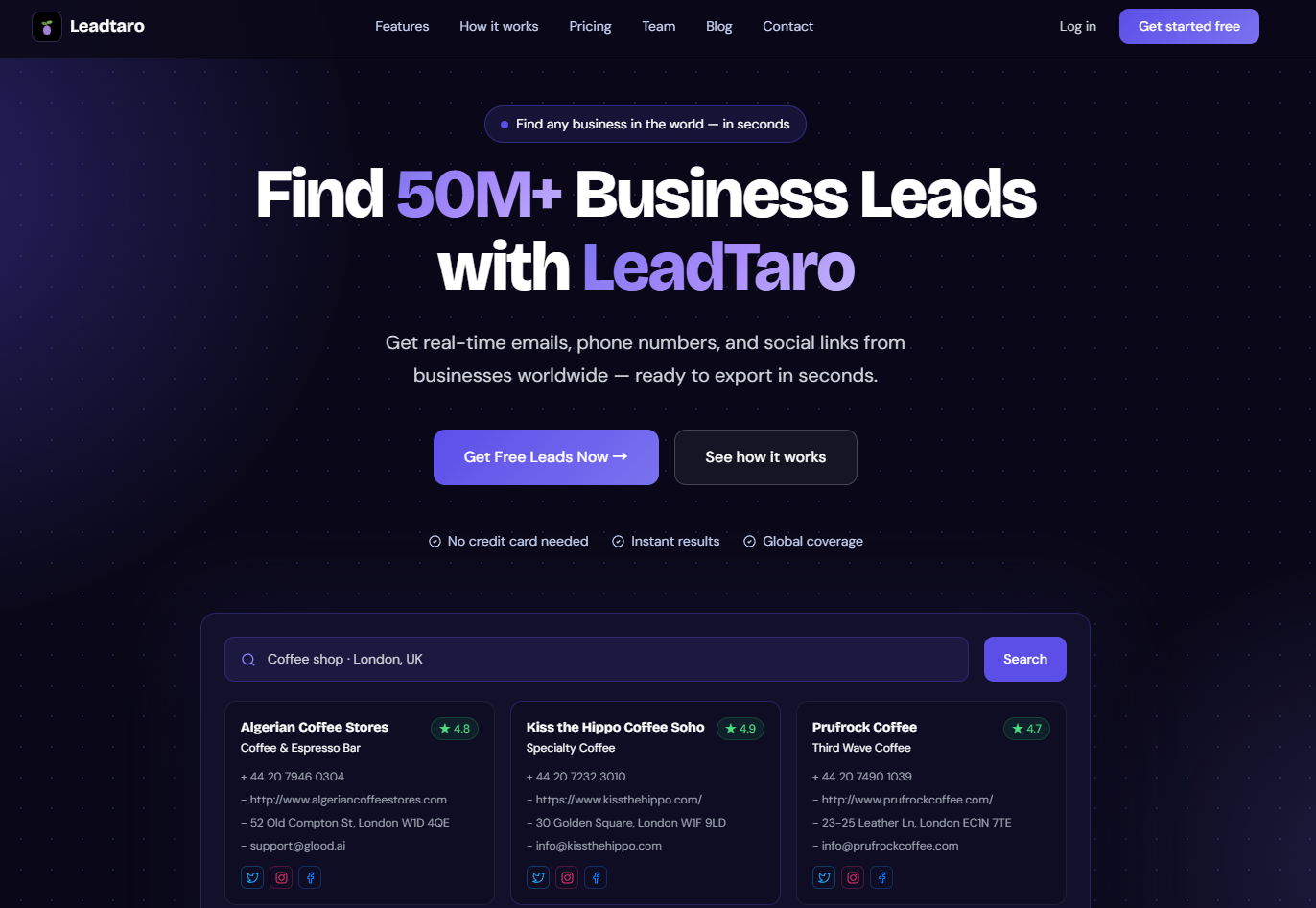
LeadTaro helps users discover B2B business leads across different industries and locations. Depending on the available information, business records may include company names, websites, phone numbers, email addresses, and social links.
You can use this information to assemble a prospect list aligned with your target market, then review the businesses before contacting them.
Start with a manageable segment rather than trying to reach every possible customer. For example, you might begin with one industry in a particular city, measure the results, and expand once you have a clearer understanding of which prospects respond.
The objective is not maximum list size. It is a list of businesses that are genuinely relevant to your offer.
3. Qualify each prospect
Not every business that matches your search criteria will be worth pursuing.
Qualification helps you decide which prospects deserve attention and which should be set aside.
Depending on your sales process, you might assess:
Whether the business fits your ICP.
Whether your product or service is relevant to its operations.
Whether there is a plausible business need.
Whether you can identify an appropriate contact channel.
Whether the potential opportunity justifies the time required.
Some teams use frameworks such as BANT, which considers budget, authority, need, and timeline. This can be useful, although you may not know all four factors until you speak with the prospect.
At the list-building stage, focus on the information you can reasonably establish. Do not assume a business has a budget or immediate buying intention simply because it fits a category.
4. Reach out with a relevant message
After identifying suitable prospects, choose an appropriate channel and explain why you are contacting them.
Cold email, telephone outreach, professional networking, and referrals can all play a role.
A good first message should be concise, accurate, and focused on a potential business benefit.
For example, a software company might contact an agency after identifying a plausible opportunity to simplify its lead management process. Rather than sending a generic product description, it could explain the problem the software helps address and ask whether that challenge is relevant to the agency.
LeadTaro's AI-assisted email generation can help prepare personalized drafts more efficiently. Review every draft for factual accuracy and relevance before sending it.
5. Follow up and manage the pipeline
Prospecting does not end after the first message.
Some prospects will respond immediately, while others may need additional context. Some will not be interested at all.
A clear follow-up process helps you manage these outcomes without losing track of promising opportunities.
For example, you could organize your pipeline into stages such as:
New Lead
Contacted
Interested
Meeting
Closed
Record relevant notes, the date of the last interaction, and the next action for each prospect.
LeadTaro includes a CRM pipeline to help users organize business leads and manage progress through the sales process.
Follow up when appropriate, respect requests not to be contacted, and avoid continuing outreach when a recipient has clearly declined.
Sales Prospecting Techniques That Work in 2026
No single prospecting technique works equally well for every business. The best approach depends on your audience, sales cycle, product, and the value of each potential customer.
Here are six techniques worth considering.
Cold calling
Cold calling involves contacting potential customers by phone before they have expressed interest in your offer.
It can be useful when a product or service benefits from a live conversation or when your target market commonly conducts business over the phone.
Preparation makes a significant difference. Research the business, understand why it may be relevant, and have a clear purpose for the call.
Instead of immediately delivering a long sales pitch, start a conversation, ask an appropriate question, and determine whether there is a genuine fit.
Always follow applicable telephone marketing rules, check relevant suppression requirements, and respect requests not to be contacted.
Cold email
Cold email allows sales teams to introduce their products or services to suitable business prospects through written communication.
It can be efficient when your target market is clearly defined and you have appropriate business contact information.
However, sending more emails does not automatically produce better results.
A stronger process involves selecting suitable prospects, writing relevant messages, monitoring delivery and response rates, and improving the campaign based on results.
For example, a marketing agency could contact a business with a specific observation about its online enquiry process and explain how the agency might help. The observation should be accurate, and the proposed benefit should be relevant to the recipient.
Ensure your email campaigns comply with the marketing and privacy requirements applicable to the recipient and jurisdiction.
Social selling
Social selling uses professional networks and social platforms to research potential customers, build relationships, and establish credibility.
It may involve engaging with relevant posts, sharing useful information, participating in professional discussions, and reaching out to people in appropriate business roles.
This approach can be particularly valuable when you are targeting corporate decision-makers or selling a product that requires trust and education.
However, professional networks do not cover every market equally well. Many small local businesses have a limited professional-network presence.
If you sell to local companies, combine professional networking with other sources of business information.
Referrals
Referrals are introductions from existing customers, partners, colleagues, or professional contacts.
They can provide a natural starting point for a conversation because the prospect receives context about your business before you make contact.
To generate referrals consistently, deliver good customer experiences, maintain relationships, and make it easy for satisfied customers to introduce relevant contacts.
Referrals can produce valuable opportunities, but they are difficult to predict or scale independently. They work best as one component of a broader prospecting strategy.
Signal-based prospecting
Signal-based prospecting uses relevant events or changes to help determine when a business might be worth contacting.
Potential signals include a publicly announced new location, a new service offering, a hiring announcement, a company expansion, or a change in business operations.
For example, a supplier might research businesses that have publicly announced expansion plans because those businesses could have new operational requirements.
Signals are indicators, not proof of buying intent. A new location does not guarantee that a business needs your service, so qualify the opportunity before reaching out.
Multichannel prospecting
Multichannel prospecting combines suitable communication methods rather than relying on a single channel.
Depending on the prospect and applicable rules, a workflow might involve an introductory email, a professional-network interaction, and a follow-up call.
The purpose is to create a coherent sequence of relevant interactions, not to overwhelm the recipient.
Choose channels based on your target market and the nature of your offer. Keep the messaging consistent, track previous interactions, and stop when a recipient objects or asks not to be contacted.
B2B Sales Prospecting: Why It's Different
Business-to-business prospecting differs from consumer sales because purchasing decisions often involve several people, longer evaluation periods, and more complex requirements.
A consumer may be able to purchase a product independently. A business purchase could require agreement from a department manager, finance team, IT specialist, procurement team, or senior executive.
That complexity affects how you should prospect.
Understand the organization
In B2B sales, identifying the right company is only the first step.
You may also need to understand which department uses the product, who influences the decision, and who has the authority to approve a purchase.
For smaller businesses, the owner or founder may be the appropriate person to approach. For larger organizations, a department head or specialist may be more relevant.
Avoid assuming that the first contact you find is automatically the decision-maker.
Research the business problem
B2B prospecting works better when you can connect your offer to a plausible business need.
A software company might focus on businesses whose workflows align with its product. A recruitment agency might identify employers operating in industries relevant to its services. A marketing consultant might research companies that could benefit from a specific marketing capability.
Your message should demonstrate that you understand the business context rather than simply describing your own product.
Build relationships over time
Some B2B prospects will not be ready to buy when you first contact them.
A prospect may have a contract with another provider, be working through an internal project, or lack the resources to make a change immediately.
Maintain appropriate records and follow up only when there is a valid reason to do so. Useful follow-up might involve answering a question, sharing relevant information, or reconnecting at a mutually appropriate time.
A well-managed pipeline helps you distinguish between prospects that need further discussion, prospects that may be suitable later, and businesses that are not a fit.
The Best Sales Prospecting Tools and Software in 2026
Prospecting tools can help you find potential customers, research companies, prepare outreach, and manage follow-up.
The best choice depends on which part of the process creates the most friction for your team.
Tool categoryMain purposeBest suited toB2B lead generation platformsDiscover businesses and available contact detailsBuilding targeted prospect listsSales intelligence toolsResearch companies and professional contactsCorporate and role-based prospectingCRM softwareOrganize leads, activities, and opportunitiesPipeline and relationship managementSales engagement toolsCoordinate outreach sequencesTeams managing structured campaignsAI research and writing toolsAssist with research and message preparationReducing repetitive workSome platforms combine several functions, while others focus on one specific area.
LeadTaro for business lead generation and prospect management
LeadTaro helps users discover B2B business leads across industries and locations, review available contact information, and organize suitable prospects for outreach.
It is designed for users such as founders, freelancers, agencies, and sales teams that need a repeatable way to find potential business customers.
Key capabilities include:
B2B business lead discovery across different industries and locations.
Access to available business information, including contact fields where present.
AI-assisted personalized email generation.
A CRM pipeline for managing prospects and follow-up activity.
Support for organizing leads as they progress through the sales process.
This workflow connects prospect discovery with the activities that follow. Instead of treating lead research, outreach preparation, and pipeline management as completely separate tasks, you can organize them around a single prospecting process.
LeadTaro is a B2B lead generation platform, not a guarantee that every record contains complete contact information or an identified decision-maker. Review and qualify prospects before contacting them.
The free plan includes 60 B2B leads without requiring a credit card, allowing you to explore the platform before deciding whether it suits your workflow.
How to choose the right tools
Before investing in prospecting software, consider these questions:
Does it cover your target industries and locations?
Does it provide the business information you actually need?
Can you qualify and organize prospects efficiently?
Does it fit your existing sales workflow?
Are its pricing, usage limits, and permitted data uses suitable for your business?
Start by identifying your biggest bottleneck. If you struggle to find suitable businesses, prioritize lead discovery. If you already have a strong list but lose track of conversations, focus on CRM and follow-up. If research and message preparation consume too much time, look for tools that help streamline those tasks.
The right software should improve the process, not simply add another dashboard.
Where Do Good Prospecting Lists Come From?
Your prospect list influences every stage of the sales process.
A list containing irrelevant companies or unsuitable contact details can waste time, reduce campaign performance, and make it difficult to identify what is working.
There are several ways to build a prospect list, each with different strengths.
Referrals and your professional network
Existing relationships can provide highly relevant introductions. The main limitation is that referral volume depends on your network and the relationships you maintain.
Professional networks
Professional networks can help you identify businesses and people in specific roles. They are especially useful for corporate sales, although their coverage of local businesses and contact details may vary.
Purchased databases
Purchased databases can provide a starting point for prospect research. However, quality and coverage vary between providers.
Before purchasing, review the data sources, update practices, contact fields, geographic coverage, and conditions governing use. Do not assume that every record is current or suitable for your campaign.
Company websites and business directories
Websites and directories help you find companies, understand their services, and review publicly available business contact information.
Manual research can work well for a small, highly targeted list. It becomes more time-consuming when you need to cover multiple industries or locations.
B2B lead generation platforms
Lead generation platforms can make business discovery more repeatable by helping you find companies that match your criteria and organize the information available about them.
LeadTaro supports B2B prospect discovery across different industries and locations. Users can review business information, identify suitable prospects, and manage leads through a CRM pipeline.
The most useful list is not necessarily the largest. It is the list that best matches your ideal customer profile and provides an appropriate basis for relevant outreach.
Qualify before scaling
Before expanding a campaign, test a smaller group of prospects.
Measure how many businesses fit your criteria, how much relevant contact information is available, how many messages are delivered, and how many qualified conversations result.
If the results are weak, investigate the underlying cause before simply collecting more records.
You may need to refine your target market, improve qualification, change your message, or select a more suitable contact channel.
Staying Compliant with GDPR and Cold Outreach Rules
Sales prospecting must account for privacy, data protection, and electronic marketing rules. The relevant requirements depend on the country, the recipient, the type of information collected, and how the information will be used.
Publicly available business information is not automatically exempt from every legal obligation.
UK and European data protection
The UK GDPR and EU GDPR can apply when personal data is processed. Some business contact information identifies an individual and may therefore constitute personal data.
Legitimate interests can be a lawful basis for certain processing activities when the relevant requirements are met. It is not a blanket authorization for all prospecting or marketing.
You may need to assess the purpose of processing, whether it is necessary, the impact on the individuals concerned, and their rights. Transparency, data minimization, security, and retention requirements may also apply.
Electronic marketing rules
In the UK, the Privacy and Electronic Communications Regulations (PECR) govern certain forms of electronic marketing. The rules differ depending on the type of recipient and communication method.
For example, the treatment of corporate subscribers can differ from the treatment of sole traders and certain partnerships. Data protection obligations may also apply when a named person's information is used.
Check the requirements for your recipient category before running a campaign.
United States requirements
The US CAN-SPAM Act establishes requirements for commercial email, including accurate sender information, non-deceptive subject lines, a valid postal address, and an effective opt-out mechanism.
Other federal and state privacy or marketing laws may also be relevant.
Practical compliance steps
Before launching a prospecting campaign:
Use appropriate data sources and respect applicable terms.
Collect information relevant to a defined business purpose.
Establish the appropriate lawful basis where required.
Provide required privacy information.
Follow applicable email and telephone marketing rules.
Include required sender details and opt-out mechanisms.
Honor objections and maintain suppression records.
Apply reasonable data security and retention practices.
LeadTaro can help users discover and organize B2B business leads, but the platform does not automatically make every collection or outreach activity compliant. Your business remains responsible for how you use the information and communicate with prospects.
For campaigns involving multiple jurisdictions or substantial amounts of personal data, seek advice appropriate to your situation.
Common Sales Prospecting Mistakes
Even a well-designed sales process can underperform when basic prospecting mistakes go unaddressed.
Prioritizing volume over relevance
A list of thousands of businesses is not necessarily useful if most are poor fits.
Start with a clear ICP and prioritize prospects based on their relevance to your product or service.
Using incomplete or outdated information
Incorrect contact details, outdated company records, and missing context can waste research time and undermine outreach.
Check the available information, monitor delivery outcomes, and correct records when you discover problems.
Sending generic messages
A message that could be sent to any business often gives the recipient little reason to respond.
Explain why the prospect is relevant to your offer and focus on a plausible business benefit. Make sure your observations are accurate.
Skipping qualification
Contacting every business in a broad list without evaluating suitability can create unnecessary work.
Use consistent criteria to decide which prospects deserve immediate attention and which need more research.
Following up without a plan
Without a clear process, salespeople may forget promising prospects or contact the same person repeatedly without considering previous interactions.
Use a CRM or structured tracking system to record activity and determine appropriate next steps.
Treating AI output as verified information
AI can help with research and writing, but it can misinterpret company information or produce unsupported statements.
Verify important facts and review every message before sending it.
Ignoring compliance and recipient preferences
Prospecting is not just about generating responses. Businesses must also follow applicable marketing rules and respect recipients' objections.
Maintain clear processes for managing opt-outs and preventing inappropriate follow-up.
Frequently Asked Questions
What does sales prospecting mean?
Sales prospecting means identifying, researching, and contacting potential customers to create sales opportunities. It typically involves defining a target market, building a list, qualifying prospects, and initiating relevant conversations.
How do you do sales prospecting?
A practical process has five steps:
Define your ideal customer profile.
Build a targeted list of businesses or individuals.
Qualify prospects against your criteria.
Reach out through an appropriate channel with a relevant message.
Follow up and manage outcomes in your sales pipeline.
Measure the results and refine the process as you learn which prospects and approaches work best.
What are the four pillars of prospecting?
One useful framework is Targeting, Data, Communication, and Consistency.
Targeting: Focus on potential customers who fit your ICP.
Data: Use relevant business information and appropriate contact details.
Communication: Deliver accurate, personalized messages through suitable channels.
Consistency: Maintain an organized process for tracking conversations and follow-up.
This is a practical framework rather than a universally standardized model.
What is the 3-3-3 rule in sales?
The 3-3-3 rule is sometimes used as a practical time-management framework: spend around three minutes researching a prospect, three minutes preparing a personalized message, and three minutes planning or completing follow-up activity.
It is not a universal sales standard. The appropriate time investment depends on the value and complexity of the opportunity.
What is the difference between sales prospecting and lead generation?
Lead generation focuses on attracting or identifying potential customers. Sales prospecting focuses on researching, qualifying, and engaging suitable potential buyers to create sales opportunities.
They complement each other and are often managed by different teams within the same customer acquisition process.
Which sales prospecting technique is best?
There is no single best technique for every business. Cold email, telephone outreach, referrals, social selling, and business-data prospecting can all be useful.
Choose the methods that suit your audience, product, sales cycle, and available resources. Test your approach and compare the results rather than assuming one channel will always perform best.
How can I build a B2B prospect list?
Define your ICP, choose relevant data sources, identify suitable businesses, review available contact information, and qualify each prospect before outreach.
You can use company websites, professional networks, referrals, business directories, or a lead generation platform such as LeadTaro to support this process.
How can LeadTaro improve sales prospecting?
LeadTaro helps users discover B2B business leads across different industries and locations, review available business contact information, prepare AI-assisted personalized emails, and manage prospects through a CRM pipeline.
It supports several stages of the prospecting workflow, while qualification, message review, and appropriate outreach remain important.
Conclusion: Build a Better Prospecting Process
Effective sales prospecting is not about sending the most messages or collecting the largest possible list. It is about finding suitable potential customers, understanding why your offer may be relevant, and creating opportunities for meaningful business conversations.
The process starts with a clear ideal customer profile and a targeted prospect list. From there, qualification, personalized outreach, consistent follow-up, and performance measurement help turn potential customers into real opportunities.
LeadTaro helps simplify the process by combining B2B business lead discovery with AI-assisted email generation and CRM pipeline management.
Whether you are a founder looking for your first customers, a freelancer expanding your client base, or a sales team exploring new markets, start with a focused group of relevant prospects and improve your approach using real results.
Try LeadTaro's free plan to explore 60 B2B leads without a credit card and build a more organized sales prospecting workflow.