Waterfall enrichment has become a popular approach to B2B lead generation in 2026. By combining multiple data providers, sales teams can improve their chances of finding verified business email addresses, phone numbers, and other contact details.
But higher data coverage does not automatically mean better leads.
The effectiveness of waterfall enrichment depends on your target audience, the quality of your existing data, the providers you use, and the cost of each lookup. It can be highly effective for corporate decision-makers, yet less useful for local businesses that have limited information in traditional B2B databases.
In this guide, you'll learn how waterfall enrichment works, which tools are worth considering in 2026, how to manage enrichment costs, and when an alternative data source may produce better results.
What Is Waterfall Enrichment?
Waterfall enrichment is a lead data enrichment process that checks multiple data providers to find missing information about a prospect.
Instead of relying on a single database, an enrichment workflow moves through several providers until it finds the requested information or exhausts the available sources.
For example, a sales team might use waterfall enrichment to find a decision-maker's professional email address. The workflow could check one provider first, move to another if no result is found, and then verify the final address before adding it to the CRM.
This approach can improve data coverage because different providers maintain different databases and specialize in different types of business information.
However, actual results vary by industry, geography, job role, and the quality of the original prospect data. No universal email find rate applies to every campaign.
How Does Waterfall Enrichment Work?
A typical waterfall enrichment workflow follows four steps.
Import prospect data. Start with information such as a person's name, company name, company domain, or professional profile URL.
Query multiple data providers. The workflow checks available sources for missing email addresses, phone numbers, job titles, and company information.
Apply matching and verification rules. The system evaluates whether the returned information matches the intended prospect and whether the contact details appear valid.
Update your CRM. Enriched records are added to your sales database, while unresolved records can be routed for manual research or another enrichment method.
Some platforms query providers sequentially, while others use parallel lookups or dynamic provider ordering. The best approach depends on the required speed, available integrations, and pricing model.
Waterfall Enrichment vs. Single-Provider Enrichment
Single-provider enrichment is often simpler to manage, while waterfall enrichment offers additional opportunities to find missing information.
Single-provider enrichment may be suitable when you already know which database performs well for your audience. Waterfall enrichment can be more useful when contact coverage is a priority and no single source provides enough information.
The trade-off is cost and complexity. Multiple lookups can increase total spending, and combining data from several providers does not guarantee that every result is accurate or current.
8 Best Waterfall and Lead Enrichment Tools in 2026
The right platform depends on whether you need dedicated enrichment, custom workflows, prospecting data, or an integrated outreach system.
The following tools offer different approaches to B2B data enrichment. Check each provider's current pricing, credit rules, integrations, and feature availability before choosing a subscription.
1. FullEnrich: Dedicated Waterfall Enrichment
FullEnrich focuses on finding professional email addresses and phone numbers by combining multiple data sources.
Its main advantage is its enrichment-first workflow. Sales teams can upload prospect lists and attempt to find missing contact information without building a complex automation system from scratch.
FullEnrich may be a good fit for teams that already have a defined target audience and want to improve contact coverage.
Best for: B2B sales teams that need dedicated email and phone enrichment.
2. Clay: Custom Enrichment Workflows
Clay allows users to combine multiple data providers, enrichment actions, and conditional logic in customized workflows.
For example, a team can check an initial provider, validate the result, and query additional sources only when information remains missing. This flexibility makes Clay useful for sophisticated prospecting operations.
The main consideration is workflow complexity and credit management. Poorly configured automations can generate unnecessary lookups and increase costs.
Best for: Growth teams and sales operations professionals building customized enrichment workflows.
3. BetterContact: Multi-Provider Contact Discovery
BetterContact focuses on finding contact information through multiple providers, with features designed to simplify the enrichment process.
Depending on the available plan, its workflow and billing model may help teams manage the relationship between successful lookups and enrichment costs.
As with any provider, review the definitions of a successful result, verification guarantees, and credit consumption before running a large campaign.
Best for: Teams looking for a dedicated contact discovery platform.
4. Apollo.io: Prospecting and Enrichment in One Platform
Apollo.io combines prospect discovery, contact information, enrichment, and sales engagement features.
Its integrated workflow can reduce the need to manage multiple subscriptions. Sales teams can discover prospects, organize lists, and move contacts into outreach workflows within the same platform.
The main limitation is that database coverage varies by market and business type. Teams targeting small local businesses should test coverage before relying on Apollo as their primary source.
Best for: B2B teams that want prospecting and outreach in one platform.
5. Lemlist: Enrichment and Outreach
Lemlist combines sales engagement capabilities with prospecting and contact enrichment features.
This can be useful for teams that want to find contact information and launch personalized outreach without moving data between several tools.
Before committing, compare its available enrichment features with your existing email outreach workflow and verify current plan limits.
Best for: Teams that prioritize personalized outbound campaigns.
6. Instantly: Cold Email and Lead Discovery
Instantly provides tools for cold email campaigns and lead discovery, including features associated with its SuperSearch offering.
Combining prospect discovery with outreach can simplify campaign management, particularly for teams running outbound email at scale.
However, contact discovery and email deliverability are separate challenges. Even a well-enriched list still requires appropriate verification, targeting, and sending practices.
Best for: Outbound teams looking to combine lead discovery with cold email operations.
7. Dropcontact: European B2B Data Enrichment
Dropcontact focuses on professional contact enrichment and is particularly relevant to businesses prospecting in European markets.
Its approach differs from platforms that primarily combine numerous external data providers. Teams should evaluate its actual coverage for their target countries, industries, and company sizes.
For organizations handling European prospect data, data processing practices and GDPR obligations should also be considered.
Best for: Businesses targeting European B2B contacts.
8. Cognism: Enterprise Contact Data
Cognism focuses on B2B sales intelligence, professional contact information, and enterprise prospecting.
Its platform may suit larger organizations that need structured sales data, integrations, and support for international prospecting operations.
Pricing, data access, and contractual requirements should be evaluated directly with the provider.
Best for: Enterprise sales teams with international prospecting requirements.
Waterfall Enrichment Comparison Table
The following comparison summarizes the main differences between these platforms. Features, prices, and availability can change, so treat the table as a starting point for evaluation rather than a guarantee of current plan details.
Tool | Primary Approach | Main Strength | Best For
FullEnrich | Multi-provider enrichment | Dedicated contact discovery | Email and phone enrichment
Clay | Custom workflows | Flexible provider integrations and automation | Advanced enrichment workflows
BetterContact | Multi-provider enrichment | Contact discovery and enrichment workflows | Teams optimizing enrichment costs
Apollo.io | Prospecting and sales engagement | Integrated sales platform | All-in-one B2B prospecting
Lemlist | Sales engagement and enrichment | Personalized outbound workflows | Email outreach teams
Instantly | Cold email and lead discovery | Combined prospecting and campaign management | Outbound email teams
Dropcontact | Professional data enrichment | European B2B prospecting | European markets
Cognism | Enterprise sales intelligence | Structured professional contact data | Enterprise sales organizations
LeadTaro | Business lead generation | Discovering businesses by category and location | Local businesses and geographic prospecting
The Limitations of Waterfall Enrichment
Waterfall enrichment can be valuable, but it is not a universal solution for every prospecting challenge.
1. Coverage Depends on Your Target Audience
Many enrichment workflows are designed around professional contacts, company domains, and established B2B databases.
That makes them useful for identifying executives, department heads, and employees at established companies.
However, a local restaurant, independent plumber, small dental practice, or family-owned retailer may have limited information in these databases. The business might maintain an active website and Google Business Profile without having a substantial corporate data footprint.
When that happens, querying additional corporate providers may produce diminishing returns.
2. More Providers Do Not Guarantee Accurate Data
Combining multiple sources can increase the chance of finding a contact, but it does not guarantee that the information is correct.
A result may be outdated, incorrectly matched, or associated with a former employee. An email address that passes a syntax check may also be undeliverable.
A reliable workflow should distinguish between finding data, matching it to the correct person, and verifying its current validity.
3. Enrichment Costs Can Increase Quickly
Some platforms charge for attempted lookups, while others use successful results, credits, subscriptions, or a combination of billing methods.
If your workflow repeatedly queries expensive providers or enriches records that already contain valid information, costs can rise without improving campaign performance.
To control spending, prioritize lower-cost sources when appropriate, use conditional enrichment, and measure cost per usable contact rather than cost per lookup alone.
4. Local Businesses May Require a Different Data Source
Traditional B2B enrichment is often most effective when you already know the person or company you want to contact.
Local prospecting frequently begins with a different question:
Which businesses in this city, neighborhood, or service area match my ideal customer profile?
For that task, a business discovery platform that searches by category and geography may be more appropriate than a waterfall workflow that begins with a list of known contacts.
Google Maps Lead Generation: An Alternative for Local Businesses
Google Maps can help businesses discover local prospects by business category and geographic area.
For example, an agency selling website redesign services might search for restaurants in Manchester. A commercial cleaning company might identify offices in a specific service area. A software provider might build a list of independent retailers across several towns.
Instead of starting with an existing contact list, this approach starts with the types of businesses a company wants to reach.
How LeadTaro Fits Into Local Prospecting
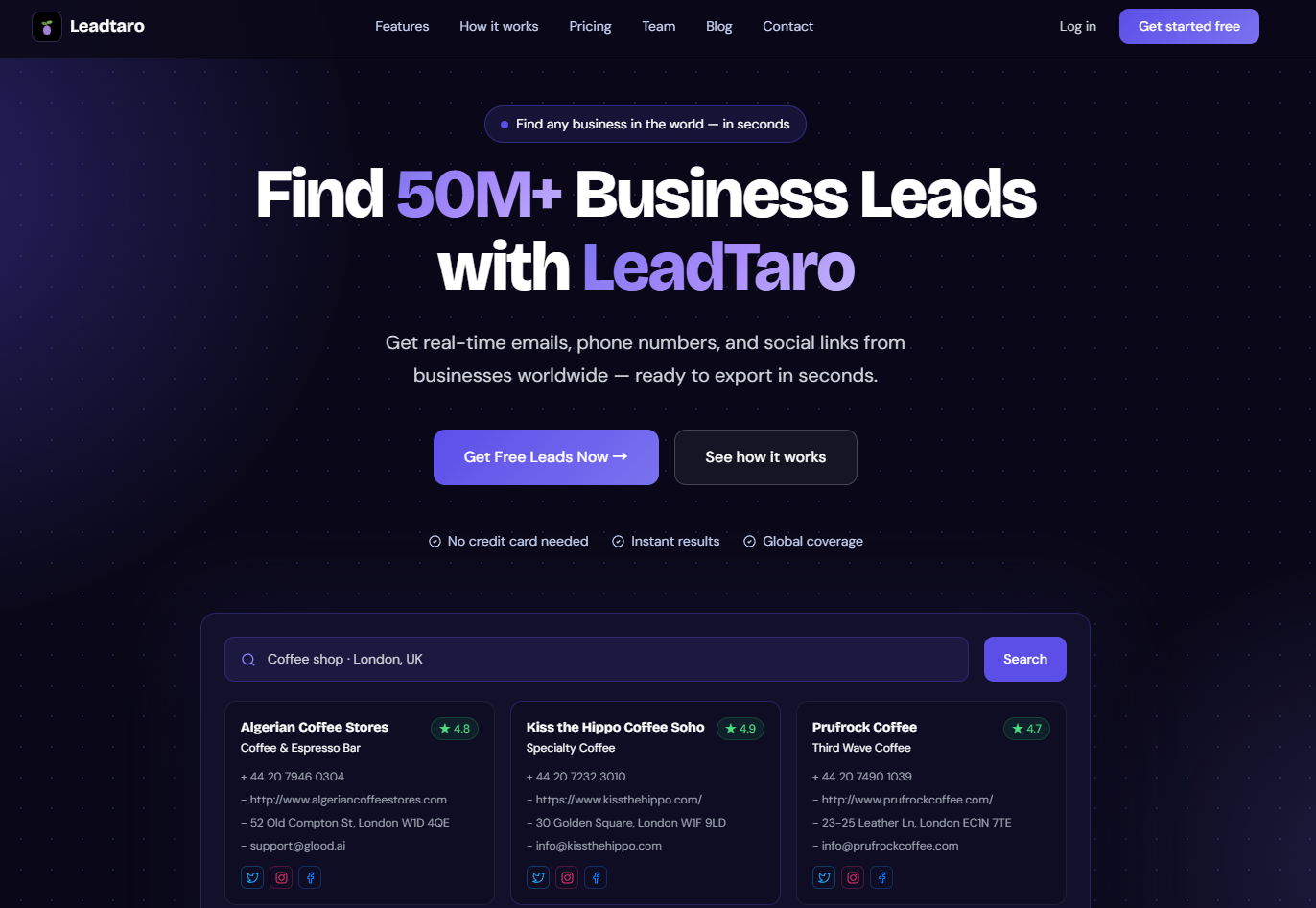
LeadTaro helps users discover B2B business leads based on their prospecting requirements.
For teams targeting local companies, business discovery can complement contact enrichment by identifying relevant organizations before the sales team decides which contacts require additional research.
A practical workflow looks like this:
Define your ideal customer profile, including business category, location, and company characteristics.
Discover businesses that match those criteria.
Review available business information and identify missing contact details.
Enrich or verify the information required for your campaign.
Segment prospects and route them into the appropriate sales workflow.
This process is particularly relevant to businesses selling services to restaurants, retailers, contractors, professional practices, and other geographically defined markets.
Lead discovery and contact enrichment solve different problems. A business database helps you identify potential customers, while enrichment tools help you fill gaps in the information you already have.
Geographic Targeting for More Relevant Leads
Geographic targeting is important when your product or service depends on where a business operates.
For example, a roofing company may serve a limited radius, while a SaaS company may sell internationally. A local marketing agency may prioritize businesses in selected towns or commercial districts.
Combining geographic filters with business categories can help sales teams create more focused prospect lists and reduce time spent researching irrelevant companies.
The Hybrid Strategy: Waterfall Enrichment and Business Discovery
For many B2B teams, the strongest workflow is not choosing between enrichment and business discovery. It is using each approach for the task it handles best.
When to Use Waterfall Enrichment
Waterfall enrichment is a strong candidate when you already have a list of professional contacts and need missing information.
Typical use cases include:
Finding professional email addresses for executives.
Enriching existing CRM records.
Identifying additional contact details for known companies.
Improving coverage across multiple professional data sources.
Automating repetitive sales operations tasks.
When to Use Business Discovery
Business discovery is more appropriate when your goal is to identify organizations that match specific geographic or industry criteria.
Typical use cases include:
Finding restaurants in a particular city.
Building prospect lists for local service businesses.
Identifying retailers, clinics, contractors, or independent professional practices.
Expanding into new geographic markets.
Discovering companies that are not already present in your CRM.
How to Combine Both Approaches
A hybrid workflow can be organized around five steps.
Discover businesses. Build a list based on your ideal customer profile, industry, and target location.
Identify relevant contacts. Determine which people at those businesses are most likely to make purchasing decisions.
Enrich missing information. Use a waterfall provider when professional email addresses, phone numbers, or other contact fields are unavailable.
Verify the results. Check email deliverability, record accuracy, and whether the information matches the intended contact.
Sync the data with your CRM. Store the results, remove duplicates, track sources, and prepare targeted outreach.
This approach avoids using expensive enrichment tools to solve a discovery problem they were not designed to handle.
Waterfall Enrichment Best Practices
1. Start With High-Quality Input Data
The quality of your original records affects the quality of the results.
Whenever possible, include a company domain, full name, company name, country, or professional profile URL. Remove duplicates and normalize formatting before starting enrichment.
2. Configure Provider Order Carefully
If your platform allows custom provider ordering, consider cost, expected coverage, and the type of prospect being enriched.
A cheaper provider may be a sensible first step, but the cheapest option is not always the most cost-effective if its results are frequently inaccurate.
Measure the total cost of obtaining a verified, usable contact.
3. Enrich Only Missing Fields
Avoid querying providers for information that is already available and verified.
Use conditional logic to identify incomplete records and run enrichment only where it is needed. This helps reduce unnecessary credit consumption.
4. Verify Contact Information Before Outreach
A successful lookup does not necessarily mean that an email address is deliverable or that a phone number reaches the intended person.
Use appropriate verification tools and maintain suppression lists for invalid contacts, unsubscribes, and other records that should not receive further outreach.
5. Track Results by Segment
Measure enrichment performance across different industries, countries, company sizes, and data sources.
Useful metrics include:
Enrichment success rate.
Percentage of verified contacts.
Cost per usable contact.
Duplicate rate.
Email bounce rate.
Meetings booked per 100 prospects.
These metrics reveal which providers and prospecting methods work best for your actual audience.
Compliance: GDPR, CCPA, and B2B Enrichment
Data enrichment does not remove your legal responsibilities.
Depending on your location, audience, data source, and intended use, relevant obligations may include GDPR, UK GDPR, the Data Protection Act 2018, CCPA/CPRA, and applicable electronic marketing rules.
Public availability does not automatically make personal data unrestricted for marketing. Organizations should identify an appropriate lawful basis where required, document data sources, provide necessary privacy information, respect objections and suppression requests, and follow relevant retention requirements.
Before combining multiple providers, review their data provenance, contractual terms, security practices, and permitted uses.
For UK and European prospecting, also distinguish between corporate subscribers and individual subscribers when assessing electronic marketing requirements. The applicable rules can differ, particularly for sole traders and certain partnerships.
A responsible enrichment workflow should include data minimization, access controls, retention policies, and a clear process for honoring opt-outs.
Frequently Asked Questions
What is waterfall enrichment?
Waterfall enrichment is a process that queries multiple data providers to find missing information about a prospect. Depending on the platform, providers may be queried sequentially or in parallel. The aim is to improve coverage compared with relying on a single source.
How does waterfall enrichment work?
A workflow receives existing prospect data, checks multiple providers for missing fields, evaluates the returned information, and updates the CRM with suitable results. Records that remain incomplete can be sent for additional research.
What is the best waterfall enrichment tool in 2026?
The best option depends on your requirements. FullEnrich and BetterContact focus on contact discovery, Clay offers customizable enrichment workflows, Apollo combines prospecting and engagement, and Cognism targets enterprise sales intelligence. Compare current pricing, coverage, integrations, and verified results for your target market.
Is waterfall enrichment worth the cost?
It can be worthwhile when additional verified contact information improves prospecting efficiency enough to justify the cost. Measure cost per usable contact and the resulting sales outcomes rather than relying only on advertised find rates.
What is the difference between waterfall enrichment and single-provider enrichment?
Single-provider enrichment checks one source, while waterfall enrichment combines multiple sources. Waterfall may improve coverage, but it can also increase cost and complexity.
Does waterfall enrichment work for local businesses?
It can work for some local businesses, but coverage depends on the availability of their information in the selected providers. For discovering businesses by industry and location, business discovery tools can provide a more suitable starting point.
Can I combine waterfall enrichment with Google Maps lead generation?
Yes. Business discovery can identify relevant companies, while waterfall enrichment can help find missing professional contact details. The resulting data should be matched, verified, and processed according to applicable privacy and marketing rules.
How do I reduce waterfall enrichment costs?
Remove duplicate records, enrich only missing fields, configure provider order carefully, and compare providers using the cost per verified contact. Stop unnecessary lookups once the required information has been found.
Is waterfall enrichment GDPR compliant?
Compliance depends on the data sources, the processing activities, the intended use, and the legal basis for processing. Using multiple providers requires appropriate checks of data provenance, contractual terms, transparency, and individual rights.
Final Thoughts
Waterfall enrichment is a useful approach to improving B2B contact coverage, especially when sales teams already have a defined list of companies or professional contacts.
However, it should not be treated as a complete lead generation strategy. Finding missing information about a known prospect is different from discovering which businesses are worth targeting in the first place.
For corporate prospecting, enrichment platforms can help sales teams identify contact details and improve CRM records. For geographically focused campaigns, business discovery tools can help uncover relevant organizations before enrichment begins.
The most practical strategy is to match the tool to the task: discover the right businesses, enrich the information that is missing, verify the results, and measure the cost of generating usable leads.
By combining these steps, B2B teams can build more relevant prospect lists, reduce unnecessary data costs, and create a more efficient sales process.