Meta Title: Web Scraping for Business in the UAE: 2026 Guide
Meta Description: Discover how UAE businesses use web scraping for competitor analysis, real estate research, pricing intelligence, and B2B lead generation. Compare tools and learn about data compliance.
URL Slug: web-scraping-business-uae
Primary Keyword: web scraping for business in the UAE
Secondary Keywords: UAE web scraping tools, business data extraction UAE, B2B lead generation UAE, Google Maps scraping UAE, web scraping for market research, UAE competitor analysis
Introduction
The United Arab Emirates is home to a diverse business environment spanning e-commerce, real estate, hospitality, financial services, and technology. For companies operating in Dubai, Abu Dhabi, Sharjah, and other Emirates, access to accurate business and market data can support better decisions and more effective customer acquisition.
However, collecting that data manually can be slow and difficult to maintain. Competitor prices change, business directories evolve, property listings are updated, and new companies enter the market every day.
Web scraping helps businesses automate parts of this process by extracting publicly accessible information from websites and organizing it into structured datasets. Depending on the source and applicable restrictions, that information can support competitor monitoring, market research, pricing analysis, and B2B prospecting.
This guide explains how web scraping works, its most useful business applications in the UAE, the tools worth considering in 2026, and the legal and practical issues businesses should evaluate before collecting data.
1. Why Web Scraping Matters for UAE Businesses
Businesses make better decisions when they can access relevant, up-to-date information about their markets.
Consider a retailer comparing prices across online marketplaces, a real estate agency researching property listings, or a B2B sales team identifying companies in Dubai that could benefit from its services. Each task requires collecting information from multiple sources and turning it into something useful.
Manual research can work for small projects. At larger scales, it becomes harder to repeat consistently, verify every record, and keep the resulting dataset current.
Web scraping can help businesses:
Monitor publicly available competitor prices and product information.
Research market trends and changes in product availability.
Analyze property listings and publicly advertised rental prices.
Discover businesses in specific industries or locations.
Collect public company information for market segmentation.
Organize online reviews and other publicly accessible information for analysis.
Build repeatable data collection workflows.
The most useful approach is not to collect as much data as possible. It is to collect the information that supports a specific business decision.
For example, a company selling accounting software may want to identify small businesses in Dubai. A marketing agency may want to find restaurants in Abu Dhabi with websites but limited online marketing activity. A retailer may need a daily overview of competitor prices for a selected group of products.
Each objective requires different sources, collection methods, and quality checks.
2. What Is Web Scraping?
Web scraping is the automated process of retrieving information from web pages and converting it into a structured format, such as a spreadsheet, CSV file, database, or API response.
A typical workflow includes four stages:
Select a source: Identify the website or publicly accessible data source relevant to the project.
Extract information: Use software to retrieve the required fields.
Clean and validate: Remove duplicates, standardize formats, and check for missing or inconsistent values.
Analyze or use the data: Import the results into a CRM, reporting dashboard, pricing system, or research workflow.
For example, a company researching UAE suppliers might collect publicly listed company names, business categories, websites, and locations. After removing duplicate records and validating the information, the company could segment suppliers by industry or Emirate.
The quality of the final dataset depends on more than extraction speed. Source reliability, data freshness, field coverage, and validation are equally important.
What Data Can Businesses Collect?
Depending on the source, permissions, and applicable law, web scraping can support the collection of several types of information.
E-commerce data
Publicly listed product prices
Product names and descriptions
Public stock or availability indicators
Product categories
Public customer reviews
Real estate data
Advertised property prices
Property types
Listing locations
Public listing dates
Advertised property characteristics
Business information
Company names
Public business addresses
Business websites
Publicly listed business phone numbers
Business categories
Public reviews and ratings
Market and financial information
Public market reports
Published financial announcements
Public company disclosures
News and industry updates
Not every website permits automated extraction, and not every publicly visible field is unrestricted personal data. Before collecting information, review the source's terms, access controls, applicable data protection rules, and any relevant licensing conditions.
3. Web Scraping vs. APIs vs. Manual Data Collection
Businesses generally have three options for gathering online information: manual research, official APIs, and web scraping.
MethodMain AdvantagesMain LimitationsBest Use CaseManual researchSimple to start; direct human reviewSlow at scale; difficult to repeat consistentlySmall research projectsOfficial APIsStructured data; documented access rulesMay require payment, approval, or work within usage limitsSupported integrations and recurring data accessWeb scrapingFlexible extraction from supported web pagesRequires maintenance and careful compliance checksCustom research and structured collection from permitted sourcesThere is no universally best method.
An official API is often preferable when a platform provides the required data under suitable terms. Manual research may be sufficient when only a few records are needed. Web scraping can be useful when permitted information is available through web pages but no suitable API provides the required fields.
The correct choice depends on the source, the volume of data, the frequency of updates, the budget, and the applicable restrictions.
4. Five Practical Web Scraping Use Cases in the UAE
4.1 E-commerce Price Monitoring
Online retailers often compete on price, product availability, delivery options, and promotions.
A business selling products through marketplaces or its own online store may need to understand how competing offers change over time. Manually checking every product is difficult when the catalog contains hundreds or thousands of items.
A permitted automated monitoring workflow can help teams:
Compare advertised prices across selected competitors.
Track changes in product availability.
Identify recurring promotional periods.
Monitor changes to product descriptions.
Analyze pricing patterns across product categories.
For UAE retailers, relevant sources may include regional online marketplaces and retailer websites. Access conditions differ between platforms, so businesses should confirm that their collection method is permitted.
Example: A Dubai electronics retailer could maintain a daily dataset of selected publicly advertised products and compare price changes against its own catalog. The resulting analysis could inform pricing decisions without automatically changing prices or assuming that every competitor offer is directly comparable.
4.2 Real Estate Market Research
The UAE property market includes residential, commercial, rental, and investment opportunities across multiple Emirates.
Real estate professionals can use structured listing data to research advertised prices, property types, neighborhood trends, and changes in listing availability.
Potential applications include:
Comparing asking prices across neighborhoods.
Monitoring rental listings over time.
Identifying changes in the volume of advertised properties.
Researching commercial property opportunities.
Comparing publicly advertised property characteristics.
For meaningful analysis, records should include collection dates and consistent location categories. Asking prices are not necessarily completed transaction prices, and duplicate listings can distort market estimates.
Businesses should also review the terms of individual property platforms before collecting their data.
4.3 Travel and Hospitality Intelligence
Hotels, travel agencies, and hospitality service providers operate in a competitive market where pricing and availability can change frequently.
Where permitted, automated collection of public information can help teams compare advertised room rates, promotional offers, amenities, and public review trends.
Potential uses include:
Comparing advertised hotel prices for equivalent dates.
Monitoring publicly listed amenities.
Tracking promotional offers.
Analyzing recurring themes in public reviews.
Researching hospitality businesses in specific locations.
Comparisons should account for differences in taxes, cancellation policies, room types, occupancy, and other booking conditions. A lower advertised rate does not necessarily represent a cheaper overall booking.
4.4 Financial and Industry Research
Businesses and analysts may need to consolidate information from public financial announcements, regulatory disclosures, market reports, and industry news.
Automated extraction can help organize information into searchable datasets and reduce repetitive manual research.
Possible applications include:
Tracking published company announcements.
Organizing publicly available market reports.
Monitoring industry news.
Comparing historical public financial disclosures.
Identifying recurring themes in sector developments.
Financial information should be collected from appropriate sources and checked against original publications. Scraped data can contain errors, missing context, or outdated information, so it should not automatically be treated as verified investment advice.
4.5 B2B Lead Generation with Business Data
For many service providers, agencies, consultants, and SaaS companies, finding potential business customers is a more immediate use case than collecting marketplace prices.
A sales team may want to find restaurants in Dubai, construction companies in Abu Dhabi, or marketing agencies across the UAE. Instead of compiling a list manually, the team can use business directories and other permitted sources to organize relevant company information.
Useful fields may include:
Business name
Industry or category
City or service area
Public business website
Public business phone number
Publicly listed business email, where available
Website and online presence indicators
The goal is to build a targeted list rather than a large, unfiltered database.
For example, a web design agency could identify restaurants in Dubai that have an established business presence but may benefit from an improved website. A software provider could segment companies by industry and location before prioritizing outreach.
How LeadTaro fits into this workflow
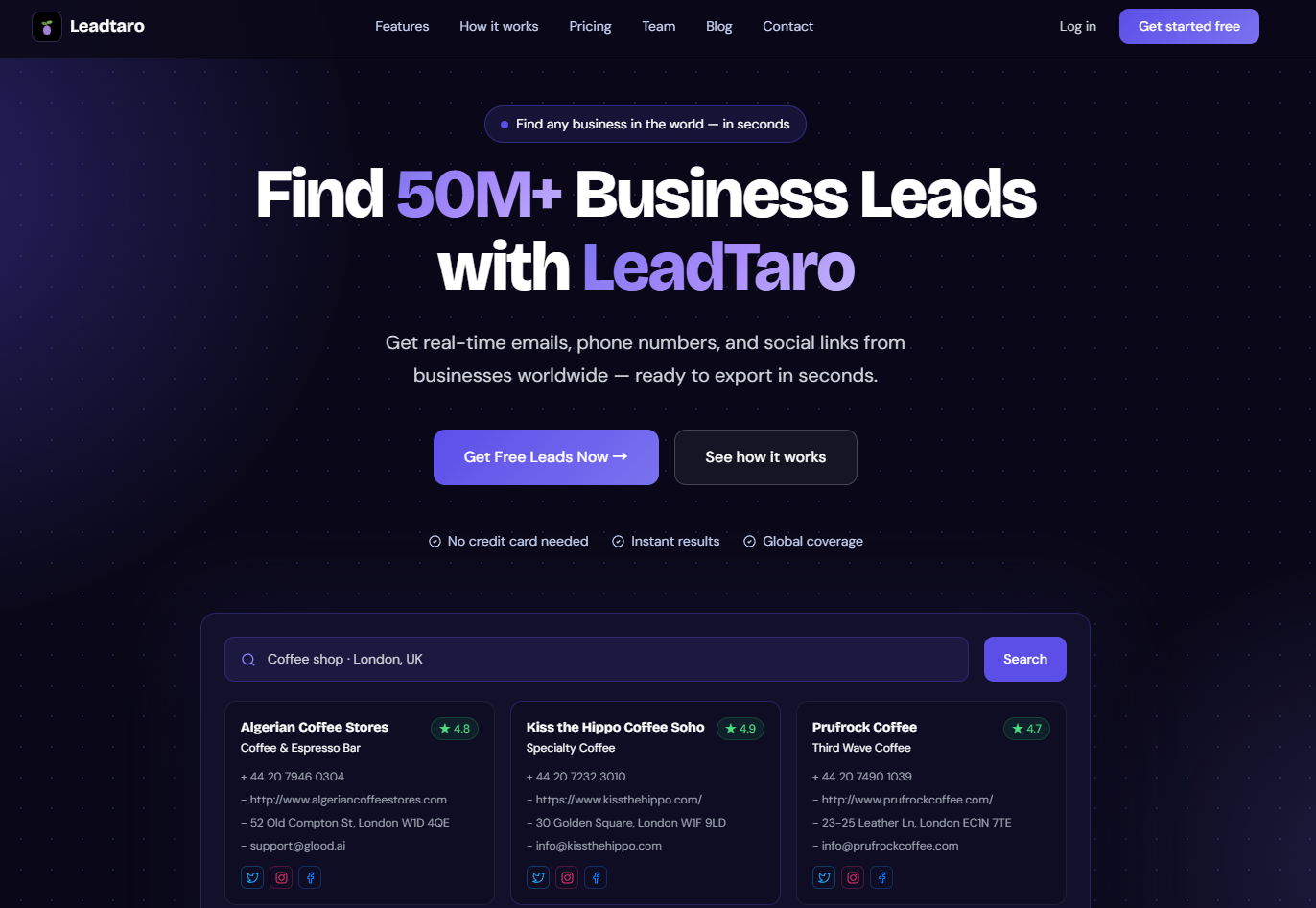
LeadTaro helps businesses discover and organize B2B prospects for sales and marketing. For teams targeting UAE companies, a practical prospecting workflow is to define an industry and location, identify relevant businesses, review available contact information, and segment the resulting list before outreach.
The distinction matters: web scraping is a data collection technique, while lead generation is the broader process of identifying, qualifying, and contacting potential customers. A useful lead generation process also requires data validation, qualification, and compliant outreach.
5. How to Build a UAE Business Lead List
If the goal is B2B prospecting, start with a clear process rather than collecting every available record.
Step 1: Define Your Ideal Customer Profile
Decide which companies are most likely to need your product or service.
Useful criteria include:
Industry
Location or Emirate
Company size, where reliable data is available
Website availability
Business category
Relevant business characteristics
A narrow target is usually easier to evaluate than a broad list of every company in the country.
Step 2: Choose Relevant Data Sources
Select sources that provide the fields needed for your research. These may include business directories, official company websites, industry directories, or supported business data platforms.
Review each source's terms and collection restrictions before automating access.
Step 3: Collect Only Relevant Fields
Avoid collecting information simply because it is available. For a first prospecting list, business name, category, location, website, and a relevant public contact channel may be enough.
Limiting collection to necessary fields can simplify validation and reduce privacy risks.
Step 4: Clean and Validate the Dataset
Before importing leads into a CRM:
Remove duplicate businesses.
Normalize phone numbers and website URLs.
Check whether websites are accessible.
Separate missing contact fields from verified information.
Record when the data was collected.
Mark uncertain fields instead of treating them as confirmed.
An email address being present does not guarantee deliverability, and a valid email does not automatically establish permission to send marketing messages.
Step 5: Segment and Prioritize Prospects
Create segments based on industry, location, business characteristics, or how well each company matches your ideal customer profile.
For instance, a marketing agency could create separate lists for restaurants, clinics, real estate firms, and professional services. Each segment can then receive relevant messaging rather than a generic sales pitch.
Step 6: Use Responsible Outreach
Check the rules that apply to your organization, the recipient, the communication channel, and the data source before contacting prospects.
Maintain suppression lists, respect opt-out requests, and avoid sending irrelevant or excessive messages. Good data improves targeting, but it does not replace responsible sales practices.
6. Best Web Scraping Tools for UAE Businesses in 2026
The right tool depends on the type of data you need and the technical resources available to your team.
ToolTool TypeCoding RequiredBest ForApifyCloud scraping platformDepends on the actor or workflowCustom extraction and developer workflowsOctoparseVisual scraping platformGenerally designed for no-code useStructured extraction from supported websitesBright DataData collection infrastructureDepends on the serviceLarge-scale and enterprise data projectsScrapyOpen-source Python frameworkYesCustom scraping projects requiring codePlaywrightBrowser automation frameworkYesDynamic web pages and browser-based workflowsLeadTaroB2B prospecting platformDepends on the workflow and available featuresDiscovering and organizing business prospectsThese tools serve different purposes, so they should not be treated as interchangeable.
Apify
Apify provides infrastructure and reusable tools for web data extraction. It can be useful for teams that need custom workflows or want to use existing scraping tools for supported sources.
It is worth evaluating when flexibility matters and someone on the team can configure, monitor, and maintain the chosen workflow.
Octoparse
Octoparse offers a visual approach to extracting data from supported websites. It may suit users who prefer a graphical workflow rather than writing scraping code.
Before choosing it, test the target website and verify that the fields you need can be collected reliably and in accordance with the source's restrictions.
Bright Data
Bright Data offers data collection infrastructure and related services for businesses with more complex requirements.
It may be relevant to organizations that need to manage large data workflows, but the appropriate service and cost depend on the project's scale and requirements.
Scrapy
Scrapy is an open-source framework for building web crawlers in Python. Developers can use it to implement custom extraction rules, pipelines, and data processing.
It provides flexibility but requires technical expertise, ongoing maintenance, and appropriate handling of access restrictions.
Playwright
Playwright automates browser interactions and can help developers work with websites that rely heavily on JavaScript.
It is not a complete data sourcing solution by itself. Developers still need to design extraction logic, handle failures, validate the results, and respect the target website's rules.
LeadTaro for B2B Prospecting
If your main objective is to find companies to sell to, a prospecting platform may be more appropriate than building and maintaining a general-purpose scraper.
LeadTaro focuses on B2B lead generation, helping businesses organize their prospecting around relevant companies and target markets. For UAE sales campaigns, define the target industry and geography first, then assess which business records and contact fields are available for your use case.
Selection tip: Compare tools using the same test criteria: data coverage, accuracy, freshness, export options, integration requirements, total cost, and compliance controls. Do not assume that a tool can access every website or field.
7. AI-Powered Web Scraping: What Is Changing?
AI is changing how businesses interact with web data, but it does not eliminate the need for reliable collection and validation.
Traditional scrapers often depend on page structures, selectors, or predefined extraction rules. When a website changes its layout, those rules may need to be updated.
AI-assisted systems can help with tasks such as:
Identifying relevant fields in semi-structured content.
Classifying businesses or products.
Extracting information from pages with varying layouts.
Normalizing inconsistent text.
Summarizing large collections of public information.
Supporting natural-language research workflows.
However, AI-generated extraction results can be incomplete or incorrect. A model may confuse a product price with a shipping charge, mistake a company name for a product name, or infer information that the source never stated.
A robust workflow combines automated extraction with validation rules, source references, and human review for important decisions.
For B2B prospecting, AI can also help categorize companies and prioritize potential customers. The final qualification should still be based on relevant evidence rather than unsupported assumptions.
8. No-Code vs. Developer-Based Scraping
The choice between no-code and code-based tools depends on the team's needs.
No-code tools can be appropriate when:
The workflow is relatively simple.
The source is supported by the platform.
Users want to configure extraction visually.
A technical development team is not available.
Developer-based tools can be appropriate when:
The project needs custom extraction logic.
Multiple systems must be integrated.
The source requires complex browser interactions.
The business needs more control over validation and processing.
The team can maintain the code over time.
No-code does not automatically mean easier at every scale, and code does not automatically mean better data. Test a representative sample before committing to either approach.
For many small businesses, a dedicated prospecting platform may be more practical than developing a custom scraper when the primary goal is discovering B2B customers.
9. Is Web Scraping Legal in the UAE?
Web scraping does not have a single legal status that applies to every website, every type of data, and every purpose.
The legal position depends on factors such as the data being collected, how it is accessed, the purpose of processing, the applicable jurisdiction, and the website's terms.
In the UAE, one important framework is Federal Decree-Law No. 45 of 2021 on the Protection of Personal Data. Businesses should consult the official UAE government information and qualified legal advice to determine how the law applies to their specific activities.
Public availability alone does not mean that all data can be collected, stored, combined, or used without restriction.
Business Data vs. Personal Data
A company's general business information may be different from information that identifies an individual.
For example:
A company's published business address may be business contact information.
A general company telephone number may be used for business enquiries.
A named employee's direct email address may qualify as personal data, depending on the circumstances.
A person's private contact details may require additional care and a valid legal basis for processing.
The context matters. A sole trader's business information may also identify a natural person, so businesses should not assume that every business-related field falls outside data protection rules.
Practical Compliance Checklist
Before scraping or using business data in the UAE:
Check the source's terms. Review applicable website terms, usage policies, and restrictions on automated access.
Review access permissions. Do not bypass authentication, technical access controls, or other restrictions.
Assess personal data. Determine whether the collected fields identify individuals and what legal basis or safeguards may be required.
Limit collection. Collect only the information needed for a defined business purpose.
Protect stored data. Apply appropriate access controls, security measures, and retention periods.
Check marketing rules. Data collection and permission to contact a prospect are separate questions. Review the rules applicable to the communication channel and recipient.
Respect opt-outs. Maintain records of objections and suppression requests where relevant.
Document the process. Keep records of the source, collection date, intended purpose, and validation steps.
Some UAE businesses may also operate in free zones or across international markets where additional data protection frameworks apply. The relevant requirements should be assessed for the actual organization and activity.
This section is general information, not legal advice.
10. Common Web Scraping Mistakes to Avoid
Collecting Too Much Data
A large dataset is not necessarily a useful dataset. Excessive collection increases cleaning costs and can create unnecessary compliance risks.
Define the required fields before extraction.
Ignoring Data Quality
Missing emails, duplicate businesses, outdated prices, and inconsistent addresses can undermine the value of a dataset.
Measure quality using practical indicators such as duplicate rate, field completeness, and successful validation rate.
Treating Public Information as Permission for Any Use
A webpage being publicly accessible does not automatically authorize unrestricted collection or marketing use.
Review source terms, privacy obligations, and communication rules separately.
Ignoring Maintenance
Websites change their layouts, content, and access controls. Scraping workflows should be monitored and tested instead of being assumed to work indefinitely.
Sending Generic Outreach
A prospect list is only the starting point. Messages that ignore a company's industry, needs, or location are unlikely to be as useful as relevant, targeted communication.
Segment prospects and make the reason for contacting each business clear.
11. Frequently Asked Questions
Is web scraping legal in the UAE?
It depends on the data, source, method, and purpose. The UAE's personal data protection framework may apply when personal data is processed, and website terms or other laws may impose additional restrictions. Review the specific use case before collecting or using data.
What is web scraping used for in the UAE?
Common business applications include competitor price monitoring, e-commerce research, real estate analysis, hospitality benchmarking, public financial research, and B2B lead generation.
Can businesses scrape Google Maps data in the UAE?
Businesses should review Google's applicable terms, policies, and permitted access methods before attempting automated collection. Accessing a public listing does not by itself establish permission to extract or reuse every field. Consider compliant business data providers or authorized APIs where appropriate.
What is the best web scraping tool for UAE businesses?
The best choice depends on the objective. Apify and Scrapy can support custom extraction workflows, Octoparse provides a visual approach, and Bright Data offers data collection infrastructure. Businesses focused on B2B prospecting should also evaluate dedicated lead generation platforms such as LeadTaro.
Is web scraping better than using an API?
Not necessarily. APIs often provide structured, documented access and may be the better choice when they supply the required data under suitable terms. Web scraping can be useful for permitted information that is available through web pages but not through an appropriate API.
Can web scraping help generate B2B leads?
Yes. When conducted appropriately, business data collection can help identify companies by industry, location, and other relevant characteristics. The resulting records still need validation, qualification, and compliant outreach.
How can I improve the quality of scraped business leads?
Define an ideal customer profile, select relevant sources, collect only necessary fields, remove duplicates, verify available contact information, record data freshness, and segment companies before outreach.
Does AI make web scraping completely automatic?
No. AI can assist with extraction, classification, and data cleaning, but it can still make mistakes. Reliable workflows require validation, monitoring, and review of important records.
Conclusion: Turn UAE Business Data Into Actionable Insights
The UAE offers opportunities across e-commerce, real estate, hospitality, financial services, and B2B markets. Businesses can use web data to understand competitors, evaluate market conditions, and discover potential customers.
The right approach starts with a clear objective. Choose suitable sources, select a collection method that fits the project, validate the resulting data, and review the legal and contractual requirements before putting it to use.
For pricing intelligence and market research, automated data collection can help organize information that would otherwise require repeated manual work. For sales teams, the priority is to turn relevant company information into a well-qualified prospect list.
If your goal is to find potential B2B customers, explore how LeadTaro can support your prospecting workflow. Start with a defined industry and target location, assess the available business information, and build a focused list that your sales team can actually use.
The goal is not simply to collect more data. It is to make better decisions and identify the right business opportunities with less repetitive research.