Articles » Lead Generation » What Is Prospecting? The Complete 2026 Guide to Sales Prospecting
Table of Contents
What Is Prospecting? The Definition
What Is Sales Prospecting?
Prospecting vs. Lead Generation
Leads vs. Prospects
Types and Methods of Prospecting
The Sales Prospecting Process: 6 Steps
Where Do Sales Prospects Come From?
Prospecting in 2026: What Has Changed?
Sales Prospecting Tools
Frequently Asked Questions
Sales prospecting is one of the most important activities in business growth. Whether you run a SaaS company, manage a sales team, operate a marketing agency, or work as an independent consultant, finding potential customers is essential to building a reliable sales pipeline.
But prospecting involves more than collecting names or sending hundreds of cold emails. Effective prospecting means identifying businesses that fit your ideal customer profile, understanding their needs, and starting relevant conversations.
In 2026, sales teams have access to more data and automation tools than ever before. Yet finding the right prospects, choosing the right communication channel, and earning a response remain significant challenges.
This guide explains what prospecting means, how it differs from lead generation, which methods work best, and how to build a repeatable prospecting process using tools such as LeadTaro.
What Is Prospecting? The Definition
Prospecting is the process of identifying potential customers and taking steps to start a business relationship with them.
In sales, prospecting is usually the first stage of the sales process. It involves finding people or companies that may benefit from your product or service, researching their suitability, and reaching out to begin a conversation.
For example, imagine you operate a web design agency. You might identify local businesses whose websites could benefit from improved mobile usability, better service pages, or a more effective enquiry process. You then research those companies, find an appropriate business contact channel, and introduce your services.
That is sales prospecting.
The term has other meanings in different contexts. In geology, prospecting means searching for mineral deposits. In business, however, it refers to finding and engaging potential customers.
Successful prospecting has three core elements:
Identification: Find companies or people who may be suitable customers.
Qualification: Determine whether they fit your target market and could benefit from your offer.
Engagement: Contact suitable prospects through an appropriate channel to start a conversation.
The objective is not to contact everyone. It is to find the right potential customers and give them a relevant reason to respond.
What Is Sales Prospecting?
Sales prospecting is the process of identifying potential buyers, researching their needs, and contacting them to generate new business opportunities.
It is closely associated with outbound sales, where a salesperson initiates contact instead of waiting for a prospect to enquire.
However, prospecting is not synonymous with cold calling. Cold calling is one prospecting method, alongside cold email, professional networking, referrals, social selling, and other forms of targeted outreach.
A typical sales prospecting workflow looks like this:
Define the type of customer you want to reach.
Build a list of businesses or individuals who match your criteria.
Research their needs and suitability.
Identify an appropriate contact method.
Send a personalized message or initiate a conversation.
Qualify the response and determine the next step.
For B2B sales, this process often begins with identifying suitable companies. Depending on the sale, the next step may involve finding a founder, sales manager, marketing director, or another relevant decision-maker.
For example, a company selling appointment scheduling software might target clinics, salons, and other service businesses. A SaaS provider selling sales automation software might instead focus on agencies and growing sales teams.
The prospecting process changes with the target market, but the principle stays the same: find relevant potential customers and engage them with a clear purpose.
Prospecting vs. Lead Generation
Prospecting and lead generation are related, but they are not identical.
Lead generation generally focuses on attracting potential customers and collecting their interest or contact information. Prospecting focuses on identifying suitable potential customers and initiating or developing sales conversations.
The two activities can overlap, especially in smaller businesses where the same person handles marketing and sales.
DimensionLead GenerationSales ProspectingPrimary goalAttract and identify potential customersStart relevant sales conversationsCommon approachContent, SEO, advertising, events, lead captureResearch, qualification, email, calls, networkingTypical directionOften inbound, but can include outbound campaignsOften proactive and outboundMain outputLeads and enquiriesQualified conversations and opportunitiesSuccess measuresLeads, acquisition cost, conversion rateReplies, meetings, qualified opportunities, revenueWhat is prospecting in marketing?
In marketing, the word can refer to identifying new audiences or targeting people who have not previously engaged with a brand. However, traditional sales prospecting focuses more directly on qualifying potential buyers and starting conversations.
Consider a company publishing a guide to attract people searching for a particular solution. That is lead generation.
If its sales team then identifies relevant businesses, researches their requirements, and contacts appropriate decision-makers, that is prospecting.
Both activities can support the same customer acquisition strategy.
Marketing creates awareness and captures interest. Prospecting helps the business reach potential buyers who may not have discovered it independently.
Leads vs. Prospects
The terms lead and prospect are often used interchangeably, but there is a useful distinction.
A lead is a potential customer identified through research, an enquiry, a referral, or another source. A prospect is generally a lead that has been assessed and appears suitable for the product or service.
For example, a list of 200 local businesses might contain 200 leads. After reviewing their industries, locations, websites, and potential needs, you might identify 40 that closely match your ideal customer profile.
Those 40 businesses are stronger prospects for your campaign.
DimensionLeadProspectDefinitionA potential customer identifiedA potential customer assessed for suitabilityQualificationMay be incompleteMeets relevant qualification criteriaSales priorityNot yet establishedMore clearly definedNext stepResearch and qualificationRelevant outreach or further discoveryA prospect does not necessarily have a confirmed budget or immediate buying intention. Those details may only become clear after a conversation.
The important point is to avoid treating every record as equally valuable.
A well-qualified list helps you focus your time on businesses that are more likely to benefit from your offer.
Types and Methods of Prospecting
There are several ways to find and engage potential customers. The right approach depends on your industry, audience, product, and sales cycle.
1. Cold calling
Cold calling involves contacting a potential customer by phone before they have expressed interest in your offer.
It can be useful when your product requires explanation, when a conversation is more effective than a long email, or when your target customers commonly conduct business by phone.
The key is preparation. Before calling, understand what the business does, why it may be relevant, and what you want to learn from the conversation.
Follow the applicable telemarketing rules, check relevant suppression lists, and respect requests not to be contacted.
2. Cold emailing
Cold email involves sending a business message to a potential customer who has not previously engaged with you.
A good cold email is relevant, concise, and specific. It explains why you are contacting the recipient and offers a clear reason to continue the conversation.
For example, a software company might contact an agency that could benefit from a particular workflow improvement. The message should explain the potential benefit rather than simply listing product features.
Email prospecting is most effective when supported by suitable contact data, careful targeting, and responsible follow-up.
3. Social selling
Social selling involves using professional and social platforms to research potential customers, build familiarity, and develop business relationships.
It may include commenting on relevant posts, sharing useful insights, participating in professional communities, and contacting suitable business professionals.
This method can be particularly valuable when the buying process depends on trust and relationships.
4. Warm prospecting
Warm prospecting involves contacting someone who has already shown some level of interest or has an existing connection with your business.
Examples include following up with an event attendee, responding to a product enquiry, or contacting a referral from an existing customer.
Because there is already some context, warm prospecting may provide a more natural starting point than completely unsolicited outreach.
5. Referrals
Referrals come from customers, colleagues, partners, or other contacts who introduce you to potential buyers.
They can be valuable because the introduction provides context and an initial degree of trust.
However, referrals are difficult to scale predictably on their own. A repeatable prospecting system can complement referrals by helping you identify additional potential customers.
6. Networking and events
Trade shows, conferences, local business events, and professional communities can help you meet people who may benefit from your services.
The most effective networking is not simply collecting business cards. It involves identifying shared interests, understanding business challenges, and following up with a relevant next step.
7. Account-based prospecting
Account-based prospecting focuses on a selected group of companies that represent particularly valuable opportunities.
Instead of creating a broad list, you research specific accounts and tailor your outreach to each organization's circumstances.
This method can work well for enterprise software, consulting, and higher-value B2B services where each potential deal justifies substantial research.
8. Business-data prospecting
Business-data prospecting involves identifying potential customers using business records, directories, company websites, and B2B lead generation platforms.
It is especially useful for agencies, service providers, and sales teams targeting businesses by industry or location.
For example, a marketing agency might build a list of independent retailers in several cities. A software company might search for businesses in industries that match its ideal customer profile.
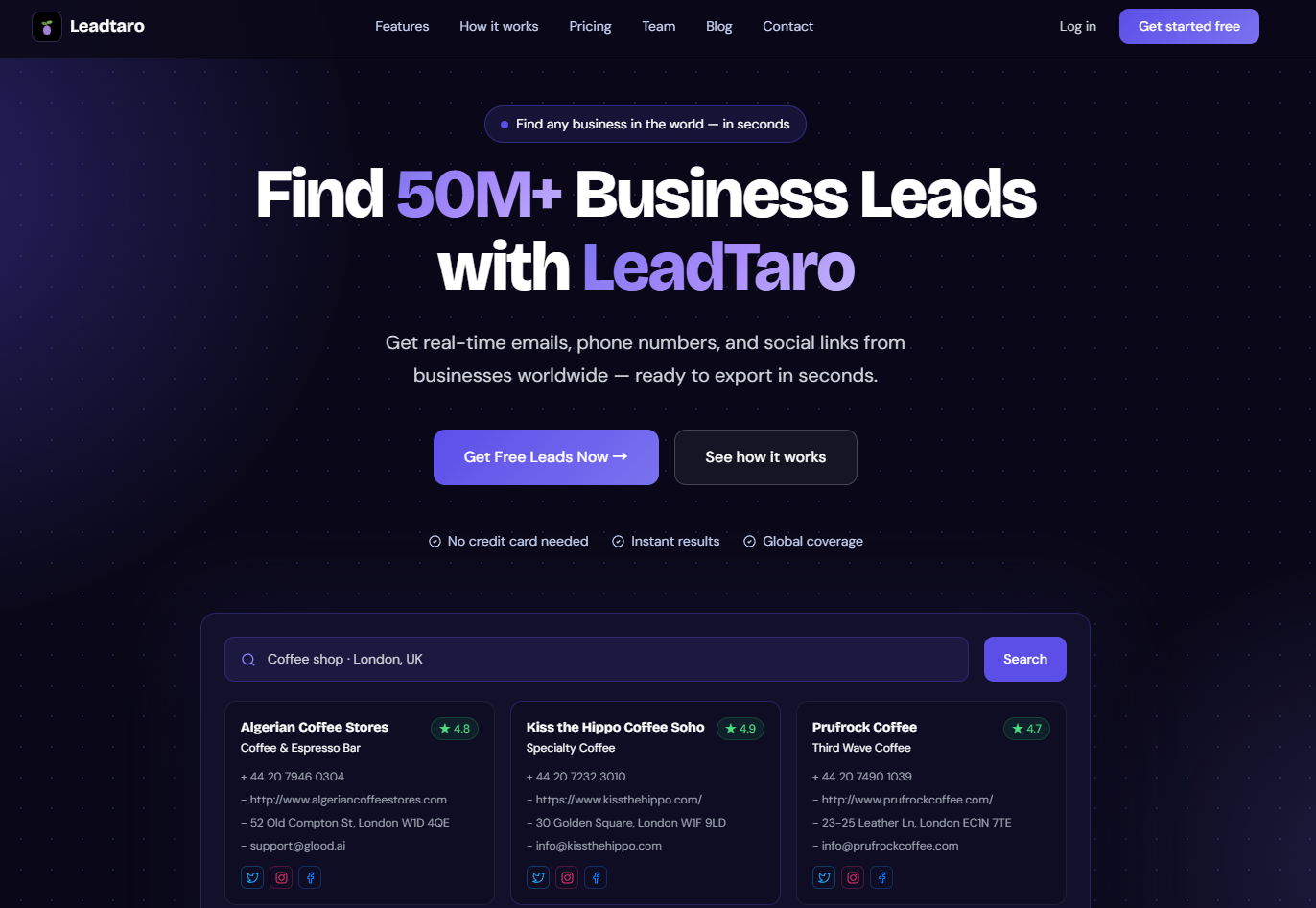
LeadTaro helps users discover B2B business leads across different industries and locations, review available business contact information, and organize prospects for follow-up.
The important distinction is that business discovery is only the starting point. You still need to qualify companies and decide which ones are appropriate to contact.
The Sales Prospecting Process: 6 Steps
An effective prospecting process should be structured enough to repeat but flexible enough to adapt to different markets.
Here are six steps to follow.
Step 1: Define your ideal customer profile
Your ideal customer profile, or ICP, describes the type of company that is most likely to benefit from your product or service.
Depending on your business, relevant criteria might include:
Industry.
Location.
Company size.
Business model.
Likely operational challenges.
Potential value of the customer relationship.
Suitability for your product or service.
For example, an agency specializing in website redesigns might target independent businesses whose online presence is important to customer acquisition.
A CRM provider might target sales teams that need better visibility into leads and follow-up activities.
The more specific your ICP, the easier it becomes to identify relevant prospects and write useful messages.
Step 2: Build your prospect list
Once you know which businesses you want to reach, find companies that match your criteria.
Potential sources include business directories, company websites, professional networks, referrals, industry associations, and B2B lead generation platforms.
LeadTaro can help you discover relevant B2B business leads across industries and locations. Available records may include company names, websites, phone numbers, email addresses, and social links.
Choose a source that suits your target market and verify that its coverage and permitted uses meet your requirements.
Start with a manageable segment rather than trying to contact every possible customer immediately.
Step 3: Research and qualify prospects
Before reaching out, review the information available about each business.
Look for legitimate indicators of relevance, such as its services, target customers, operating locations, public announcements, or website functionality.
Then decide whether the company is a reasonable fit for your offer.
A simple qualification system might classify prospects as:
High priority: Strong fit and a clear reason to make contact.
Medium priority: Potential fit, but more research is needed.
Low priority: Limited evidence of relevance or a poor match.
This prioritization helps prevent your team from spending too much time on unsuitable businesses.
Step 4: Choose the right channel
Different prospects may respond better to different communication methods.
Email can work well when you have a suitable business contact and a relevant written message. Phone calls may be more appropriate for certain service businesses. Professional networking can be valuable when the sale depends on relationships or specialized expertise.
Consider your audience, the nature of your offer, and applicable communication rules before choosing a channel.
You do not need to use every channel for every prospect. Select the approach most likely to create a useful, appropriate conversation.
Step 5: Start a relevant conversation
A prospecting message should be clear about why you are reaching out.
Avoid generic introductions that could apply to any business. Where possible, explain the connection between the company's situation and the problem your product or service solves.
For example:
"Hi, we help independent service businesses simplify their online enquiry process. I noticed your website provides information about your services, and I wanted to ask whether improving the way customers request appointments is something your team is considering."
This is only a starting point. Make sure any observation is accurate and that the message is relevant to the recipient.
LeadTaro's AI-assisted email generation can help you prepare personalized drafts more efficiently. Review the details before sending and adapt the message to the actual business.
Step 6: Follow up and qualify the response
Prospecting does not end when you send the first message.
Some potential customers will respond immediately. Others may need more information, while many will not be interested.
Use a CRM or another organized tracking system to record the outcome and determine the next step.
Your process might include:
Recording the first contact.
Scheduling an appropriate follow-up.
Documenting the prospect's response.
Identifying whether there is a genuine business need.
Arranging a meeting when appropriate.
Closing or disqualifying the opportunity.
Follow-up should be respectful and relevant. Stop when a recipient objects or asks not to be contacted, and comply with applicable rules.
Where Do Sales Prospects Come From?
One of the most common challenges in prospecting is deciding where to find suitable companies in the first place.
Different sources serve different purposes. Combining them can give you a more complete view of your target market.
Referrals and existing relationships
Your existing customers, colleagues, and professional contacts may know companies that need your services.
Referrals are useful for building trust, but they depend on the size and activity of your network.
Professional networks
Professional networks can help you find people by role, company, industry, and professional background.
They are particularly helpful for reaching corporate decision-makers, although coverage of smaller local businesses can vary.
B2B databases
B2B databases can provide company information and, depending on the provider, professional contact details.
Before choosing one, evaluate its coverage of your industry and location, the fields available, its update practices, and the terms governing its use.
Business websites and directories
Business websites and directories are useful for researching local companies and understanding what they offer.
The drawback is that contact information may be spread across many pages, requiring manual work to assemble a usable prospect list.
Lead generation platforms
A B2B lead generation platform can help make prospect discovery more repeatable.
LeadTaro supports business lead discovery across different industries and locations. Users can review available business information, identify suitable prospects, and organize leads in a CRM pipeline.
This can be particularly useful for teams that repeatedly target similar customer groups or need to explore new markets.
The best source is the one that provides relevant businesses and appropriate contact information for your particular sales objective. More records do not automatically mean more sales opportunities.
Prospecting in 2026: What Has Changed?
Prospecting continues to evolve as buyers receive more messages, businesses adopt AI, and sales teams gain access to more data.
Several developments are especially important.
Relevance matters more than raw volume
Sending a large number of generic messages may produce activity, but it does not guarantee meaningful sales conversations.
Prospects are more likely to engage when the message is relevant to their business, addresses a plausible need, and makes the next step clear.
This starts with good targeting. If your list contains businesses that are unlikely to benefit from your offer, personalization alone cannot fix the underlying problem.
AI is changing prospect research and outreach
AI tools can help sales teams summarize company information, prepare first drafts, classify prospects, and adapt messages to different audiences.
These capabilities can reduce repetitive work, but they also introduce risks. AI can misinterpret information, invent details, or produce messages that sound generic despite being personalized.
Use AI to assist with research and writing, then verify the facts and apply human judgment.
Business data is becoming easier to organize
Sales teams no longer need to rely exclusively on manually maintained spreadsheets. Lead generation platforms and CRM tools can help connect prospect discovery with qualification, outreach, and follow-up.
For example, LeadTaro combines B2B lead discovery with AI-assisted email generation and a CRM pipeline.
This helps make prospecting a more organized process rather than a collection of disconnected tasks.
Buyers expect relevant communication
Potential customers are increasingly selective about which messages deserve their attention.
Instead of focusing only on how many messages you can send, consider whether each message is relevant, accurate, and appropriate for the recipient.
A clear value proposition and well-qualified list can be more useful than simply increasing campaign volume.
Measurement is essential
Modern prospecting should be measured throughout the funnel.
Track the number of qualified prospects, messages delivered, replies received, meetings booked, and opportunities won.
These figures help you distinguish between a data problem, a targeting problem, and an outreach problem.
For example, a low reply rate may result from poor targeting, an unclear offer, inaccurate contact information, or unsuitable messaging. Measuring the whole process helps you investigate rather than guessing.
Sales Prospecting Tools
You can prospect without specialized software, especially when you are building a small list. As your activity grows, however, tools can reduce repetitive work and make it easier to manage opportunities.
The most useful tools typically fall into four categories.
Tool categoryMain purposeWhen it is usefulB2B lead generationDiscover potential business customersBuilding prospect lists by industry or locationSales intelligenceResearch companies and professional contactsTargeting specific roles or organizationsCRM softwareTrack leads, conversations, and opportunitiesManaging follow-ups and the sales pipelineAI writing and researchAssist with qualification and message preparationReducing repetitive research and draftingSome platforms combine multiple functions, while others specialize in one area.
LeadTaro for B2B prospect discovery
LeadTaro is a B2B lead generation platform designed to help users discover business leads across different industries and locations.
It can help you:
Find businesses relevant to your target market.
Review available business contact details.
Organize prospects in a CRM pipeline.
Prepare personalized outreach using AI-assisted email generation.
Manage leads as they progress through your sales process.
This workflow is particularly useful for founders, agencies, freelancers, and sales teams that need a repeatable way to identify potential business customers.
LeadTaro is a business lead generation platform, not a guarantee that every record contains a verified decision-maker or that every business is ready to buy. Review the information available for your market and qualify prospects before contacting them.
Our free plan includes 60 B2B leads without requiring a credit card, so you can explore the platform before deciding whether it suits your prospecting process.
Frequently Asked Questions
What does it mean when someone is prospecting?
In sales, prospecting means identifying potential customers, assessing whether they are a suitable fit, and contacting them to start a business conversation. It is a proactive way to develop new sales opportunities.
What are the 5 P's of prospecting?
A useful framework is Purpose, Preparation, Personalization, Persistence, and Patience.
Purpose: Know why you are contacting the prospect.
Preparation: Research the business and understand its relevance.
Personalization: Adapt your message to the recipient's circumstances.
Persistence: Follow up appropriately when there is a valid reason to do so.
Patience: Recognize that business relationships and buying decisions can take time.
This is a practical framework rather than a universal, formally standardized definition.
What is the difference between prospecting and lead generation?
Lead generation focuses on attracting or identifying potential customers. Prospecting focuses on researching, qualifying, and engaging potential buyers to develop sales opportunities. The two activities often work together as part of a customer acquisition strategy.
What is an example of prospecting?
A software company identifies 100 businesses that fit its target market, reviews their websites and business contact information, selects the most relevant prospects, and contacts them with personalized messages explaining how the software could help. The team records responses in its CRM and follows up appropriately.
Is prospecting the same as cold calling?
No. Cold calling is one prospecting method. Prospecting also includes cold email, referrals, networking, social selling, account-based research, and other approaches to identifying and engaging potential customers.
Is prospecting still worth it in 2026?
Yes. Businesses still need ways to identify potential customers and develop sales opportunities. The key is to focus on relevant prospects, use appropriate contact channels, provide a clear value proposition, and measure the results rather than relying on message volume alone.
How do I find prospects for my business?
Start by defining your ideal customer profile. Then search suitable business directories, company websites, professional networks, referrals, or B2B lead generation platforms. Qualify the results, review available contact information, and prioritize businesses that are likely to benefit from your offer.
How can LeadTaro help with prospecting?
LeadTaro helps users discover B2B business leads across industries and locations, review available business information, prepare AI-assisted personalized emails, and manage prospects through a CRM pipeline. It supports the process of finding and organizing potential customers, while qualification and appropriate outreach remain essential.
Start Prospecting with a Better Process
Sales prospecting begins with finding the right potential customers. Your messaging, follow-up, and sales skills matter, but they are much harder to apply effectively when your prospect list is poorly targeted.
A repeatable process gives you a stronger foundation:
Define your ideal customer.
Find businesses that match your criteria.
Review available information and qualify prospects.
Choose an appropriate communication channel.
Start relevant conversations.
Track outcomes and improve your approach.
LeadTaro helps bring several parts of this workflow together, from discovering B2B business leads to preparing personalized emails and organizing prospects in a CRM pipeline.
Whether you are a freelancer looking for new clients, an agency expanding into another city, or a SaaS founder building a sales pipeline, start with a focused group of suitable prospects and learn from the results.
Try LeadTaro's free plan to explore 60 B2B leads without a credit card and build a more organized prospecting workflow.