Meta Title: What Is Vibe Prospecting? AI Sales Prospecting Guide 2026
Meta Description: Learn what vibe prospecting is, how AI-powered lead generation works, and how to find, qualify, and convert B2B prospects using natural-language prompts.
URL Slug: vibe-prospecting
Primary Keyword: vibe prospecting
Secondary Keywords: AI prospecting, AI sales prospecting, natural language lead generation, B2B lead generation tools, Google Maps prospecting, automated lead qualification
What Is Vibe Prospecting?
Vibe prospecting is an AI-powered approach to sales prospecting that allows you to describe your ideal customers in natural language instead of manually navigating complex search filters, spreadsheets, and multiple data tools.
Rather than building a list one filter at a time, you might ask an AI assistant:
"Find 200 marketing agencies in Manchester with a business website, an active LinkedIn presence, and publicly listed contact information."
The goal is to translate a sales objective into a practical prospecting workflow. Depending on the tools and data sources available, AI can help identify matching businesses, apply filters, organize prospect records, and prepare data for outreach.
For sales teams, agencies, consultants, and founders, vibe prospecting offers a simpler way to move from an idea about the ideal customer to a structured list of potential buyers.
However, generating a list is only the first step. The real value comes from identifying suitable prospects, understanding their needs, and using relevant information to start meaningful business conversations.
How Does Vibe Prospecting Differ from Traditional Prospecting?
Traditional prospecting often involves several disconnected tasks. A salesperson searches a database, adjusts filters, exports records, cleans a spreadsheet, verifies contact information, and transfers the results into a CRM or outreach platform.
Vibe prospecting aims to simplify this process through natural-language instructions and AI-assisted workflows.
FeatureTraditional ProspectingVibe ProspectingSearch processManual filters and database queriesNatural-language instructionsAudience definitionConfigure filters individuallyDescribe the ideal customerLead qualificationManual review or separate scoring toolsAI-assisted filtering and prioritizationData managementMultiple exports and spreadsheetsIntegrated workflows where supportedPersonalizationResearch each prospect manuallyAI-assisted personalization using available dataHuman involvementHigh during research and preparationLower for repetitive tasks, with human review still neededFinal sales decisionsSalespersonSalesperson supported by AIThe important distinction is not that AI eliminates sales work. It reduces the friction involved in research and preparation so salespeople can spend more time evaluating opportunities and speaking with potential customers.
Why AI Is Changing Sales Prospecting
Sales teams need more than a large contact database. They need relevant prospects, reliable information, and a repeatable process for identifying potential buyers.
AI can help with three common prospecting challenges.
1. Too Much Time Spent on Research
Finding suitable prospects often requires switching between business directories, company websites, professional networks, spreadsheets, and CRM records.
AI-assisted workflows can reduce repetitive research by turning clearly defined criteria into reusable searches and processing steps.
For example, an agency selling website redesign services could define its target audience as local businesses that have no website or appear to have an outdated online presence. Instead of researching every business individually, the team can begin with a targeted list and investigate the strongest matches first.
2. Poorly Qualified Lead Lists
A list of thousands of companies is not necessarily a list of potential customers.
A useful prospect should match your target market and have a plausible reason to consider your offer. AI can help apply qualification criteria such as industry, location, company size, website status, and publicly available business signals.
The results still need review. An absent website field does not always prove that a business has no website, and a low review rating does not automatically mean its owner wants reputation-management services.
3. Generic Outreach
Generic messages are easy to ignore because they provide little evidence that the sender understands the recipient's business.
AI can help personalize messages using relevant, verified information. For example, a salesperson might reference a business's service category, location, website experience, or publicly visible business activity.
Personalization should be accurate and useful rather than merely inserting a company name into a template.
How Vibe Prospecting Works: A Practical Workflow
A practical vibe prospecting process has five stages.
Step 1: Define Your Ideal Customer Profile
Before searching for leads, decide which businesses are most likely to benefit from your product or service.
Your ideal customer profile (ICP) should describe the type of business you want to reach and the characteristics that make it a strong prospect.
Consider these factors:
Industry: Which business categories need your solution?
Geography: Which cities, regions, or service areas can you target?
Business characteristics: What size, operating model, or online presence makes a business suitable?
Buying signals: What observable information suggests a possible need?
Contactability: Can you identify an appropriate, lawful way to contact the business?
Commercial fit: Does the business have a plausible reason and ability to purchase?
For example, a web design agency might target independent restaurants in Birmingham that have an active business listing but no functioning website.
A marketing consultancy might target local professional-service businesses with an established website but limited evidence of recent marketing activity.
The more specific your ICP, the easier it becomes to filter prospects and write relevant outreach.
Step 2: Describe Your Search in Plain English
Once you know your audience, translate your criteria into a clear prompt.
A useful prompt specifies the business category, location, qualifying conditions, and desired output.
Example prompt:
"Find independent dental clinics in Leeds. Include their business name, address, website, publicly listed business contact information, and review count where available. Exclude duplicate records and organize the results by relevance."
For local prospecting, another example might be:
"Identify plumbing businesses within my target service area that have a business website and publicly available contact information. Separate businesses with missing website information into a review list rather than assuming they have no website."
A clear prompt makes the intended outcome easier to evaluate and reduces ambiguity.
Keep in mind that the AI can only return data supported by its connected sources and permissions. Natural-language instructions do not automatically grant access to every database or website.
Step 3: Filter and Qualify the Results
After the initial search, refine the list.
Remove duplicates, check whether businesses match your ICP, and flag missing or conflicting information. Where appropriate, verify contact details before using them in outreach.
A simple lead qualification framework can score each prospect across three dimensions:
DimensionQuestions to AskFitDoes the business match the industry, location, and customer profile?NeedIs there a relevant business problem your product could solve?ContactabilityIs there an appropriate and permitted channel for reaching the business?You can assign each dimension a score from 1 to 5 and prioritize businesses with the strongest overall fit.
Treat the score as a decision aid, not proof that a prospect is ready to buy. Public business information rarely reveals the full purchasing context.
Step 4: Prepare Personalized Outreach
Use the information you have verified to develop a relevant opening message.
For example, a website agency contacting a local business might write:
"Hi Alex, I came across your plumbing business while researching service providers in Leeds. I couldn't find a working website linked to your business listing. Are you currently considering any improvements to how customers find and contact you online?"
This message identifies the reason for reaching out and asks a straightforward question without promising results or assuming the business has a particular problem.
A good AI-assisted outreach workflow should:
Use accurate business information.
Keep the message concise.
Explain why the offer might be relevant.
Avoid fabricated personal details or unsupported claims.
Use one clear call to action.
Respect applicable marketing and privacy rules.
AI can draft the message, but a person should review important claims and ensure that the message fits the recipient.
Step 5: Track Outcomes and Improve the Workflow
Vibe prospecting should be treated as a repeatable sales process rather than a one-time list-generation exercise.
Track the performance of each audience segment and campaign.
Useful metrics include:
Percentage of records that match your ICP.
Contact-data verification rate.
Email delivery and bounce rates.
Positive reply rate.
Qualified meetings booked.
Opportunity-to-customer conversion rate.
Cost per qualified opportunity.
Customer acquisition cost.
Use these results to refine your targeting. If a particular industry produces few qualified conversations, adjust your criteria or test another segment before increasing outreach volume.
Local Vibe Prospecting: Using Google Maps Data for Lead Generation
Many AI prospecting discussions focus on corporate databases, professional networks, and technology companies. But a large market of potential B2B customers consists of local businesses.
Examples include:
Restaurants and cafés.
Dentists and healthcare practices.
Plumbers, electricians, and other contractors.
Accountants and law firms.
Gyms and fitness studios.
Hotels and hospitality businesses.
Local retailers and professional-service providers.
These businesses may be easier to identify through geographic business listings than through databases designed primarily around corporate employees and technology buyers.
Why Geography Matters
For businesses selling locally, the customer's location can be as important as its industry.
A cleaning company serving Sheffield may not benefit from a list of businesses hundreds of miles away. A regional marketing agency may want to target particular towns or commercial districts rather than an entire country.
Geographic targeting helps narrow the search to businesses within a practical sales territory.
When supported by the data source, you can combine location with business categories and other available characteristics to build a more relevant prospect list.
Turning Business Listings Into Useful Sales Signals
Business listings can provide several useful signals, depending on the source and the information available.
SignalPotential UseBusiness categoryIdentify companies that may fit your ICPLocationPrioritize prospects within your service areaWebsite availabilityIdentify businesses for further website researchReview countUnderstand the business's visible customer feedback activityPublicly listed contact detailsIdentify appropriate contact channelsSocial profile availabilityUnderstand which public marketing channels a business appears to useThese signals are starting points for research, not definitive evidence of buying intent.
For example, a business with a low rating may already be working with a reputation-management agency. A business without a listed website may receive enough referrals that a new website is not a priority.
Use these observations to decide which businesses deserve further research, rather than treating them as proof that a sale is likely.
Vibe Prospecting Tools: What Should You Look For?
The right setup depends on your target audience and how much of the sales process you want to automate.
Instead of selecting a tool based on marketing claims alone, evaluate the following capabilities.
1. Natural-Language Search
Can you describe the audience you want to reach without manually configuring dozens of filters?
Check whether the tool understands industry, geography, company characteristics, and more complex combinations of criteria.
2. Reliable Data Sources
Identify where the tool obtains business and contact information. Check how recently records are updated, which fields are available, and whether the data can be verified.
A conversational interface is not a substitute for accurate underlying data.
3. Lead Filtering and Qualification
Look for practical filters that help you remove irrelevant records before exporting them. Useful options depend on your market and may include business category, location, website availability, company characteristics, or contact-data availability.
4. Integrations and Workflow Automation
Consider whether the tool works with your CRM, spreadsheets, email platform, or automation software.
The objective is to reduce repetitive work without creating an opaque process that is difficult to troubleshoot.
5. Data Protection and Compliance
Review the provider's data sources, terms of use, security practices, and compliance documentation. Also assess your own obligations when storing personal data or contacting prospective customers.
6. Transparent Pricing
Compare the actual cost of obtaining usable, qualified leads rather than focusing only on the advertised price per record.
A cheaper database may be less valuable if many records are irrelevant, outdated, duplicated, or missing essential information.
How LeadTaro Fits Into an AI-Assisted Prospecting Workflow
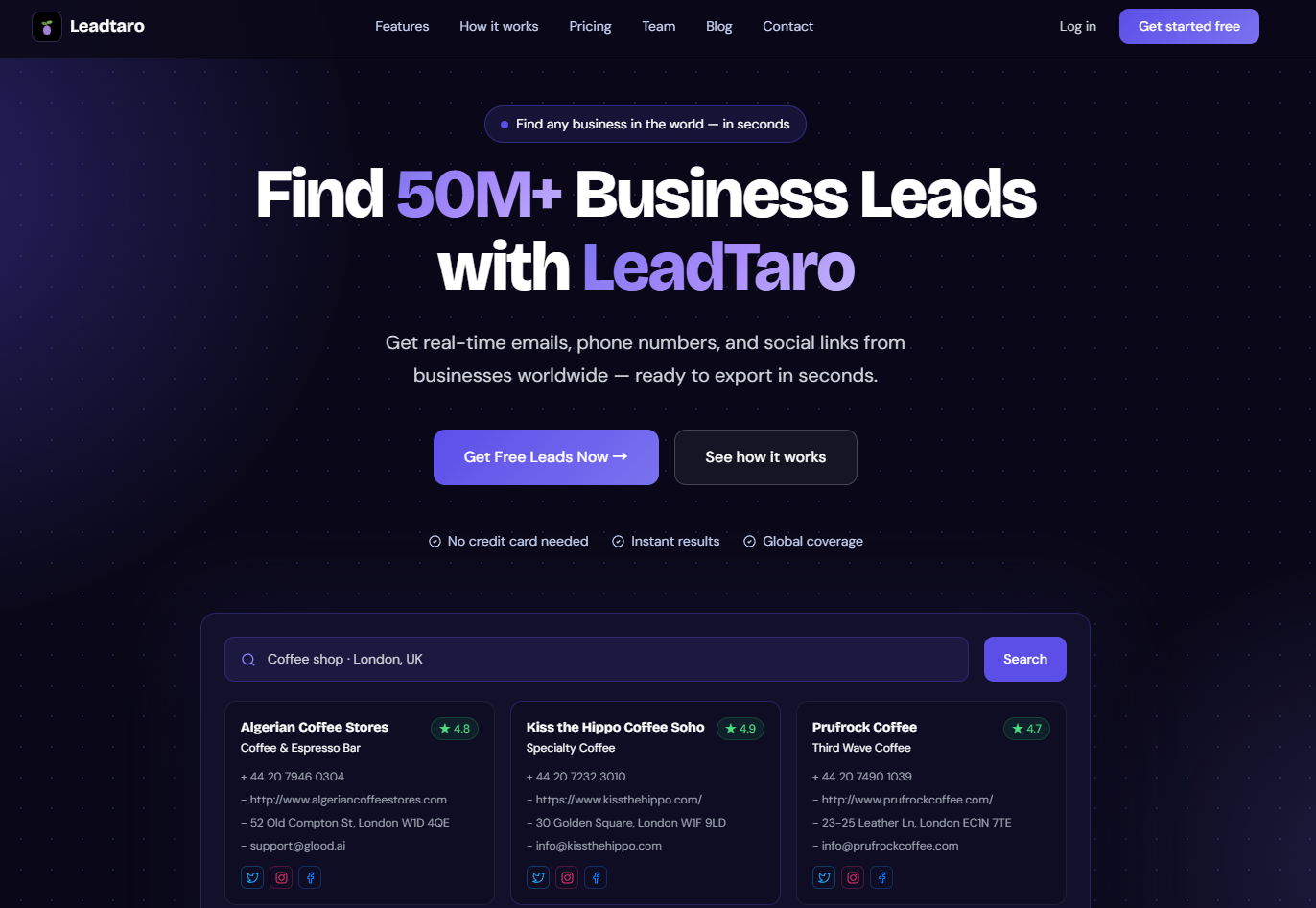
LeadTaro focuses on B2B lead generation and helping users discover potential business prospects.
For teams targeting local businesses, a useful workflow starts by defining the desired business category and geographic area, then narrowing the results to prospects that fit the intended campaign.
A practical process looks like this:
Define the target business category and location.
Generate a list of potential businesses using the available search criteria.
Review and filter the results to improve relevance.
Verify contact information and identify suitable outreach channels.
Export eligible leads and organize them for follow-up.
Personalize outreach and measure the results.
For example, a digital marketing agency could build a prospect list of restaurants in a specific city, review their online presence, and prioritize businesses that fit its services.
A B2B service provider could instead target contractors in selected regions and organize its prospecting activity around service territory.
AI can complement this process by helping users define search criteria, analyze exported records, draft personalized messages, and summarize campaign performance. The exact degree of automation depends on the AI tools and integrations available.
The important principle is to connect lead discovery with qualification and follow-up. A large list has limited commercial value until it helps you identify and engage suitable customers.
How to Measure Whether Vibe Prospecting Is Working
Do not evaluate a prospecting workflow only by the number of records it produces.
A system that generates 500 highly relevant prospects may be more valuable than one that generates 10,000 poorly matched businesses.
Use a simple funnel to identify where opportunities are being lost:
Businesses identified → Qualified leads → Valid contacts → Outreach delivered → Positive replies → Meetings → Customers
Measure the conversion rate between each stage.
For example, if many businesses match your search but few have usable contact details, improve the data requirements or verification process.
If messages are delivered but generate few positive replies, review the relevance of the audience, the offer, and the opening message.
If meetings happen but few prospects purchase, investigate qualification, pricing, sales conversations, and the product's fit with customer needs.
This approach helps you improve the underlying process instead of responding to weak results by simply increasing volume.
Common Vibe Prospecting Mistakes
Mistake 1: Using Vague Prompts
"Find businesses that need marketing" is too broad to produce a consistent target audience.
Define the industry, location, qualifying characteristics, and output you need.
Mistake 2: Assuming Every Search Result Is a Qualified Lead
A matching business category does not mean the company needs your solution or is ready to purchase.
Review the records and apply qualification criteria before outreach.
Mistake 3: Trusting Unverified Data
AI-generated summaries and business databases can contain missing, stale, or incorrect information.
Verify important details before relying on them in a sales conversation.
Mistake 4: Automating Generic Messages
Sending the same message to thousands of businesses does not become effective simply because AI generated it.
Use relevant business context, test your messaging, and prioritize the recipient's potential needs.
Mistake 5: Ignoring Compliance
Public availability does not automatically make every use of business or personal contact information lawful.
Check applicable privacy, marketing, platform, and data-protection requirements before collecting information or conducting outreach.
Mistake 6: Scaling Before Testing
Start with a manageable segment, evaluate data quality and campaign outcomes, and expand only when the process is producing useful results.
Is Vibe Prospecting Legal?
Vibe prospecting is a workflow, not a legal exemption. Whether a particular activity is permitted depends on the data source, the information collected, the intended use, the relevant jurisdiction, and the method of outreach.
Before launching a campaign:
Review the source website's terms and applicable restrictions.
Collect only information that is necessary for a legitimate business purpose.
Determine whether the information identifies an individual and whether data-protection rules apply.
Follow the marketing rules relevant to the recipient's location and contact channel.
Provide required sender identification and opt-out mechanisms.
Maintain suppression lists and honor objections.
Apply appropriate security and retention practices.
In the UK, businesses should consider UK GDPR, the Data Protection Act 2018, and PECR where applicable. Rules for unsolicited electronic marketing can differ depending on whether the recipient is a corporate subscriber, a sole trader, or another type of individual subscriber.
In the United States, CAN-SPAM applies to commercial email, including requirements relating to sender information, deceptive subject lines, and opt-out requests.
For cross-border campaigns, check the rules in the countries where recipients are located. Seek qualified legal advice when the campaign involves substantial volumes of personal data or uncertain legal grounds.
Frequently Asked Questions
What is vibe prospecting in sales?
Vibe prospecting is an AI-assisted approach to finding potential customers by describing the target audience in ordinary language. Depending on the connected tools, AI can help translate those instructions into searches, apply filters, organize results, and prepare data for sales outreach.
Is vibe prospecting the same as AI sales prospecting?
The concepts overlap. AI sales prospecting is the broader category of using AI for lead research, qualification, personalization, and related tasks. Vibe prospecting emphasizes a natural-language interface in which users describe their desired audience or workflow instead of configuring every step manually.
Can vibe prospecting find local businesses?
Yes, when the connected data source includes local businesses and supports the required search criteria. Local prospecting can use business categories, geography, websites, and available public business information to identify potential customers.
Can I use vibe prospecting without coding?
Yes. Natural-language prospecting is designed to make searches and workflows more accessible to non-technical users. However, connecting data sources, configuring integrations, or building more advanced automation may still require setup.
Does vibe prospecting guarantee more sales?
No. It can reduce research effort and improve how consistently prospects are identified, but revenue still depends on data quality, customer fit, the offer, outreach relevance, sales execution, and market demand.
What is the difference between vibe prospecting and buying a lead list?
A purchased list provides records assembled by a data provider. A vibe prospecting workflow uses instructions to identify and organize prospects through available data sources and tools. Either approach can produce weak results if the data is inaccurate or the targeting is poorly defined.
How do I get started with vibe prospecting?
Start with a specific ICP, choose a data source that covers your target audience, and write a prompt describing the industry, geography, and qualifying criteria. Review a small sample, verify important details, prepare relevant outreach, and measure results before expanding the campaign.
Final Thoughts
Vibe prospecting represents a practical shift in how sales teams interact with prospecting tools. Instead of spending most of their time navigating filters and moving data between systems, users can describe their objectives in natural language and use AI to assist with the research process.
But the quality of the workflow still depends on the quality of its inputs. Clear targeting, reliable data, thoughtful qualification, relevant outreach, and responsible data handling remain essential.
For B2B teams targeting local businesses, the opportunity is to combine efficient business discovery with a disciplined sales process. Start with a narrow audience, validate the data, test your outreach, and improve the workflow using actual results.
The goal is not to generate the biggest list possible. It is to find the right businesses, understand why they might need your solution, and turn that understanding into meaningful sales conversations.