LinkedIn Ads for B2B in 2026: How to Build Better Audiences and Generate More Leads
Great creative and a strong offer only get you so far if you're showing ads to the wrong companies. Here's how to think about LinkedIn Ads targeting, costs, and formats in 2026 — and how business lead data can help you define exactly who you want to reach before you spend a single pound on media.
Pairing LinkedIn's ad targeting with a defined target account list gives your campaigns a much sharper starting point
LinkedIn Ads can be a powerful channel for B2B companies — but running ads is only one part of the equation.
You can have great creative, a strong landing page, and a compelling offer and still struggle if you're showing your ads to the wrong companies. For many B2B businesses, the real challenge starts before the campaign is even launched: who should you target?
If you sell software to marketing agencies, for example, you don't necessarily want to advertise to every person with "marketing" somewhere in their LinkedIn profile. You may want specific agencies, in specific locations, with specific characteristics — and that's where business data becomes useful.
Instead of relying entirely on broad audience targeting, you can first identify the companies you want to reach, organize those prospects, and then use the resulting data as part of your broader B2B marketing strategy. LeadTaro helps businesses discover local and international companies by industry and location, collect available business contact information, organize leads in a CRM, and use those leads for personalized outreach.
- →Are LinkedIn Ads worth using for B2B?
- →How much do LinkedIn Ads cost?
- →How LinkedIn Ads work
- →LinkedIn ad formats
- →LinkedIn Ads targeting options
- →The problem with B2B audience targeting
- →How to build a B2B target account list
- →How LeadTaro can help with B2B prospecting
- →Using local business data for LinkedIn marketing
- →LinkedIn Ads vs cold email
- →Combining LinkedIn Ads and email outreach
- →B2B lead generation metrics to track
- →Common LinkedIn Ads mistakes
- →Is it legal to use business data for B2B marketing?
- →Frequently asked questions
Are LinkedIn Ads Worth Using for B2B?
LinkedIn is built around professional identities, companies, job roles, and business relationships — which makes it particularly relevant for companies selling to other businesses. That said, LinkedIn Ads aren't automatically the right channel for every business. Your target customer matters.
Before launching a campaign, it's worth asking a few questions:
- Who is the buyer?
- What type of company do they work for?
- How large is the company?
- What industry are they in?
- Where are they located?
- How much is a new customer worth?
- How long is the sales cycle?
- How many customers do you need for the campaign to make financial sense?
If your average customer is worth thousands of pounds or dollars, paid B2B advertising has more room to work than if you're selling a very low-cost product. LinkedIn Ads should be evaluated against your customer acquisition economics, not simply against the cost of a click.
How Much Do LinkedIn Ads Cost?
There isn't one fixed price for LinkedIn advertising. Your costs can vary depending on audience size, industry, job title, seniority, location, competition, campaign objective, ad format, bidding strategy, and conversion rate.
CPC — Cost Per Click
How much you pay when someone clicks your advertisement.
CPM — Cost Per Thousand Impressions
How much you're paying for exposure.
CPL — Cost Per Lead
The cost of acquiring a lead through the campaign.
CAC — Customer Acquisition Cost
CAC goes one step further: instead of asking "how much did the lead cost?" you ask "how much did it cost to acquire an actual customer?" — a much more useful number when evaluating a B2B campaign. A campaign generating £50 leads may look expensive next to one generating £5 leads. But if the £50 leads regularly become £5,000 customers while the £5 leads never purchase, CPL alone tells you very little.
How LinkedIn Ads Work
LinkedIn Ads are managed through LinkedIn's advertising platform. The general process is straightforward — building an audience that makes financial sense is usually the harder part.
LinkedIn Ad Formats
Different LinkedIn ad formats can serve different purposes.
Single image ads
Useful for straightforward campaigns built around one primary message — e.g. "find more qualified B2B prospects in your target market."
Video ads
Useful for product demonstrations, educational content, brand awareness, and customer stories.
Carousel ads
Let multiple pieces of content appear in one advertisement — useful when your product has several features or you want to explain a process.
Document ads
Useful for guides, reports, and other downloadable resources. A "2026 B2B Lead Generation Playbook" can be more compelling to a cold audience than immediately asking them to book a sales call.
Lead gen forms
Let users submit their information directly through LinkedIn, reducing the steps between seeing an ad and becoming a lead.
Thought leader ads
Promote content from individuals rather than relying only on company advertising — useful for founder-led companies distributing educational content.
LinkedIn Ads Targeting Options
LinkedIn provides several ways to define your audience.
Job title
CEO, Founder, Head of Sales, Marketing Director, Sales Manager, Business Development Manager, and similar roles.
Company size
Helps separate small businesses from larger organizations.
Industry
Software, marketing, financial services, real estate, manufacturing, recruitment, consulting, and more.
Geography
United Kingdom, United States, London, Manchester, New York, California, or another specific market.
Company lists and matched audiences
For account-based marketing, you may want to work with a defined list of companies rather than relying on broad targeting — changing the question from "which LinkedIn users match my criteria?" to "which companies do I specifically want to reach?" That distinction can be valuable for B2B campaigns.
The Problem With B2B Audience Targeting
LinkedIn has a large amount of professional information, but no targeting platform perfectly describes every business. Suppose you're selling software to independent dental practices. Your ideal customer might be:
- Independent dental practice
- 5–20 employees
- Located in the UK
- Has an active website
- Has an established local presence
- Has multiple online reviews
A generic LinkedIn audience such as "Industry = Healthcare" could include hospitals, pharmaceutical companies, medical manufacturers, consultants, and thousands of other organizations that aren't your ideal customers.
The problem isn't that LinkedIn targeting is bad — it's that your ideal customer may require information from outside LinkedIn's standard targeting categories. This is where business lead data can complement your advertising strategy.
How to Build a B2B Target Account List
Before launching an advertising campaign, you can build a list of companies that match your ideal customer profile — start with four questions.
How LeadTaro Can Help With B2B Prospecting
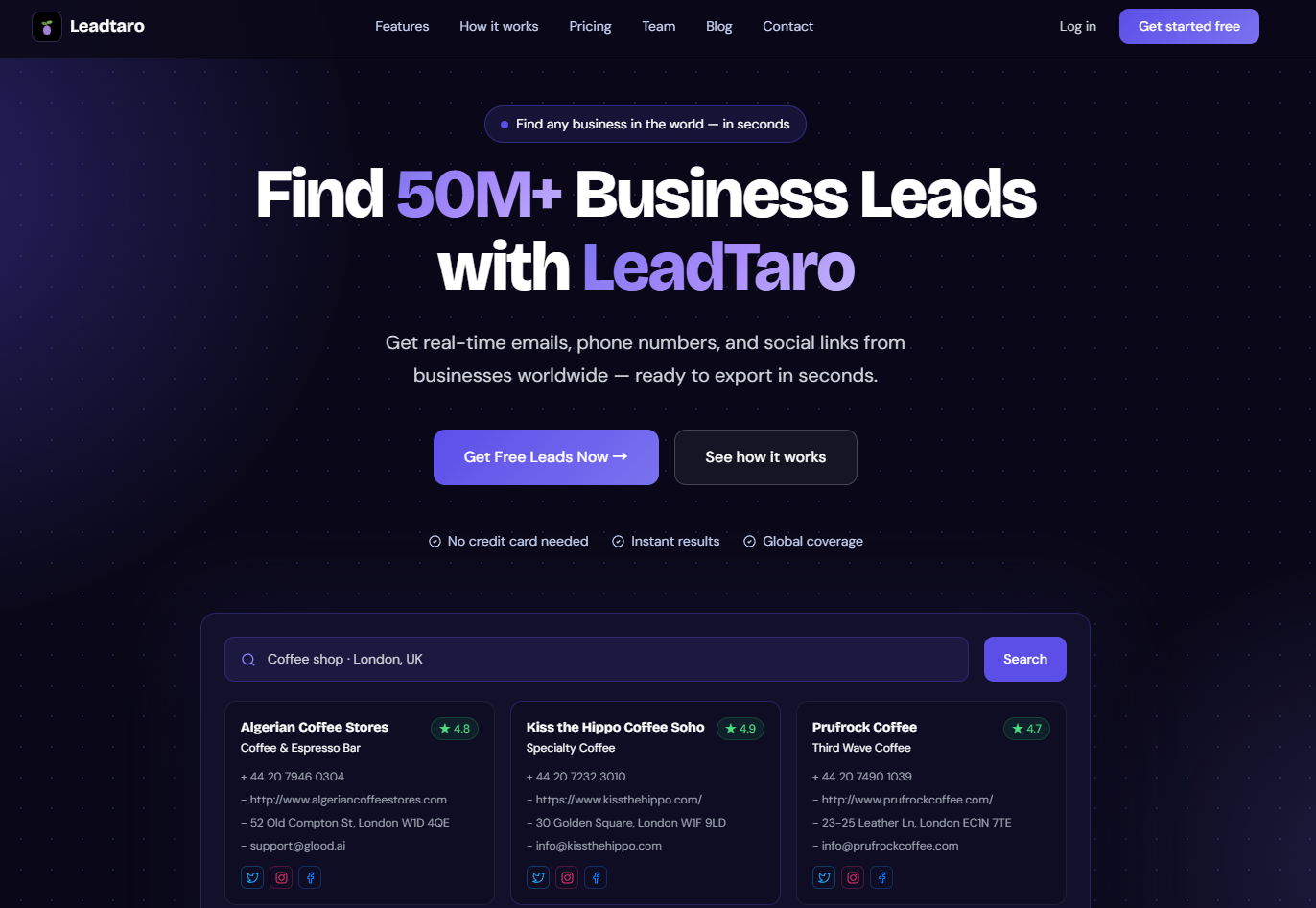
LeadTaro is built around finding businesses based on industry and location. For example, you could search "marketing agencies in London," "dental clinics in Manchester," "real estate agencies in New York," or "IT companies in Texas."
The results can contain available business information such as:
- Company name
- Phone
- Website
- Address
- Location
- Reviews
- Rating
- Social profiles
You can then filter and organize the leads according to your campaign requirements — so your advertising strategy doesn't have to begin with an abstract audience definition. You can begin with actual businesses.

Searching "marketing agencies in London" returns companies with available emails, phone numbers, and social profiles
Using Local Business Data for LinkedIn Marketing
Local business data can be particularly useful when your target market is geographically defined. Imagine you're selling marketing software to restaurants. Instead of creating a broad audience for "Hospitality + Marketing," you could first identify restaurants in your target cities — Leeds, Manchester, Birmingham — and organize those businesses into segments.
Suppose your ideal customer is an established restaurant with an active website. You could create a prospect segment containing businesses with the restaurant category, a target location, a website, an email, a phone number, and a strong review presence. That list can then support several marketing activities:
- LinkedIn Ads — use the companies as part of your account-based marketing strategy where supported.
- Cold email — contact relevant businesses directly using appropriate business contact information.
- Sales research — use websites, reviews, locations, and social profiles to understand prospects.
- CRM — track which businesses have already been contacted.
The advantage isn't simply having more data — it's having a repeatable workflow from discovery to outreach.
LinkedIn Ads vs Cold Email
LinkedIn Ads and cold email are fundamentally different channels — neither needs to replace the other, and for many B2B companies, they work together.
You pay to reach an audience. Advantages include brand exposure, scalable reach, professional targeting, retargeting, and content distribution. The downside is that you pay for impressions or interactions whether or not the person eventually becomes a customer.
You contact specific businesses directly. Advantages include direct communication, personalized messaging, more control over the prospect list, and potentially lower media costs. It also requires careful attention to data quality, deliverability, relevance, unsubscribe handling, and applicable privacy and marketing laws.
How to Combine LinkedIn Ads and Email Outreach
One possible B2B workflow looks like this:

Tracking the same target account list through the pipeline, regardless of whether a lead first came from an email or an ad click
B2B Lead Generation Metrics to Track
Don't stop at impressions. A B2B campaign should ultimately be measured against business outcomes — the further down the funnel you measure, the more useful the information becomes.
| Metric | What it tells you |
|---|---|
| Impressions | How many times your ad appeared |
| CTR | How many people clicked |
| Leads | How many people became leads |
| Qualified leads | How many leads actually matched your ICP |
| Meetings | How many leads became sales conversations |
| Opportunities | How many entered your sales pipeline |
| Customers | How many became paying customers |
| CAC | How much you spent to acquire each customer |
| Revenue | How much revenue the campaign ultimately generated |
Common LinkedIn Ads Mistakes
1. Targeting too broadly
"Marketing professionals" may sound like a large audience, but large isn't automatically useful. Start with the specific customer you actually want.
2. Optimizing only for cheap clicks
A low CPC doesn't guarantee good leads. A campaign with expensive clicks can still work if the resulting customers are valuable.
3. Ignoring company-level data
B2B sales often depend on the company, not just the individual — understand the account as well as the person.
4. Sending everyone to the same landing page
Different audiences can have different problems. A campaign aimed at agencies may need a different message from one aimed at SaaS companies.
5. Asking for a demo too early
Cold audiences may not be ready to book a call. Educational content can sometimes be a better first step.
6. Measuring leads instead of revenue
A campaign that generates 500 low-quality leads isn't necessarily more successful than one generating 50 highly qualified opportunities. Track what happens after the lead is created.
Is It Legal to Use Business Data for B2B Marketing?
Data collection and marketing laws vary by country and by how the information is obtained and used. Publicly available business information doesn't automatically mean every possible use of it is permitted.
If you're running B2B email campaigns or uploading business data to advertising platforms, it's worth considering:
- Where the information came from
- Whether you’re allowed to use it for the intended purpose
- Applicable privacy laws
- Marketing rules in the recipient’s country
- Opt-out requirements
- Data retention
- Platform terms of service
For email outreach in particular, don't assume "B2B" means there are no compliance requirements — build your process around applicable laws and respect removal and unsubscribe requests.
Frequently Asked Questions
Start With Who You Want to Reach, Not Just the Platform
Successful B2B advertising starts before you create the advertisement — it starts with understanding exactly who you want to reach. LinkedIn provides powerful professional targeting options, but your ideal customer may require information that isn't captured by a simple job-title or industry filter.
A practical workflow: define your ICP → find relevant businesses → segment your prospects → reach them through the right channels → track the sales pipeline. LeadTaro helps with the business discovery and prospecting side of that process — search by industry and location, find available contact information, organize prospects in a CRM, export leads, and use lead information for personalized outreach.
Whether your next campaign uses LinkedIn Ads, cold email, sales calls, or a combination of channels, starting with a clearly defined target market gives you a much better foundation than simply trying to reach everyone.
Build your B2B target account list before your next campaign
Search any industry and location, and let LeadTaro pull emails, phone numbers, and social profiles together for you — so your LinkedIn Ads and cold email start with the same clearly defined list.
Leads Generator
Target businesses you won't find on LinkedInExtract leads from Google Maps, Apple Maps and Bing Maps
Restaurant in your area